t(X;14)(p11.4;q32.33) IGH/GPR34
2013-08-01 Iwona Wlodarska Affiliation1.Center for Human Genetics, KU Leuven, Leuven, Belgium
Clinics and Pathology
Disease
B-cell non Hodgkins lymphoma, including mucosa-associated lymphoid tissue (MALT) lymphoma, nodal marginal zone lymphoma (nMZL) and gastric diffuse large B-cell lymphoma (DLBCL)
Etiology
Five cases have been reported so far: three females aged 60-69 years with primary MALT lymphoma involving the lung (two cases) and the parotid gland (one case), one 82-years old female with nMZL and one 82-years old male with gastric DLBCL. All patients had an underlying disorder, including Sjögren syndrome, a leukocytoclastic vasculitis and polyneuropathy, and Helicobacter Pylori-negative chronic gastritis with intestinal metaplasia. t(X;14)(p11.4;q32.33) is a rare translocation, being identified in 2 of 61 (3.3%) cases of MALT lymphoma, in one of 43 (2.3%) cases of nMZL and one of 19 (5.2) cases of extranodal DLBCL with clonal chromosomal abnormalities collected in Center for Human Genetics, KU Leuven, Leuven, Belgium (Baens et al., 2012). t(X;14)/IGH-GPR34 and the well known t(1;14)/IGH-BCL10, t(3;14)/IGH-FOXP1, t(11;18)/API2-MALT1 and t(14;18)/IGH-MALT1 are mutually exclusive in MALT lymphoma.
Prognosis
Unknown so far.
Cytogenetics
Cytogenetics molecular
FISH and molecular studies demonstrated involvement of IGH/14q32.33 (Fig. 2a) and the GPR34 gene at Xp11.4 (Fig. 2b).
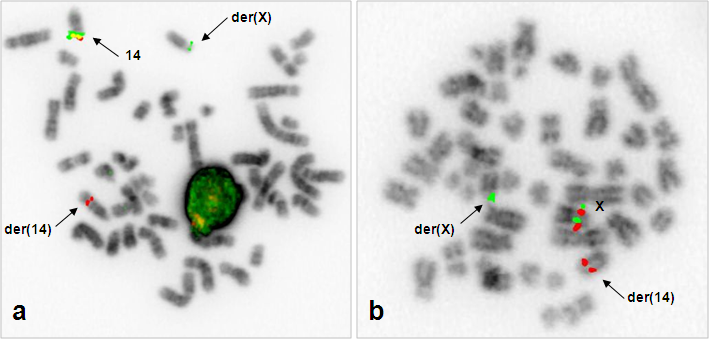
Figure 2. FISH analysis of t(X;14)(p11.4;q32.33). Applied probes: (a) LSI IGH; (b) BAC clones flanking the Xp11.4 breakpoint (RP11-204C16/red and RP11-1174J21/green) (Baens et al., 2012).
Additional anomalies
Cytogenetic data are available in four cases. The translocation occurred as the sole aberration in one case and was accompanied by 2 to 4 additional chromosomal abnormalities in the remaining cases. Subclonal duplication of der(14)t(X;14) or extra copy of IGH-GPR34 were found in three reported cases.
Genes Involved and Proteins
Gene name
GPR34 (G protein-coupled receptor 34)
Location
Xp11.4
Note
Alias: G Protein-Coupled Receptor 34.
Dna rna description
GPR34 consists of 3 exons, but only one is protein coding exon. Transcript length: 1924 bps. Transcription is from centromere to telomere. GPR34 and the neighboring GPR82 are housed by intron 5 of CASK. Expression of GPR34 mRNA is ubiquitous in human tissues.
Protein description
GPR34 codes for a G protein-coupled receptor that belongs to the largest family of cell surface molecules involved in signal transmission. These integral membrane proteins contain 7 putative transmembrane domains and mediate signals to the interior of the cell. The predicted 381-amino acid GPR34 has a calculated relative molecular mass of approximately 44 kDa, potential N-glycosylation sites within the extracellular N-terminal region, consensus acceptor phosphorylation sites for protein kinase A and C, and potential receptor-specific kinase phosphorylation sites (multiple serine and threonine residues). The receptor encoded by GPR34 is most similar to the PY2 receptor subfamily of GPCR and it is evolutionarily conserved being present in all vertebrate classes. GPR34 protein is ubiquitously expressed; its highest levels of expression were found in placenta, spleen and brain (Engemaier et al., 2006). Experimental data suggest that GPR34 is required for adequate immune responses to antigen and pathogen contact. The natural ligand of GPR34 and downstream signaling pathways are largely unknown.
Gene name
IGH (Immunoglobulin Heavy)
Location
14q32.33
Result of the Chromosomal Anomaly
Note
Sequence analysis of one case with t(X;14)(p11.4;q32.33) showed that the Xp11.4 breakpoint fell between exon 1 and 2 of GPR82, the gene located in close vicinity to GPR34, and the 14q32.33 breakpoint occurred in the IGHA2 switch region, placing both genes in close proximity to the IGHA2 3 regulatory region enhancers, HS4, HS1, HS2, and HS3 (Ansell et al., 2012). Overexpression of GPR34 mRNA, but not GPR82 and CASK, indicates that the translocation targets GPR34. The functional consequences of the translocation remain elusive. Experimental data of Ansell et al. (2012) indicate that overexpression of GPR34 leads to constitutive activation of the ERK pathway, and also implicate a role of GPR34 in the activation of CREB, AP-1, PKC and NF-kB. Activation of NF-kB and ERK by GPR34, however, was not confirmed by Baens et al. (2012).
Article Bibliography
| Pubmed ID | Last Year | Title | Authors |
|---|---|---|---|
| 22966169 | 2012 | t(X;14)(p11;q32) in MALT lymphoma involving GPR34 reveals a role for GPR34 in tumor cell growth. | Ansell SM et al |
| 22058210 | 2012 | t(X;14)(p11.4;q32.33) is recurrent in marginal zone lymphoma and up-regulates GPR34. | Baens M et al |
| 16338117 | 2006 | Genomic and supragenomic structure of the nucleotide-like G-protein-coupled receptor GPR34. | Engemaier E et al |
Summary
Fusion gene
IGH/GPR34 IGH (14q32.33) GPR34 (Xp11.4) M t(X;14)(p11;q32)
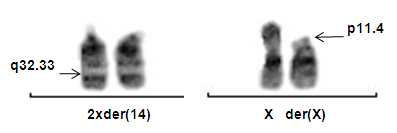
Figure 1. Partial karyotype of t(X;14)(p11.4;q32.33). Duplication of der(14) occurs recurrently in t(X;14)-positive cases.
Citation
Iwona Wlodarska
t(X;14)(p11.4;q32.33) IGH/GPR34
Atlas Genet Cytogenet Oncol Haematol. 2013-08-01
Online version: http://atlasgeneticsoncology.org/haematological/1637/t(x
