t(9;14)(q33;q32) IGH/LHX2
2013-11-01 Elise Chapiro , Nathalie Nadal Affiliation1.Laboratoire d hematologie, CHU Hopital Nord, F-42055 St Etienne cedex 2, France (NN); Service d Hematologie Biologique, Hopital Pitie-Salpetriere, APHP, Universite Pierre et Marie Curie-Paris 6, France (EC)
2.Laboratoire dhematologie, CHU Hopital Nord, F-42055 St Etienne cedex 2, France (NN); Service dHematologie Biologique, Hopital Pitie-Salpetriere, APHP, Universite Pierre et Marie Curie-Paris 6, France (EC)
Clinics and Pathology
Phenotype stem cell origin
B cell phenotype (CD19, CD10) with 2 aberrant myeloid markers (CD13 and CD33).
Etiology
Unknown.
Epidemiology
Only one case to date, a 10-year-old male patient (Nadal et al., 2012).
Clinics
Lymphadenopathies, enlarged spleen and liver. Central nervous system involvement.
Cytology
High WBC with blast cells (44%), myelemia, eosinophilia and basophilia. Bone marrow aspiration showed 60% of undifferentiated blast cells with persistence of the granulocytic lineage.
Treatment
The patient was treated according to the European protocol ESPHALL (imatinib, asparaginase, vincristine, vindesine, daunorubicin, aracytine, VP16, ifosfamide, and methotrexate, followed by an allograft).
Evolution
After induction, minimal residual disease (MRD) detection by CMF and by molecular analysis was negative, whereas RT-PCR for BCR-ABL1 transcript was still positive. Chromosomal examination showed the presence of one metaphase out of 30 with only the t(9;22)(q34;q11), suggesting that the t(9;14) translocation was a secondary chromosomal abnormality.
Thus, the chemotherapy had eradicated the lymphoblast cells but a CML clone persisted, further supporting the diagnosis of CML in BC.
By 7 months after diagnosis, the patient underwent allogenic stem cell transplantation from his HLA-matched sister. At 2 years post-transplantation, the patient was alive and well. BCR-ABL1 transcript was undetectable (
Thus, the chemotherapy had eradicated the lymphoblast cells but a CML clone persisted, further supporting the diagnosis of CML in BC.
By 7 months after diagnosis, the patient underwent allogenic stem cell transplantation from his HLA-matched sister. At 2 years post-transplantation, the patient was alive and well. BCR-ABL1 transcript was undetectable (
Genes Involved and Proteins
Gene name
LHX2 (LIM homeobox 2)
Location
9q33.3
Note
LIM homeobox gene LHX2 is a member of the LIM homeobox family of transcription factors characterized by a DNA binding homeodomain and a cystein-rich LIM-domain. LHX2, initially identified as an early marker in B-lymphocyte differentiation (Xu et al., 1993), is involved in the neurogenesis, hair follicle, and hematopoietic development (Porter et al., 1997).
Gene name
IGH (Immunoglobulin Heavy)
Location
14q32.33
Result of the Chromosomal Anomaly
Note
The translocation links sequence located 148 kb centromeric of LHX2 on chromosome 9 to JH6 segment on chromosome 14.No fusion protein.
Oncogenesis
LHX2 juxtaposition with the IGH locus results in strong over-expression of LHX2, which may have contributed to the rapid progression in the blastic phase. It has been shown that over-expression of LHX2 in murine hematopoietic precursors leads to the development of chronic myeloproliferative disorders (Richter et al., 2003). Thus, transcriptional deregulation of LHX2 plays a recurrent role in leukemogenesis.
Article Bibliography
| Pubmed ID | Last Year | Title | Authors |
|---|---|---|---|
| 22727509 | 2012 | LHX2 deregulation by juxtaposition with the IGH locus in a pediatric case of chronic myeloid leukemia in B-cell lymphoid blast crisis. | Nadal N et al |
| 9247336 | 1997 | Lhx2, a LIM homeobox gene, is required for eye, forebrain, and definitive erythrocyte development. | Porter FD et al |
| 14687986 | 2003 | Lhx2 expression in hematopoietic progenitor/stem cells in vivo causes a chronic myeloproliferative disorder and altered globin expression. | Richter K et al |
| 8649822 | 1996 | Identification of a human LIM-Hox gene, hLH-2, aberrantly expressed in chronic myelogenous leukaemia and located on 9q33-34.1. | Wu HK et al |
| 7678338 | 1993 | LH-2: a LIM/homeodomain gene expressed in developing lymphocytes and neural cells. | Xu Y et al |
Summary
Fusion gene
IGH/LHX2 IGH (14q32.33) LHX2 (9q33.3) M t(9;14)(q33;q32)
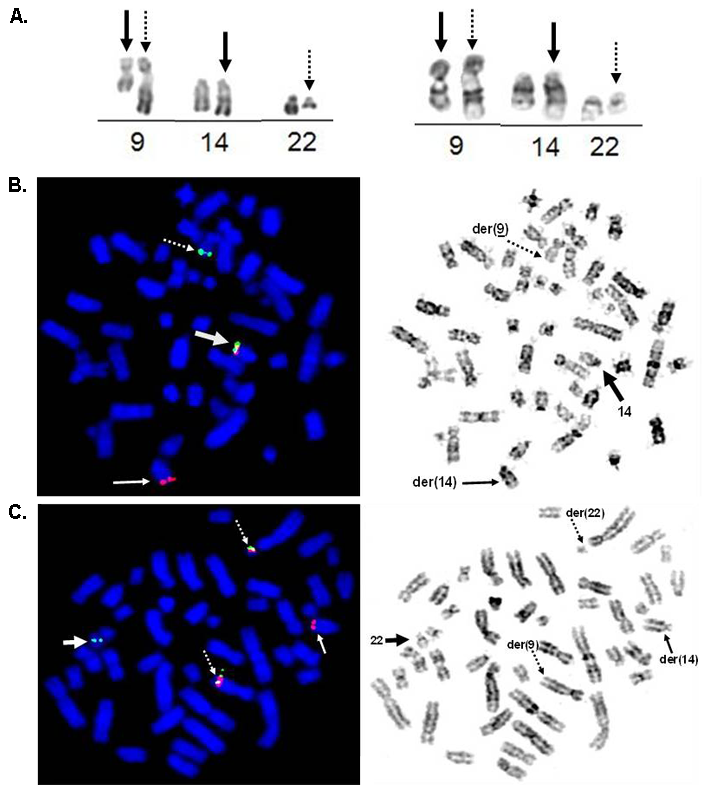
A. Conventional karyotype: partial R and G-banded karyotype. The derivative chromosomes of translocations t(9;14)(q33;q32) and t(9;22)(q34;q11) are denoted by solid and dotted arrows, respectively.
B. FISH: representative metaphase hybridized with dual color break-apart IGH probe (Abbott, Rungis, France). A fusion signal is seen on normal chromosome 14 (large arrows), a red signal on derivative chromosome 14 (small solid arrows) and a green signal on derivative chromosome 9 (small dotted arrows).
C. FISH: representative metaphase hybridized with a BCR/ABL ES probe (Abbott). A green signal is seen on a normal chromosome 22 (large arrows), and two fusion signals on derivative chromosomes 9 and 22 (small dotted arrows), confirming the BCR-ABL1 rearrangement with a breakpoint in the mBCR region. A red signal is observed on derivative chromosome 14 (small solid arrows), indicating that the breakpoint of t(9;14) was centromeric to the ABL1 gene in chromosome 9.
Citation
Elise Chapiro ; Nathalie Nadal
t(9;14)(q33;q32) IGH/LHX2
Atlas Genet Cytogenet Oncol Haematol. 2013-11-01
Online version: http://atlasgeneticsoncology.org/haematological/1659/t(9
