Classification of Hodgkin lymphoma over years
2016-12-01 Annunziata Gloghini , Antonino Carbone Affiliation1.Department of Pathology Centro di Riferimento Oncologico Aviano (CRO), Istituto Nazionale Tumori, IRCCS, Aviano, Italy; [email protected] (AC); Department of Diagnostic Pathology and Laboratory Medicine, Fondazione IRCCS Istituto Nazionale dei Tumori, Milano, Italy; [email protected] (AG
Abstract
Histologic classification of Hodgkin lymphoma (HL) evolved through different systems, starting from the modern histologic classifications by Jackson and Parker in 1944 and Lukes and Butler in 1966, to the 2008 World Health Organization (WHO) classification. HL has been classified into classical HL, which accounts for 95% of all HL cases, and the less common nodular lymphocyte predominant HL (NLPHL). Classical HL is a distinct neoplastic entity with typical clinical and epidemiological characteristics and unique pathological, genetic, and virological features.
Clinics and Pathology
Disease
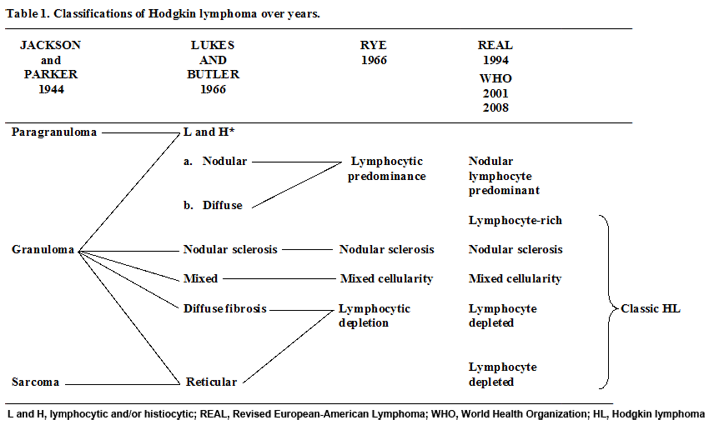
Lymphocyte predominant (LP) HL, is characterized by a lymphocyte- rich background with admixed histiocytes. In 1944 Jackson and Parker called it in as "paragranuloma" to separate it from Hodgkin "granuloma". In 1966 Lukes and Butler (Lukes and Butler JJ, 1966) renamed paragranuloma "lymphocytic and/or histiocytic predominance HD", recognizing a nodular and a diffuse pattern and used the term of lymphocytic and histiocytic (L&H) RS-cell variant for the diagnostic cell (Lukes, Butler et al., 1966), now called LP cell. At the Rye symposium, it was decided to combine the nodular and diffuse types of the Lukes and Butler classification into LPHL (Lukes, Craver et al., 1966) (Table 1).
In the last decades, a considerable body of evidence has indicated that LPHL exhibits features of a B-cell lymphoma, with a characteristic antigen profile and clinical behavior (reviewed in Younes et al., 2014). This led the authors of the REAL classification proposal to separate LPHL as a distinct clinicopathologic entity from the other subtypes of HL, which were grouped under the term "classical HL (CHL) ID: 1569> " (Harris et al.,1994; Mason et al., 1994; Stein, 2001; Stein et al., 2008) (Table 1). According to its cell of origin, phenotype and type of progression to large B-cell lymphoma, NLPHL should probably be considered as a B-cell lymphoma tout court.
Phenotype stem cell origin
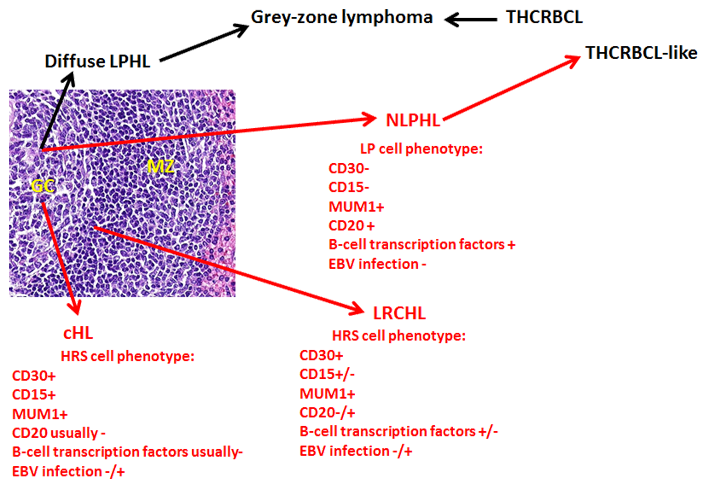
LRCHL cases also exhibit, in the majority of cases, a nodular growth pattern as well as a broad morphologic spectrum of the neoplastic cells. The tumor cell phenotype, however, is always characteristic of CHL with expression of CD30 and CD15, infrequent expression of B-cell antigens (Figure 1). Furthermore, it could be shown by means of immunostains that the vast majority of LPHL cases contain areas with nodular growth pattern, whereas purely diffuse cases are extremely rare. Probably these cases, could be classified as grey zone lymphomas because they exhibit intermediate features between NLPHL and THCRLBCL (Figure 1) (Younes et al., 2014).
Clinics
Pathology
Also, nodular lymphocyte predominant Hodgkin lymphoma (NLPHL) and T-cell/histiocyte rich large B-cell lymphoma (THRLBCL) are closely related: both diseases contain neoplastic cells with similar morphologic and immunophenotypic features but differ with respect to their architecture and the nature of the reactive background (table 2).
An additional type of HL with an abundance of lymphocytes was subsequently recognized. It was termed "lymphocyte-rich (LR) form of classical HL" and included in the REAL classification. This variant of classical HL (CHL), resembles, in terms of nodular growth and lymphocyte-richness, nodular LPHL and, in terms of the immunophenotype of the tumor cells, CHL (Figure 1). Clinically, patients with LPHL and LRCHL show similar disease characteristics at presentation but differ in the frequency of multiple relapses and prognosis after relapse (Gloghini and Carbone, 2016a; Gloghini and Carbone, 2016b).
Table 2. Phenotypic and virologic features of neoplastic cells of classic Hodgkin lymphoma (cHL), nodular lymphocyte predominance Hodgkin lymphoma (NLPHL) and T-cell/histiocyte rich large B-cell lymphoma (THRLBCL).
| cHL | NLPHL | THRLBCL | ||
Phenotype | ||||
| CD15 | + | - | - | |
| CD20 | Usually - | + | + | |
| CD30 | + | - | - or + | |
| IRF4/MUM1 | + | + | - or + | |
| BCL6 | + (30%) | + | - | |
| EMA | - | + | Usually - | |
EBV infection | ||||
| -/+* | - | - | ||
Background | ||||
| T cells | + | - | + | |
| B cells / B and T cells | + | + | - | |
| CD57+ rosetting cells | - | + | - | |
| CD40L+ rosetting cells | + | + | - | |
| Histiocytes | +/- | +/- | + | |
| Eosinophils | + | - | - | |
| Plasma cells | + | - | - | |
| DRCs meshworks | - /+ | + | - | |
| Fibrosis | + (Common) | + (Rare) | - |
*Association with EBV is less frequent in NS than in MC cHL and LRCHL.
Other features
EBV is found in HRS cells preferentially in cases of MC and LD cHL, and less frequently in NS and LRCHL. Notably, EBV is found in HRS cells in nearly all cases of cHL occurring in patients infected with HIV (Younes et al., 2014; Dolcetti et al., 2016; Carbone et al., 2016).
The virologic characteristics of cHL vary according to the immunocompetence status of the host and cHL subtype (Carbone et al., 2016).
Table 3. Morphologic and virologic characteristics of Hodgkin lymphoma.
| Host | Hodgkin lymphoma subtype | EBV infection |
| HL of the general population | ||
| Nodular lymphocyte predominance | - | |
| cHL, nodular sclerosis | Usually -* | |
| cHL, mixed cellularity | Usually +* | |
| Rare types | ||
| cHL, lymphocyte rich | Variably + | |
| cHL, lymphocyte depleted | Variably + | |
| Immunodeficiency-associated HL | ||
| HIV-associated HL | ||
| cHL, lymphocyte depleted | + | |
| cHL, mixed cellularity | + | |
| Less frequent | ||
| cHL, lymphohistiocyoid | + | |
| cHL, nodular sclerosis | + | |
Abbreviations. cHL, classical Hodgkin lymphoma; -, negative; +, positive.
*Association with EBV is less frequent in ns (10-40%) than in mc cHL (approximately 75% of cases)
Evolution
The 2016 revision of WHO classification proposal recommend the designation of these cases as THRLBCL like transformation of NLPHL, with inclusion of the word "like" due to some remaining uncertainties (Figure 1) (Swerdlow et al., 2016).
Note
Genes Involved and Proteins
Article Bibliography
| Pubmed ID | Last Year | Title | Authors |
|---|---|---|---|
| 10961891 | 2000 | European Task Force on Lymphoma project on lymphocyte predominance Hodgkin disease: histologic and immunohistologic analysis of submitted cases reveals 2 types of Hodgkin disease with a nodular growth pattern and abundant lymphocytes. | Anagnostopoulos I et al |
| 18794340 | 2008 | Origin and pathogenesis of nodular lymphocyte-predominant Hodgkin lymphoma as revealed by global gene expression analysis. | Brune V et al |
| 27750386 | 2017 | The impact of EBV and HIV infection on the microenvironmental niche underlying Hodgkin lymphoma pathogenesis. | Carbone A et al |
| 26773045 | 2016 | A lymphomagenic role for HIV beyond immune suppression? | Dolcetti R et al |
| 8068936 | 1994 | A revised European-American classification of lymphoid neoplasms: a proposal from the International Lymphoma Study Group. | Harris NL et al |
| 8172327 | 1994 | Nodular lymphocyte predominance Hodgkin's disease. A distinct clinicopathological entity. | Mason DY et al |
| 26980727 | 2016 | The 2016 revision of the World Health Organization classification of lymphoid neoplasms. | Swerdlow SH et al |
Citation
Annunziata Gloghini ; Antonino Carbone
Classification of Hodgkin lymphoma over years
Atlas Genet Cytogenet Oncol Haematol. 2016-12-01
Online version: http://atlasgeneticsoncology.org/haematological/1767/meetings/calendar
