T-cell/histiocyte rich large B-cell lymphoma
2016-08-01 Annunziata Gloghini , Antonino Carbone Affiliation1.Department of Pathology Centro di Riferimento Oncologico Aviano (CRO), Istituto Nazionale Tumori, IRCCS, Aviano, Italy; [email protected] (AC); Department of Diagnostic Pathology and Laboratory Medicine, Fondazione IRCCS Istituto Nazionale dei Tumori, Milano, Italy; [email protected] (AG)
2.Department of Pathology Centro di Riferimento Oncologico Aviano (CRO), Istituto Nazionale Tumori, IRCCS, Aviano, Italy; [email protected] (AC); Department of Diagnostic Pathology and Laboratory Medicine, Fondazione IRCCS Istituto Nazionale dei Tumori, Milano, Italy; [email protected] (AG)
Abstract
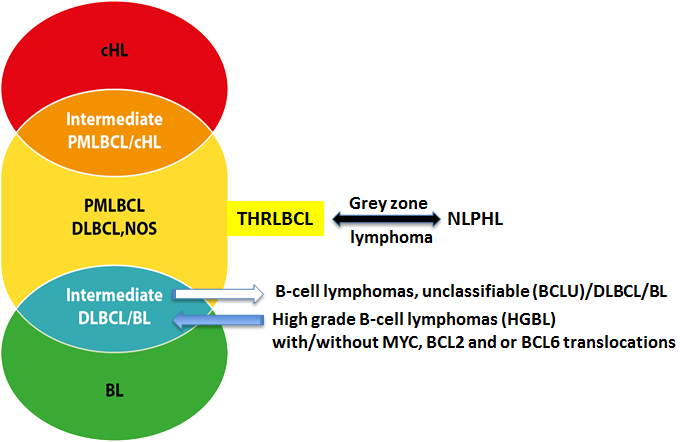
Although T-cell/histiocyte rich large B-cell lymphoma (THRLBCL) is an aggressive diffuse large B-cell lymphoma (DLBCL), its morphology can resemble nodular lymphocyte predominant Hodgkin lymphoma (NLPHL). These two entities are closely related: both diseases contain neoplastic cells with similar morphologic and immunophenotypic features but differ with respect to their architecture and the nature of the reactive background.
Clinics and Pathology
Disease
Epidemiology
Pathology
In the THRLBCL there are few large neoplastic B cells scattered in a background of non-neoplastic T cells with histiocytes (De Wolf-Peeters C et al., 2008; Carbone et al., 2010). The neoplastic cells may resemble centroblasts, immunoblasts, lymphocyte-predominant (LP) Hodgkin cells, or classic Hodgkin Reed-Sternberg (HRS) cells (Lim et al., 2002; Carbone et al., 2010). The pattern of involvement in lymph nodes is usually diffuse or may be vaguely nodular, in absence of aggregates of follicular dendritic reticulum cells (FDC).
Immunophenotype
Neoplastic cells of THRLBCL express CD45 and B-cell antigens, are strongly positive for BCL6, are negative for CD30 and CD15, and are not infected by EBV (Achten et al., 2002; Lim et al., 2002).
Background
Small B cells are virtually absent in THRLBCL, and T cells with a follicular helper T-cell phenotype (CD57 and/or PD1) are not numerous and do not form rosettes around the neoplastic B cells. Presence of granzyme B positive and Tia1 positive T cells is restricted to primary THRLBCL (Table 1).
The background in NLPHL is composed of large meshworks of FDC filled with B cells, histiocytes and numerous germinal center CD4 positive T cells. These T cells specifically express CD3, CD4, PD1, and MUM1/IRF4. Tia1 and CD40L positive CD3 T cells are absent. PD1-ringing is a feature commonly seen in NLPHL (Carbone et al., 1995; Carbone et al., 2002; Poppema et al., 2008) (Table 1).
NLPHL may evolve to a completely diffuse T-cell-rich proliferation lacking any follicular dendritic cells which would be consistent with a THRLBCL.
Table 1 Comparative expression of molecular markers and cell microenvironment.
| NLPHL | THRLBCL |
| Expression of molecular markers | ||
CD15 | - | - |
CD30 | Usually - | -or + |
EMA | + | Usually + |
CD20 | + | + |
CD79a | + | + |
IRF4 | + | -or + |
EBV | - | Usually - |
| Cell microenvironment | ||
T-cells | -or + | + |
B-cells/B and T-cells | + | - |
CD57 + rosetting T-cells | + or - | - |
CD40L + rosetting T-cells | - | - |
MUM1 + rosetting T-cells | + | - |
Histiocytes | -or + | + |
DRCs meshworks | + | - |
NLPHL: Nodular lymphocyte predominant Hodgkin lymphoma; THRLBCL: T-cell/histiocyte rich large B-cell lymphoma; EBV: Epstein-Barr virus; DRCs: Dendritic reticulum cells
Prognosis
Note
In conclusion, GEP and array CGH studies have shown similarities between NLPHL and THRLBCL, suggesting a relationship to each other, in spite of other major differences. (Hartman et al., 2015; Swerdlow et al., 2016).
Genes Involved and Proteins
Article Bibliography
| Pubmed ID | Last Year | Title | Authors |
|---|---|---|---|
| 11903596 | 2002 | Histiocyte-rich, T-cell-rich B-cell lymphoma: a distinct diffuse large B-cell lymphoma subtype showing characteristic morphologic and immunophenotypic features. | Achten R et al |
| 18794340 | 2008 | Origin and pathogenesis of nodular lymphocyte-predominant Hodgkin lymphoma as revealed by global gene expression analysis. | Brune V et al |
| 20398809 | 2010 | B-cell lymphomas with features intermediate between distinct pathologic entities. From pathogenesis to pathology. | Carbone A et al |
| 25644177 | 2015 | Array comparative genomic hybridization reveals similarities between nodular lymphocyte predominant Hodgkin lymphoma and T cell/histiocyte rich large B cell lymphoma. | Hartmann S et al |
| 24192382 | 2014 | Matched-pair analysis comparing the outcomes of T cell/histiocyte-rich large B cell lymphoma and diffuse large B cell lymphoma in patients treated with rituximab-CHOP. | Kim YS et al |
| 12409722 | 2002 | T-cell/histiocyte-rich large B-cell lymphoma: a heterogeneous entity with derivation from germinal center B cells. | Lim MS et al |
| 9926235 | 1998 | Workshop report on Hodgkin's disease and related diseases ('grey zone' lymphoma). | Rüdiger T et al |
| 26980727 | 2016 | The 2016 revision of the World Health Organization classification of lymphoid neoplasms. | Swerdlow SH et al |
| 16874743 | 2006 | Relationship between classic Hodgkin lymphoma and overlapping large cell lymphoma investigated by comparative expressed sequence hybridization expression profiling. | Vanhentenrijk V et al |
| 18784812 | 2008 | Nodular lymphocyte-predominant hodgkin lymphoma or T-cell/histiocyte rich large B-cell lymphoma: the problem in "grey zone" lymphomas. | Zhao FX et al |
Citation
Annunziata Gloghini ; Antonino Carbone
T-cell/histiocyte rich large B-cell lymphoma
Atlas Genet Cytogenet Oncol Haematol. 2016-08-01
Online version: http://atlasgeneticsoncology.org/haematological/1764/t-cell-histiocyte-rich-large-b-cell-lymphoma
