Nodular lymphocyte-predominant Hodgkin lymphoma
2016-04-01 Antonino Carbone , Annunziata Gloghini Affiliation1.Department of Diagnostic Pathology and Laboratory Medicine, Fondazione IRCCS Istituto Nazionale dei Tumori, Milano, Italy; [email protected] (AG); Department of Pathology Centro di Riferimento Oncologico Aviano (CRO), Istituto Nazionale Tumori, IRCCS, Aviano, Italy; [email protected] (AC)
Abstract
Diagnostic characteristics of nodular lymphocyte-predominant Hodgkin lymphoma (NLPHL): nodular or nodular and diffuse proliferation of scattered lymphocyte predominant (LP) tumour cells within a background reminiscent of primary or secondary lymphoid follicles.
Clinics and Pathology
Disease
Phenotype stem cell origin
Tumour cells are antigen-selected mutating germinal center (GC) B cells. This origin is supported by
The expression of BCL6 and CD40 by tumour cells (Carbone et al., 1995; Liso et al., 2006).
The presence of CD4+, CD57+, PD1+ T cells surrounding the tumour cells (Poppema et al., 2008).
The presence of a follicular dendritic cell meshowork within the tumour nodules (Mason et al., 1994 ; Carbone and Gloghini, 2012)
The gene expression profile (Brune et al., 2008).
Rearranged, clonal and mutated (ongoing) Ig genes of tumour cells (Marafioti et al., 1997; Küppers, 2011).
Phenotype
LP cells profile: CD45+, CD20+, CD40+, CD79a+, CD75+, BCL6+, IRF4/MUM1+, and OCT2+, BOB1+, PAX5+, PU.1+, epithelial membrane antigen+. CD15 and CD30 are usually negative (Poppema et al., 2008).
Nodules compositon: CD20+ and IgD+ small B cells, CD3+ and CD4+ T cells and histiocytes.
The background of the nodules also includes an increase in GC-derived CD57+, IRF4/MUM1+, and PD-1+ T-cells populations which form a rim around LP cells (Carbone and Gloghini, 2012).
Epidemiology
Clinics
Cytology
Pathology
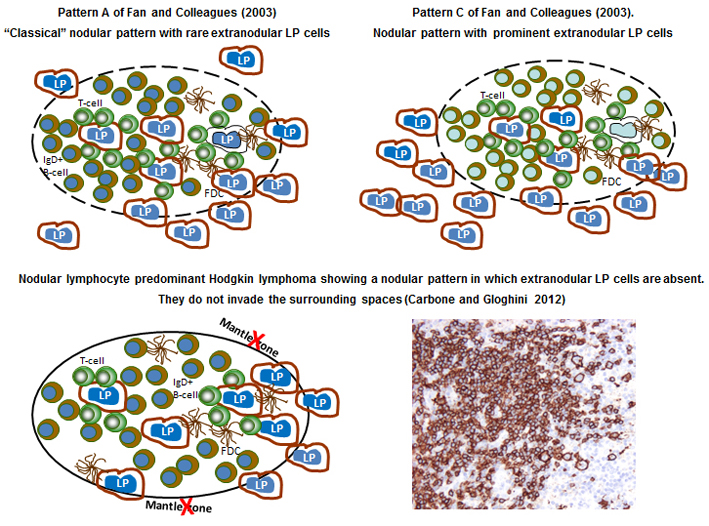
On morphologic and immunohistologic grounds, six patterns are recognizable in NLPHL (Fan et al., 2003): A) classical nodular, B) serpiginous/interconnected nodular, C) nodular with prominent extra-nodular LP cells, D) T-cell-rich nodular, E) diffuse with a T-cell-rich background, and F) diffuse, B-cell-rich pattern.
Typical histopathologic patterns in NLPHL include patterns A and B. Both of these patterns show a predominantly nodular growth, with LP cells located within the nodules. So called "histopathologic variants" include patterns from C to F and are associated to prominent extranodular LP cells or to B-cell depletion of the microenvironment (Hartmann et al. Blood, 2013).
An additional nodular pattern in which LP cells proliferate within a background reminiscent of a secondary follicle without invasion of the extranodular space has been recognized (Carbone and Gloghini, 2012; Gloghini et al., 2015).
Other features
The neoplastic cells are usually EBV negative (Anagnostopoulos et al., 2000).
Treatment
Locally extensive or advanced stages: paradigms used for classical HL with similar outcomes (Advani and Hoppe, 2015). Excellent response rates (but increased relapse rates) observed with single agent rituximab. Promising data observed with R-CHOP (Advani and Hoppe, 2013; Younes et al., 2014).
Relapsed disease: single agent rituximab is a reasonable choice because of excellent tolerability (Advani and Hoppe, 2015).
Evolution
Prognosis
Compared with "typical NLPHL", "histopathologic variants" are associated with more advanced disease and a higher relapse rate (Hartmann et al. Blood, 2013).
Note
Strong NFKB activity (Küppers, 2011).
Aberrant somatic hypermutation of multiple proto-oncogenes (PIM1, RHOH (TTF), MYC, and PAX5) in a fraction of cases. Most of mutations are on the 5 untranslated regions of the genes (Liso et al, 2006).
Mutation in SOCS1 (Küppers, 2011).
BAG6 (BAT3), HIGD1A, and UBD (FAT10) gene espression (Hartmann et al. PlosOne, 2013).
Genes Involved and Proteins
Article Bibliography
| Pubmed ID | Last Year | Title | Authors |
|---|---|---|---|
| 26062064 | 2015 | XVIII. Management of nodular lymphocyte predominant Hodgkin lymphoma. | Advani RH et al |
| 10961891 | 2000 | European Task Force on Lymphoma project on lymphocyte predominance Hodgkin disease: histologic and immunohistologic analysis of submitted cases reveals 2 types of Hodgkin disease with a nodular growth pattern and abundant lymphocytes. | Anagnostopoulos I et al |
| 18794340 | 2008 | Origin and pathogenesis of nodular lymphocyte-predominant Hodgkin lymphoma as revealed by global gene expression analysis. | Brune V et al |
| 22209342 | 2012 | "Intrafollicular neoplasia" of nodular lymphocyte predominant Hodgkin lymphoma: description of a hypothetic early step of the disease. | Carbone A et al |
| 7530508 | 1995 | Expression of functional CD40 antigen on Reed-Sternberg cells and Hodgkin's disease cell lines. | Carbone A et al |
| 14508396 | 2003 | Characterization of variant patterns of nodular lymphocyte predominant hodgkin lymphoma with immunohistologic and clinical correlation. | Fan Z et al |
| 25487651 | 2015 | Immunoarchitectural patterns in nodular lymphocyte predominant Hodgkin lymphoma: pathologic and clinical implications. | Gloghini A et al |
| 24100447 | 2013 | The prognostic impact of variant histology in nodular lymphocyte-predominant Hodgkin lymphoma: a report from the German Hodgkin Study Group (GHSG). | Hartmann S et al |
| 16614247 | 2006 | Aberrant somatic hypermutation in tumor cells of nodular-lymphocyte-predominant and classic Hodgkin lymphoma. | Liso A et al |
| 9250847 | 1997 | Origin of nodular lymphocyte-predominant Hodgkin's disease from a clonal expansion of highly mutated germinal-center B cells. | Marafioti T et al |
| 8172327 | 1994 | Nodular lymphocyte predominance Hodgkin's disease. A distinct clinicopathological entity. | Mason DY et al |
Citation
Antonino Carbone ; Annunziata Gloghini
Nodular lymphocyte-predominant Hodgkin lymphoma
Atlas Genet Cytogenet Oncol Haematol. 2016-04-01
Online version: http://atlasgeneticsoncology.org/haematological/1570/nodular-lymphocyte-predominant-hodgkin-lymphoma
