Waldenstrom macroglobulinemia
2017-11-01 Phillip Hsieh , Yu-Tzu Tai , Matthew Ho Zhi Guang , Giada Bianchi Affiliation1.LeBow Institute for Myeloma Therapeutics and Jerome Lipper Multiple Myeloma Center, Department of Medical Oncology, Dana Farber Cancer Institute, Harvard Medical School, Boston, MA, 02115. PH, YTT: these authors contribute equally. [email protected], [email protected], [email protected]; [email protected]
Abstract
Waldenstroms Macroglobulinemia (WM), also known as lymphoplasmacytic lymphoma (LPL), is lymphoproliferative disorder classified by the WHO as an indolent lymphoma. WM cells display characteristics of both lymphocytes and plasma cells with gene expression profiling revealing a phenotype more similar to chronic lymphocytic leukemia than multiple myeloma (MM). At its core, WM is a clonal disease of B-lymphocytes and is characterized by the presence of (1) a monoclonal IgM immunoglobulin (M-protein), (2) malignant lymphoplasmacytic cell infiltration in the bone marrow. WM patients can present with symptoms/signs consistent with hyperviscosity syndrome when the M protein is conspicuous. Clinically, WM presents similarly to MM except that organomegaly and lymphadenopathies are common in WM but not in MM, and lytic bone disease and renal disease are uncommon in WM but common in MM.
Clinics and Pathology
Disease
Phenotype stem cell origin
Phenotype: CD19+; CD20+; CD22+; FMC7+; CD38+; cytoplasmic IgM bright+; CD5-; CD23-; CD10-
Etiology
In 90% of cases, WM cells have an activating mutation in MYD88 (L265P) resulting in constitutive/dysregulated NF-kB signaling which promotes the proliferation and survival of WM cells (Treon SP et al, 2014).
Epidemiology
Overall survival: 78% (5y) (Wang H et al, 2012)
Median age at diagnosis: 65y (Wang H et al, 2012)
Ethnicity: More common in Caucasians (90% of cases) than other ethnic groups; uncommon in Blacks (5% of cases) (Wang H et al, 2012). Those of Ashkenazi descent may be predisposed (Hanzis C et al, 2011)
Clinics
Symptoms Resulting from Abnormal M-Protein/Light-Chain Secretion (Ansell SM et al, 2010)
Symptoms Secondary to LPL Infiltration (Ansell SM et al, 2010)
Diagnosis
| Ig-MGUS | |
| Asymptomatic WM | |
| Symptomatic WM |
Pathology
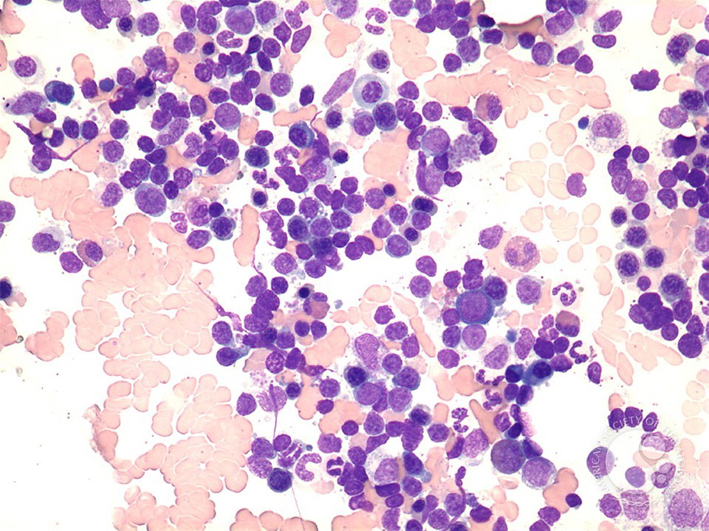
Treatment
WM can remain indolent, thus not requiring treatment for many years. In the absence of clear symptoms/signs related to WM, watchful waiting approach with interim visit, laboratory evaluation and possibly imaging is appropriate.
Once it becomes symptomatic, WM necessitate commencement of chemotherapy. As WM has features similar to lymphoma and MM, both lymphoma- and MM-based chemotherapy regimens are commonly used; the choice of regimen usually depends on whether the patient is being treated by a lymphoma or MM specialist.
| Types of agents | Single Agent | Combination Therapy |
| CD20 mAb based therapies (Anti-lymphoma) | Rituximab | Preferred regimen: Dexamethasone, rituximab, cyclophosphamide (DRC) Other: Bendamustine, rituximab (BR); thalidomide, rituximab; lenalidomide, rituximab |
| Proteasome inhibitor based therapies (Anti-myeloma) | Bortezomib, Carfilzomib | Bortezomib, rituximab, dexamethasone (BoRD) |
| IMiDs | Thalidomide, Lenalidomide | Used together in Rituximab based therapies |
| Others | Ibrutinib (BTK tyrosine kinase inhibitor used in patients with MYD88 mutation), Alemtuzumab (anti-CD52 mAb) Purine nucleoside analogues: - Fludarabine - Cladribine |
Newly-Diagnosed
Relapsed WM
Response Criteria (NCCN Guidelines for WM)
| Complete Response (CR) | |
| Very Good Partial Response | |
| Partial Response | |
| Minor Response | |
| Stable Disease | |
| Progressive Disease |
Evolution
Of a group of 1,466 WM patients, 20 had WM transform into Diffuse Large B-Cell Lymphoma (DLBCL) (Castillo JJ et al, 2016).
Prognosis
Genes Involved and Proteins
Article Bibliography
| Pubmed ID | Last Year | Title | Authors |
|---|---|---|---|
| 19362966 | 2009 | Genetic abnormalities in Waldenström's macroglobulinemia. | Adamia S et al |
| 27415417 | 2016 | Histological transformation to diffuse large B-cell lymphoma in patients with Waldenström macroglobulinemia. | Castillo JJ et al |
| 21454200 | 2011 | Associated malignancies in patients with Waldenström's macroglobulinemia and their kin. | Hanzis C et al |
| 28294689 | 2017 | Genomics, Signaling, and Treatment of Waldenström Macroglobulinemia. | Hunter ZR et al |
| 28056114 | 2017 | Diagnosis and Management of Waldenström Macroglobulinemia: Mayo Stratification of Macroglobulinemia and Risk-Adapted Therapy (mSMART) Guidelines 2016. | Kapoor P et al |
| 22451426 | 2012 | Progression in smoldering Waldenstrom macroglobulinemia: long-term results. | Kyle RA et al |
| 12883242 | 2003 | Waldenstrom macroglobulinemia involving extramedullary sites: morphologic and immunophenotypic findings in 44 patients. | Lin P et al |
| 11601139 | 2001 | Cytogenetic findings in lymphoplasmacytic lymphoma/Waldenström macroglobulinemia. Chromosomal abnormalities are associated with the polymorphous subtype and an aggressive clinical course. | Mansoor A et al |
| 24553177 | 2014 | Somatic mutations in MYD88 and CXCR4 are determinants of clinical presentation and overall survival in Waldenstrom macroglobulinemia. | Treon SP et al |
| 22139816 | 2012 | Temporal and geographic variations of Waldenstrom macroglobulinemia incidence: a large population-based study. | Wang H et al |
Citation
Phillip Hsieh ; Yu-Tzu Tai ; Matthew Ho Zhi Guang ; Giada Bianchi
Waldenstrom macroglobulinemia
Atlas Genet Cytogenet Oncol Haematol. 2017-11-01
Online version: http://atlasgeneticsoncology.org/haematological/2043/meetings/tumors-explorer/gene-explorer/calendar
