B-cell lymphoma, unclassifiable, with features intermediate between diffuse large B-cell lymphoma and classical Hodgkin lymphoma
2016-06-01 Liron Pantanowitz , Sandro Sulfaro , Annunziata Gloghini , Antonino Carbone Affiliation1.Department of Pathology Centro di Riferimento Oncologico Aviano (CRO), Istituto Nazionale Tumori, IRCCS, Aviano, Italy - [email protected] (AC); Department of Pathology, University of Pittsburgh Medical Center, Pittsburgh, Pennsylvania - [email protected] (LP); Department of Pathology, A.O. "S. Maria degli Angeli" Pordenone, Italy - [email protected] (SS); Department of Diagnostic Pathology and Laboratory Medicine, Fondazione IRCCS Istituto Nazionale dei Tumori, Milano, Italy; - [email protected] (AG)
Abstract
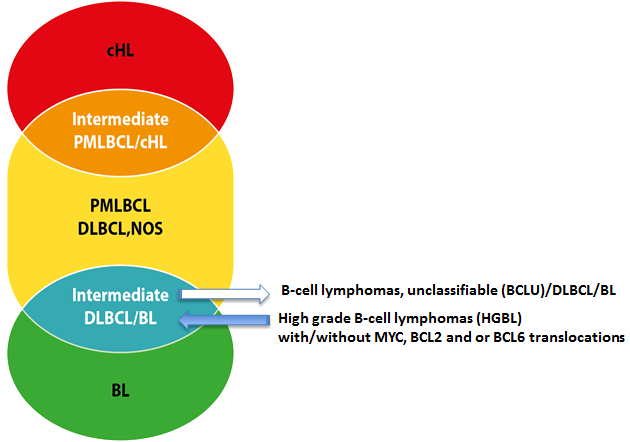
The 2016 revised World Health Organization (WHO) classification includes several provisional borderline categories for lymphoma cases that do not clearly fit into one entity, such as B-cell lymphoma, unclassifiable (BCLU), with features intermediate between diffuse large B-cell lymphoma (DLBCL) and classical Hodgkin lymphoma (cHL).
Clinics and Pathology
Disease
Epidemiology
Clinics
Pathology
| PMLBCL morphology | ||
| - Tumour cells | - Large cells with clear cytoplasm and multilobated nuclei - Large cells with Hodgkin Reed-Sternberg (HRS)-like morphology | |
| -Tumor background | - Contains eosinophils, plasma cells, T-cells. The inflammatory background is less abundant than that of cHL - Fine compartmentalizing alveolar fibrosis | |
| cHL morphology | ||
| - Tumour cells | - Typical Reed-Sternberg (RS) cells - Mononuclaer Hodgkin cells | |
| - Tumor background | - Contains admixed T-cells, B-cells, plasma cells, eosinophils, histiocytes, and fibroblasts - Abundant sclerosis (especially in the nodular sclerosis subtype) | |
| BCLU morphology with features intermediate between PMLBCL and cHL | ||
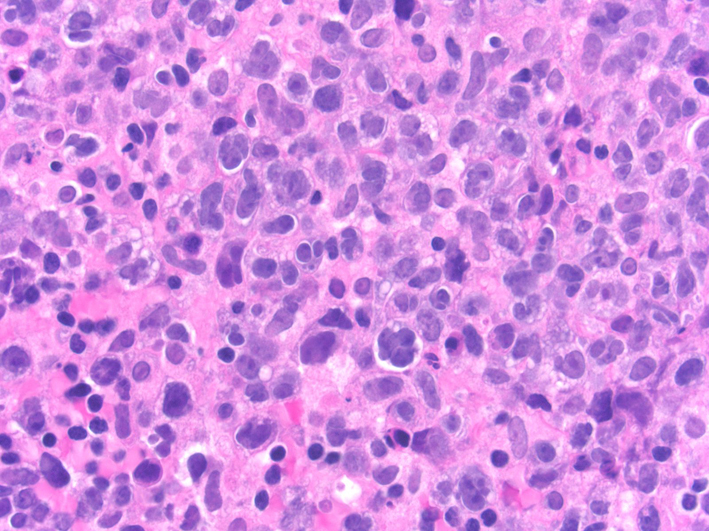
| - Tumour cells | - Large cells resembling HRS cells, which comprise the majority of the infiltrate | |
| - Tumor background | - Sparse inflammatory infiltrate with eosinophils, plasma cells, histiocytes, and T-cells - Sclerosis (variable and focal) - Necrosis (frequent) | |
| - Variation in morphology, with some tumor areas resembling DLBCL and other regions more closely resembling cHL | ||
Other features
Table 2:Transitional features between PMLBCL and cHL (Gaulard et al., 2008; Stein et al., 2008; Carbone et al., 2010).
| PMLBCL | |
| - CD30+ (80% of the cases, weak and heterogeneous) - CD15- (occasionally present) - B-cell antigens+ (CD20, CD19, CD22, CD79a) - BCL6+, BCL2+, CD23+, CD10+ (less common) - IRF4/MUM1+ | |
| cHL | |
| - CD30+ strong (100% of the cases) - CD15+ - CD45- - CD20- - CD40 (consistently positive) - BCL6- - IRF4/MUM1 (consistently positive) - B-cell transcription factors- | |
| BCLU with features intermediate between PMLBCL and cHL | |
| - CD30+ (variable amount) - CD15+ (variable amount) - CD45+ - B-cell antigens+ - B-cell transcription factors+ | |
Note
However, unlike cHL Epstein-Barr virus sequences have been found in fewer (20% or less) cases.
| DLBCL, NOS | |||||||
| Pubmed ID | Last Year | Title | Authors |
|---|---|---|---|
| 26980727 | 2016 | The 2016 revision of the World Health Organization classification of lymphoid neoplasms. | Swerdlow SH et al |
Citation
Liron Pantanowitz ; Sandro Sulfaro ; Annunziata Gloghini ; Antonino Carbone
B-cell lymphoma, unclassifiable, with features intermediate between diffuse large B-cell lymphoma and classical Hodgkin lymphoma
Atlas Genet Cytogenet Oncol Haematol. 2016-06-01
