Head and Neck: Laryngeal tumors: an overview
2008-12-01 Nikolaos S Mastronikolis , Theodoros A Papadas , Panos D Goumas , Irene-Eva Triantaphyllidou , Dimitrios A Theocharis , Nikoletta Papageorgakopoulou , Demitrios H Vynios Affiliation1.Laboratory of Biochemistry, Department of Chemistry, University of Patras, Patras, Greece
Summary
Note
Classification
Note
True benign tumours constitute 5% or less of all laryngeal tumours. The most common benign tumour of the larynx is papilloma (85%).
Other types include: chondroma, haemangioma, lymphangioma, schwannoma, neurofibroma, adenoma, granular cell myoblastoma, leiomyoma, rhabdomyoma, fibroma, lipoma and paraganglioma.
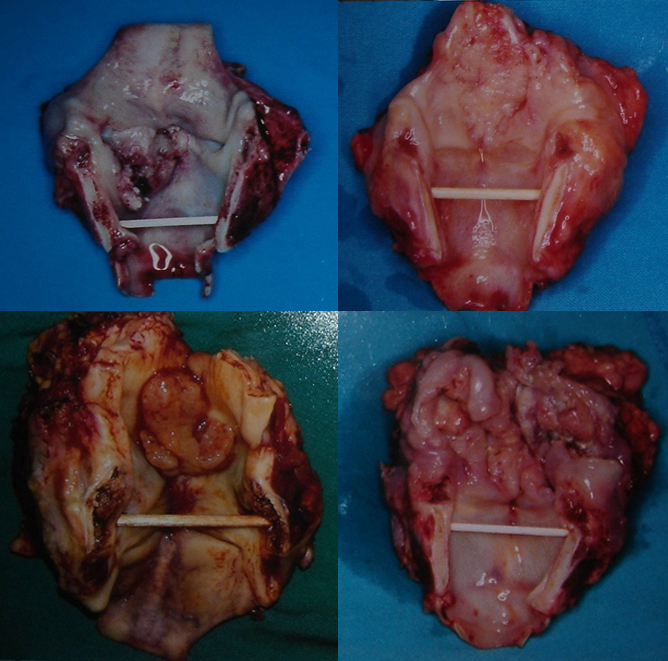
Classification
- Carcinoma in situ
- Verrucous, spindle cell and basaloid SCC
- Undifferentiated carcinoma
- Adenocarcinoma
- Miscellaneous carcinomas (adenoid cystic, neuroendocrine carcinomas, etc)
- Sarcomas
Squamous cell carcinoma is further divided according to tumour location into four subtypes:
Glottic carcinomas represent the majority of laryngeal cancers (50%-60%), followed by the supraglottic carcinomas (30%-40%), while the subglottic carcinomas are uncommon (5% or less).
Clinics and Pathology
Etiology
Epidemiology
Clinics
Pathology
The vast majority of all laryngeal malignancies (95%) are conventional squamous cell carcinomas (SCC) and they vary according to their degree of differentiation to well, moderate and poor carcinomas. Glottic cancers are generally well differentiated and have a less aggressive behaviour in comparison with carcinomas at the other sites of the larynx. SCC often arises in a background of mucosal squamous dysplasia or carcinoma in situ and typically presents islands, tongues and clusters of atypical cells invading the laryngeal stroma. Features of squamous differentiation also comprise individual cell keratinisation, intercellular bridges and keratin pearls. Recognition of the less common variants like verrucous, spindle cell and basaloid SCC is significant because their biological course often is different from that of conventional SCC.
- Verrucous SCC: comprises approximately 1% to 4% of laryngeal malignancies. It presents as a locally invasive fungating mass and characteristically does not metastasize to regional lymph nodes. Histologically, it appears broad pegs of highly differentiated squamous cells invading the laryngeal stroma in a pushing pattern and mitoses rarely found mainly at the tumour base. Surgical excision is the cornerstone of therapy since radiotherapy associated with poor results and the possibility of anaplastic transformation of the tumour.
- Spindle SCC: presents usually as a polypoid or less as an endophytic mass. Comprised of a pleomorphic spindle cell component related with typical in situ or invasive SCC, which sometimes cannot be identified, especially in the presence of extensive ulceration. Spindle cell SCC has been reported to be more aggressive than conventional one. Surgery is the treatment of choice, while radiotherapy is ineffective.
- Basaloid SCC: usually presented at an advanced stage with neck metastases. Microscopically, the tumour is characterized by nests and lobules of small basaloid cells with a high nuclear-to-cytoplasmic ratio and areas demonstrating abrupt squamous differentiation, foci of carcinoma in situ or invasive SCC. Comedonecrosis and stromal hyalinosis are also common findings. Surgery of the primary tumour and neck and radiation therapy is the usual therapeutic approach.
Except of conventional methods, various ancillary techniques provide information about a tumour that cannot be obtained by routine histopathologic examination. These methods have been applied to LSCC in order to evaluate a range of potential prognostic indicators, including DNA ploidy, proliferative activity, and oncogene amplification.
- DNA ploidy: refers to the nuclear DNA content and is determined by either DNA flow cytometry or image analysis.
- Proliferative activity: may reflect the biologic potential and therapeutic responsiveness of a tumour. It can be measured by mitotic index, flow cytometry, image analysis, and immunohistochemical demonstration of proliferation markers, such as proliferating cell nuclear antigen (PCNA), or Ki67.
- Oncogenes: Proto-oncogenes are genes that normally promote cell growth. Alteration of either the structure or regulaton of a proto-oncogene converts it to an oncogene. The protein encoded by the oncogene (i.e. oncoprotein), is abnormal either in quantity or structure (i.e. ras proto-oncogene encodes p21 ras oncoprotein, c-erb B/ERBB2 encodes epidermal growth factor receptor-EGFR, etc)
Treatment
The standard options for treatment of LSCC are surgery, radiotherapy, chemotherapy or a combination of them. Radiotherapy is used in more than 70% of patients, surgery in about 55% and chemotherapy in about 10%. The management of laryngeal cancer varies in different parts of the world. However, it is widely accepted that early-stage LSCC can be adequately treated with single-modality therapy, either surgery or radiotherapy, with a 5-year local control of 85-95%. For more advanced disease (stages III and IV), a multimodality treatment based upon a combination of surgery and irradiation is the most common approach.
Recently, new therapies based on a molecular basis of LSCC are in use or under development. The use of cellular tumour markers as therapeutic targets is being studied in order to block specific pathways involved in the cancerous process and tumour aggressiveness or invasiveness, restoring effective oncosuppression. Considering this, EGFR pathway is a good target for therapeutic interventions in LSCC. Several approaches can interfere with EGFR function and may be useful for anticancer treatment such as, the use of monoclonal antibodies (MAb) against the extracellular ligand binding domain, ligand-toxin conjugates that kill target cells following endocytosis, tyrosine kinase inhibitors that inhibit ligand-induced EGFR activation, and antisense oligonucleotides against EGFR mRNA. Furthermore, transient overexpression of the wild-type p53 gene could provide a potential molecular treatment strategy in LSCC. In head and neck cancer, the most used gene-delivery tool has been the recombinant adenovirus Ad-p53. A gene therapy approach using wild-type human p53 has already been demonstrated to induce apoptosis and radio-, chemosensitisation in cell lines. Thus, the use of p53 gene therapy in combination with radio- or chemotherapy could be considered a rational possibility. Another potential application is the treatment of dysplastic lesions, as p53 mutations seem to occur early in laryngeal carcinogenesis. However, the main problem of all these approaches, remains the absence of a really efficient, long-term gene-delivery system.
Prognosis
Small glottic cancers have better prognosis than supraglottic ones. The overall 5-year survival following treatment is 80% for glottic and 50% for supraglottic tumours, mainly because the latter present an increased incidence of nodal metastases. Nearly two-thirds of patients with supraglottic cancers have neck metastases at the time of initial treatment. Survival decreases by more than one third when clinically positive lymph nodes are present. Five-year disease free survival of patients with supraglottic cancer is 80% for stages I-II, 70% for stage III and 40% for stage IV. Patients with glottic cancers have a better long-term prognosis. Five-year disease free for stages I-II is 85%-90%, for stage III is 75% and for stage IV is 45%-50%. However, in cases with an extremely advanced local and regional disease the overall 5-year survival is less than 5%.
Cytogenetics
Note
The nuclear phosphoprotein p53 is involved in gene transcription, DNA synthesis and repair, cell cycle coordination and apoptosis. Disruption, or perturbation of p53 function have been detected not only in the laryngeal but almost in all head and neck cancers. p53 point mutations or deletions (also by LOH at 17p13) are frequent and p53 inactivation occurs in the transition from the preinvasive to the invasive state.
Cyclin D1 is involved in cell cycle progression and interacts with cyclin-dependent kinases. When Cyclin D1 gene (CCND1) amplification is observed in precancerous and cancerous lesions, cyclin D1 is always overexpressed. In turn, cyclin D1 overexpression does not determine, but always anticipates gene amplification, which probably represents a more stable, non-reversible, alteration in tumour cells.
Early in the cancerous process altered p53 gene function and CCND1 gene overexpression increase genetic instability and promote further genetic and chromosomal alterations, such as CCND1 amplification which is considered as the ultimate transforming event by the selection of a malignant subclone from a genetically altered field.
Genes Involved and Proteins
Note
EGFR is frequently and early overexpressed in LSCC, mainly by post-translational mechanisms. EGFR expression retains a strong predictive value independently of treatment (surgery, chemotherapy and radiation) and adversely influences overall relapse-free and metastasis-free survival in LSCC. At present, EGFR is the most reliable biological marker for molecular characterisation, aggressiveness and invasiveness of LSCC.
Alterations of p53 protein expression and mutations of the p53 gene have been proposed as independent predictors of recurrence in LSCC, however with controversial prognostic value.
p53 protein overexpression has been detected in a high percentage of LSCC correlating well with p53 gene mutation.
p53 gene mutation has been suggested more reliably than p53 protein overexpression for characterisation, predicting also the response to radiotherapy in LSCC patients. This observation is in accordance with the biological role of p53, which mediates apoptosis associated with DNA damage.
Alterations in p53 status have been evaluated in healthy mucosa, precancerous lesions and tumour cells in order to predict the development of LSCC and secondary primary tumours. Mutations of p53 have also been evaluated to detect whether multiple primary tumours have a mono- or polyclonal origin, without however, definitive conclusions.
In LSCC, degradation mediated by other cellular proteins, such as MDM2 or by human papillomavirus (HPV) E6 oncoprotein may represent alternative pathways leading to loss of p53 function.
A p53 gene therapy approach has already been shown to induce apoptosis, radio- and chemosensitisation in cell lines and this, in combination with radiotherapy or chemotherapy, is a rational possibility. Another potential application considered the treatment of dysplastic lesions, as p53 mutations seem to occur early in laryngeal carcinogenesis.
Telomerase activity often is present at high levels in most laryngeal cancer cells. It can at least partly depend on h-TERT gene (coding for catalytic subunit of telomerase) overexpression. It can be used for molecular epidemiology, diagnostics and targeting.
An early CCND1 overexpression is often detectable without evidence of gene amplification; it can be used for molecular epidemiology but it seems to retain a lower prognostic value, if compared with CCND1 amplification. The latter is a marker of aggressiveness and has an impact on relapse-free and overall survival in LSCC.
An overexpression of metalloproteases, hyaluronidases and cathepsin D is often detectable in tumour cells. These molecules are responsible for degradation of extracellular matrix and thus play an important role in tumour growth, invasion and metastasis, as well as in tumour-induced angiogenesis. In addition, overexpression of CD44 hyaluronan receptor in a less glycanated form is observed.
Among the extracellular matrix components, the proteoglycan versican appeares to be overexpressed becoming the macromolecule characteristic of the tumour state and being another marker of aggressiveness. Similarly, hyaluronan is found in increased amounts and of rather smaller molecular size. Alterations, also, in the sulphation pattern of chondroitin/dermatan sulphate are observed, indicating different expression of sulphotransferases.
Human papillomavirus (HPV) may affect epithelia with mucosal or epidermal tropism according to genotype. It has been reported that oncosuppressors such as p53 and pRb/RB1 are inhibited and degraded by HPV oncoproteins, while overexpression of oncogenes such as EGFR and cyclins A and B is induced.
Type II oestrogen binding sites (EBS), normally found in laryngeal mucosa, have been reported that may partly mediate tumour growth inhibition by tamoxifen and quercetin and could be possible targets for chemoprevention and therapy.
S100A2 has recently been described as an actual oncosuppressor with a prognostic significance stronger than simple histopathological grading. Its underexpression in cancer cells is inversely proportional to tumour differentiation.
Methyl-phydroxyphenyllactate esterase (MEPHLase) low activity in LSCC is associated with poor differentiation and shorter overall survival and metastasis-free survival.
Type 2 cyclo-oxygenase activity seems to promote tumour neoangiogenesis. However, evidence exists that low COX2 expression indicates poor differentiation and higher aggressiveness and invasiveness.
Galectin-3 participates in a variety of cell processes and mediating cell-to-cell interactions. Its expression seems positively associated with tumour keratinisation and histological grade and a significant correlation was described between galectin-3 tumour positivity and longer metastasis-free and overall survival in LSCC patients.
Article Bibliography
| Pubmed ID | Last Year | Title | Authors |
|---|---|---|---|
| 15763643 | 2005 | Molecular markers in laryngeal squamous cell carcinoma: towards an integrated clinicobiological approach. | Almadori G et al |
| 8386140 | 1993 | Over-expression of p53 protein in human laryngeal carcinoma. | Anwar K et al |
| 9816104 | 1996 | Cyclin D1 gene amplification in human laryngeal squamous cell carcinomas: prognostic significance and clinical implications. | Bellacosa A et al |
| 9052669 | 1997 | Histopathology and pathologic prognostic indicators. | Cappellari JO et al |
| 17786346 | 2007 | Expression of metalloproteinases and their tissue inhibitors in squamous cell laryngeal carcinoma. | Christopoulos TA et al |
| 16946667 | 2006 | Laryngeal cancer in the United States: changes in demographics, patterns of care, and survival. | Hoffman HT et al |
| 14974761 | 2004 | Cancer statistics, 2004. | Jemal A et al |
| 8995133 | 1997 | The etiology and pathogenesis of laryngeal carcinoma. | Koufman JA et al |
| 18570952 | 2008 | The molecular genetics of laryngeal cancer. | Loyo M et al |
| 16920269 | 2006 | Current opinion in diagnosis and treatment of laryngeal carcinoma. | Marioni G et al |
| 16690200 | 2006 | The increased accumulation of structurally modified versican and decorin is related with the progression of laryngeal cancer. | Skandalis SS et al |
| 18383852 | 2008 | Stage-related decorin and versican expression in human laryngeal cancer. | Stylianou M et al |
| 18661351 | 2008 | Biochemical changes of extracellular proteoglycans in squamous cell laryngeal carcinoma. | Vynios DH et al |
Citation
Nikolaos S Mastronikolis ; Theodoros A Papadas ; Panos D Goumas ; Irene-Eva Triantaphyllidou ; Dimitrios A Theocharis ; Nikoletta Papageorgakopoulou ; Demitrios H Vynios
Head and Neck: Laryngeal tumors: an overview
Atlas Genet Cytogenet Oncol Haematol. 2008-12-01
Online version: http://atlasgeneticsoncology.org/solid-tumor/5087/head-and-neck-laryngeal-tumors-an-overview
