Kidney: Clear cell sarcoma with t(10;17)(q22;p13) YWHAE/NUTM2E
2005-08-01 Noel A Brownlee , Patrick Koty , A Julian Garvin , Mark J Pettenati Affiliation1.Department of Pathology, Wake Forest University School of Medicine, Winston-Salem, NC 27157, USA
Clinics and Pathology
Phenotype stem cell origin
Embryonic origin
Etiology
Epidemiology
Clinics
Pathology
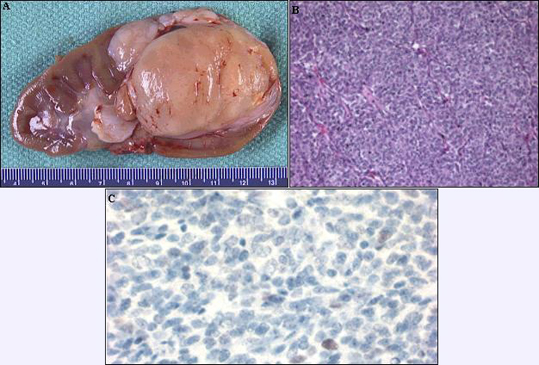
Several histologic variants of CCSK are recognized. The most common variant is the myxoid CCSK. This histology features diffuse accumulation of mucopolysaccharide matrix material between tumor cells sometimes creating a cystic appearance. The sclerosing variant of CCSK is characterized by prominent collagen bundles that may isolate single or small groups of tumor cells in a dense matrix that may become hyalinized. The cellular pattern of CCSK is characterized by less extracellular matrix material between cells with overlapping of nuclei, a feature that may lead to confusion with a blastemal predominant Wilms tumor or primitive neuroectodermal tumor. Mitotic activity is usually increased in this variant. The epithelioid CCSK variant may be confused with nephroblastoma due to condensation of tumor cell cords. The palisading pattern is described as having spindle cell nuclei in parallel linear arrays alternating with nuclear free zones, a feature that resembles Verocay bodies of schwannomas. The spindle cell and storiform patterns are relatively uncommon. Anaplasia is a rare finding in CCSK (3% of cases), and is characterized by the presence of enlarged, hyperchromatic polypoid nuclei with multipolar mitotic figures. The nuclear accumulation of p53 in anaplastic tumors is thought to represent evidence of p53 gene mutation, a finding that has been well-documented in anaplastic Wilms tumors. The frequency of different CCSK variants is listed below:
Immunohistochemistry is rarely informative in CCSK. Immunoreactivity for the intermediate filament vimentin is usually present, however, reactivity with most other proteins including epithelial markers are negative.
Like other renal tumors of childhood, CCSK is staged by the National Wilms Tumor Study staging scheme as follows:
Stage I (25% of CCSK): For stage I tumors, 1 or more of the following criteria must be met:
Stage II (37% of CCSK): For Stage II tumors, 1 or more of the following criteria must be met:
Any of the following conditions may also exist:
Stage III (34% of CCSK): For Stage III tumors, 1 or more of the following criteria must be met:
Stage IV (4% of CCSK): defined as the presence of hematogenous metastases (lung, liver, bone, or brain), or lymph node metastases outside the abdomenopelvic region.
Stage V (not yet reported for CCSK): defined as bilateral renal involvement at time of initial diagnosis.
Treatment
Prognosis
Patients with tumors without areas of necrosis have a more favorable prognosis. Twenty-nine percent of patients with CCSK have lymph node metastases at the time of diagnosis, and bone metastasis is the most common form of relapse. Metastatic lesions have also been reported in the liver, brain, soft tissue sites, and lung with more unusual metastases to the skeletal muscle, testis, and salivary gland. Relapses of CCSK as many as 10 years after original diagnosis have been reported.
Cytogenetics
Note
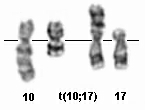
Of five patients reviewed at this institution, karyotypes were available for four of these. One patient had a clonal balanced translocation 10;17 and an interstitial deletion of the long arm of chromosome 14 as follows: 46, XY, t(10;17)(q22;p13)del(14)(q24.1q31.1).Three other patients had normal karyotypes. Fluorescent in-situ hybridization using a p53 probe was employed on the same cells harboring the clonal translocation above. This study documented the presence of two p53 signals on chromosome 17 indicating the absence of deletion or translocation of the TP53 tumor suppressor gene.
Genes Involved and Proteins
Note
Article Bibliography
| Pubmed ID | Last Year | Title | Authors |
|---|---|---|---|
| 10632483 | 2000 | Clear cell sarcoma of the kidney: a review of 351 cases from the National Wilms Tumor Study Group Pathology Center. | Argani P et al |
| 10657872 | 2000 | Comparative genomic hybridization analysis of clear cell sarcoma of the kidney. | Barnard M et al |
| 12007018 | 2002 | Functional and gene expression analysis of the p53 signaling pathway in clear cell sarcoma of the kidney and congenital mesoblastic nephroma. | Brownlee NA et al |
| 8912350 | 1996 | Implications of p53 protein expression in clear cell sarcoma of the kidney. | Cheah PL et al |
| 2981607 | 1985 | Abnormalities of chromosomes 1 and 11 in Wilms' tumor. | Douglass EC et al |
| 12065773 | 2002 | Infrequent p53 gene mutations and lack of p53 protein expression in clear cell sarcoma of the kidney: immunohistochemical study and mutation analysis of p53 in renal tumors of unfavorable prognosis. | Hsueh C et al |
| 1657374 | 1991 | Correlation of chromosome abnormalities with histological and clinical features in Wilms' and other childhood renal tumors. | Kaneko Y et al |
| 708576 | 1978 | Bone-metastasizing renal tumour of childhood. | Marsden HB et al |
| 213187 | 1978 | Undifferentiated sarcoma of the kidney: a tumor of childhood with histopathologic and clinical characteristics distinct from Wilms' tumor. | Morgan E et al |
| 8453549 | 1993 | Clear cell sarcoma of kidney. Two cases in adults. | Oda H et al |
| 2548705 | 1989 | Translocation 10;17 in clear cell sarcoma of the kidney. A first report. | Punnett HH et al |
| 15474157 | 2004 | Translocation (10;17)(q22;p13): a recurring translocation in clear cell sarcoma of kidney. | Rakheja D et al |
| 2158398 | 1990 | Chromosome analysis of 31 Wilms' tumors. | Sheng WW et al |
Citation
Noel A Brownlee ; Patrick Koty ; A Julian Garvin ; Mark J Pettenati
Kidney: Clear cell sarcoma with t(10;17)(q22;p13) YWHAE/NUTM2E
Atlas Genet Cytogenet Oncol Haematol. 2005-08-01
Online version: http://atlasgeneticsoncology.org/solid-tumor/5412/kidney-clear-cell-sarcoma-with-t(10
