Soft Tissues: Angiofibroma
2013-01-01 Yuesheng Jin , Fredrik Mertens Affiliation1.Department of Clinical Genetics, University, Regional Laboratories, Skane University Hospital, Lund University, Lund, Sweden
Clinics and Pathology
Phenotype stem cell origin
Unknown.
Embryonic origin
Unknown. Immunohistochemical evaluation suggests a fibroblastic/myofibroblastic line of differentiation.
Etiology
Unknown.
Epidemiology
Presumably rare, but differential diagnostic problems may have hampered the distinction of these neoplasms in the past. The tumor occurs most frequently in middle-aged adults, affecting women twice as often as men.
Clinics
The tumor typically presents as a slowly growing, painless mass located in the soft tissue of the extremities, mainly the lower extremities, often in relation to joints or fibrotendinous structures. It can, however, display a broad anatomic distribution. The tumor is benign, with rare local recurrences and no evidence of metastasis potential.
Pathology
The tumors are most often well circumscribed, consisting of a patternless or vaguely lobulated spindle cell proliferation accompanied by a prominent vascular component. The cytomorphology is non-distinctive, characterized by bland fibroblastic spindle cells with a pale eosinophilic cytoplasm and short ovoid nuclei. There is no atypia. There is also a complex network of numerous thin-walled branching blood vessels, in addition to larger round or branching blood vessels. The stroma is variably collagenous or myxoid.
Treatment
Local surgical resection is an adequate treatment.
Prognosis
These lesions behave in a benign manner with excellent prognosis; few cases recur after local excision.
Cytogenetics
Note
A balanced chromosome translocation t(5;8)(p15;q13) is a specific aberration characterizing soft tissue angiofibromas. This translocation was identified in five of six angiofibromas investigated cytogenetically; the sixth case had a t(7;8;14)(q11;q13;q31).
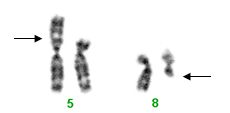
Representative partial karyogram from an angiofibroma showing the translocation t(5;8)(p15;q13). Arrows indicate breakpoints.
Cytogenetics molecular
In two tumors, the breakpoints of the t(5;8) were mapped by FISH. The breakpoints at 5p15 and 8q13 were delineated by BAC clones RP11-1006P13, covering the AHRR locus, and RP11-479K21, harboring NCOA2, which both gave split signals.
Interphase FISH on cut sections from nine additional cases of soft tissue angiofibroma using pools of BACs covering AHRR and NCOA2 yielded fusion signals in at least 10% of the nuclei in three cases. Additional interphase FISH using a break-apart probe for the NCOA2 gene in the six fusion-negative cases did not reveal any split signals.
Interphase FISH on cut sections from nine additional cases of soft tissue angiofibroma using pools of BACs covering AHRR and NCOA2 yielded fusion signals in at least 10% of the nuclei in three cases. Additional interphase FISH using a break-apart probe for the NCOA2 gene in the six fusion-negative cases did not reveal any split signals.
Probes
For metaphase FISH the BAC clones detecting the gene fusion are RP11-1006P13 (AC113363.1), covering the AHRR locus, and RP11-479K21 (AQ637276.1 and AQ6379.1), harboring NCOA2.
Pools of RP11-323M9 and RP11-1006P13 as well as RP11-479K21, RP11-746L20 (AC021558.10) and RP11-333A23 (AC022730.7) were used to detect AHRR/NCOA2 fusions in interphase nuclei. RP11-152C15 and RP11-265O14 were used as a break-apart probe to detect rearrangements of NCOA2.
Pools of RP11-323M9 and RP11-1006P13 as well as RP11-479K21, RP11-746L20 (AC021558.10) and RP11-333A23 (AC022730.7) were used to detect AHRR/NCOA2 fusions in interphase nuclei. RP11-152C15 and RP11-265O14 were used as a break-apart probe to detect rearrangements of NCOA2.
Genes Involved and Proteins
Gene name
AHRR (aryl-hydrocarbon receptor repressor)
Location
5p15.33
Dna rna description
The AHRR gene consists of 12 exons with a transcript length of 5661 bp. It has a TATA-less promoter and several transcription start sites. The translation initiation codon is located in exon 2. Intron 1 contains a functional regulatory sequence called xenobiotic response element (XRE). The bHLH domain of the AHRR protein is located in the aminoterminal part (encoded by exon 3), followed by the PAS domain (exons 5 and 6). The carboxyterminal part has a repression domain.
Protein description
The open reading frame of AHRR encodes a 719 amino acid protein, the aryl hydrocarbon receptor repressor, a key regulator of the activity of the aryl hydrocarbon receptor (AHR).
AHR is a crucial mediator of the cellular response to xenobiotics such as polycyclic aromatic hydrocarbons, including 2,3,7,8-tetrachlorodibenzo-p-dioxin (TCDD), better known as dioxin. AHRR is a putative tumor suppressor gene implicated in several tumor types.
AHR is a crucial mediator of the cellular response to xenobiotics such as polycyclic aromatic hydrocarbons, including 2,3,7,8-tetrachlorodibenzo-p-dioxin (TCDD), better known as dioxin. AHRR is a putative tumor suppressor gene implicated in several tumor types.
Gene name
NCOA2 (nuclear receptor coactivator 2)
Location
8q13.3
Dna rna description
The NCOA2 gene consists of 23 exons with a transcript length of 8447 bp. NCOA2 has been identified as the 3-partner in gene fusions involved in various leukemias and sarcomas.
Protein description
NCOA2, nuclear receptor co-activator 2, (also known as TIF2 and SRC2) is one of three members of the p160 steroid receptor coactivator (SRC) family. The protein is about 160 kDa in size and contains 1464 aa including three structural domains. The N-terminal bHLH/PAS domain is the most conserved region, and can bind to DNA as well as heterodimerize with a variety of proteins with similar regions to enhance transcription of nuclear hormone receptor target genes. The central region of the SRC proteins contains three LXXLL motifs which interact with the nuclear hormone receptors. The C-terminus has two transcriptional activation domains (AD1 and AD2). AD1, also known as CREB binding protein (CREBBP) interacting domain (CID), binds other coactivators, such as CREBBP and EP300 (E1A binding protein p300), which leads to chromatin remodeling. AD2 is responsible for interaction with histone methyltransferases, coactivator-associated arginine methyltransferase 1 and PRMT1.
Result of the chromosomal anomaly
Note
The translocation t(5;8) has so far been reported in five soft tissue angiofibromas. Breakpoint mapping by metaphase FISH followed by RT-PCR has disclosed that this translocation results in a fusion between the AHRR and NCOA2 genes; in-frame AHRR/NCOA2 as well as NCOA2/AHRR were found in all four cases investigated so far. The location of the breakpoints has been characterized in a few cases with the t(5;8). In three tumors nt 1018 (the last nt of exon 9; NM_020731) of AHRR was joined with nt 3321 (the first nt of exon 16; NM_006540) of NCOA2. In one case, the fusion was most likely between nt 1080 (last nt of exon 10) of AHRR and nt 2975 (first nt of exon 14) of NCOA2. As the case with the three-way t(7;8;14)(q11;q13;q31) resulted in a GTF2I/NCOA2 fusion, it seems reasonable to assume that it is the transcripts with NCOA2 as 3 partner that are pathogenetically relevant.
Detection protocole
A detailed description of a protocol for the detection of AHRR/NCOA2 and NCOA2/AHRR chimeras has been reported.
Note
The function of the AHRR/NCOA2 and NCOA2/AHRR chimeras is unknown. Based on previously reported fusion genes involving the p160 SRC gene family, as well as the finding of an alternative GTF2I/NCOA2 fusion in one case, we assume that it is the AHRR/NCOA2 transcript that is pathogenetically significant. As the amino terminal part of the transcription factor AHRR, responsible for the recognition of xenobiotic response elements in target genes and for heterodimerization, shows extensive homology with the aryl hydrocarbon receptor (AHR), the fusion is predicted to upregulate the AHR/ARNT signaling pathway. Indeed, global gene expression analysis showed upregulation of CYP1A1 as well as other typical target genes of this pathway, such as those encoding toll-like receptors. However, the relative impact of the reciprocal NCOA2/AHRR transcript, as well as of the individual domains contributed by each partner in the chimeric proteins, will have to be studied in experimental models.
Description
The fusion protein AHRR/NCOA2 contains the N-terminal AHRR, i.e., the bHLH (encoded by exon 3) and PAS (encoded by exon 5) domains, and the C-terminal NCOA2, including two transcriptional activation domains (AD1 and AD2), which replaces the repression domain of AHRR (C-terminal).
Highly cited references
| Pubmed ID | Year | Title | Citations |
|---|---|---|---|
| 37621777 | 2023 | Detection of various fusion genes by one-step RT-PCR and the association with clinicopathological features in 242 cases of soft tissue tumor. | 38 |
| 27633981 | 2016 | Gene fusions AHRR-NCOA2, NCOA2-ETV4, ETV4-AHRR, P4HA2-TBCK, and TBCK-P4HA2 resulting from the translocations t(5;8;17)(p15;q13;q21) and t(4;5)(q24;q31) in a soft tissue angiofibroma. | 30 |
| 36060023 | 2022 | Arthroscopic Excision of Intra-articular AHRR-NCOA2- positive Angiofibroma of Soft Tissue of the Knee: A Case Report. | 27 |
| 35832542 | 2022 | Angiofibroma of Soft Tissue: A Clinicopathological Study of Eight Cases With Emphasis on the Diagnostic Utility of Fluorescence In Situ Hybridization Detection for NCOA2 Rearrangement. | 26 |
| 37680034 | 2023 | Novel EWSR1::GFI1B gene fusion in angiofibroma of soft tissue. | 18 |
| 22337624 | 2012 | Fusion of the AHRR and NCOA2 genes through a recurrent translocation t(5;8)(p15;q13) in soft tissue angiofibroma results in upregulation of aryl hydrocarbon receptor target genes. | 0 |
| 28759137 | 2017 | Soft tissue sarcomas: From a morphological to a molecular biological approach. | 0 |
| 28639284 | 2017 | Soft tissue angiofibroma: Clinicopathologic, immunohistochemical and molecular analysis of 14 cases. | 0 |
| 37855220 | 2024 | CYP1A1 immunohistochemistry is highly specific for angiofibroma of soft tissue among morphological mimics. | 0 |
| 26845637 | 2016 | Histological spectrum of angiofibroma of soft tissue: histological and genetic analysis of 13 cases. | 0 |
| 36860189 | 2023 | Clinicopathologic and genetic characterization of angiofibroma of soft tissue: a study of 12 cases including two cases with AHRR::NCOA3 gene fusion. | 0 |
| 24856853 | 2014 | Diagnostic utility of NCOA2 fluorescence in situ hybridization and Stat6 immunohistochemistry staining for soft tissue angiofibroma and morphologically similar fibrovascular tumors. | 0 |
| 23261176 | 2013 | Soft tissue angiofibroma: report of 2 cases of a recently described tumor. | 0 |
Article Bibliography
| Pubmed ID | Last Year | Title | Authors |
|---|---|---|---|
| 23225380 | 2013 | A novel GTF2I/NCOA2 fusion gene emphasizes the role of NCOA2 in soft tissue angiofibroma development. | Arbajian E et al |
| 11423533 | 2001 | Structure and expression of the Ah receptor repressor gene. | Baba T et al |
| 9558366 | 1998 | A novel fusion between MOZ and the nuclear receptor coactivator TIF2 in acute myeloid leukemia. | Carapeti M et al |
| 12676584 | 2003 | MOZ-TIF2-induced acute myeloid leukemia requires the MOZ nucleosome binding motif and TIF2-mediated recruitment of CBP. | Deguchi K et al |
| 20075607 | 2010 | Molecular mechanisms of the physiological functions of the aryl hydrocarbon (dioxin) receptor, a multifunctional regulator that senses and responds to environmental stimuli. | Fujii-Kuriyama Y et al |
| 18848529 | 2009 | Regulation of constitutive and inducible AHR signaling: complex interactions involving the AHR repressor. | Hahn ME et al |
| 22337624 | 2012 | Fusion of the AHRR and NCOA2 genes through a recurrent translocation t(5;8)(p15;q13) in soft tissue angiofibroma results in upregulation of aryl hydrocarbon receptor target genes. | Jin Y et al |
| 9731070 | 1998 | Acute mixed lineage leukemia with an inv(8)(p11q13) resulting in fusion of the genes for MOZ and TIF2. | Liang J et al |
| 22301504 | 2012 | Angiofibroma of soft tissue: clinicopathologic characterization of a distinctive benign fibrovascular neoplasm in a series of 37 cases. | Mariño-Enríquez A et al |
| 22895276 | 2012 | Angiofibroma of soft tissue: core needle biopsy diagnosis, with cytogenetic confirmation. | Schoolmeester JK et al |
| 18281529 | 2008 | ETV6-NCOA2: a novel fusion gene in acute leukemia associated with coexpression of T-lymphoid and myeloid markers and frequent NOTCH1 mutations. | Strehl S et al |
| 19953635 | 2010 | Recurrent t(2;2) and t(2;8) translocations in rhabdomyosarcoma without the canonical PAX-FOXO1 fuse PAX3 to members of the nuclear receptor transcriptional coactivator family. | Sumegi J et al |
| 22034177 | 2012 | Identification of a novel, recurrent HEY1-NCOA2 fusion in mesenchymal chondrosarcoma based on a genome-wide screen of exon-level expression data. | Wang L et al |
| 11393538 | 2001 | Human arylhydrocarbon receptor repressor (AHRR) gene: genomic structure and analysis of polymorphism in endometriosis. | Watanabe T et al |
| 19701241 | 2009 | Normal and cancer-related functions of the p160 steroid receptor co-activator (SRC) family. | Xu J et al |
| 18172554 | 2008 | The aryl hydrocarbon receptor repressor is a putative tumor suppressor gene in multiple human cancers. | Zudaire E et al |
Citation
Yuesheng Jin ; Fredrik Mertens
Soft Tissues: Angiofibroma
Atlas Genet Cytogenet Oncol Haematol. 2013-01-01
Online version: http://atlasgeneticsoncology.org/solid-tumor/6395/soft-tissues-angiofibroma
