RAC3 (ras-related C3 botulinum toxin substrate 3 (rho family, small GTP binding protein Rac3))
2012-04-01 Nora C Heisterkamp AffiliationDivision of Hematology-Oncology, Childrens Hospital of Los Angeles, CA, USA
DNA/RNA
Note
6 exons, spread out over approximately 2,4 kb.
Description
The Rac3 gene encompasses 6 exons on chromosome 17. Exon 1 encodes residues 1-12, exon 2 residues 13-36, exon 3 residues 37-75, exon 4 residues 76-96, exon 5 residues 97-149 and exon 6 residues 150-192.
Transcription
Human Rac3 mRNA is a single species of around 1 kb. No splice variants have been reported. Factors that would regulate gene expression on a transcriptional level have not yet been reported.
Pseudogene
No pseudogenes of Rac3 are reported in human.
Proteins
Note
The Rac3 gene encodes a single protein of 192 amino acid residues.
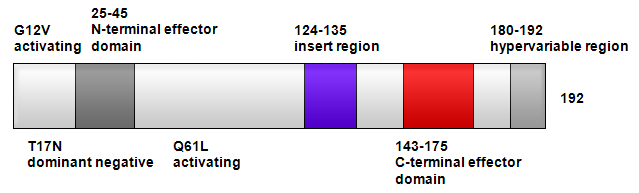
Schematic representation of the Rac3 protein (not to scale). Mutations that generate mutants that are locked in a certain conformation - constitutively active or dominant negative - are shown. The C-terminal end contains the CTVM motif that is post-translationally modified the three last amino acid residues are removed and the C residue is geranyl-geranylated.
Description
Rac3 is a small 21 kDa GTPase that acts as a molecular switch. In its active form, it is bound to GTP, whereas it is inactive in its GDP-bound form. Racs are controlled by guanidine activating proteins (GEFs) that exchange bound GDP for GTP and by GTPase activating proteins (GAPs) that promote GTP hydrolysis. Because of the hydrophobic isoprenyl moiety at the C-terminal end, it is associated with membranes. In the cytoplasm it associates with the chaperone RhoGDI.
Expression
Rac3 mRNA was reported in human cell lines including GM04155 (lymphoblastic leukemia), K562 (CML), 5838 (Ewing sarcoma), HL60 (promyelocytic leukemia) and DU4475 (breast cancer). Rac3 expression was reported using semi-quantitative RT/PCR in gastric tumor and adjacent normal tissue as well as gastric cancer cell lines. Expression of Rac3 using RT/PCR (38 cycles) was reported in human brain, liver, kidney and pancreas poly A RNA and also 19% of brain tumors expressed Rac3 mRNA. Rac3-specific polyclonal antibodies were used to show Rac3 protein in the brain (deep cerebellar nuclei and the pons) in 7 day old mice. Low level expression of mouse rac3 has been reported in bone-marrow-derived monocytes and in B-lineage lymphoblasts using standard and Real-Time RT/PCR. Expression of Rac3 is inferred because of the effect of siRNA knockdown in cell lines including HCT116 colon cancer, MDA-MB231 breast cancer, HeLa, and PC3 prostate cancer (Zhu et al., 2011). Real-time RT/PCR showed Rac3 mRNA in prostate cancer biopsy samples (Engers et al., 2007). Analysis of gene expression profiling datasets (Chang et al., 2005) in breast cancer samples showed Rac3 expression (Walker et al., 2011).
Localisation
The Rac3 protein is located on endomembranes and cell membranes. Nuclear localization was also reported (Walker et al., 2011).
Function
Rac proteins regulate a variety of functions including cytoskeletal organization, cell cycle, reactive oxygen species production, and vesicle trafficking. In its activity on reactive oxygen species production, Rac3 is able to activate Nox1, Nox2 and Nox3 (Miyano et al., 2009; Miyano and Sumimoto, 2012). Studies of null mutant Rac3 mice showed that Rac3 regulates cerebellar functions and in a mouse model plays a role in leukemia development caused by the Bcr/Abl oncogene. Point mutations (N26D, F37L, Y40C, N43D) were introduced into different critical residues of the effector domain of Rac3 and the effects of these were investigated on the ability of Rac3 to regulate membrane ruffles, c-jun activation and transformation. Transformation was assayed as the ability to cooperate with activated Raf in focus formation of NIH3T3 cells and the ability to promote growth of these cells in soft agar. Rac3 was found to negatively regulate autophagy in colon, breast and prostate cancer cell lines, since its knockdown stimulated LC3-II expression (Zhu et al., 2011). Different effects on migration are reported. Rac3 negatively regulates diapedesis of PC3 cells, since knockdown using siRNA increases migration of PC3 prostate cancer cells through a BMEC layer (Chatterjee et al., 2011). In contrast, overexpression of Rac3 in MCF7 breast cancer cells stimulates E2-induced migration (Walker et al., 2011).
Homology
Rac3 is most closely related to Rac1 and Rac2. On a nucleotide level human Rac3 has 77% identity with Rac1, 83% identity with Rac2 and 69% identity with RhoG. On an amino acid level, Rac3 and Rac1 differ in 14/192 residues (92% identical), whereas Rac3 and Rac2 differ in 22/192 residues (89% identical). Rac belongs to the extended Rho family of small G-proteins. Biochemically, Rac1 and Rac3 are closely related and have overlapping (Corbetta et al., 2009; Pennucci et al., 2011; Basso et al., 2011) as well as distinct functions. Rac3 differs from Rac1 in the presence of a residue in its C-terminal end, S151, which is A151 in Rac1 and mediates binding of Rac3 to ERα (Walker et al., 2011). Rac3 and Rac1 also differ in their effect on NIE-115 neuroblastoma cells, in which Rac3 induces cell rounding and Rac1 induces spreading (Hajdo-Milasinovic et al., 2007; Hajdo-Milasinovic et al., 2009).
Implicated in
Entity name
Breast cancer
Note
Using in situ hybridization, Rac3 was reported to lies outside of the BROV region commonly deleted in breast and ovarian cancer.
Activated Rac3 protein was reported in MDA-435, T47D and MCF7 breast cancer cell lines and 1 of 3 patient samples using a GST-Pak pull-down assay to detect activated Rac.
Transgenic mice with tissue specific expression of constitutively active (V12)Rac3 in the mammary gland were generated. Post-lactational female mice had delayed involution.
It was showed that introduction of a constitutively active Rac3 into the MDA-MB-435 breast cancer cell line caused increased invasion and motility in vitro.
In the MCF7 breast cancer cell line, E2-stimulated migration was decreased by siRNA-mediated knockdown of Rac3, and Rac3 interacted with the ERα in a ligand-dependent manner (Chatterjee et al., 2011). Meta-analysis of gene expression profiling datasets of breast cancer samples (Chang et al., 2005) for Rac3 showed that expression levels correlated with increased probability of metastatic events (Walker et al., 2011).
Activated Rac3 protein was reported in MDA-435, T47D and MCF7 breast cancer cell lines and 1 of 3 patient samples using a GST-Pak pull-down assay to detect activated Rac.
Transgenic mice with tissue specific expression of constitutively active (V12)Rac3 in the mammary gland were generated. Post-lactational female mice had delayed involution.
It was showed that introduction of a constitutively active Rac3 into the MDA-MB-435 breast cancer cell line caused increased invasion and motility in vitro.
In the MCF7 breast cancer cell line, E2-stimulated migration was decreased by siRNA-mediated knockdown of Rac3, and Rac3 interacted with the ERα in a ligand-dependent manner (Chatterjee et al., 2011). Meta-analysis of gene expression profiling datasets of breast cancer samples (Chang et al., 2005) for Rac3 showed that expression levels correlated with increased probability of metastatic events (Walker et al., 2011).
Entity name
Gastric cancer
Note
Semi-quantitative RT/PCR was used to examine Rac3 mRNA expression in gastric cancer tissues and 7 gastric cell lines. Rac3 expression was detected in the tumor samples but there was no statistically significant difference between the expression levels in gastric cancer and adjacent non-tumorous tissues. The cell lines had a varying but detectable Rac3 expression.
Entity name
Brain tumors
Note
RT-PCR was used to evaluate Rac3 mRNA expression in human brain tumor tissues. Expression of rac3 was reported in 3/9 meningiomas, 1/11 astrocytomas, 1/6 pituitary adenomas. The PCR fragments were subcloned and sequenced, and mutations were reported in Rac3 in 12/19 brain tumors including E10V, V14E, D35N, P35S, N43D, V46A, D57V, R57P, L67V, S83F, V85A, E100G, H104L, P109H, R120H, T125P, S158P, P180T, V182E, V182A, H184L and G186E.
Entity name
Prostate cancer
Note
Using real-time RT/PCR, increased Rac3 mRNA was detected in involved prostate cancer biopsy samples compared to adjacent normal tissue (Engers et al., 2007).
Article Bibliography
| Pubmed ID | Last Year | Title | Authors |
|---|---|---|---|
| 21469092 | 2011 | Absence of Rac1 and Rac3 GTPases in the nervous system hinders thymic, splenic and immune-competence development. | Basso V et al |
| 16280046 | 2005 | Rac1 and Rac3 isoform activation is involved in the invasive and metastatic phenotype of human breast cancer cells. | Baugher PJ et al |
| 14622142 | 2003 | Differential distribution of Rac1 and Rac3 GTPases in the developing mouse brain: implications for a role of Rac3 in Purkinje cell differentiation. | Bolis A et al |
| 16027728 | 2005 | Roles of the Rac1 and Rac3 GTPases in human tumor cell invasion. | Chan AY et al |
| 15701700 | 2005 | Robustness, scalability, and integration of a wound-response gene expression signature in predicting breast cancer survival. | Chang HY et al |
| 21776386 | 2011 | Individual rac GTPases mediate aspects of prostate cancer cell and bone marrow endothelial cell interactions. | Chatterjee M et al |
| 15964830 | 2005 | Generation of rac3 null mutant mice: role of Rac3 in Bcr/Abl-caused lymphoblastic leukemia. | Cho YJ et al |
| 19126596 | 2009 | Essential role of Rac1 and Rac3 GTPases in neuronal development. | Corbetta S et al |
| 9299243 | 1997 | Structure and chromosomal assignment to 22q12 and 17qter of the ras-related Rac2 and Rac3 human genes. | Courjal F et al |
| 17639041 | 2007 | Prognostic relevance of increased Rac GTPase expression in prostate carcinomas. | Engers R et al |
| 9252344 | 1997 | Characterization of RAC3, a novel member of the Rho family. | Haataja L et al |
| 14675773 | 2003 | Comparative functional analysis of the Rac GTPases. | Haeusler LC et al |
| 19494130 | 2009 | Rac3 inhibits adhesion and differentiation of neuronal cells by modifying GIT1 downstream signaling. | Hajdo-Milasinovic A et al |
| 15993075 | 2005 | Expression of Rac3 in human brain tumors. | Hwang SL et al |
| 16267012 | 2005 | Rac3-mediated transformation requires multiple effector pathways. | Keller PJ et al |
| 14605486 | 2003 | Targeted expression of activated Rac3 in mammary epithelium leads to defective postlactational involution and benign mammary gland lesions. | Leung K et al |
| 19534724 | 2009 | The insert region of the Rac GTPases is dispensable for activation of superoxide-producing NADPH oxidases. | Miyano K et al |
| 22144277 | 2012 | Assessment of the role for Rho family GTPases in NADPH oxidase activation. | Miyano K et al |
| 10894930 | 2000 | The small GTPase RAC3 gene is located within chromosome band 17q25.3 outside and telomeric of a region commonly deleted in breast and ovarian tumours. | Morris CM et al |
| 14975755 | 2004 | Expression of seven main Rho family members in gastric carcinoma. | Pan Y et al |
| 21949760 | 2011 | Rac1 and Rac3 GTPases regulate the development of hilar mossy cells by affecting the migration of their precursors to the hilus. | Pennucci R et al |
| 21217774 | 2011 | RAC3 is a pro-migratory co-activator of ERα. | Walker MP et al |
| 21852230 | 2011 | A role for Rac3 GTPase in the regulation of autophagy. | Zhu WL et al |
Other Information
Locus ID:
NCBI: 5881
MIM: 602050
HGNC: 9803
Ensembl: ENSG00000169750
Variants:
dbSNP: 5881
ClinVar: 5881
TCGA: ENSG00000169750
COSMIC: RAC3
RNA/Proteins
| Gene ID | Transcript ID | Uniprot |
|---|---|---|
| ENSG00000169750 | ENST00000306897 | P60763 |
| ENSG00000169750 | ENST00000580965 | J3QLK0 |
| ENSG00000169750 | ENST00000584341 | J3KSC4 |
Expression (GTEx)
Pathways
Protein levels (Protein atlas)
References
| Pubmed ID | Year | Title | Citations |
|---|---|---|---|
| 37310098 | 2024 | Establishment of a prognostic model to predict chemotherapy response and identification of RAC3 as a chemotherapeutic target in bladder cancer. | 1 |
| 37310098 | 2024 | Establishment of a prognostic model to predict chemotherapy response and identification of RAC3 as a chemotherapeutic target in bladder cancer. | 1 |
| 35595279 | 2023 | Gain-of-function p.F28S variant in RAC3 disrupts neuronal differentiation, migration and axonogenesis during cortical development, leading to neurodevelopmental disorder. | 4 |
| 35595279 | 2023 | Gain-of-function p.F28S variant in RAC3 disrupts neuronal differentiation, migration and axonogenesis during cortical development, leading to neurodevelopmental disorder. | 4 |
| 35851598 | 2022 | Variant-specific changes in RAC3 function disrupt corticogenesis in neurodevelopmental phenotypes. | 12 |
| 35917927 | 2022 | Hypomethylated gene RAC3 induces cell proliferation and invasion by increasing FASN expression in endometrial cancer. | 2 |
| 35851598 | 2022 | Variant-specific changes in RAC3 function disrupt corticogenesis in neurodevelopmental phenotypes. | 12 |
| 35917927 | 2022 | Hypomethylated gene RAC3 induces cell proliferation and invasion by increasing FASN expression in endometrial cancer. | 2 |
| 33600260 | 2021 | Rac Family Small GTPase 3 Correlates with Progression and Poor Prognosis in Bladder Cancer. | 4 |
| 34257551 | 2021 | Rac3 Expression and its Clinicopathological Significance in Patients With Bladder Cancer. | 8 |
| 34943902 | 2021 | Pathophysiological Mechanisms in Neurodevelopmental Disorders Caused by Rac GTPases Dysregulation: What's behind Neuro-RACopathies. | 10 |
| 33600260 | 2021 | Rac Family Small GTPase 3 Correlates with Progression and Poor Prognosis in Bladder Cancer. | 4 |
| 34257551 | 2021 | Rac3 Expression and its Clinicopathological Significance in Patients With Bladder Cancer. | 8 |
| 34943902 | 2021 | Pathophysiological Mechanisms in Neurodevelopmental Disorders Caused by Rac GTPases Dysregulation: What's behind Neuro-RACopathies. | 10 |
| 30293988 | 2019 | De novo missense variants in RAC3 cause a novel neurodevelopmental syndrome. | 23 |
Citation
Nora C Heisterkamp
RAC3 (ras-related C3 botulinum toxin substrate 3 (rho family, small GTP binding protein Rac3))
Atlas Genet Cytogenet Oncol Haematol. 2012-04-01
Online version: http://atlasgeneticsoncology.org/gene/42022/rac3
Historical Card
2007-02-01 RAC3 (ras-related C3 botulinum toxin substrate 3 (rho family, small GTP binding protein Rac3)) by Nora C Heisterkamp Affiliation
Division of Hematology-Oncology, Childrens Hospital of Los Angeles, CA, USA
