SLIT2 (slit homolog 2 (Drosophila))
2012-10-01 Kim Brussen AffiliationSanquin Research, Landsteiner Laboratory, Department of Hematopoiesis, Academic Medical Center, University of Amsterdam, Amsterdam, The Netherlands
Identity
HGNC
LOCATION
4p15.2
IMAGE

LEGEND
Genomic localization of SLIT2. The SLIT2 gene is shown in red, the surrounding genes in grey. The arrows indicate the direction of transcription (NCBI, version 10 Jul 12).
LOCUSID
ALIAS
SLIL3,Slit-2
FUSION GENES
DNA/RNA
Note
SLIT2 is a member of the SLIT gene family. In mammals, this family contains 3 genes named SLIT1, SLIT2 and SLIT3.
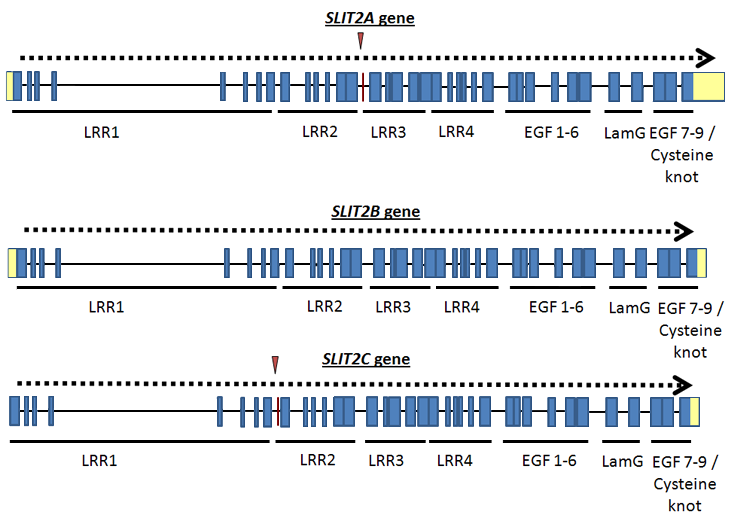
Map of the SLIT2 gene, direction from 5UTR till 3UTR. The direction of transcription is indicated by the arrow. Exons are depicted as blue boxes. Within the first and the last exon, the 5UTR and 3UTR are depicted in yellow. There are three differently spliced variants of SLIT2, named SLIT2A, SLIT2B and SLIT2C (Holmes et al., 1998; Itoh et al., 1998; Brose et al., 1999). Exons that are only present in one of the transcripts are depicted in red (see below for further explanation). The length of the exons and introns is roughly indicated, but is not up to scale. The size of the exons ranges from 12 base pairs up to 1790 base pairs, the size of the introns ranges from 110 base pairs up to 198870 base pairs. For clarity, the exons are depicted larger than the introns. Below is indicated which protein domains are encoded by particular exons. Based on ENSEMBL version 68 Juli 2012 transcripts ENST00000504154 (SLIT2A), ENST00000503823 (SLIT2B) and ENST00000503837 (SLIT2C). Information on protein domains encoded by particular exons was obtained from Little et al., 2002.
Description
SLIT2A and SLIT2C have 37 coding exons, while SLIT2B has 36 coding exons, spanning 365 kb of the genome. All SLIT genes contain CpG islands in their promoter regions and intron length and exon-intron boundaries are highly similar (Little et al., 2002; Dallol et al., 2005).
Transcription
The leucine rich repeat regions of the three human SLIT genes contain a large number of very small exons, mostly encoding for one individual leucine rich repeat. This allows alternative splicing of the exons, without altering the frame (Little et al., 2002). Three alternatively spliced variants were identified after screening of a human fetal brain cDNA library and nucleotide database searching (Little et al., 2002). These variants have been described by different groups (Holmes et al., 1998; Itoh et al., 1998; Brose et al., 1999). The transcript described by Itoh et al. (1998) was named SLIT2A, the transcript described by Holmes et al. (1998) was named SLIT2B and the transcript described by Brose et al. (1999) was named SLIT2C. SLIT2B and SLIT2C lack exon 15. This exon encodes for eight amino acids of unkown function (Holmes et al., 1998; Brose et al., 1999; Little et al., 2002). In addition, SLIT2C contains an additional exon. This exon is located in an intron between exon 8 and 9 and encodes for four amino acids (Little et al., 2002). Between transcripts, differences can also be found in the length of the 5UTR and the 3UTR. The relevance of the differently spliced variants is unclear.
Proteins
Note
The extracellular matrix protein SLIT was first identified in a genetic screen for mutations that affected the dorsal-ventral patterning or the development of the central nervous system in Drosophila (Anderson et al., 1984; Seeger et al., 1993). SLIT homologues have since been found in C. elegans and in vertebrates, including mammals (Holmes et al., 1998; Itoh et al., 1998; Brose et al., 1999; Holmes et al., 2001; Vargesson et al., 2001; Gilthorpe et al., 2002). The cognate receptor of the SLIT proteins is Roundabout or ROBO (Kidd et al., 1998; Huminiecki et al., 2002).
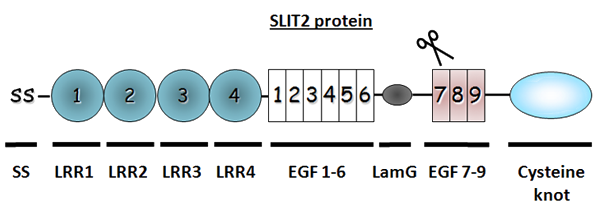
Domain organization of the SLIT protein from N-terminus to C-terminus. SS: N-terminal signal peptide; LRR: leucin-rich repeat; EGF-like: epidermal growth factor-like domain; Lam-G like: Agrin, Laminin, Perlecan and SLIT (ALPS) or laminin G-like module; Cystein knot: C-terminal cystein knot. The sciccors represent a proteolytic cleavage site. Adapted from a figure created by dr. S.B. Geutskens (Leiden University Medical Center; Department of Immunohematology and Blood Transfusion and Einthoven laboratory for Experimental Vascular Medicine; Leiden; The Netherlands)
Description
In mammals there are three SLIT genes which encode large ECM glycoproteins of about 200 kDa, comprising a stretch of four leucine rich repeats (LRR) connected by disulphide bonds, seven to nine epidermal growth factor (EGF)-like domains, a domain named Agrin, Laminin, Perlecan and SLIT (ALPS) or laminin G-like module, and a C-terminal cystein knot (Rothberg and Artavanis-Tsakonas, 1992; Hohenester et al., 1999; Nguyen-Ba-Charvet and Chedotal, 2002). SLIT proteins can be proteolytically cleaved within the EGF-like region, this has been shown to occur for SLIT2 and for SLIT3 (Brose et al., 1999; Patel et al., 2001; Condac et al., 2012). Differently spliced variants of the SLIT2 protein exist, three of which were reported in literature (Itoh et al., 1998; Holmes et al., 1998; Brose et al., 1999). SLIT2A is 1529 amino acids long (ENSEMBL protein ID ENSP00000422591), SLIT2B is 1521 amino acids long (ENSEMBL protein ID ENSP00000427548) and SLIT2C is 1525 amino acids long (ENSEMBL protein ID ENSP00000422261).
Expression
In humans, SLIT2 is expressed both during embryonic development and during adult life. It is expressed in the fetal kidney and lung (Itoh et al., 1998) as well as in the adult kidney (Wu et al., 2001), in the female reproductive tract (endometrium, fallopian tube and ovaries) (Dickinson et al., 2008; Duncan et al., 2010; Dickinson et al;, 2011), the adrenal gland, the brain and the spinal cord (Itoh et al., 1998) and in bone marrow stromal and endothelial cells (Geutskens et al., 2012). For two of the differently spliced variants of SLIT2, the expression pattern was examined in several fetal and adult tissues. SLIT2A is expressed in the adult human spinal cord and in low levels in the fetal lung and kidney (Itoh et al., 1998), expression of SLIT2B can also be detected outside the CNS in postnatal human tissues (Holmes et al., 1998). SLIT2C is expressed in the rat spinal cord during embryonic development (Brose et al., 1999). The functional relevance of the differently spliced variants is not clear.
Localisation
SLIT is a secreted extracellular matrix protein that is bound to the surface of the cell by the extracellular matrix, mainly by heparan sulfates (Liang et al., 1999; Ronca et al., 2001). It has been reported that both the N-terminal part of SLIT2 (Hussain et al., 2006) and the C-terminal part of SLIT2 and SLIT3 bind to heparin and heparan sulfates (Ronca et al., 2001; Condac et al., 2012). The interaction between SLIT proteins and heparan-sulfates is not only important for the binding of SLIT proteins to the extracellular matrix, but can also increase the affinity of SLIT for ROBO (Hu et al., 2001). Removal of heparan sulfates from the cell surface abolishes the response to SLIT2 (Hu et al., 2001; Hussain et al., 2006). Therefore, heparan-sulfates are considered as important co-receptors in SLIT-ROBO signalling (Inatani et al., 2003; Steigemann et al., 2004; Hussain et al., 2006). The SLIT2 and the SLIT3 protein can be proteolytically cleaved. Following proteolytic cleavage of SLIT2, the 140kDa N-terminal fragment remains tightly associated to the cell surface, while the 50-60kDa C-terminal fragment is more loosely attached and can also be detected in conditioned medium (Brose et al., 1999; Wang et al., 1999).
Function
The extracellular matrix protein SLIT binds to the transmembrane receptor Roundabout or ROBO and has a conserved role in axon guidance in the central nervous system (CNS), where SLIT functions as a repellent for ROBO-expressing axons (Brose et al., 1999; Kidd et al., 1999; Long et al., 2004). Outside the CNS, SLIT plays an important role during embryonic development and in human pathology.
Neuronal guidance: SLIT proteins function as chemorepellents throughout the central nervous system to restrict the positioning of axons to their proper sites. Deletion of SLIT2 resulted in defects in cortical inhibitory neurons, commisural neurons and sensory neurons (Nguyen-Ba-Charvet et al., 1999; Bagri et al., 2002; Nguyen-Ba-Charvet et al., 2002; Plump et al., 2002; Long et al., 2004; Unni et al., 2012). Cortical inhibitory neurons (interneurons) modulate the response of pyramidal cells to incoming signals, thereby preventing overexcitation and maintaining the balance between different signals. In rodents, they are generated in the ventral telencephalon whereafter they migrate into the cortex (reviewed by Rossignol, 2011). Slit1/2 double knockout mice display an increased interneuron proliferation and an increase in neuronal process length and branching (Andrews et al., 2008). Vertebrate commissural neurons first arise in the dorsal spinal cord. Their axons are directed to the midline/ floorplate by the chemoattractants netrin and sonic hedgehog. When these axons have reached the midline, they cross it and turn longitudinally on the opposite side, growing right alongside the midline/ floor plate (reviewed by Dickson and Gilestro, 2006). Bagri et al. (2002) reported a broad spectrum of neuronal defects in Slit2 knockout or Slit1/Slit2 double knockout mice. Without SLIT2, axons project erronuously in ventral and medial directions. Without SLIT1 and SLIT2, axons also travel to and cross the midline. These defects occured in corticofugal, thalamocortical, and callosal tracts (Bagri et al., 2002). The corpus callosum defects were further investigated by Unni et al. (2012). In Slit2 knockout mice, defects in corpus callosum formation occurred. Axons stalled at the midline or projected aberrantly. There was no phenotype in Slit1 knockout mice and only a mild phenotype in Slit3 knockout mice, but in Slit1/Slit2 double knockout mice the phenotype was more severe than in Slit2 knockout mice. In addition, in both Slit2 knockout and Slit1/2 double knockout mice, there was a mispositioning of glial cells (Unni et al., 2012). In Slit1/2/3 triple knockout mice, 72% of commisural axons failed to leave the midline and 20% recrossed the midline (Long et al., 2004). Olfactory sensory neurons located in the olfactory epithelium pick up different odors and translate these odors into sensory information for the brain. Axons from the sensory neurons project into the olfactory bulb (OB) into separate units that are specific for one odor, the glomeruli. Dendrites from mitral and tufted cells transmit the information from the different glomeruli to the olfactory cortex of the brain. The olfactory system is organized into distinct regions. Odorants activate a typical pattern of glomeruli in different regions of the OB. The distinct patterning of the OB and the type and place of the activated glomeruli determine the behavior elicited by an odorant (Reviewed by Mori and Sakano, 2011). In the developing mouse and rat olfactory system, Slit2 is the first repellent expressed in the septum, Slit1 follows. From E14 to E18, both are expressed in the midline of the telencephalon including the septum. At this stage, Robo2 is expressed by tufted and mitral cells in the OB. In vitro, SLIT1 and SLIT2 repelled OB axons (Nguyen-Ba-Charvet et al., 1999; Nguyen-Ba-Charvet et al., 2002). Moreover, in Slit1 and Slit2 double KO mice, axons were not repelled by the midline and the septum. Correspondingly, the lateral olfactory tract (LOT) was increased in size. No defects were found in Slit1 or Slit2 single KO mice (Nguyen-Ba-Charvet et al., 2002). Sensory neurons in the visual pathway were also affected by Slit factors. In Slit1/Slit2 knockout mice a second optic chiasm was formed with aberrantly projecting axons (Plump et al., 2002).
Kidney development: Development of the kidney is initiated by the Wolfferian duct, which forms the ureteric bud. The ureteric bud branches and further develops in the ureters and the kidney. An important growth factor during bud development is the TGF-β family member glial cell-line-derived neurotrophic factor (GDNF), which signals through a receptor kinase, RET and is restricted to the site of ureteric bud development. Defects in ureteric bud development can result in malformation of the kidney or ureters, renal agenesis or a reduced number of nephrons (Costantini and Shakya, 2006). In Slit2 mutant embryos, GDNF expression was not restricted to the site of bud development and an additional ureteric bud developed. This resulted in the development of two or more ureters or kidneys at the same site. The ureters failed to connect to the bladder and the collecting ducts and the ureter were dilated. Later during development, in some of the embryos the kidneys fused. Nephron formation was expanded from the periphery to the interior of the kidney. Consequently, the mice did not survive after birth (Grieshammer et al., 2004).
Migration: SLITs not only regulate migration and differentiation during embryogenesis, but also during adult life. SLIT2 has been shown to inhibit the chemotaxis of peripheral blood mononuclear cells, leukocytes, neutrophils, macrophages, lymphocytes and dendritic cells both in vitro and in vivo (Wu et al., 2001; Guan et al., 2003; Chen et al., 2004; Kanellis et al., 2004; Prasad et al., 2007; Tole et al., 2009; Ye et al., 2010), while it enhanced the chemotaxis of eosinophils in vivo (Ye et al., 2010). In some cell types, such as endothelial cells, the response to SLIT2 is more variable (Wang et al., 2003; Kaur et al., 2008). The differential response of cells to SLIT2 may be explained in part by cell-specific downstream signaling cues. Ye et al. have shown that the level of the SLIT-ROBO GTPase activating protein 1 is lower in eosinophils than in neutrophils. As a consequence, CDC42 and PI3K are activated in eosinophils, resulting in enhanced chemotaxis, whereas CDC42 is inactivated in neutrophils, leading to inhibition of chemotaxis (Ye et al., 2010).
Osteoblast differentiation: SLIT2 has also been implicated in the regulation of osteoblast differentiation. Sun et al. (2009) reported that osteogenic differentiation was inhibited by SLIT2 in vitro (Sun et al., 2009).
Neuronal guidance: SLIT proteins function as chemorepellents throughout the central nervous system to restrict the positioning of axons to their proper sites. Deletion of SLIT2 resulted in defects in cortical inhibitory neurons, commisural neurons and sensory neurons (Nguyen-Ba-Charvet et al., 1999; Bagri et al., 2002; Nguyen-Ba-Charvet et al., 2002; Plump et al., 2002; Long et al., 2004; Unni et al., 2012). Cortical inhibitory neurons (interneurons) modulate the response of pyramidal cells to incoming signals, thereby preventing overexcitation and maintaining the balance between different signals. In rodents, they are generated in the ventral telencephalon whereafter they migrate into the cortex (reviewed by Rossignol, 2011). Slit1/2 double knockout mice display an increased interneuron proliferation and an increase in neuronal process length and branching (Andrews et al., 2008). Vertebrate commissural neurons first arise in the dorsal spinal cord. Their axons are directed to the midline/ floorplate by the chemoattractants netrin and sonic hedgehog. When these axons have reached the midline, they cross it and turn longitudinally on the opposite side, growing right alongside the midline/ floor plate (reviewed by Dickson and Gilestro, 2006). Bagri et al. (2002) reported a broad spectrum of neuronal defects in Slit2 knockout or Slit1/Slit2 double knockout mice. Without SLIT2, axons project erronuously in ventral and medial directions. Without SLIT1 and SLIT2, axons also travel to and cross the midline. These defects occured in corticofugal, thalamocortical, and callosal tracts (Bagri et al., 2002). The corpus callosum defects were further investigated by Unni et al. (2012). In Slit2 knockout mice, defects in corpus callosum formation occurred. Axons stalled at the midline or projected aberrantly. There was no phenotype in Slit1 knockout mice and only a mild phenotype in Slit3 knockout mice, but in Slit1/Slit2 double knockout mice the phenotype was more severe than in Slit2 knockout mice. In addition, in both Slit2 knockout and Slit1/2 double knockout mice, there was a mispositioning of glial cells (Unni et al., 2012). In Slit1/2/3 triple knockout mice, 72% of commisural axons failed to leave the midline and 20% recrossed the midline (Long et al., 2004). Olfactory sensory neurons located in the olfactory epithelium pick up different odors and translate these odors into sensory information for the brain. Axons from the sensory neurons project into the olfactory bulb (OB) into separate units that are specific for one odor, the glomeruli. Dendrites from mitral and tufted cells transmit the information from the different glomeruli to the olfactory cortex of the brain. The olfactory system is organized into distinct regions. Odorants activate a typical pattern of glomeruli in different regions of the OB. The distinct patterning of the OB and the type and place of the activated glomeruli determine the behavior elicited by an odorant (Reviewed by Mori and Sakano, 2011). In the developing mouse and rat olfactory system, Slit2 is the first repellent expressed in the septum, Slit1 follows. From E14 to E18, both are expressed in the midline of the telencephalon including the septum. At this stage, Robo2 is expressed by tufted and mitral cells in the OB. In vitro, SLIT1 and SLIT2 repelled OB axons (Nguyen-Ba-Charvet et al., 1999; Nguyen-Ba-Charvet et al., 2002). Moreover, in Slit1 and Slit2 double KO mice, axons were not repelled by the midline and the septum. Correspondingly, the lateral olfactory tract (LOT) was increased in size. No defects were found in Slit1 or Slit2 single KO mice (Nguyen-Ba-Charvet et al., 2002). Sensory neurons in the visual pathway were also affected by Slit factors. In Slit1/Slit2 knockout mice a second optic chiasm was formed with aberrantly projecting axons (Plump et al., 2002).
Kidney development: Development of the kidney is initiated by the Wolfferian duct, which forms the ureteric bud. The ureteric bud branches and further develops in the ureters and the kidney. An important growth factor during bud development is the TGF-β family member glial cell-line-derived neurotrophic factor (GDNF), which signals through a receptor kinase, RET and is restricted to the site of ureteric bud development. Defects in ureteric bud development can result in malformation of the kidney or ureters, renal agenesis or a reduced number of nephrons (Costantini and Shakya, 2006). In Slit2 mutant embryos, GDNF expression was not restricted to the site of bud development and an additional ureteric bud developed. This resulted in the development of two or more ureters or kidneys at the same site. The ureters failed to connect to the bladder and the collecting ducts and the ureter were dilated. Later during development, in some of the embryos the kidneys fused. Nephron formation was expanded from the periphery to the interior of the kidney. Consequently, the mice did not survive after birth (Grieshammer et al., 2004).
Migration: SLITs not only regulate migration and differentiation during embryogenesis, but also during adult life. SLIT2 has been shown to inhibit the chemotaxis of peripheral blood mononuclear cells, leukocytes, neutrophils, macrophages, lymphocytes and dendritic cells both in vitro and in vivo (Wu et al., 2001; Guan et al., 2003; Chen et al., 2004; Kanellis et al., 2004; Prasad et al., 2007; Tole et al., 2009; Ye et al., 2010), while it enhanced the chemotaxis of eosinophils in vivo (Ye et al., 2010). In some cell types, such as endothelial cells, the response to SLIT2 is more variable (Wang et al., 2003; Kaur et al., 2008). The differential response of cells to SLIT2 may be explained in part by cell-specific downstream signaling cues. Ye et al. have shown that the level of the SLIT-ROBO GTPase activating protein 1 is lower in eosinophils than in neutrophils. As a consequence, CDC42 and PI3K are activated in eosinophils, resulting in enhanced chemotaxis, whereas CDC42 is inactivated in neutrophils, leading to inhibition of chemotaxis (Ye et al., 2010).
Osteoblast differentiation: SLIT2 has also been implicated in the regulation of osteoblast differentiation. Sun et al. (2009) reported that osteogenic differentiation was inhibited by SLIT2 in vitro (Sun et al., 2009).
Homology
A single slit gene was isolated in invertebrates, whereas there are three SLIT genes in mammals. The human SLIT2 protein shows 44,3 sequence homology to Drosophila Slit (Itoh et al., 1998; Brose et al., 1999), 65% homology to the human SLIT1 protein (NCBI accession BAA35184.1, NCBI protein blast) and 67% homology to the human SLIT3 protein (NCBI accession AAQ89243.1, NCBI protein blast).
Implicated in
Entity name
Medulloblastoma
Note
86% of medulloblastoma tumors express SLIT2, which is not silenced by methylation of the CpG islands. Interestingly, administration of recombinant SLIT2 protein to medulloblastoma spheroids could inhibit tumor cell invasion without affecting cell direction or proliferation. Treatment with SLIT2 conditioned media resulted in reduced CDC42 activation and moderately reduced Rac1 activation. There was no effect on RhoA activity (Werbowetski-Ogilvie et al., 2006).
Entity name
Glioma
Note
Dallol et al. (2003) detected methylation of the CpG islands in the SLIT2 promoter in 59% of gliomas and in 71% of the tested glioma cell lines. 66,7% of the gliomas were classified as glioblastoma multiforme, the most malignant stage, the rest was randomly collected. Promoter methylation correlated with reduced SLIT2 expression. Exogenous expression of SLIT2 in a methylated glioma cell line suppressed tumor growth in a colony formation assay (Dallol et al., 2003). In another study, administration of SLIT2 to glioma spheroids of a non-methylated cell line did not affect tumor invasion (Werbowetski-Ogilvie et al., 2006).
Entity name
Colorectal carcinoma
Note
In 72% of colorectal carcinomas, methylation of the SLIT2 promoter was found, which correlated with abolished expression of SLIT2. Exogenous expression of SLIT2 in two methylated colorectal tumor cell lines suppressed tumor growth in a colony formation assay. In addition, administration of SLIT2 conditioned medium suppressed tumor growth and induced apoptosis in a methylated colorectal tumor cell line (Dallol et al., 2003). In contrast, Wang et al. (2003) reported that SLIT2 expression was not detected in normal and hyperplastic colon tissues, was moderately detected in colon adenomas (21,4%) and was upregulated in 64,6% of colon carcinomas. SLIT2 expression appeared to be enhanced in areas of high tumor cell and vessel density. Blood vessel growth and tumor volume increased in athymic nude mice injected with melanoma cells that overexpress SLIT2, but it was not investigated whether this occurs in colon cancer cells (Wang et al., 2003).
Entity name
Lung cancer
Note
Methylation of the SLIT2 promoter was found in 53% of primary non-small cell lung cancer (NSCLC) tumors, in 77% of NSCLC cell lines, in 36% of primary small cell lung cancer (SCLC) tumors and in 55% of SCLC cell lines (Dallol et al., 2002; Tseng et al., 2010), which correlated with reduced SLIT2 expression (Tseng et al., 2010). Furthermore, low SLIT2 expression correlated with a poor prognosis and lower disease-free survival rates in NSCLC patients. For patients with metastasis, the poor survival rate correlated not only with low SLIT2 expression but also with accumulation of β-catenin (Tseng et al., 2010). When SLIT2 was re-expressed after treatment with demethylating agents, the migration of lung cancer cells decreased, while β-catenin-E-cadherin association was enhanced. Moreover, migration was also inhibited when the cells were treated with SLIT2 conditioned media or after exogenous expression of SLIT2 in the cells. Besides reduced migration, these cells had increased E-cadherin and decreased SNAI1 levels. On the contrary, after knock down of SLIT2, migration was increased while cell adhesion was reduced. Reduced cell adhesion was attributed to deregulation of β-catenin and E-cadherin/ SNAI1 (Tseng et al., 2010).
Entity name
Breast cancer
Note
Methylation of the SLIT2 promoter was discovered in 43% of breast cancer primary tumors and in 59% of breast cancer cell lines, which correlated with reduced SLIT2 expression in these tumors. In breast tumor cell lines, both overexpression of SLIT2 and treatment with SLIT2 conditioned media suppressed tumor cell growth in an in vitro colony assay (Dallol et al., 2002). Overexpression of SLIT2 also reduced proliferation and migration in vitro (Prasad et al., 2008). There was no effect on breast cancer cell lines with a normal expression level of SLIT2 (Dallol et al., 2002). In mice injected with SLIT2 overexpressing MCF-7 breast cancer cells, tumor size was reduced (Prasad et al., 2008). The tumor-suppressive effect of SLIT2 may be mediated via 2 different mechanisms, namely through the modulation of β-catenin signaling and through the modulation of CXCL12/ CXCR4-signaling. Overexpression of SLIT2 resulted in increased cell-cell adhesion due to enhanced β-catenin-E-cadherin association. This was combined with decreased expression of β-catenin and target genes of β-catenin, decreased nuclear translocation of β-catenin and increased expression of E-cadherin (Prasad et al., 2008). Several studies found a correlation between CXCR4 and SLIT expression in breast cancer cells. Loss of SLIT2 and SLIT3 expression correlated with the upregulation of CXCR4 and resulted in hyperplastic lesions and in desmoplastic stroma in mouse mammary gland and in human MCF7 breast cancer cells. Overexpression of SLIT2 or SLIT3 in human breast carcinoma MDA-MB-231 cells resulted in a down-regulation of CXCR4 expression, reduced colony formation in vitro and in inhibition of tumor growth in a xenograft model in vivo. Furthermore, SLIT2 addition inhibited CXCL12/ CXCR4-induced breast cancer cell chemotaxis, chemo-invasion and adhesion. SLIT2 affects CXCR4 signaling via the inhibition of CXCL12-induced phosporylation of focal adhesion components and the inhibition of PI3K, MAPK and metallo-protease activity (Prasad et al., 2004, Marlow et al., 2008).
Entity name
Melanoma
Note
SLIT2 was expressed in 42,9% of melanomas, while SLIT2 was not expressed in nearby normal tissue. Blood vessel growth and tumor volume increased in athymic nude mice injected with melanoma cells that overexpress SLIT2, while both were decreased when SLIT-ROBO signaling was inhibited by ectopic expression of ROBON, an extracellular fragment which contains the SLIT-binding domain of ROBO1 and functions as scavenger for SLIT proteins, or the use of R5, an antibody directed against the SLIT-binding domain of ROBO1 (Wang et al., 2003).
Entity name
Lymphatic metastasis of pancreatic islet tumors
Note
Administration of SLIT2 to human lymphatic endothelial cells (hLEC) resulted in enhanced tubular formation and in increased migration, while there was no effect on the proliferation of the cells. Overexpression of Slit2 resulted in an increase of lymphatic vessel length in the pancreas. When Slit2 transgenic mice were crossed with the non-metastatic pancreatic islet tumor mouse line RIP1-Tag2, tumor lymphangiogenesis was increased and metastases in the regional mesentheric lymph nodes and in the intestines were found. Although some metastases were found in control mice, metastasis formation was higher in mice that overexpress Slit2 and overall survival was decreased (Yang et al., 2010).
Article Bibliography
| Pubmed ID | Last Year | Title | Authors |
|---|---|---|---|
| 6434989 | 1984 | Information for the dorsal--ventral pattern of the Drosophila embryo is stored as maternal mRNA. | Anderson KV et al |
| 18054781 | 2008 | The role of Slit-Robo signaling in the generation, migration and morphological differentiation of cortical interneurons. | Andrews W et al |
| 14735202 | 2004 | SLIT2 promoter methylation analysis in neuroblastoma, Wilms' tumour and renal cell carcinoma. | Astuti D et al |
| 11804571 | 2002 | Slit proteins prevent midline crossing and determine the dorsoventral position of major axonal pathways in the mammalian forebrain. | Bagri A et al |
| 10102268 | 1999 | Slit proteins bind Robo receptors and have an evolutionarily conserved role in repulsive axon guidance. | Brose K et al |
| 15528323 | 2004 | Cutting edge: bone morphogenetic protein antagonists Drm/Gremlin and Dan interact with Slits and act as negative regulators of monocyte chemotaxis. | Chen B et al |
| 22641771 | 2012 | The C-terminal fragment of axon guidance molecule Slit3 binds heparin and neutralizes heparin's anticoagulant activity. | Condac E et al |
| 16435290 | 2006 | GDNF/Ret signaling and the development of the kidney. | Costantini F et al |
| 12384551 | 2002 | SLIT2, a human homologue of the Drosophila Slit2 gene, has tumor suppressor activity and is frequently inactivated in lung and breast cancers. | Dallol A et al |
| 12881718 | 2003 | Frequent epigenetic inactivation of the SLIT2 gene in gliomas. | Dallol A et al |
| 12615722 | 2003 | SLIT2 axon guidance molecule is frequently inactivated in colorectal cancer and suppresses growth of colorectal carcinoma cells. | Dallol A et al |
| 22132142 | 2011 | Glucocorticoid regulation of SLIT/ROBO tumour suppressor genes in the ovarian surface epithelium and ovarian cancer cells. | Dickinson RE et al |
| 17029581 | 2006 | Regulation of commissural axon pathfinding by slit and its Robo receptors. | Dickson BJ et al |
| 20651036 | 2010 | Expression of the repulsive SLIT/ROBO pathway in the human endometrium and Fallopian tube. | Duncan WC et al |
| 19550140 | 2009 | Frequent epigenetic inactivation of the SLIT2 gene in chronic and acute lymphocytic leukemia. | Dunwell TL et al |
| 22614124 | 2012 | Control of human hematopoietic stem/progenitor cell migration by the extracellular matrix protein Slit3. | Geutskens SB et al |
| 12361964 | 2002 | The migration of cerebellar rhombic lip derivatives. | Gilthorpe JD et al |
| 15130495 | 2004 | SLIT2-mediated ROBO2 signaling restricts kidney induction to a single site. | Grieshammer U et al |
| 14662852 | 2003 | Neuronal repellent Slit2 inhibits dendritic cell migration and the development of immune responses. | Guan H et al |
| 10619025 | 1999 | The crystal structure of a laminin G-like module reveals the molecular basis of alpha-dystroglycan binding to laminins, perlecan, and agrin. | Hohenester E et al |
| 11668607 | 2001 | Expression of slit-2 and slit-3 during chick development. | Holmes G et al |
| 10349621 | 1998 | Distinct but overlapping expression patterns of two vertebrate slit homologs implies functional roles in CNS development and organogenesis. | Holmes GP et al |
| 11426225 | 2001 | Cell-surface heparan sulfate is involved in the repulsive guidance activities of Slit2 protein. | Hu H et al |
| 17062560 | 2006 | A molecular mechanism for the heparan sulfate dependence of slit-robo signaling. | Hussain SA et al |
| 14605369 | 2003 | Mammalian brain morphogenesis and midline axon guidance require heparan sulfate. | Inatani M et al |
| 9813312 | 1998 | Cloning and expressions of three mammalian homologues of Drosophila slit suggest possible roles for Slit in the formation and maintenance of the nervous system. | Itoh A et al |
| 15215188 | 2004 | Modulation of inflammation by slit protein in vivo in experimental crescentic glomerulonephritis. | Kanellis J et al |
| 18980679 | 2008 | Silencing of directional migration in roundabout4 knockdown endothelial cells. | Kaur S et al |
| 10102267 | 1999 | Slit is the midline repellent for the robo receptor in Drosophila. | Kidd T et al |
| 10364234 | 1999 | Mammalian homologues of the Drosophila slit protein are ligands of the heparan sulfate proteoglycan glypican-1 in brain. | Liang Y et al |
| 12141424 | 2002 | Conserved modularity and potential for alternate splicing in mouse and human Slit genes. | Little M et al |
| 14550534 | 2003 | Congenital diaphragmatic hernia, kidney agenesis and cardiac defects associated with Slit3-deficiency in mice. | Liu J et al |
| 15091338 | 2004 | Conserved roles for Slit and Robo proteins in midline commissural axon guidance. | Long H et al |
| 18829537 | 2008 | SLITs suppress tumor growth in vivo by silencing Sdf1/Cxcr4 within breast epithelium. | Marlow R et al |
| 21469960 | 2011 | How is the olfactory map formed and interpreted in the mammalian brain? | Mori K et al |
| 10197527 | 1999 | Slit2-Mediated chemorepulsion and collapse of developing forebrain axons. | Nguyen Ba-Charvet KT et al |
| 12097499 | 2002 | Slit1 and slit2 proteins control the development of the lateral olfactory tract. | Nguyen-Ba-Charvet KT et al |
| 11748139 | 2001 | Slit proteins are not dominant chemorepellents for olfactory tract and spinal motor axons. | Patel K et al |
| 11804570 | 2002 | Slit1 and Slit2 cooperate to prevent premature midline crossing of retinal axons in the mouse visual system. | Plump AS et al |
| 14645233 | 2004 | Slit protein-mediated inhibition of CXCR4-induced chemotactic and chemoinvasive signaling pathways in breast cancer cells. | Prasad A et al |
| 18611862 | 2008 | Slit-2 induces a tumor-suppressive effect by regulating beta-catenin in breast cancer cells. | Prasad A et al |
| 17565045 | 2007 | Slit-2/Robo-1 modulates the CXCL12/CXCR4-induced chemotaxis of T cells. | Prasad A et al |
| 11375980 | 2001 | Characterization of Slit protein interactions with glypican-1. | Ronca F et al |
| 21876820 | 2011 | Genetics and function of neocortical GABAergic interneurons in neurodevelopmental disorders. | Rossignol E et al |
| 1404356 | 1992 | Modularity of the slit protein. Characterization of a conserved carboxy-terminal sequence in secreted proteins and a motif implicated in extracellular protein interactions. | Rothberg JM et al |
| 8461134 | 1993 | Mutations affecting growth cone guidance in Drosophila: genes necessary for guidance toward or away from the midline. | Seeger M et al |
| 14761655 | 2004 | Heparan sulfate proteoglycan syndecan promotes axonal and myotube guidance by slit/robo signaling. | Steigemann P et al |
| 19759280 | 2009 | The axonal repellent, Slit2, inhibits directional migration of circulating neutrophils. | Tole S et al |
| 22214468 | 2012 | Congenital diaphragmatic hernia. | Tovar JA et al |
| 20068157 | 2010 | SLIT2 attenuation during lung cancer progression deregulates beta-catenin and E-cadherin and associates with poor prognosis. | Tseng RC et al |
| 22349628 | 2012 | Multiple Slits regulate the development of midline glial populations and the corpus callosum. | Unni DK et al |
| 11472852 | 2001 | Expression patterns of Slit and Robo family members during vertebrate limb development. | Vargesson N et al |
| 12892710 | 2003 | Induction of tumor angiogenesis by Slit-Robo signaling and inhibition of cancer growth by blocking Robo activity. | Wang B et al |
| 10102266 | 1999 | Biochemical purification of a mammalian slit protein as a positive regulator of sensory axon elongation and branching. | Wang KH et al |
| 16636676 | 2006 | Inhibition of medulloblastoma cell invasion by Slit. | Werbowetski-Ogilvie TE et al |
| 11309622 | 2001 | The neuronal repellent Slit inhibits leukocyte chemotaxis induced by chemotactic factors. | Wu JY et al |
| 20438712 | 2010 | Slit-Robo signaling mediates lymphangiogenesis and promotes tumor lymphatic metastasis. | Yang XM et al |
| 20944010 | 2010 | Slit2 regulates attractive eosinophil and repulsive neutrophil chemotaxis through differential srGAP1 expression during lung inflammation. | Ye BQ et al |
| 12702769 | 2003 | A genetic model for a central (septum transversum) congenital diaphragmatic hernia in mice lacking Slit3. | Yuan W et al |
Other Information
Locus ID:
NCBI: 9353
MIM: 603746
HGNC: 11086
Ensembl: ENSG00000145147
Variants:
dbSNP: 9353
ClinVar: 9353
TCGA: ENSG00000145147
COSMIC: SLIT2
RNA/Proteins
Expression (GTEx)
Pathways
Protein levels (Protein atlas)
References
| Pubmed ID | Year | Title | Citations |
|---|---|---|---|
| 38122948 | 2024 | Recombinant Slit2 attenuates tracheal fibroblast activation in benign central airway obstruction by inhibiting the TGF-β1/Smad3 signaling pathway. | 0 |
| 38714291 | 2024 | circVAPA-rich small extracellular vesicles derived from gastric cancer promote neural invasion by inhibiting SLIT2 expression in neuronal cells. | 1 |
| 38122948 | 2024 | Recombinant Slit2 attenuates tracheal fibroblast activation in benign central airway obstruction by inhibiting the TGF-β1/Smad3 signaling pathway. | 0 |
| 38714291 | 2024 | circVAPA-rich small extracellular vesicles derived from gastric cancer promote neural invasion by inhibiting SLIT2 expression in neuronal cells. | 1 |
| 36894950 | 2023 | Bone marrow mesenchymal stem cell-derived exosomal microRNA-382 promotes osteogenesis in osteoblast via regulation of SLIT2. | 0 |
| 37773612 | 2023 | The chemorepellent, SLIT2, bolsters innate immunity against Staphylococcus aureus. | 0 |
| 36894950 | 2023 | Bone marrow mesenchymal stem cell-derived exosomal microRNA-382 promotes osteogenesis in osteoblast via regulation of SLIT2. | 0 |
| 37773612 | 2023 | The chemorepellent, SLIT2, bolsters innate immunity against Staphylococcus aureus. | 0 |
| 34490644 | 2022 | Ductular reaction promotes intrahepatic angiogenesis through Slit2-Roundabout 1 signaling. | 14 |
| 34543483 | 2022 | Genomic evolution and the impact of SLIT2 mutation in relapsed intrahepatic cholangiocarcinoma. | 6 |
| 35426130 | 2022 | Slit guidance ligand 2 promotes the inflammatory response of periodontitis through activation of the NF-κB signaling pathway. | 0 |
| 35813663 | 2022 | The Role of Slit-2 in Gestational Diabetes Mellitus and Its Effect on Pregnancy Outcome. | 3 |
| 36250924 | 2022 | RNA m6A reader IGF2BP3 promotes metastasis of triple-negative breast cancer via SLIT2 repression. | 6 |
| 36411451 | 2022 | SLIT2 promoter hypermethylation predicts disease progression in chronic myeloid leukemia. | 3 |
| 34490644 | 2022 | Ductular reaction promotes intrahepatic angiogenesis through Slit2-Roundabout 1 signaling. | 14 |
Citation
Kim Brussen
SLIT2 (slit homolog 2 (Drosophila))
Atlas Genet Cytogenet Oncol Haematol. 2012-10-01
Online version: http://atlasgeneticsoncology.org/gene/42328/slit2
