TGFBR3 (transforming growth factor, beta receptor III)
2012-05-01 Catherine E Gatza , David Rawson , Gerard C Blobe AffiliationDepartment of Medicine, Department of Pharmacology, Cancer Biology, Duke University Medical Center, 354 LSRC, B wing, Research Drive, Box 91004, Durham NC 27708, USA
Identity
HGNC
LOCATION
1p22.1
LOCUSID
ALIAS
BGCAN,betaglycan
FUSION GENES
DNA/RNA
Description
The TGFbetaR3 gene encodes 16 exons.
Transcription
The human TGFBR3 gene has two promoters, a proximal promoter and a distal promoter and produces a 4,2 kb mRNA. TGF-beta1 has been demonstrated to down regulate TbetaRIII expression through direct inhibition of the proximal TbetaRIII promoter.
Proteins
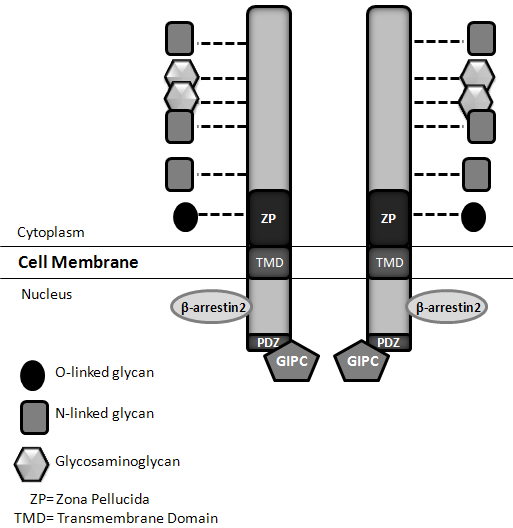
Structure of TbetaRIII. TbetaRIII consists of a large extracellular domain, which has multiple sites of glycan modification, including N- and O-glycans, and glycosaminoglycan side chains, a hydrophobic transmembrane domain, and a short cytoplasmic domain. TbetaRIII interacts with the scaffolding proteins beta-arrestin2, via phosphorylation of amino acid site Thr841 in the cytoplasmic domain, and with GIPC via the PDZ domain.
Description
TbetaRIII is an 853 amino acid transmembrane proteoglycan, which contains a short 41 amino acid cytoplasmic domain. TbetaRIII is a proteoglycan, with glycosaminoglycan (GAG) side chain modifications (S535 and S546) composed of heparin and chondroitin sulfate. The TbetaRIII core has predicted molecular weight of 100 kDa, however fully processed TbetaRIII migrates at an apparent molecular weight of 180 to 300 kDa due to these glycosaminoglycan post-translational modifications. TbetaRIII contains a class I PDZ binding motif and a beta-arrestin2 interacting motif in the cytoplasmic domain, as well as a ZP-1 (zona pellucida) domain in the extracellular domain. The cytoplasmic domain of TbetaRIII is phosphorylated by TbetaRII. TbetaRIII also undergoes ectodomain shedding to produce soluble TbetaRIII (sTbetaRIII).
Expression
TbetaRIII is ubiquitously expressed on nearly all cell types. Some cell types, including endothelial and hematopoietic cells, appear to have low to no TbetaRIII expression. The level of TbetaRIII expression is cell type specific.
Localisation
TbetaRIII exists as a transmembrane protein in the cell membrane and as a secreted protein, known as soluble TbetaRIII (sTbetaRIII), which can be detected in the extracellular matrix and serum.
Function
TbetaRIII is a member of the TGF-beta superfamily signaling pathways, which have essential roles in mediating cell proliferation, apoptosis, differentiation, and migration in most human tissues. TbetaRIII is the most abundantly expressed TGF-beta superfamily receptor and functions as a TGF-beta superfamily co-receptor, by binding the TGF-beta superfamily members, TGF-beta1, TGF-beta2, or TGF-beta3, inhibin, BMP-2, BMP-4, BMP-7, and GDF-5 and presents these ligand to their respective signaling receptors to activate or repress (in the case of inhibin) TGF-beta1, BMP, or activin signaling to the Smad transcription factors. For example, in the case of TGF-beta1, 2, or 3, TbetaRIII presents ligand to the TGF-beta type II receptor (TbetaRII). Once bound to ligand, TbetaRII then recruits and transphosphorylates the TGF-beta type I receptor (TbetaRI), activating its kinase function and leading to the phosphorylation of Smad2/3. Phosphorylation of Smad2 and Smad3 leads to formation of a complex with Smad4, and accumulation of this complex in the nucleus, where along with co-activators and co-repressors they regulate the transcription of genes involved in proliferation, angiogenesis, apoptosis, and differentiation. In addition to regulating receptor mediated Smad signaling, TbetaRIII also mediates ligand dependent and independent p38 pathway signaling. TbetaRIII can also undergo ectodomain shedding to generate soluble TbetaRIII (sTbetaRIII), which binds and sequesters TGF-beta superfamily members to inhibit their signaling. Although sTbetaRIII expression has been demonstrated to correlate with the cell surface expression of TbetaRIII, little is known about the regulation of sTbetaRIII production. TbetaRIII shedding may be mediated in part by the membrane type matrix metalloproteases (MT-MMP) MT1-MMP and/or MT3-MMP, and plasmin, a serine proteinase which has been shown to cleave the extracellular domain of TbetaRIII. In addition, TbetaRIII shedding is modulated by pervanadate, a tyrosine phosphatase inhibitor. Supporting this, TAPI-2, a MT-MMP and ADAM protease inhibitor, has been shown to inhibit TbetaRIII shedding. The regulation of TbetaRIII expression is sufficient to alter TGF-beta signaling. The cytoplasmic domain of TbetaRIII interacts with GIPC, a PDZ-domain containing protein, which stabilizes TbetaRIII cell surface expression and increases TGF-beta signaling. The interaction between TbetaRIII and GIPC also plays an important role in TbetaRIII mediated inhibition of TGF-beta signaling, cell migration, and invasion during breast cancer progression. The cytoplasmic domain of TbetaRIII is phosphorylated by TbetaRII, which results in TbetaRIII binding to the scaffolding protein beta-arrestin2. The TbetaRIII/beta-arrestin2 interaction results in the co-internalization of beta-arrestin2/TbetaRIII/ TbetaRII and the down-regulation of TGF-beta signaling. The interaction between TbetaRIII and beta-arrestin2 regulates BMP signaling as well as TGF-beta signaling. TbetaRIII complexes with ALK6, a BMP type I receptor, in a beta-arrestin2 dependent manner to mediate the internalization of ALK6 and stimulation of ALK6 specific BMP signaling events. Through its interaction with beta-arrestin2, TbetaRIII negatively regulates NFκ-B signaling in the context of breast cancer, regulates epithelial cellular adhesion to fibronectin, fibrillogenesis, and focal adhesion formation via regulation of alpha5beta1 internalization and trafficking to nascent focal adhesions, activates Cdc42, to alter the actin cytoskeleton and suppresses migration in normal and cancerous ovarian epithelial cells. During development, TbetaRIII has an important role in the formation of the atrioventricular cushion in the heart. Consistent with an important role for TbetaRIII during development, TGFbetaR3 null mice are embryonic lethal due to heart and liver defects. TGFbetaR3 has been recently identified as a tumor suppressor in multiple types of human cancers, including breast, lung, ovarian, pancreatic and prostate cancer. The loss of TGFbetaR3 in these cancer types correlates with disease progression, and results in increased motility and invasion in vitro and increased invasion and metastasis in vivo.
Homology
TbetaRIII shares several regions of homology with the superfamily co-receptor, endoglin, with 2 regions of homology in the extracellular domain, a large domain near the amino terminus with 21% homology, and a shorter domain near the sites of GAG modification with 50% homology. In addition, their cytoplasmic domains share 70% homology.
Mutations
Somatic
There is a high rate of rearrangements at the TGFBR3 locus in myxoinflammatory fibroblastic sarcomas (MIFS) and hemosiderotic fibrolipomatous tumors (HFLT). Mutations in TbetaRIII have not been found in other human cancers.
Implicated in
Entity name
Breast cancer
Disease
Breast cancer is the second leading cause of cancer death in women, exceeded only by lung cancer in the United States. Types of breast cancer include ductal carcinoma in situ (DCIS), lobular carcinoma in situ (LCIS), and invasive or infiltrating ductal carcinoma (IDC).
Prognosis
The current five year survival rate for breast cancer is 98% for localized cancer, 80% for regional cancer, and 27% for metastatic disease with distant spread.
Oncogenesis
TbetaRIII loss occurs relatively early in mammary carcinogenesis, with loss beginning in the pre-invasive state of DCIS. The degree of TbetaRIII loss correlates with breast cancer progression and with a decrease in patient survival. TbetaRIII loss in breast cancer is due to LOH (loss of heterozygosity) at the TGFbetaR3 gene locus and potential transcriptional down regulation of TbetaRIII by increased levels of TGF-beta in the tumor microenvironment. Restoring TbetaRIII expression inhibits tumor invasion, angiogenesis, and metastasis in vivo. TbetaRIII functions, in part, through the production of sTbetaRIII by ectodomain shedding, which antagonizes TGF-beta signaling, leading to a decrease in invasiveness and angiogenesis in vivo. In addition, the TbetaRIII cytoplasmic domain, specifically the interaction with GIPC, is required for TbetaRIII mediated inhibition of breast cancer progression. TbetaRIII also functions as a tumor suppressor in non-tumorigenic mammary epithelial cells through the inhibition of NFkappa-B mediation repression of E-cadherin. Loss of TbetaRIII in non-tumorigenic mammary epithelial cells leads to increased invasive capabilities due to up-regulated NFkappa-B activity and loss of E-cadherin expression.
Entity name
Colorectal cancer
Disease
Colon cancer is the third most commonly diagnosed cancer in in men and women in the United States and is the third leading cause of death in men and women.
Prognosis
The five year survival rate for colon cancer by stage is: stage 1: 93%, stage II: 78%, stage III: 64%, and stage IV: 8%.
Oncogenesis
Evidence suggests that TbetaRIII may promote colon cancer progression. In contrast to other cancer types, TbetaRIII expression is unaltered at the mRNA level and increases at the protein level in human colon cancer. Increasing TbetaRIII expression in colon cancer cells enhances ligand mediated phosphorylation of p38 and the Smad proteins and increase cell proliferation in response to ligand stimulation, inhibiting ligand mediated induction of p21 and p27. In addition, increasing TbetaRIII expression enhances cell migration, anchorage-independent growth, resistance to ligand and chemotherapeutic induced apoptosis and modestly enhances tumorigenicity in a xenograft model of colon cancer. Reciprocally, silencing endogenous TbetaRIII inhibited ligand induced migration. These data support a role for TbetaRIII as a mediator of colon cancer progression.
Entity name
Hepatocellular carcinoma
Disease
Hepatocellular carcinoma (HCC) is the most common type of primary liver cancer, the 5th most common cancer worldwide and the 3rd leading cause of cancer deaths worldwide. The vast majority of cases arise in the setting of pre-existing liver disease, which can result from viral hepatitis, alcohol use, or toxin exposure.
Prognosis
5-year survival rates are quite poor (
Oncogenesis
TbetaRIII may function as a tumor suppressor in HCC. TGFBR3 expression is decreased in the progression from normal tissue to precancerous lesion to invasive carcinoma, based on DNA microarray data and qRT-PCR analysis. This decreased expression does not appear to be a result of mutations in the TGFBR3 gene, and HCC samples also showed a low rate of loss of heterozygosity for TGFBR3, indicating that other mechanisms are likely responsible for its down-regulation.
Entity name
Disease
Multiple myeloma (MM) is the second most common hematologic malignancy. Most frequently arising in older individuals, it accounts for 10-15% of hematologic malignancies and 1-2% of all human cancers.
Prognosis
MM is generally regarded as incurable, with a poor 5-year survival rate of 31%.
Oncogenesis
TbetaRIII likely acts as a tumor suppressor in multiple myeloma. TbetaRIII mRNA expression is down-regulated during MM progression, decreasing from normal bone marrow to MGUS to MM, and TbetaRIII also has decreased expression at the protein level in human MM specimens compared to normal bone marrow controls. Restoration of TbetaRIII expression in vitro decreases cell growth and proliferation rates in myeloma cells and is associated with significantly increased levels of the cyclin-dependent kinase inhibitors p21 and p27. Expression of TbetaRIII also decreases adhesion to bone marrow stromal cells and increases homotypic adhesion among myeloma cells. Lastly, restoration of TbetaRIII expression in myeloma cells significantly inhibits cell motility in a ligand-independent manner.
Entity name
Myxoinflammatory fibroblastic sarcoma (MIFS) and hemosiderotic fibrolipomatous tumor (HFLT)
Disease
Myxoinflammatory fibroblastic sarcoma (MIFS) and hemosiderotic fibrolipomatous tumor (HFLT) are rare types of low-grade sarcoma that typically present as painless, slow-growing masses in the soft tissue of distal extremities.
Prognosis
Prognosis is very good for both tumor types. MIFS has a local recurrence rate of 22-67%, but distant metastasis is very rare, observed in less than 2% of all reported cases. A case series of HFLT showed a local recurrence rate of 33%, but no occurrences of metastasis.
Oncogenesis
MIFS and HFLT share a high incidence of t(1;10)(p22;q24) translocations, with the breakpoint at 1p22 mapped to the TGFBR3 locus. Cytogenetic analysis has shown a high rate of rearrangements at the TGFBR3 locus in both tumor types, possibly indicating a shared mechanism of pathogenesis that involves TbetaRIII for these two rare sarcomas.
Entity name
Oral squamous cell carcinoma (OSCC)
Disease
Oral squamous cell carcinoma (OSCC) is the most common type of malignant oral lesion (>90%). It is thought to arise in a stepwise process, from normal epithelium to premalignant lesions such oral leukoplakia, to carcinoma in situ, and finally to invasive carcinoma.
Prognosis
Five-year survival for OSCC is roughly 50%, with females having a significantly higher survival rate than males.
Oncogenesis
TbetaRIII expression is significantly down-regulated at the protein level in OSCC compared to normal epithelium - roughly 50% of cancer specimens show low or absent TbetaRIII expression. Decreased expression correlates with disease progression, and TbetaRIII loss appears to be an early event in carcinogenesis. TbetaRIII is also significantly decreased in cancer-associated fibroblasts compared to normal fibroblasts.
Entity name
Non-small cell lung cancer (NSCLC)
Disease
Lung cancer is the leading cause of death of both males and females in the United States. Non-small cell lung cancer accounts for 87% of all lung cancers.
Prognosis
The five year survival rate for all stages of lung cancer is 15%. The survival rate is 49% for localized disease; however few cases are identified at this stage.
Oncogenesis
TbetaRIII has been characterized as a tumor suppressor in non-small cell lung cancer. Expression of TbetaRIII is lost in the majority of non-small cell lung cancer (NSCLC) at both the mRNA expression level and the protein level. Loss of heterozygosity (LOH) occurs in 38,5% of NSCLC human specimens and correlates with decreased TbetaRIII expression, suggesting that LOH is one mechanism of loss of TbetaRIII expression. Loss of TbetaRIII expression correlates with NSCLC progression and increasing tumor grade, with a trend towards decreased survival. The loss of TbetaRIII results in a functional increase in cellular migration, invasion, and anchorage independent growth of lung cancer cells. TbetaRIII regulates cellular invasion and motility in lung cancer in part through the generation of sTbetaRIII, although the mechanism of these effects remains unclear.
Entity name
Prostate cancer
Disease
Prostate cancer is the most commonly diagnosed malignancy in men and the third leading cause of cancer-related deaths among men in the United States.
Prognosis
The five year survival rate for all stages of prostate cancer is near 99%. The five year survival rate for local and regional disease approaches 100%.
Oncogenesis
TbetaRIII has been characterized as a tumor suppressor in prostate cancer. Expression of TbetaRIII is lost or decreased in the majority of human prostate cancers at both the mRNA and protein level, due to the loss of heterozygosity at the TbetaRIII locus and epigenetic regulation of the TbetaRIII promoter. Loss of TbetaRIII correlates with advancing tumor stage and an increased probability of prostate-specific antigen (PSA) recurrence. Restoring TbetaRIII expression in prostate cancer cells decreases cell motility and cell invasion in vitro and tumorigenicity in vivo. The loss of TbetaRIII is a common event in human prostate cancer cells and is important for tumor progression through effects on cell motility, invasiveness, and tumorigenicity.
Entity name
Ovarian cancer
Disease
Ovarian cancer is the fifth leading cause of cancer death among women in the United States. The majority of ovarian cancers are ovarian epithelial carcinomas or malignant germ cell tumors.
Prognosis
The overall five year survival rate is 45% for ovarian cancer. The five year survival rate is 70% for patients with regional disease. However the lack of effective treatments for metastatic disease and the aggressive nature of this disease results in a 30% survival rate for those with metastatic disease.
Oncogenesis
TbetaRIII has been characterized as a tumor suppressor in ovarian cancer. TbetaRIII expression is decreased or lost in epithelial derived ovarian cancer at both the mRNA and protein level due to epigenetic silencing which is progressive with increasing tumor grade. TbetaRIII inhibits ovarian cancer cell invasiveness and migration. TbetaRIII specifically promotes the anti-migratory action of inhibin and inhibin-mediated repression of matrix metalloproteinases, which play a role in the invasive and metastatic potential of tumor cells.
Entity name
Pancreatic cancer
Disease
Pancreatic cancer is the fourth leading cause of cancer death in the Unites States, with incidence levels closely matching the death rate. The majority of pancreatic cancers are adenocarcinomas, while endocrine pancreatic cancer is rare.
Prognosis
Pancreatic cancer has a low survival rate, with the median survival rate being four to six months and a five year survival rate of less than 5%. The 5 year survival rate for local disease is 20%. This low survival rate is due to delayed diagnosis caused by a lack of symptoms until the cancer is locally invasive or metastatic, a lack of effective screening tests, and ineffective treatments.
Oncogenesis
TbetaRIII may function as a tumor suppressor in pancreatic cancer. The genomic locus for TGFBR3 is deleted in 49% of human pancreatic cancers. Loss of TbetaRIII expression at the message and protein level correlates with worsening tumor grade in human pancreatic cancer specimens. In a pancreatic model of epithelial to mesenchymal transition (EMT), TbetaRIII expression is lost at the mRNA and protein levels. The loss of TbetaRIII protein expression occurs before the loss of E-cadherin and cytoskeletal reorganization, both markers of early EMT, and correlates with increased invasion and motility, hallmarks of EMT. The ability of TbetaRIII to suppress invasion and motility is partially mediated by sTbetaRIII.
Entity name
Renal cell carcinoma (RCC)
Disease
RCC is the most common form of kidney cancer. There are several subtype of RCC including clear cell RCC, papillary RCC, chromophobe RCC, and collecting duct RCC.
Prognosis
The 5 year survival rate for all stages of renal cell carcinoma is 65,5%. There is a lack of effective treatments for metastatic RCC and the 5 year survival rate is 9,5% for metastatic disease.
Oncogenesis
Loss of TbetaRIII at both the mRNA and the protein level occurs in all RCC tumor stages. Loss of TbetaRIII RNA expression is an early event in RCC and leads to a partial loss of TGF-beta responsiveness and attenuation of TGF-beta signaling. The sequential loss of TbetaRII after TbetaRIII loss leads to complete TGF-beta resistance and a more aggressive, metastatic RCC phenotype. Restoring TbetaRIII expression in the presence of TbetaRII, leads to enhanced TGF-beta signaling, restoration of growth inhibition, and the loss of anchorage independent growth over that observed with TbetaRII alone.
Article Bibliography
| Pubmed ID | Last Year | Title | Authors |
|---|---|---|---|
| 21717526 | 2011 | Consistent t(1;10) with rearrangements of TGFBR3 and MGEA5 in both myxoinflammatory fibroblastic sarcoma and hemosiderotic fibrolipomatous tumor. | Antonescu CR et al |
| 19639191 | 2009 | Down-regulation of transforming growth factor beta receptor type III in hepatocellular carcinoma is not directly associated with genetic alterations or loss of heterozygosity. | Bae HJ et al |
| 17694321 | 2007 | Myxoinflammatory fibroblastic sarcoma: investigations by comparative genomic hybridization of two cases and review of the literature. | Baumhoer D et al |
| 11546783 | 2001 | A novel mechanism for regulating transforming growth factor beta (TGF-beta) signaling. Functional modulation of type III TGF-beta receptor expression through interaction with the PDZ domain protein, GIPC. | Blobe GC et al |
| 16487368 | 2006 | Haemosiderotic fibrolipomatous tumour (so-called haemosiderotic fibrohistiocytic lipomatous tumour): analysis of 13 new cases in support of a distinct entity. | Browne TJ et al |
| 12958365 | 2003 | Beta-arrestin 2 mediates endocytosis of type III TGF-beta receptor and down-regulation of its signaling. | Chen W et al |
| 12970754 | 2003 | Genomic profiling identifies alterations in TGFbeta signaling through loss of TGFbeta receptor expression in human renal cell carcinogenesis and progression. | Copland JA et al |
| 17823118 | 2007 | Modulation of NFkappaB activity and E-cadherin by the type III transforming growth factor beta receptor regulates cell growth and motility. | Criswell TL et al |
| 17160136 | 2007 | The type III TGF-beta receptor suppresses breast cancer progression. | Dong M et al |
| 15774796 | 2005 | Role of transforming growth factor Beta in human cancer. | Elliott RL et al |
| 11278442 | 2001 | Ligand binding and functional properties of betaglycan, a co-receptor of the transforming growth factor-beta superfamily. Specialized binding regions for transforming growth factor-beta and inhibin A. | Esparza-Lopez J et al |
| 18174241 | 2008 | TbetaRIII suppresses non-small cell lung cancer invasiveness and tumorigenicity. | Finger EC et al |
| 21847367 | 2011 | Type III TGF-β receptor enhances colon cancer cell migration and anchorage-independent growth. | Gatza CE et al |
| 17999987 | 2008 | Loss of type III transforming growth factor beta receptor expression increases motility and invasiveness associated with epithelial to mesenchymal transition during pancreatic cancer progression. | Gordon KJ et al |
| 18299279 | 2008 | Expression of the type III TGF-beta receptor is negatively regulated by TGF-beta. | Hempel N et al |
| 8068006 | 1994 | Plasmin cleaves betaglycan and releases a 60 kDa transforming growth factor-beta complex from the cell surface. | Lamarre J et al |
| 21411633 | 2011 | The type III transforming growth factor-β receptor inhibits proliferation, migration, and adhesion in human myeloma cells. | Lambert KE et al |
| 19726563 | 2009 | The transforming growth factor-beta type III receptor mediates distinct subcellular trafficking and downstream signaling of activin-like kinase (ALK)3 and ALK6 receptors. | Lee NY et al |
| 21352603 | 2011 | Downregulation of TGF-beta receptor types II and III in oral squamous cell carcinoma and oral carcinoma-associated fibroblasts. | Meng W et al |
| 22562249 | 2013 | TβRIII/β-arrestin2 regulates integrin α5β1 trafficking, function, and localization in epithelial cells. | Mythreye K et al |
| 12773577 | 2003 | Heart and liver defects and reduced transforming growth factor beta2 sensitivity in transforming growth factor beta type III receptor-deficient embryos. | Stenvers KL et al |
| 17283142 | 2007 | The type III transforming growth factor-beta receptor as a novel tumor suppressor gene in prostate cancer. | Turley RS et al |
| 14672946 | 2004 | The shedding of betaglycan is regulated by pervanadate and mediated by membrane type matrix metalloprotease-1. | Velasco-Loyden G et al |
| 17768179 | 2007 | The type III TGF-beta receptor signals through both Smad3 and the p38 MAP kinase pathways to contribute to inhibition of cell proliferation. | You HJ et al |
| 19325136 | 2009 | The type III transforming growth factor-beta receptor negatively regulates nuclear factor kappa B signaling through its interaction with beta-arrestin2. | You HJ et al |
Other Information
Locus ID:
NCBI: 7049
MIM: 600742
HGNC: 11774
Ensembl: ENSG00000069702
Variants:
dbSNP: 7049
ClinVar: 7049
TCGA: ENSG00000069702
COSMIC: TGFBR3
RNA/Proteins
Expression (GTEx)
Protein levels (Protein atlas)
PharmGKB
| Entity ID | Name | Type | Evidence | Association | PK | PD | PMIDs |
|---|---|---|---|---|---|---|---|
| PA447278 | Depression | Disease | ClinicalAnnotation | associated | PD | 23092981 | |
| PA452229 | antidepressants | Chemical | ClinicalAnnotation | associated | PD | 23092981 |
References
| Pubmed ID | Year | Title | Citations |
|---|---|---|---|
| 38730107 | 2024 | Polymorphism of Transforming Growth Factor TGFB and Its Receptors TGFBRI, TGFBRII, TGFBRIIII Genes in Western Siberia Patients with Open-Angle Glaucoma. | 0 |
| 38730107 | 2024 | Polymorphism of Transforming Growth Factor TGFB and Its Receptors TGFBRI, TGFBRII, TGFBRIIII Genes in Western Siberia Patients with Open-Angle Glaucoma. | 0 |
| 35781614 | 2023 | Does TGFBR3 Polymorphism Increase the Risk of Silent Cerebral Infarction in Egyptian Children with Sickle Cell Disease? | 1 |
| 36897738 | 2023 | Exosomal miR-103a-3p from Crohn's Creeping Fat-Derived Adipose-Derived Stem Cells Contributes to Intestinal Fibrosis by Targeting TGFBR3 and Activating Fibroblasts. | 4 |
| 36976645 | 2023 | MEX3B inhibits collagen production in eosinophilic nasal polyps by downregulating epithelial cell TGFBR3 mRNA stability. | 0 |
| 35781614 | 2023 | Does TGFBR3 Polymorphism Increase the Risk of Silent Cerebral Infarction in Egyptian Children with Sickle Cell Disease? | 1 |
| 36897738 | 2023 | Exosomal miR-103a-3p from Crohn's Creeping Fat-Derived Adipose-Derived Stem Cells Contributes to Intestinal Fibrosis by Targeting TGFBR3 and Activating Fibroblasts. | 4 |
| 36976645 | 2023 | MEX3B inhibits collagen production in eosinophilic nasal polyps by downregulating epithelial cell TGFBR3 mRNA stability. | 0 |
| 35853432 | 2022 | Altered Endometrial Expression of α-Inhibin Subunit and Its Co-Receptor Betaglycan in Infertile Women with Endometriosis. | 2 |
| 35912788 | 2022 | TGFBR3 supports anoikis through suppressing ATF4 signaling. | 0 |
| 35853432 | 2022 | Altered Endometrial Expression of α-Inhibin Subunit and Its Co-Receptor Betaglycan in Infertile Women with Endometriosis. | 2 |
| 35912788 | 2022 | TGFBR3 supports anoikis through suppressing ATF4 signaling. | 0 |
| 33410269 | 2021 | Up-regulation of TβRIII facilitates the osteogenesis of supraspinous ligament-derived fibroblasts from patients with ankylosing spondylitis. | 7 |
| 33566682 | 2021 | ALK1 regulates the internalization of endoglin and the type III TGF-β receptor. | 6 |
| 33772427 | 2021 | A tumor-promoting role for soluble TβRIII in glioblastoma. | 7 |
Citation
Catherine E Gatza ; David Rawson ; Gerard C Blobe
TGFBR3 (transforming growth factor, beta receptor III)
Atlas Genet Cytogenet Oncol Haematol. 2012-05-01
Online version: http://atlasgeneticsoncology.org/gene/42541/tgfbr3
Historical Card
2008-04-01 TGFBR3 (transforming growth factor, beta receptor III) by Catherine E Gatza,Gerard C Blobe Affiliation
Department of Medicine, Department of Pharmacology, Cancer Biology, Duke University Medical Center, 354 LSRC, B wing, Research Drive, Box 91004, Durham NC 27708, USA
