Atlas of Genetics and Cytogenetics in Oncology and Haematology


Home   Genes   Leukemias   Solid Tumours   Cancer-Prone   Deep Insight   Case Reports   Journals  Portal   Teaching   

X Y 1 2 3 4 5 6 7 8 9 10 11 12 13 14 15 16 17 18 19 20 21 22 NA

THBS2 (thrombospondin-2)

Identity

Other namesTSP2,
CISP (corticotropin-induced secreted protein)
HGNC (Hugo) THBS2
Location 6q27
Location_base_pair Starts at 169615876 and ends at 169654137 bp from pter ( according to hg19-Feb_2009)  [Mapping]
Local_order Telomeric to SMOC2 (SPARC related modular calcium binding 2), centromeric to LOC442278

DNA/RNA

 
  Intron-exon organization of the THBS2 gene.
Description The THBS2 gene is 38,261 bases in size and is composed of 23 exons. Exons 3-22 encode the 5,808 base mRNA.
Transcription Unlike TSP1, TSP2 is less-to-moderately responsive to serum in mouse NIH3T3 and Swiss 3T3 cells respectively. Transcription of THBS2 in some human cancers is suppressed through hypermethylation. TSP2 mRNA is upregulated by Rac1-induced reactive oxygen species, Hox A5, ACTH, TGFb, cerivastatin and in-vitro, by increasing cell confluency. Downregulation of TSP2 mRNA occurs by inhibiting TGFb-dependent p38 MAPK pathway or perturbing the Smad pathway by dexamethasone, ATF3 overexpression, human papilloma virus positive cells, cytomegalovirus infected cells, tissue factor overexpressing sarcoma cells. The oncogene c-myb affects TSP 2 expression via a post-transcriptional regulation of its mRNA stability. Potential transcription factor binding sites have been described for: NF-kB, NF-Y,p53, Myc-CF1, Sp1, CF-1,GATA and AP-1.
Pseudogene none described

Protein

 
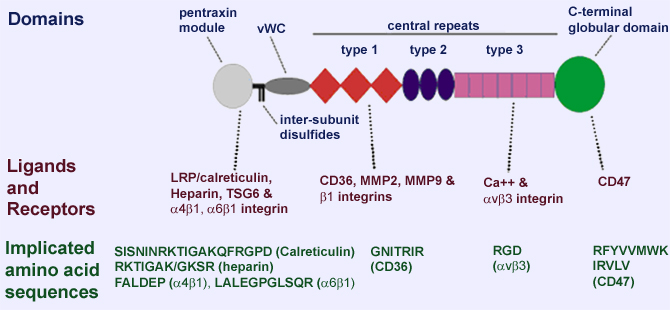
  Domain organization and localization of selected ligand binding sites in TSP2. TSP2 is a homotrimer linked via disulfide bonds. In most cases, sequences recognized by TSP2 receptors are inferred from mutagenesis of the corresponding sequences in TSP1 and supported by peptide inhibitions studies using the TSP2 sequences.
Description The TSP2 precursor contains 1172 amino acids; 129,955 Da. The mature secreted protein comprises residues 19-1172 and assembles into a disulfide linked homotrimer. Secreted TSP2 is a glycoprotein with a molecular mass of 150-160 kDa that contains approximately 7 potential Asn-linked oligosaccharide attachment sites and variable numbers of C-mannosylated Trp residues in the type 1 repeats. An X-ray crystal structure for the C-terminal regions of TSP2 revealed that the type 3 repeats when replete with Ca wrap around the globular G domain.
Expression TSP2 is expressed in many tissues during embryonic development, in the healthy adult and in various tumor stromal environments. Predominant expression is found in the connective tissue compartment and based on EST profiling, expression is highest in bone. Mice lacking thrombospondin 2 show an atypical pattern of endocortical and periosteal bone formation in response to mechanical loading. Expression is induced during the later stages of wound repair, during tissue remodeling, in rheumatoid synovium, ovarian follicle development, in wound keratocytes, hypertrophied heart, by ACTH, cAMP analogs and adenylate cyclase activators in bovine adrenocortical cells, in aged mice. Downregulation has been observed in fetal Leydig cells of mice overexpressing human chorionic gonadotropin/ luteinizing hormone, herpes simplex 1 infected cells, and in Cyclosporin A-induced gingival overgrowths.
TSP2 expression has been reported in some tumors including invasive breast carcinoma, metastatic malignant melanoma, malignant pleural effusions, cervix of pregnant mice, ischemic brain, aggressive ovarian tumor, gastric cancer, renal cell carcinoma, endometrial cancer, colorectal cancer, chemically-induced skin cancer, osteoclastoma, in ACTH-dependent aldosterone producing adenomas, esophageal cancer. Down regulation of TSP2 was reported in ovarian serous papillary carcinoma, salivary gland carcinoma, invasive cervical cancer, and non-small cell lung cancer.
Localisation TSP2 is secreted but is present only transiently in extracellular matrix and is rapidly internalized for degradation by fibroblasts after binding to the cell surface. Degradation is similar to TSP1 removal in that it is LRP- and HSPG-dependent and has similar kinetics. Given its pericellular distribution, TSP2, like TSP1, can modulate cell-matrix interactions and cell behavior.
Function TSP2 binds to extracellular matrix ligands including, transforming growth factor-beta-1, histidine rich glycoprotein, TSG6, heparin, matrix metalloproteinase-2, and heparan sulfate proteoglycans. TSP2 binds to cell surface receptors including CD36, CD47, LDL receptor-related protein-1 (via calreticulin) and the integrins alpha-V/beta-3, alpha-4/beta-1, and alpha-6/beta-1. In contrast to TSP1, TSP2 does not activate latent TGF-beta-1 but similarly to TSP1, TSP2 contains EGF-like modules that bind calcium in a cooperative manner. TSP2 in a context-dependent and cell-specific manner stimulates or inhibits cell adhesion, proliferation, motility, and survival. TSP2 is a potent inhibitor of angiogenesis mediated by the TSP2 receptor CD36. However, its N-terminal region exhibits pro-angiogenic activities mediated by beta-1 integrins . By way of alpha-4/beta-1, TSP2, like TSP1, modulates T cell behavior in-vitro. TSP2 stimulates chemotaxis, MMP gene expression, and activation-dependent adhesion of T cells. In a model of rheumatoid synovium, cell-based TSP2 therapy had an anti-inflammatory role in-vivo and depleted the tissue of infiltrating T cells. In the CNS, TSP2 secreted by astrocytes promotes synaptogenesis.

TSP2 null mice are viable and fertile but display connective tissue abnormalities associated with a defect in collagen fibrillogenesis that manifests as fragile skin, lax tendons and ligaments. Several defects have been reported in responses of TSP2 null mice to specific stresses. Nulls have an enhanced cutaneous inflammatory response, increased endosteal bone density, increased vascular density in dermis, adipose and thymus, a prolonged bleeding time. Fibroblasts isolated from TSP2 nulls are defective in adhesion. In response-to-injury models, TSP2 null mice have an increased vascularity of wounds with a concomitant increase in activity of MMP2 and MMP9 and demonstrate enhanced wound repair.

Homology TSP2 is a member of the thrombospondin family that also contains thrombospondin-1, thrombospondin-3, thrombospondin-4, and cartilage oligomeric matrix protein (COMP). The central type 1 repeats are also known as thrombospondin-repeats and are shared with the larger thrombospondin/properdin repeat superfamily.

Mutations

Germinal t3949g substitution in the 3'-untranslated region is associated with a reduced risk of premature myocardial infarcts
Somatic LOH in markers proximal to THBS2 were reported in salivary carcinomas, but disruption of the THBS2 gene has not been confirmed to date.

Implicated in

Entity various cancers
Disease Loss of TSP2 expression is associated with local invasive behavior, tumor neovascularization, and metastasis.
Prognosis Decreased TSP2 expression has been correlated with malignant progression and angiogenesis in some but not all cancers. In a study of 37 gliomas, a lack of TSP2 expression was significantly associated with higher histological grade (P = 0.0019) and increased vessel counts and density (p < 0.0001). In a study of 61 colon cancers, those expressing TSP2 showed a lower incidence of hepatic metastasis than those not expressing TSP2 (p = 0.02). TSP2 negative/VEGF-189 positive colon cancers showed significantly increased vessel counts and density in the stroma (P < 0.0001). Finally, in a study of 10 normal cervix and 78 invasive cervical cancer samples, TSP2 mRNA expression in normal cervix was significantly higher than that in cervical cancer (p = 0.032). Microvessel counts were marginally increased in the cervical cancer patients lacking TSP2 mRNA expression (p = 0.062). To date, the numbers of specimens examined for each of these cancers are too small to evaluate the independent prognostic value of TSP2 expression.
Conversely, TSP2 was strongly expressed in a series of melanoma metastases, but not in primary tumors, and in 55 endometrial cancer specimens TSP2 expression was significantly higher in malignancies exhibiting cervical and lymph-vascular space involvement (p=0.029 and p=0.009, respectively).
Oncogenesis Somatic mutation of THBS2 has not been clearly established in human cancers, but loss of TSP2 expression due to hypermethylation of its promoter was reported in a study of endometrial carcinomas. LOH in 6q15-27 between D6S297 and D6S1590 was reported in a study of salivary gland carcinomas and associated in 8 of 9 cases with loss of TSP2 expression.

Transgenic mouse models support the tumor suppressor activity of THBS2. Tumor progression of chemically-induced skin cancer is accelerated in TSP2 null mice, and there is an increased rate of lymph node metastases. The correlated increase in vessel density and size in these nulls also supports a suppressive role for TSP2. Tumor growth and angiogenesis are delayed and decreased when TSP2 is overexpressed in this model. Mouse models have also been used to explore therapeutic use of TSP2 to limit tumor growth and angiogenesis. These utilize a cell-based approach wherein TSP2 cDNA is transfected into a variety of cells including: glioblastoma, fibrosarcoma, squamous cell carcinoma and breast carcinoma cells. In turn, these TSP2 overexpressing cells when injected subcutaneously into immunodeficient mice exhibit decreased tumor growth and angiogenesis.


External links

Nomenclature
HGNC (Hugo)THBS2   11786
Entrez_Gene (NCBI)THBS2  7058  thrombospondin 2
Cards
AtlasTHBS2ID42549ch6q27
GeneCards (Weizmann)THBS2
Ensembl (Hinxton)ENSG00000186340 [Gene_View]  THBS2 [Vega]
AceView (NCBI)THBS2
Genatlas (Paris)THBS2
euGene (Indiana)7058
SOURCE (Stanford)NM_003247
Gene Expression (Array Express) ENSG00000186340
Genomic and cartography
GoldenPath (UCSC)THBS2  -  6q27   chr6:169615876-169654137 -  6q27   [Description]    (hg19-Feb_2009)
EnsemblTHBS2 - 6q27 [CytoView]
Mapping of homologs : NCBITHBS2 [Mapview]
OMIM188061   603932   
Gene and transcription
Gene : Genbank (Entrez)AA853383 AA853654 AI130835 AK292429 AL603377
Reference sequence (RefSeq transcript) :SRSNM_003247
Reference transcript : EntrezNM_003247
RefSeq genomic : SRSAC_000049 AC_000138 NC_000006 NT_025741 NW_001838994 NW_923184
RefSeq genomic : EntrezAC_000049 AC_000138 NC_000006 NT_025741 NW_001838994 NW_923184
Consensus coding sequences : CCDS NCBITHBS2
Cluster EST : UnigeneHs.371147 [ SRS ] Hs.371147 [ NCBI ]
Alternative Splicing : Fast-db (Paris)17072
Protein : pattern, domain, 3D structure
Protein : UniProt/SwissProtP35442 (SRS) P35442 (Expasy) P35442 (Uniprot)
With graphics : InterProP35442
Splice isoforms : VarSplice FASTAP35442(VarSplice FASTA)
Domaine pattern : Prosite (SRS)EGF_1 (PS00022)    EGF_2 (PS01186)    EGF_3 (PS50026)    TSP1 (PS50092)    TSP3 (PS51234)    TSP_CTER (PS51236)    VWFC_1 (PS01208)    VWFC_2 (PS50184)   
Domain pattern : Prosite (Expaxy)EGF_1 (PS00022)    EGF_2 (PS01186)    EGF_3 (PS50026)    TSP1 (PS50092)    TSP3 (PS51234)    TSP_CTER (PS51236)    VWFC_1 (PS01208)    VWFC_2 (PS50184)   
Domains : Interpro (SRS)ConA-like_lec_gl    ConA-like_subgrp    EGF    EGF-like    EGF-like_reg_CS    EGF_3    EGF_Ca_bd_2    Laminin_G_thrombospondin_N    Thrombospondin_1_rpt    Thrombospondin_1_rpt_sub    Thrombospondin_2    Thrombospondin_3-like_rpt    Thrombospondin_3_rpt    Thrombospondin_C    VWF_C   
Domains : Interpro (EBI)ConA-like_lec_gl    ConA-like_subgrp    EGF    EGF-like    EGF-like_reg_CS    EGF_3    EGF_Ca_bd_2    Laminin_G_thrombospondin_N    Thrombospondin_1_rpt    Thrombospondin_1_rpt_sub    Thrombospondin_2    Thrombospondin_3-like_rpt    Thrombospondin_3_rpt    Thrombospondin_C    VWF_C   
Related proteins : CluSTrP35442
Domain families : Pfam SRSEGF (PF00008)    EGF_CA (PF07645)    TSP_1 (PF00090)    TSP_3 (PF02412)    TSP_C (PF05735)    VWC (PF00093)   
Domain families : Pfam SangerEGF (PF00008)    EGF_CA (PF07645)    TSP_1 (PF00090)    TSP_3 (PF02412)    TSP_C (PF05735)    VWC (PF00093)   
Domain families : Pfam NCBIpfam00008    pfam07645    pfam00090    pfam02412    pfam05735    pfam00093   
Domain families : Smart EMBLEGF (SM00181)  TSP1 (SM00209)  TSPN (SM00210)  VWC (SM00214)  
Blocks (Seattle)P35442
Crystal structure of protein : PDB SRS1YO8    2RHP   
Crystal structure of protein : PDBSum1YO8    2RHP   
Crystal structure of protein : IMB1YO8    2RHP   
Crystal structure of protein : PDB RSDB1YO8    2RHP   
Human Protein AtlasENSG00000186340
HPRD01766
Protein Interaction databases
DIP (DOE-UCLA)P35442
IntAct (EBI)P35442
FunCoupENSG00000186340
Polymorphism : SNP, mutations, diseases
Single Nucleotide Polymorphism (SNP) : dbSNP NCBITHBS2
SNP : GeneSNP UtahTHBS2
SNP : HGBaseTHBS2
Genetic variants : HAPMAPTHBS2
Somatic Mutations in Cancer : COSMICTHBS2 
Mutations and Diseases : HGMDTHBS2
Hereditary diseases : OMIM188061    603932   
Hereditary diseases : GENETests188061    603932   
Diseases : Genetic AssociationTHBS2
General knowledge
Homologs : HomoloGeneTHBS2
Homology/Alignments : Family Browser UCSCTHBS2
Phylogenetic Trees/Animal Genes : TreeFamTHBS2
Chemical/Protein Interactions : CTD7058
Keywords Ontology : AmiGOstructural molecule activity  calcium ion binding  protein binding  extracellular region  cell adhesion  heparin binding  platelet alpha granule lumen  
Keywords Ontology : EGO-EBIstructural molecule activity  calcium ion binding  protein binding  extracellular region  cell adhesion  heparin binding  platelet alpha granule lumen  
Pathways : BIOCARTA
Pathways : KEGGECM-receptor interactionFocal adhesionTGF-beta signaling pathwayCell Communication
Other databases
Probes
Probes : ImagenesTHBS2 Related clones (RZPD - Berlin)
Literature
PubMed49 Pubmed reference(s) in Entrez
PubGeneTHBS2

Bibliography

Corticotropin-induced secreted protein, an ACTH-induced protein secreted by adrenocortical cells, is structurally related to thrombospondins.
Pellerin S, Lafeuillade B, Scherrer N, Gagnon J, Shi DL, Chambaz EM, Feige JJ
The Journal of biological chemistry. 1993 ; 268 (6) : 4304-4310.
PMID 8382699
 
Tissue factor controls the balance of angiogenic and antiangiogenic properties of tumor cells in mice.
Zhang Y, Deng Y, Luther T, Mˆºller M, Ziegler R, Waldherr R, Stern DM, Nawroth PP
The Journal of clinical investigation. 1994 ; 94 (3) : 1320-1327.
PMID 7521887
 
Analysis of the promoter and transcription start sites of the human thrombospondin 2 gene (THBS2).
Adolph KW, Liska DJ, Bornstein P
Gene. 1997 ; 193 (1) : 5-11.
PMID 9249061
 
Thrombospondin-1 and -2 messenger RNA expression in normal, benign, and neoplastic human breast tissues: correlation with prognostic factors, tumor angiogenesis, and fibroblastic desmoplasia.
Bertin N, Clezardin P, Kubiak R, Frappart L
Cancer research. 1997 ; 57 (3) : 396-399.
PMID 9012463
 
Myb-dependent regulation of thrombospondin 2 expression. Role of mRNA stability.
Bein K, Ware JA, Simons M
The Journal of biological chemistry. 1998 ; 273 (33) : 21423-21429.
PMID 9694906
 
Thrombospondin 2 gene expression is correlated with decreased vascularity in non-small cell lung cancer.
Oshika Y, Masuda K, Tokunaga T, Hatanaka H, Kamiya T, Abe Y, Ozeki Y, Kijima H, Yamazaki H, Tamaoki N, Ueyama Y, Nakamura M
Clinical cancer research : an official journal of the American Association for Cancer Research. 1998 ; 4 (7) : 1785-1788.
PMID 9676856
 
Cellular gene expression altered by human cytomegalovirus: global monitoring with oligonucleotide arrays.
Zhu H, Cong JP, Mamtora G, Gingeras T, Shenk T
Proceedings of the National Academy of Sciences of the United States of America. 1998 ; 95 (24) : 14470-14475.
PMID 9826724
 
Expression of members of the thrombospondin family by human skeletal tissues and cultured cells.
Carron JA, Bowler WB, Wagstaff SC, Gallagher JA
Biochemical and biophysical research communications. 1999 ; 263 (2) : 389-391.
PMID 10491303
 
Thrombospondin-2 (TSP2) expression is inversely correlated with vascularity in glioma.
Kazuno M, Tokunaga T, Oshika Y, Tanaka Y, Tsugane R, Kijima H, Yamazaki H, Ueyama Y, Nakamura M
European journal of cancer (Oxford, England : 1990). 1999 ; 35 (3) : 502-506.
PMID 10448307
 
Thrombospondin-2: a potent endogenous inhibitor of tumor growth and angiogenesis.
Streit M, Riccardi L, Velasco P, Brown LF, Hawighorst T, Bornstein P, Detmar M
Proceedings of the National Academy of Sciences of the United States of America. 1999 ; 96 (26) : 14888-14893.
PMID 10611308
 
Expression of angiostatic factors in colorectal cancer.
Yoshida Y, Oshika Y, Fukushima Y, Tokunaga T, Hatanaka H, Kijima H, Yamazaki H, Ueyama Y, Tamaoki N, Miura S, Nakamura M
International journal of oncology. 1999 ; 15 (6) : 1221-1225.
PMID 10568831
 
Angiogenesis modulators expression in culture cell lines positives for HPV-16 oncoproteins.
Bequet-Romero M, Lˆ„pez-Ocejo O
Biochemical and biophysical research communications. 2000 ; 277 (1) : 55-61.
PMID 11027639
 
Thrombospondins: multifunctional regulators of cell interactions.
Adams JC
Annual review of cell and developmental biology. 2001 ; 17 : 25-51.
PMID 11687483
 
Thrombospondins and tumor angiogenesis.
de Fraipont F, Nicholson AC, Feige JJ, Van Meir EG
Trends in molecular medicine. 2001 ; 7 (9) : 401-407.
PMID 11530335
 
Thrombospondin-2 plays a protective role in multistep carcinogenesis: a novel host anti-tumor defense mechanism.
Hawighorst T, Velasco P, Streit M, Hong YK, Kyriakides TR, Brown LF, Bornstein P, Detmar M
The EMBO journal. 2001 ; 20 (11) : 2631-2640.
PMID 11387198
 
Gene expression profiling in human esophageal cancers using cDNA microarray.
Kan T, Shimada Y, Sato F, Maeda M, Kawabe A, Kaganoi J, Itami A, Yamasaki S, Imamura M
Biochemical and biophysical research communications. 2001 ; 286 (4) : 792-801.
PMID 11520067
 
Thrombospondin-1 and -2 messenger RNA expression in epithelial ovarian tumor.
Kodama J, Hashimoto I, Seki N, Hongo A, Yoshinouchi M, Okuda H, Kudo T
Anticancer research. 2001 ; 21 (4B) : 2983-2987.
PMID 11712798
 
Thrombospondin-1 and -2 messenger RNA expression in invasive cervical cancer: correlation with angiogenesis and prognosis.
Kodama J, Hashimoto I, Seki N, Hongo A, Yoshinouchi M, Okuda H, Kudo T
Clinical cancer research : an official journal of the American Association for Cancer Research. 2001 ; 7 (9) : 2826-2831.
PMID 11555600
 
Comparative study of angiostatic and anti-invasive gene expressions as prognostic factors in gastric cancer.
Lee JH, Koh JT, Shin BA, Ahn KY, Roh JH, Kim YJ, Kim KK
International journal of oncology. 2001 ; 18 (2) : 355-361.
PMID 11172604
 
Transcription factor ATF3 partially transforms chick embryo fibroblasts by promoting growth factor-independent proliferation.
Perez S, Vial E, van Dam H, Castellazzi M
Oncogene. 2001 ; 20 (9) : 1135-1141.
PMID 11314051
 
Thrombospondin-1 and -2 messenger RNA expression in normal and neoplastic endometrial tissues: correlation with angiogenesis and prognosis.
Seki N, Kodama J, Hashimoto I, Hongo A, Yoshinouchi M, Kudo T
International journal of oncology. 2001 ; 19 (2) : 305-310.
PMID 11445843
 
The lack of thrombospondin-1 (TSP1) dictates the course of wound healing in double-TSP1/TSP2-null mice.
Agah A, Kyriakides TR, Lawler J, Bornstein P
The American journal of pathology. 2002 ; 161 (3) : 831-839.
PMID 12213711
 
Corneal stromal cells (keratocytes) express thrombospondins 2 and 3 in wound repair phenotype.
Armstrong DJ, Hiscott P, Batterbury M, Kaye S
The international journal of biochemistry & cell biology. 2002 ; 34 (6) : 588-593.
PMID 11943589
 
Gene expression profiling in silico: relative expression of candidate angiogenesis associated genes in renal cell carcinomas.
Gerritsen ME, Peale FV Jr, Wu T
Experimental nephrology. 2002 ; 10 (2) : 114-119.
PMID 11937758
 
Thrombospondin expression in aldosterone-producing adenomas.
Hatakeyama H, Nishizawa M, Nakagawa A, Nakano S, Kigoshi T, Miyamori I, Uchida K
Hypertension research : official journal of the Japanese Society of Hypertension. 2002 ; 25 (4) : 523-527.
PMID 12358136
 
Differential expression of thrombospondin 2 in primary and metastatic malignant melanoma.
Kunz M, Koczan D, Ibrahim SM, Gillitzer R, Gross G, Thiesen HJ
Acta dermato-venereologica. 2002 ; 82 (3) : 163-169.
PMID 12353704
 
Increased and prolonged inflammation and angiogenesis in delayed-type hypersensitivity reactions elicited in the skin of thrombospondin-2--deficient mice.
Lange-Asschenfeldt B, Weninger W, Velasco P, Kyriakides TR, von Andrian UH, Bornstein P, Detmar M
Blood. 2002 ; 99 (2) : 538-545.
PMID 11781236
 
Expression and localization of thrombospondin-1 and -2 and their cell-surface receptor, CD36, during rat follicular development and formation of the corpus luteum.
Petrik JJ, Gentry PA, Feige JJ, LaMarre J
Biology of reproduction. 2002 ; 67 (5) : 1522-1531.
PMID 12390884
 
Systemic inhibition of tumor growth and angiogenesis by thrombospondin-2 using cell-based antiangiogenic gene therapy.
Streit M, Stephen AE, Hawighorst T, Matsuda K, Lange-Asschenfeldt B, Brown LF, Vacanti JP, Detmar M
Cancer research. 2002 ; 62 (7) : 2004-2012.
PMID 11929817
 
Thrombospondins 1 and 2 function as inhibitors of angiogenesis.
Armstrong LC, Bornstein P
Matrix biology : journal of the International Society for Matrix Biology. 2003 ; 22 (1) : 63-71.
PMID 12714043
 
Molecular mechanism of the anti-cancer activity of cerivastatin, an inhibitor of HMG-CoA reductase, on aggressive human breast cancer cells.
Denoyelle C, Albanese P, Uzan G, Hong L, Vannier JP, Soria J, Soria C
Cellular signalling. 2003 ; 15 (3) : 327-338.
PMID 12531431
 
Loss of heterozygosity on chromosome 6q correlates with decreased thrombospondin-2 expression in human salivary gland carcinomas.
Kishi M, Nakamura M, Nishimine M, Ishida E, Shimada K, Kirita T, Konishi N
Cancer science. 2003 ; 94 (6) : 530-535.
PMID 12824879
 
Differential regulation of thrombospondin-1 and thrombospondin-2 after focal cerebral ischemia/reperfusion.
Lin TN, Kim GM, Chen JJ, Cheung WM, He YY, Hsu CY
Stroke; a journal of cerebral circulation. 2003 ; 34 (1) : 177-186.
PMID 12511771
 
Thrombospondin 2 regulates cell proliferation induced by Rac1 redox-dependent signaling.
Lopes N, Gregg D, Vasudevan S, Hassanain H, Goldschmidt-Clermont P, Kovacic H
Molecular and cellular biology. 2003 ; 23 (15) : 5401-5408.
PMID 12861025
 
Impaired angiogenesis in aging is associated with alterations in vessel density, matrix composition, inflammatory response, and growth factor expression.
Sadoun E, Reed MJ
The journal of histochemistry and cytochemistry : official journal of the Histochemistry Society. 2003 ; 51 (9) : 1119-1130.
PMID 12923237
 
Frequent HOXA11 and THBS2 promoter methylation, and a methylator phenotype in endometrial adenocarcinoma.
Whitcomb BP, Mutch DG, Herzog TJ, Rader JS, Gibb RK, Goodfellow PJ
Clinical cancer research : an official journal of the American Association for Cancer Research. 2003 ; 9 (6) : 2277-2287.
PMID 12796396
 
The thrombospondins.
Adams JC, Lawler J
The international journal of biochemistry & cell biology. 2004 ; 36 (6) : 961-968.
PMID 15094109
 
Thrombospondin 2 levels are increased in aged mice: consequences for cutaneous wound healing and angiogenesis.
Agah A, Kyriakides TR, Letrondo N, Bjˆrkblom B, Bornstein P
Matrix biology : journal of the International Society for Matrix Biology. 2004 ; 22 (7) : 539-547.
PMID 14996433
 
Proteomic analysis of exosomes isolated from human malignant pleural effusions.
Bard MP, Hegmans JP, Hemmes A, Luider TM, Willemsen R, Severijnen LA, van Meerbeeck JP, Burgers SA, Hoogsteden HC, Lambrecht BN
American journal of respiratory cell and molecular biology. 2004 ; 31 (1) : 114-121.
PMID 14975938
 
The role of thrombospondins 1 and 2 in the regulation of cell-matrix interactions, collagen fibril formation, and the response to injury.
Bornstein P, Agah A, Kyriakides TR
The international journal of biochemistry & cell biology. 2004 ; 36 (6) : 1115-1125.
PMID 15094126
 
Regulation of VEGF-A, VEGFR-I, thrombospondin-1, -2, and -3 expression in a human pituitary cell line (HP75) by TGFbeta1, bFGF, and EGF.
Horiguchi H, Jin L, Ruebel KH, Scheithauer BW, Lloyd RV
Endocrine. 2004 ; 24 (2) : 141-146.
PMID 15347840
 
Decreased expressions of thrombospondin 2 in cyclosporin A-induced gingival overgrowth.
Koh JT, Kim OJ, Park YS, Kim SH, Kim WJ, Chung HJ, Lee SE, Jeong BC, Jung JY, Kim KK
Journal of periodontal research. 2004 ; 39 (2) : 93-100.
PMID 15009516
 
Thrombospondin 2 deficiency in pregnant mice results in premature softening of the uterine cervix.
Kokenyesi R, Armstrong LC, Agah A, Artal R, Bornstein P
Biology of reproduction. 2004 ; 70 (2) : 385-390.
PMID 14561659
 
Tumor progression: the effects of thrombospondin-1 and -2.
Lawler J, Detmar M
The international journal of biochemistry & cell biology. 2004 ; 36 (6) : 1038-1045.
PMID 15094119
 
Thrombospondin 2 functions as an endogenous regulator of angiogenesis and inflammation in rheumatoid arthritis.
Park YW, Kang YM, Butterfield J, Detmar M, Goronzy JJ, Weyand CM
The American journal of pathology. 2004 ; 165 (6) : 2087-2098.
PMID 15579451
 
Gene expression profiles in primary ovarian serous papillary tumors and normal ovarian epithelium: identification of candidate molecular markers for ovarian cancer diagnosis and therapy.
Santin AD, Zhan F, Bellone S, Palmieri M, Cane S, Bignotti E, Anfossi S, Gokden M, Dunn D, Roman JJ, O'Brien TJ, Tian E, Cannon MJ, Shaughnessy J Jr, Pecorelli S
International journal of cancer. Journal international du cancer. 2004 ; 112 (1) : 14-25.
PMID 15305371
 
Thrombospondin-2 is essential for myocardial matrix integrity: increased expression identifies failure-prone cardiac hypertrophy.
Schroen B, Heymans S, Sharma U, Blankesteijn WM, Pokharel S, Cleutjens JP, Porter JG, Evelo CT, Duisters R, van Leeuwen RE, Janssen BJ, Debets JJ, Smits JF, Daemen MJ, Crijns HJ, Bornstein P, Pinto YM
Circulation research. 2004 ; 95 (5) : 515-522.
PMID 15284191
 
Coronary artery disease and the thrombospondin single nucleotide polymorphisms.
Stenina OI, Byzova TV, Adams JC, McCarthy JJ, Topol EJ, Plow EF
The international journal of biochemistry & cell biology. 2004 ; 36 (6) : 1013-1030.
PMID 15094117
 
Fetal but not adult Leydig cells are susceptible to adenoma formation in response to persistently high hCG level: a study on hCG overexpressing transgenic mice.
Ahtiainen P, Rulli SB, Shariatmadari R, Pelliniemi LJ, Toppari J, Poutanen M, Huhtaniemi IT
Oncogene. 2005 ; 24 (49) : 7301-7309.
PMID 16007123
 
Novel integrin antagonists derived from thrombospondins.
Calzada MJ, Roberts DD
Current pharmaceutical design. 2005 ; 11 (7) : 849-866.
PMID 15777239
 
Structure of the calcium-rich signature domain of human thrombospondin-2.
Carlson CB, Bernstein DA, Annis DS, Misenheimer TM, Hannah BL, Mosher DF, Keck JL
Nature structural & molecular biology. 2005 ; 12 (10) : 910-914.
PMID 16186819
 
Suppression of thrombospondin 1 and 2 production by herpes simplex virus 1 infection in cultured keratocytes.
Choudhary A, Hiscott P, Hart CA, Kaye SB, Batterbury M, Grierson I
Molecular vision. 2005 ; 11 : 163-168.
PMID 15761388
 
Thrombospondin and vascular endothelial growth factor are cyclically expressed in an inverse pattern during bovine ovarian follicle development.
Greenaway J, Gentry PA, Feige JJ, LaMarre J, Petrik JJ
Biology of reproduction. 2005 ; 72 (5) : 1071-1078.
PMID 15616224
 
Mice lacking thrombospondin 2 show an atypical pattern of endocortical and periosteal bone formation in response to mechanical loading.
Hankenson KD, Ausk BJ, Bain SD, Bornstein P, Gross TS, Srinivasan S
Bone. 2006 ; 38 (3) : 310-316.
PMID 16290255
 
Transdifferentiation-dependent expression of alpha-SMA in hepatic stellate cells does not involve TGF-beta pathways leading to coinduction of collagen type I and thrombospondin-2.
Lindert S, Wickert L, Sawitza I, Wiercinska E, Gressner AM, Dooley S, Breitkopf K
Matrix biology : journal of the International Society for Matrix Biology. 2005 ; 24 (3) : 198-207.
PMID 15905080
 
A role for Hox A5 in regulating angiogenesis and vascular patterning.
Rhoads K, Arderiu G, Charboneau A, Hansen SL, Hoffman W, Boudreau N
Lymphatic research and biology. 2005 ; 3 (4) : 240-252.
PMID 16379594
 
The antiangiogenic effect of thrombospondin-2 is mediated by CD36 and modulated by histidine-rich glycoprotein.
Simantov R, Febbraio M, Silverstein RL
Matrix biology : journal of the International Society for Matrix Biology. 2005 ; 24 (1) : 27-34.
PMID 15748999
 
REVIEW articlesautomatic search in PubMed
Last year publicationsautomatic search in PubMed

Search in all EBI   NCBI

Contributor(s)

Written01-2006Elizabeth M. Perruccio, David D. Roberts
National Institutes of Health, Bldg. 10, Rm. 2A33, 10 Center Dr. MSC1500, Bethesda, MD 20892-1500, USA

Citation

This paper should be referenced as such :
Perruccio EM, Roberts DD . THBS2 (thrombospondin-2). Atlas Genet Cytogenet Oncol Haematol. January 2006 .
URL : http://AtlasGeneticsOncology.org/Genes/THBS2ID42549ch6q27.html

© Atlas of Genetics and Cytogenetics in Oncology and Haematology
indexed on : Thu Jul 15 14:43:39 CEST 2010

Home   Genes   Leukemias   Solid Tumours   Cancer-Prone   Deep Insight   Case Reports   Journals  Portal   Teaching   

For comments and suggestions or contributions, please contact us

jlhuret@AtlasGeneticsOncology.org.