MUTYH associated polyposis
2006-05-01 Maartje Nielsen , Frederik J. Hes AffiliationDepartment of Clinical Genetics, Leiden University Medical Center (LUMC), Leiden, the Netherlands
Identity
Name
Inheritance
Omim
Orphanet
Umls
Clinics
Phenotype and clinics
Neoplastic risk
Treatment
Prognosis
In MAP patients who have developed colorectal carcinoma, survival will depend on the age of diagnosis and (Dukes) stage of the colorectal carcinoma.
Other Findings
Note
A possible relation between MUTYH and breast cancer has been reported because of a high prevalence of breast cancer cases in a group of Dutch female MAP patients (standardised morbidity ratio=3,75). Moreover, MUTYH knockout mouse that also carry heterozygous APC mutations are more prone to develop mammary tumours than APC-heterozygotes only. Case control studies will be necessary to confirm this relation in humans.
In 148 gastric cancer cases one bi-allelic splice site mutation encoding a truncated MUTYH protein, c.IVS10-2A>G, was found. However, there was no significant higher number of MUTYH heterozygotes as compared to controls. Furthermore, no overrepresentation of MUTYH mutations (mono or bi-allelic) was found in patients with lung cancer, hepatocellular carcinoma, cholangiocarcinoma and (childhood) leukemia, compared to healthy controls.
A suggested explanation for the relative absence of tumor growth at other places in MAP-patients is that oxidation is a more common effect in the digestive system and that the APC-gene has more sequences (AGAA or TGAA motifs, see heading somatic mutations) which are relatively dependent of MUTYH oxidative damage repair.
Genes involved and Proteins
Alias
Description
Transcription
Description
DESCRIPTION Alternative splicing generates a gene product of 521 amino Acids, referred as type 2. Type 1 is transported to the mitochondria, while type 2 lacks the first exon containing a mitochondrial targeting signal (MTS) and is transported to nucleus.
Expression
Localisation
Function
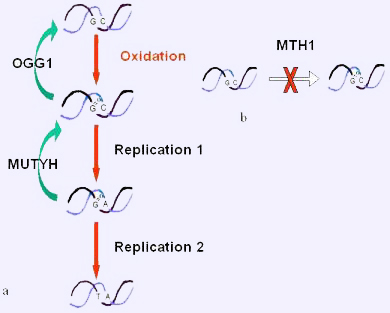
MUTYH recognizes an oxoG:A mismatch and subsequently excises the undamaged adenine base using a base flipping mechanism. To a lesser extent also G:A, C:A, 8-oxoG:G and 8-oxoA:G mispairs are recognised and catalysed by MUTYH. The MUTYH protein consists of different functional domains. The N-terminal domain on the 5 side contains the catalytic region and includes a helix hairpin helix (HhH), pseudo HhH and an iron sulfur cluster loop motif, which are also common motifs in other BER glycosylases. The C-terminal domain on the 3 side is shares homology with MTH1 and plays a role in 8-oxoG recognition.
Furthermore, MUTYH has binding sites for PCNA (proliferating cell nuclear antigen), RPA (replication protein A) and AP (apurinic\/apyrimidinic) endonuclease. The interaction with these replication enzymes and a reported increase of expression during the S phase suggests a role for MUTYH especially in the replication-coupled repair. In E.coli it was demonstrated that the MUTYH homologue, mutY, recognizes the nascent strand in association with various cellular proteins such as PCNA or a mismatch repair genes complex. Remarkably, it was demonstrated that amino acid residues 232-254 of MUTYH interacts with the MSH2\/MSH6 heterodimer via MSH6 and this interaction stimulates the glycosylase activities of MUTYH.
Homology
Germinal
Other common mutations are: A371fs (c.1105delC, sometimes referred to as 1103delC); c.891+3A>C; P391L in Dutch patients (14%); Glu466del (c.1395delGGA) in Italian and the E466X in Indian people.
The Y165C mutation is located in the pseudo HhH region that is involved in mismatch specificity and flipping of the adenine into the base specificity pocket. The G382D is located in the C-terminal domain involved in 8-oxoG recognition. In functional tests especially the Y165C, but also the G382D variants, have shown to be devoid of glycosylase activity directed towards 8-oxoG:A. The corresponding variant of G382D in mice, G365D, does not suppress the elevated spontaneous mutations in MUTHY-null ES cells and failed to prevent OGG1 from excising 8-oxo G opposite the generated AP site-which would then result in double strand DNA breaks.
Recently, the 1105 delC variant showed significantly lowered binding and cleavage activities with heteroduplex oligonucleotides containing A:8-oxoG and 8-oxoA:G mispairs.
Several SNPs (single nucleotide polymorphism) with amino acid substitutions have been registered in the NCBI database. Most frequently found in cases and controls: His 324Gln (Q324H) in 40-45% and IVS6+ 35 (462 +35) G>A in 20-25%. Pathogenic significance of the V22M SNP is disputed; its prevalence in controls and in cases is comparable (10-15%).
Somatic
All MAP tumours examined so far are MSI stable. One study found 18q LOH and P53 over-expression in the same frequency as in sporadic carcinomas. Few P53 mutations were found however and predominantly not G>T changes. No BRAF, SMAD4 or TGFBIIR mutations were detected in the same group of MAP-carcinomas. Twelve out of 13 MAP cancers tested were near-diploid. This last finding is in contrast with a more recent study that found aneuploidy in 80% of MAP-adenomas and also frequent losses at chromosome 1p, 17, 19, and 22 and gains affecting chromosomes 7 and 13. Authors explained the difference in outcomes because of the use of more sensitive and specific techniques in the last.
Article Bibliography
| Pubmed ID | Last Year | Title | Authors |
|---|---|---|---|
| 12920580 | 2003 | Analysis of MYH Tyr165Cys and Gly382Asp variants in childhood leukemias. | Akyerli CB et al |
| 14579148 | 2004 | Inherited variants in MYH are unlikely to contribute to the risk of lung carcinoma. | Al-Tassan N et al |
| 15690400 | 2005 | A kindred with MYH-associated polyposis and pilomatricomas. | Baglioni S et al |
| 16292541 | 2006 | MYH Y165C and G382D mutations in hepatocellular carcinoma and cholangiocarcinoma patients. | Baudhuin LM et al |
| 16510566 | 2006 | Chromosomal instability in MYH- and APC-mutant adenomatous polyps. | Cardoso J et al |
| 12915454 | 2003 | Exposing the MYtH about base excision repair and human inherited disease. | Cheadle JP et al |
| 11139626 | 2001 | Efficient recognition of substrates and substrate analogs by the adenine glycosylase MutY requires the C-terminal domain. | Chmiel NH et al |
| 15931596 | 2005 | Germline susceptibility to colorectal cancer due to base-excision repair gene defects. | Farrington SM et al |
| 16242460 | 2005 | Attenuation of DNA damage in canine hearts preserved by continuous hypothermic perfusion. | Fitton TP et al |
| 15231485 | 2004 | Oxidative DNA damage and DNA repair enzyme expression are inversely related in murine models of fatty liver disease. | Gao D et al |
| 14999774 | 2004 | Prevalence of the Y165C, G382D and 1395delGGA germline mutations of the MYH gene in Italian patients with adenomatous polyposis coli and colorectal adenomas. | Gismondi V et al |
| 11801590 | 2002 | Human MutY homolog, a DNA glycosylase involved in base excision repair, physically and functionally interacts with mismatch repair proteins human MutS homolog 2/human MutS homolog 6. | Gu Y et al |
| 9846876 | 1998 | MutY catalytic core, mutant and bound adenine structures define specificity for DNA repair enzyme superfamily. | Guan Y et al |
| 12917422 | 2003 | Mutator phenotype of MUTYH-null mouse embryonic stem cells. | Hirano S et al |
| 16492921 | 2006 | Risk of colorectal cancer in monoallelic and biallelic carriers of MYH mutations: a population-based case-family study. | Jenkins MA et al |
| 15083190 | 2004 | Increased frequency of the k-ras G12C mutation in MYH polyposis colorectal adenomas. | Jones S et al |
| 15034862 | 2004 | Role of inherited defects of MYH in the development of sporadic colorectal cancer. | Kambara T et al |
| 15273732 | 2004 | Genetic alterations of the MYH gene in gastric cancer. | Kim CJ et al |
| 15143881 | 2004 | Expression of DNA repair protein: MYH, NTH1, and MTH1 in colorectal cancer. | Koketsu S et al |
| 11948257 | 2002 | Hypoxia induces mitochondrial DNA damage and stimulates expression of a DNA repair enzyme, the Escherichia coli MutY DNA glycosylase homolog (MYH), in vivo, in the rat brain. | Lee HM et al |
| 14633673 | 2003 | Carcinogenesis in MYH-associated polyposis follows a distinct genetic pathway. | Lipton L et al |
| 11892789 | 2001 | Repair of oxidative DNA damage: mechanisms and functions. | Lu AL et al |
| 9287157 | 1997 | Cloning, overexpression, and biochemical characterization of the catalytic domain of MutY. | Manuel RC et al |
| 1328155 | 1992 | The GO system protects organisms from the mutagenic effect of the spontaneous lesion 8-hydroxyguanine (7,8-dihydro-8-oxoguanine). | Michaels ML et al |
| 16140997 | 2005 | Multiplicity in polyp count and extracolonic manifestations in 40 Dutch patients with MYH associated polyposis coli (MAP). | Nielsen M et al |
| 10684930 | 2000 | Identification of human MutY homolog (hMYH) as a repair enzyme for 2-hydroxyadenine in DNA and detection of multiple forms of hMYH located in nuclei and mitochondria. | Ohtsubo T et al |
| 11092888 | 2001 | Human homolog of the MutY repair protein (hMYH) physically interacts with proteins involved in long patch DNA base excision repair. | Parker A et al |
| 15987719 | 2005 | Cells with pathogenic biallelic mutations in the human MUTYH gene are defective in DNA damage binding and repair. | Parker AR et al |
| 16207212 | 2005 | Attenuated familial adenomatous polyposis and Muir-Torre syndrome linked to compound biallelic constitutional MYH gene mutations. | Ponti G et al |
| 12853198 | 2003 | Autosomal recessive colorectal adenomatous polyposis due to inherited mutations of MYH. | Sampson JR et al |
| 15604247 | 2004 | Myh deficiency enhances intestinal tumorigenesis in multiple intestinal neoplasia (ApcMin/+) mice. | Sieber OM et al |
| 12606733 | 2003 | Multiple colorectal adenomas, classic adenomatous polyposis, and germ-line mutations in MYH. | Sieber OM et al |
| 8682794 | 1996 | Cloning and sequencing a human homolog (hMYH) of the Escherichia coli mutY gene whose function is required for the repair of oxidative DNA damage. | Slupska MM et al |
| 10471731 | 1999 | Differential subcellular localization of human MutY homolog (hMYH) and the functional activity of adenine:8-oxoguanine DNA glycosylase. | Takao M et al |
| 15180946 | 2004 | A novel splice-site variant of the base excision repair gene MYH is associated with production of an aberrant mRNA transcript encoding a truncated MYH protein not localized in the nucleus. | Tao H et al |
| 15199168 | 2004 | MUTYH prevents OGG1 or APEX1 from inappropriately processing its substrate or reaction product with its C-terminal domain. | Tominaga Y et al |
| 15036665 | 2004 | Identification of critical residues required for the mutation avoidance function of human MutY (hMYH) and implications in colorectal cancer. | Wooden SH et al |
External Links
Citation
Maartje Nielsen ; Frederik J. Hes
MUTYH associated polyposis
Atlas Genet Cytogenet Oncol Haematol. 2006-05-01
Online version: http://atlasgeneticsoncology.org/cancer-prone-disease/10121/mutyh-associated-polyposis
