FANCA (Fanconi anemia, complementation group A)
2012-03-01 Jose Antonio Casado , Juan Antonio Bueren AffiliationHematopoiesis, Gene Therapy, Centro de Investigaciones Energeticas, Medioambientales y Tecnologicas,, Centro de Investigacion Biomedica en Red de Enfermedades Raras (CIBERER), Madrid, Spain
Identity

DNA/RNA
Description
Transcription
Pseudogene
Proteins
Note
Description
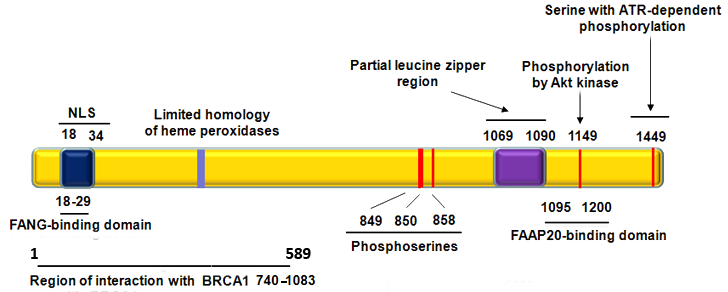
Through different complexes FANCA can interact with other proteins such as alpha spectrin II, SWI/SNF complex or BLM (DNA-helicase Bloom protein) and other proteins associated with this complex (McMahon et al., 1999; Otsuki et al, 2001; Meetei et al., 2003). FANCA is normally phosphorylated including phosphorylation by ATR-CHK1 on serine 1449 in a process that is required for the formation of the nuclear complex (Collins et al., 2009). FANCA has a consensus sequence for Akt kinase near serine 1149 and its phosphorylation can act as a negative regulator (Otsuki et al., 2002) (Figure 2).
Expression
Localisation
Function
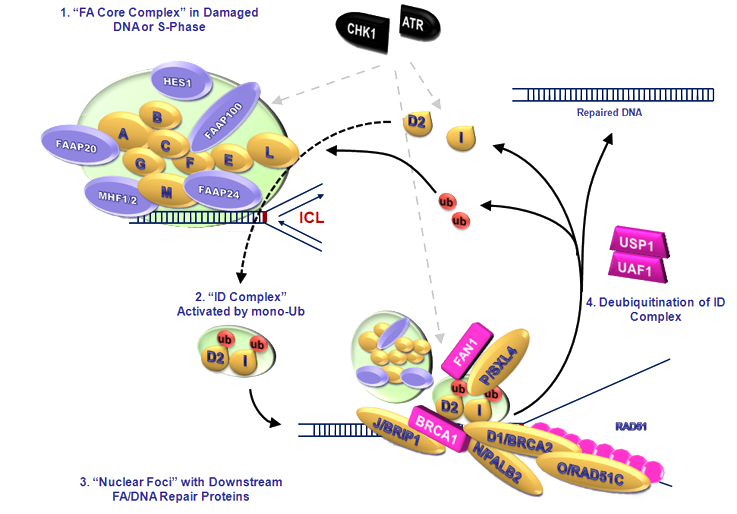
Several subcomplex are formed in the cytoplasm and from here FANCB-FANCL-FAAP100 are transported together to the nucleus (Ling et al., 2007). FANCA and FANCG form a complex in the cytoplasm, through an N-term FANCA (involving the nuclear localization signal) - FANCG interaction; FANCC join the complex and phosphorylation of FANCA would induce its translocation into the nucleus (Garcia-Higuera et al., 2000; Kruyt et al., 1999). The FA subcomplexes translocates into the nucleus, where FANCE and FANCF are present; and join to the complex (de Winter et al., 2000; kee and DAndrea, 2010). A large FA core complex is generated with FANCM-FAAP24. Interstrand cross-links are recognized by the FANCM-FAAP24-MHF1/2 complex which recruits the rest of the FA core proteins by interaction between FANCM and FANCF. Because of the ubiquitin E3 ligase activity present in FANCL (Hodson et al., 2011) the heterodimer ID complex formed by FANCD2 and FANCI can be monoubiquitinated and then translocated to chromatin, interacting with downstream proteins in the FA pathway such as FANCD1/BRCA2, FANCN/PALB2, FANCJ/BRIP1, FANCP/SLX4, FANCO/RAD51C and with BRCA1 (Garcia-Higuera et al., 2001) and the nuclease FAN1 (Liu et al., 2010). These downstream FA proteins are involved in DNA repair by homologous recombination (Moldovan and DAndrea, 2009). In addition to DNA damage, the FA pathway can be activated during S phase of cell cycle. After DNA repair, FANCD2 and FANCI return to the non-ubiquinated form by the action of a complex ubiquitin-specific protease USP1/UAF1 (Nijman et al., 2005) (Figure 3).
Biallelic mutations in FANCA (or in any other gene encoding proteins of the FA core complex) prevent the ubiquitin E3 ligase activity and the monoubiquinitation of FANCD2 and FANCI resulting in a defective FA/BRCA pathway.
Homology
Mutations
Note
Germinal
Somatic
Implicated in
It has been shown that significant phenotypic differences were found between the various complementation groups. In FA group A, patients homozygous for null mutations had an earlier onset of anemia and a higher incidence of leukemia than those with mutations producing an altered protein. Patients homozygous for null mutations in FANCA are high-risk groups with a poor hematologic outcome and should be considered as candidates both for frequent monitoring and early therapeutic intervention (Faivre et al., 2000). However, in another recent study, no clinical differences in terms of onset of hematologic disease and number of congenital anomalies were found in patients with expression of a mutant form of FANCA protein compared with patients without expression of the protein (Castella et al., 2011).
Article Bibliography
| Pubmed ID | Last Year | Title | Authors |
|---|---|---|---|
| 22343915 | 2012 | FAAP20: a novel ubiquitin-binding FA nuclear core-complex protein required for functional integrity of the FA-BRCA DNA repair pathway. | Ali AM et al |
| 17105750 | 2007 | A comprehensive strategy for the subtyping of patients with Fanconi anaemia: conclusions from the Spanish Fanconi Anemia Research Network. | Antonio Casado J et al |
| 19622403 | 2009 | Fanconi anemia and its diagnosis. | Auerbach AD et al |
| 15522956 | 2005 | A common founder mutation in FANCA underlies the world's highest prevalence of Fanconi anemia in Gypsy families from Spain. | Callén E et al |
| 21273304 | 2011 | Origin, functional role, and clinical impact of Fanconi anemia FANCA mutations. | Castella M et al |
| 19109555 | 2009 | ATR-dependent phosphorylation of FANCA on serine 1449 after DNA damage is important for FA pathway function. | Collins NB et al |
| 12685843 | 2002 | Analysis of the Fanconi anaemia complementation group A gene in acute myeloid leukaemia. | Condie A et al |
| 11110674 | 2000 | Association of complementation group and mutation type with clinical outcome in fanconi anemia. European Fanconi Anemia Research Group. | Faivre L et al |
| 12354784 | 2002 | BRCA1 interacts directly with the Fanconi anemia protein FANCA. | Folias A et al |
| 18258506 | 2008 | The Fanconi anaemia/BRCA pathway and cancer susceptibility. Searching for new therapeutic targets. | García MJ et al |
| 11239454 | 2001 | Interaction of the Fanconi anemia proteins and BRCA1 in a common pathway. | Garcia-Higuera I et al |
| 18084332 | 2008 | Hematopoietic stem cell transplantation in childhood inherited bone marrow failure syndrome. | Gluckman E et al |
| 11226273 | 2001 | Somatic mosaicism in Fanconi anemia: evidence of genotypic reversion in lymphohematopoietic stem cells. | Gregory JJ Jr et al |
| 11673408 | 2001 | Fanconi anemia and DNA repair. | Grompe M et al |
| 12697994 | 2002 | Reverse mosaicism in Fanconi anemia: natural gene therapy via molecular self-correction. | Gross M et al |
| 21775430 | 2011 | Structural analysis of human FANCL, the E3 ligase in the Fanconi anemia pathway. | Hodson C et al |
| 9169126 | 1997 | The genomic organization of the Fanconi anemia group A (FAA) gene. | Ianzano L et al |
| 20713514 | 2010 | Expanded roles of the Fanconi anemia pathway in preserving genomic stability. | Kee Y et al |
| 10567393 | 1999 | Resistance to mitomycin C requires direct interaction between the Fanconi anemia proteins FANCA and FANCG in the nucleus through an arginine-rich domain. | Kruyt FA et al |
| 15643609 | 2005 | Spectrum of sequence variations in the FANCA gene: an International Fanconi Anemia Registry (IFAR) study. | Levran O et al |
| 10332032 | 1999 | Characterization of regions functional in the nuclear localization of the Fanconi anemia group A protein. | Lightfoot J et al |
| 17396147 | 2007 | FAAP100 is essential for activation of the Fanconi anemia-associated DNA damage response pathway. | Ling C et al |
| 20671156 | 2010 | FAN1 acts with FANCI-FANCD2 to promote DNA interstrand cross-link repair. | Liu T et al |
| 8896563 | 1996 | Expression cloning of a cDNA for the major Fanconi anaemia gene, FAA. | Lo Ten Foe JR et al |
| 10551855 | 1999 | Human alpha spectrin II and the Fanconi anemia proteins FANCA and FANCC interact to form a nuclear complex. | McMahon LW et al |
| 12724401 | 2003 | A multiprotein nuclear complex connects Fanconi anemia and Bloom syndrome. | Meetei AR et al |
| 19686080 | 2009 | How the fanconi anemia pathway guards the genome. | Moldovan GL et al |
| 10521298 | 1999 | High frequency of large intragenic deletions in the Fanconi anemia group A gene. | Morgan NV et al |
| 15694335 | 2005 | The deubiquitinating enzyme USP1 regulates the Fanconi anemia pathway. | Nijman SM et al |
| 11726552 | 2001 | Fanconi anemia protein, FANCA, associates with BRG1, a component of the human SWI/SNF complex. | Otsuki T et al |
| 11855836 | 2002 | Phosphorylation of Fanconi anemia protein, FANCA, is regulated by Akt kinase. | Otsuki T et al |
| 11161829 | 2001 | Functional analysis of the putative peroxidase domain of FANCA, the Fanconi anemia complementation group A protein. | Ren J et al |
| 21236561 | 2011 | Screening for large genomic rearrangements in the FANCA gene reveals extensive deletion in a Finnish breast cancer family. | Solyom S et al |
| 11344308 | 2001 | Molecular and genealogical evidence for a founder effect in Fanconi anemia families of the Afrikaner population of South Africa. | Tipping AJ et al |
| 14749703 | 2004 | Deletion and reduced expression of the Fanconi anemia FANCA gene in sporadic acute myeloid leukemia. | Tischkowitz MD et al |
| 21493181 | 2011 | Fanconi anaemia: from a monogenic disease to sporadic cancer. | Valeri A et al |
| 10468606 | 1999 | A physical complex of the Fanconi anemia proteins FANCG/XRCC9 and FANCA. | Waisfisz Q et al |
| 11063725 | 2000 | The Fanconi anemia protein FANCF forms a nuclear complex with FANCA, FANCC and FANCG. | de Winter JP et al |
| 10754110 | 2000 | Cloning and characterization of murine fanconi anemia group A gene: Fanca protein is expressed in lymphoid tissues, testis, and ovary. | van de Vrugt HJ et al |
Other Information
Locus ID:
NCBI: 2175
MIM: 607139
HGNC: 3582
Ensembl: ENSG00000187741
Variants:
dbSNP: 2175
ClinVar: 2175
TCGA: ENSG00000187741
COSMIC: FANCA
RNA/Proteins
Expression (GTEx)
Pathways
References
| Pubmed ID | Year | Title | Citations |
|---|---|---|---|
| 38191666 | 2024 | FANCA c.3624C>T (p.Ser1208=) is a hypomorphic splice variant associated with delayed onset of Fanconi anemia. | 0 |
| 38191666 | 2024 | FANCA c.3624C>T (p.Ser1208=) is a hypomorphic splice variant associated with delayed onset of Fanconi anemia. | 0 |
| 37549632 | 2023 | BRCA-deficient metastatic prostate cancer has an adverse prognosis and distinct genomic phenotype. | 3 |
| 37549632 | 2023 | BRCA-deficient metastatic prostate cancer has an adverse prognosis and distinct genomic phenotype. | 3 |
| 34058059 | 2022 | SIK2 kinase synthetic lethality is driven by spindle assembly defects in FANCA-deficient cells. | 0 |
| 34864095 | 2022 | In silico study of missense variants of FANCA, FANCC and FANCG genes reveals high risk deleterious alleles predisposing to Fanconi anemia pathogenesis. | 1 |
| 35854323 | 2022 | Next-generation sequencing reveals novel variants and large deletion in FANCA gene in Polish family with Fanconi anemia. | 3 |
| 35954197 | 2022 | Mutated FANCA Gene Role in the Modulation of Energy Metabolism and Mitochondrial Dynamics in Head and Neck Squamous Cell Carcinoma. | 4 |
| 34058059 | 2022 | SIK2 kinase synthetic lethality is driven by spindle assembly defects in FANCA-deficient cells. | 0 |
| 34864095 | 2022 | In silico study of missense variants of FANCA, FANCC and FANCG genes reveals high risk deleterious alleles predisposing to Fanconi anemia pathogenesis. | 1 |
| 35854323 | 2022 | Next-generation sequencing reveals novel variants and large deletion in FANCA gene in Polish family with Fanconi anemia. | 3 |
| 35954197 | 2022 | Mutated FANCA Gene Role in the Modulation of Energy Metabolism and Mitochondrial Dynamics in Head and Neck Squamous Cell Carcinoma. | 4 |
| 32947577 | 2021 | Clinical and Genetic Features of Patients With Fanconi Anemia in Lebanon and Report on Novel Mutations in the FANCA and FANCG Genes. | 1 |
| 33394227 | 2021 | Severe telomere shortening in Fanconi anemia complementation group L. | 3 |
| 33523834 | 2021 | Fanconi anemia A protein participates in nucleolar homeostasis maintenance and ribosome biogenesis. | 11 |
Citation
Jose Antonio Casado ; Juan Antonio Bueren
FANCA (Fanconi anemia, complementation group A)
Atlas Genet Cytogenet Oncol Haematol. 2012-03-01
Online version: http://atlasgeneticsoncology.org/gene/102
Historical Card
2002-06-01 FANCA (Fanconi anemia, complementation group A) by Jean-Loup Huret Affiliation
2001-12-01 FANCA (Fanconi anemia, complementation group A) by Hans Joenje Affiliation
1998-04-01 FANCA (Fanconi anemia, complementation group A) by Jean-Loup Huret Affiliation
