CLSPN (claspin)
2012-10-01 Linda Mannini AffiliationIstituto di Ricerca Genetica e Biomedica CNR, Pisa, Italy
DNA/RNA

Figure 1. Schematic representation of the Claspin with the two transcript variants. The transcript variant 1 with 25 exons and the transcript variant 2 with 24 exons. The exons are indicated by boxes and introns by lines.
Description
The gene spans approximately 37 kb and contains 25 exons.
Transcription
There are different transcripts variants, five of them encode for different isoforms. Two transcript variants encode for known proteins. The transcript variant 1 of 4769 bp counts 25 exons. The transcript variant 2 of 3977 bp, counts 24 exons (lacks 1 exon maintaining the frame).
Proteins
Note
The transcript variant 1 encodes for a protein of 1339 aminoacids. The transcript variant 2 encodes for a protein of 1275 amino acids.
Expression
Claspin peaks at S/G2 phase in response to DNA replication blocks and DNA damage.
Localisation
Claspin is located in the nucleus and it associates with Chk1 following replication fork stress or other types of DNA damage.
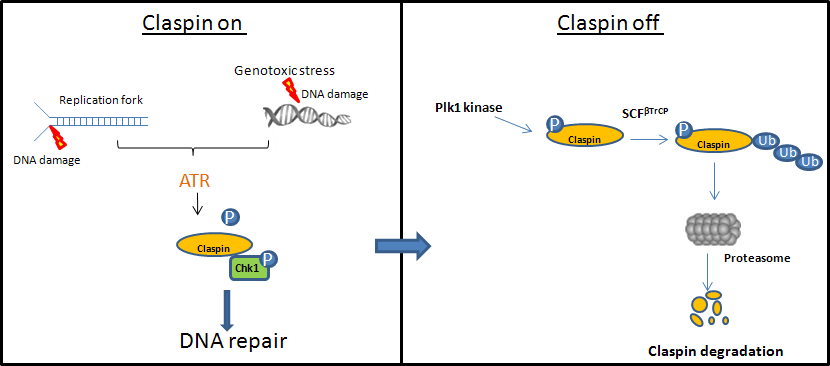
Figure 2. Claspin regulation during DNA damage checkpoint response pathway. Upon DNA damage, ATR activates Claspin, promoting the activation of the effector kinase Chk1. Once the damage is repaired, Plk1 binds and phosphorylates Claspin favoring its proteasomal degradation.
Function
Claspin is a S-phase checkpoint regulator required in response to DNA replication stress and to DNA damage induced by UV and irradiation (Chini and Chen, 2003; Sar et al., 2004; Freire et al., 2006; Tanaka, 2010). Claspin is a mediator of ATR-Chk1 signaling cascade triggers for cell cycle checkpoint activation in DNA damage response. Claspin becomes phosphorylated and interacts with Chk1 promoting its activation by ATR-dependent phosphorylation (Chini and Chen, 2004; Kumagai and Dunphy, 2003; Clarke and Clarke, 2005). Claspin also interacts with the checkpoint proteins ATR and RAd9, and ATR regulates Claspin phosphorylation in presence of DNA damage induced by genotoxic stress including UV, IR and hydroxyurea, resulting in recruitment and phosphorylation of BRCA1 (Jeong et al., 2003; Lin et al., 2004; Sørensen et al., 2004). When DNA damage has been repaired, Claspin response is turned off by ubiquitin proteasome pathway in order to inactivate checkpoint response and facilitate cells to enter the cell cycle. Therefore Claspin is phosphorylated by Plk1 kinase to permit its interaction with SCFβTrCP ubiquitin ligase that promotes its degradation (Mailand et al., 2006; Mamely et al., 2006; Peschiaroli et al., 2006). Claspin has also been found associated to replication forks in absence of DNA damage suggesting a function as a sensor required for replication fork stability (Sørensen et al., 2004; Petermann et al., 2008; Scorah et al., 2009). Finally it has been observed a role of the Claspin in genome stability. Inhibition of the Claspin by RNA interference leads to both chromosome alterations and fragile site expression in human cells. Following aphidicolin treatment, Claspin increases due to its requirement to checkpoint activation, while its synthesis decrement after a prolonged aphidicolin treatment. It has been proposed that, following an extreme replication block, Claspin allows rare cells to escape checkpoint mechanisms and enter mitosis although their genome has not yet fully replicated (Focarelli et al., 2009).
Homology
This gene is present in S. cerevisiae as scMrc1; in S. pombe as spMrc1; in vertebrates as Claspin.
Mutations
Germinal
- First study that reports the mutation screening of the CLSPN gene in familial breast cancer cases identifying different sequence changes (Erkko et al., 2008). Nevertheless no of these mutations is related to breast cancer susceptibility.
- Sequence variants of Claspin have been identified in different human cancers. Eight nonsynonymous variants were found from the germline of two cancer-prone individuals and five cancer cells lines of breast, ovarian, and hematopoietic origin (Zhang et al., 2009).
- Sequence variants of Claspin have been identified in different human cancers. Eight nonsynonymous variants were found from the germline of two cancer-prone individuals and five cancer cells lines of breast, ovarian, and hematopoietic origin (Zhang et al., 2009).
Implicated in
Entity name
Various cancers
Note
Claspin expression levels increased in cancer cells lines and tumor specimens in a study performed in normal fibroblasts and various cancer cell lines, and from tumor and normal tissues of patients with primary epithelial carcinomas, in order to evaluate Claspin as a proliferation marker (Tsimaratou et al., 2007).
Entity name
Breast cancer
Note
Transcript levels of Claspin were highly detected in tumor breast cancer tissues in which estrogen receptor and progesterone receptor was lost (Verlinden et al., 2007).
Entity name
Cervical cancer
Note
Claspin expression is found significantly high in cervical cancer cell lines and the analysis of its expression could be clinically relevant in the diagnosis of Human Papillomavirus-related high grade lesions of uterine cervix (Benevolo et al., 2012).
Article Bibliography
| Pubmed ID | Last Year | Title | Authors |
|---|---|---|---|
| 22731782 | 2012 | Claspin as a biomarker of human papillomavirus-related high grade lesions of uterine cervix. | Benevolo M et al |
| 15279790 | 2004 | Claspin, a regulator of Chk1 in DNA replication stress pathway. | Chini CC et al |
| 15707391 | 2005 | DNA-dependent phosphorylation of Chk1 and Claspin in a human cell-free system. | Clarke CA et al |
| 18077083 | 2008 | Germline alterations in the CLSPN gene in breast cancer families. | Erkko H et al |
| 19760606 | 2009 | Claspin inhibition leads to fragile site expression. | Focarelli ML et al |
| 17172868 | 2006 | Claspin: timing the cell cycle arrest when the genome is damaged. | Freire R et al |
| 12963733 | 2003 | Phosphorylated claspin interacts with a phosphate-binding site in the kinase domain of Chk1 during ATR-mediated activation. | Jeong SY et al |
| 12545175 | 2003 | Repeated phosphopeptide motifs in Claspin mediate the regulated binding of Chk1. | Kumagai A et al |
| 15096610 | 2004 | Human Claspin works with BRCA1 to both positively and negatively regulate cell proliferation. | Lin SY et al |
| 16885021 | 2006 | Destruction of Claspin by SCFbetaTrCP restrains Chk1 activation and facilitates recovery from genotoxic stress. | Mailand N et al |
| 16934469 | 2006 | Polo-like kinase-1 controls proteasome-dependent degradation of Claspin during checkpoint recovery. | Mamely I et al |
| 16885022 | 2006 | SCFbetaTrCP-mediated degradation of Claspin regulates recovery from the DNA replication checkpoint response. | Peschiaroli A et al |
| 18353973 | 2008 | Claspin promotes normal replication fork rates in human cells. | Petermann E et al |
| 15226314 | 2004 | Human claspin is a ring-shaped DNA-binding protein with high affinity to branched DNA structures. | Sar F et al |
| 19270516 | 2009 | Claspin and Chk1 regulate replication fork stability by different mechanisms. | Scorah J et al |
| 15190204 | 2004 | ATR, Claspin and the Rad9-Rad1-Hus1 complex regulate Chk1 and Cdc25A in the absence of DNA damage. | Sørensen CS et al |
| 21150122 | 2010 | Multiple functions of the S-phase checkpoint mediator. | Tanaka K et al |
| 17152083 | 2007 | Evaluation of claspin as a proliferation marker in human cancer and normal tissues. | Tsimaratou K et al |
| 17638866 | 2007 | The E2F-regulated gene Chk1 is highly expressed in triple-negative estrogen receptor /progesterone receptor /HER-2 breast carcinomas. | Verlinden L et al |
| 19737971 | 2009 | Prevalence and functional analysis of sequence variants in the ATR checkpoint mediator Claspin. | Zhang J et al |
Other Information
Locus ID:
NCBI: 63967
MIM: 605434
HGNC: 19715
Ensembl: ENSG00000092853
Variants:
dbSNP: 63967
ClinVar: 63967
TCGA: ENSG00000092853
COSMIC: CLSPN
RNA/Proteins
| Gene ID | Transcript ID | Uniprot |
|---|---|---|
| ENSG00000092853 | ENST00000251195 | Q9HAW4 |
| ENSG00000092853 | ENST00000318121 | Q9HAW4 |
| ENSG00000092853 | ENST00000373220 | Q9HAW4 |
| ENSG00000092853 | ENST00000520551 | E7ESG2 |
Expression (GTEx)
Pathways
References
| Pubmed ID | Year | Title | Citations |
|---|---|---|---|
| 38256171 | 2024 | The Interaction between CLSPN Gene Polymorphisms and Alcohol Consumption Contributes to Oral Cancer Progression. | 1 |
| 38256171 | 2024 | The Interaction between CLSPN Gene Polymorphisms and Alcohol Consumption Contributes to Oral Cancer Progression. | 1 |
| 35487167 | 2022 | CLSPN is a potential biomarker associated with poor prognosis in low-grade gliomas based on a multi-database analysis. | 1 |
| 35487167 | 2022 | CLSPN is a potential biomarker associated with poor prognosis in low-grade gliomas based on a multi-database analysis. | 1 |
| 33596143 | 2021 | Claspin Overexpression Promotes Tumor Progression and Predicts Poor Clinical Outcome in Prostate Cancer. | 4 |
| 33715066 | 2021 | Histones on fire: the effect of Dun1 and Mrc1 on origin firing and replication of hyper-acetylated genomes. | 1 |
| 33789090 | 2021 | Structural basis for recruitment of the CHK1 DNA damage kinase by the CLASPIN scaffold protein. | 4 |
| 34240817 | 2021 | Overexpression of claspin promotes docetaxel resistance and is associated with prostate-specific antigen recurrence in prostate cancer. | 8 |
| 34269180 | 2021 | circRNA derived from CLSPN (circCLSPN) is an oncogene in human glioblastoma multiforme by regulating cell growth, migration and invasion via ceRNA pathway. | 4 |
| 33596143 | 2021 | Claspin Overexpression Promotes Tumor Progression and Predicts Poor Clinical Outcome in Prostate Cancer. | 4 |
| 33715066 | 2021 | Histones on fire: the effect of Dun1 and Mrc1 on origin firing and replication of hyper-acetylated genomes. | 1 |
| 33789090 | 2021 | Structural basis for recruitment of the CHK1 DNA damage kinase by the CLASPIN scaffold protein. | 4 |
| 34240817 | 2021 | Overexpression of claspin promotes docetaxel resistance and is associated with prostate-specific antigen recurrence in prostate cancer. | 8 |
| 34269180 | 2021 | circRNA derived from CLSPN (circCLSPN) is an oncogene in human glioblastoma multiforme by regulating cell growth, migration and invasion via ceRNA pathway. | 4 |
| 31900278 | 2020 | Smoothened Promotes Glioblastoma Radiation Resistance Via Activating USP3-Mediated Claspin Deubiquitination. | 22 |
Citation
Linda Mannini
CLSPN (claspin)
Atlas Genet Cytogenet Oncol Haematol. 2012-10-01
Online version: http://atlasgeneticsoncology.org/gene/40105/clspn
