DLC1 (deleted in liver cancer 1)
2010-05-01 Frankie Chi Fat Ko , Irene Oi-Lin Ng , Judy Wai Ping Yam AffiliationDepartment of Pathology, University Pathology Building, Queen Mary Hospital, Pokfulam, Hong Kong, China
Identity
DNA/RNA
Note
Start: 12940872 bp from pter,
End: 13372395 bp from pter,
Size: 475895 bases,
Orientation: minus strand.

Description
Transcription
DLC1alpha: 6044 bp (NM_006094),
DLC1beta: 7445 bp (NM_182643),
DLC1gamma: 1975 bp (NM_024767).
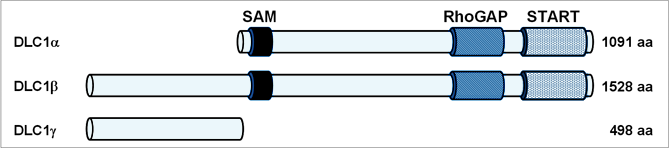
Among the three DLC1 isoforms, DLC1alpha represents the predominant isoform. It has a unique 5 untranslated region and a transcript size of 6044 bp. DLC1beta has the longest transcript size of 7445 bp. It contains a total of 19 exons including exons 2 to 14 of DLC1alpha and another 5 exons upstream of the transcriptional start site of DLC1alpha. DLC1gamma is the shortest isoform with a transcript size of 1975 bp. It shares the first 5 exons with DLC1gamma and has a unique exon 6.
CpG islands have been reported to be found in -387 to +502 and +554 to +765 of DLC1alpha promoter. In this region, 11 SP1 and 4 GCF transcription factor binding sites (-162 to +67) have also been documented (Yuan et al., 2003). Genomic deletions and promoter hypermethylation are responsible for the underexpression of DLC1 not only in HCC but in various cancer cells and tissues (Wong et al., 2003; Durkin et al., 2007a). DLC1beta and gamma share the same promoter region and are formed by alternative splicing at the 3 end. One potential AP-1 site has been reported to be localized at -134 position in DLC1beta and gamma promoter region. The absence of CpG island in DLC1beta and gamma promoter region suggests that their expressions are less likely to be transcriptionally regulated by epigenetic alterations.
Proteins
Note
DLC1alpha: 1091 amino acids; 122 kDa,
DLC1beta: 1528 amino acids,
DLC1gamma: 498 amino acids.
Description
Functional domains:
SAM (Sterile Alpha Motif)
Interpro: IPR001660; SAM
Pfam: PF07647; SAM_2
PROSITE: PS50105; SAM_DOMAIN
RhoGAP (RhoGTPase Activating Protein)
Interpro: IPR000198; RhoGAP
Pfam: PF00620; RhoGAP
PROSITE: PS50238; RHOGAP
SMART: SM00324; RhoGAP
START (STeroidogenic Acute Regulatory related lipid Transfer)
Interpro: IPR002913; START_lipid_bd
Pfam: PF01852; START
PROSITE: PS50848; START
SMART: SM00234; START
Expression
Localisation
Function
The tumor and metastasis suppressive effects of DLC1 have been well characterized by ectopic expression of DLC1 in various cancer cell lines. Extensive studies have shown that the RhoGAP activity is crucial to the biological activities of DLC1. Introduction of DLC1 into cancer cell lines has been shown to suppress cell proliferation (Ng et al., 2000), inhibit cell migration and invasion (Wong et al., 2005; Qian et al., 2007), and induce apoptosis (Zhou et al., 2004). Moreover, restoration of DLC1 expression has been shown to inhibit metastasis of cancer cells in mouse model (Goodison et al., 2005). Functional data about the loss of DLC1 in HCC tumorigenesis was first demonstrated in a mouse model using a liver-specific, short-hairpin RNA-mediated DLC1 knockdown approach (Xue at al., 2008). In p53 null; c-myc-transduced mouse hepatoblasts, RNAi knockdown of DLC1 could promote in vivo tumorigenicity of cells. Apart from RhoGAP activity, proper focal adhesion localization and interaction with tensin proteins have been demonstrated to play important roles in the biological activities of DLC1 (Yam et al., 2006; Liao et al., 2007; Qian et al., 2007; Chan et al., 2009). Other proteins including caveolin-1 (Yam et al., 2006), p120RasGAP (Yang et al., 2009) and 14-3-3 (Scholz et al., 2009) protein have also been identified as interacting partners of DLC1 with functional implications. Using knockout mouse model, DLC1 has been shown to be crucial to the early embryonic development of mouse (Durkin et al., 2005). DLC1-/- embryos are embryonic lethal while DLC1+/- mouse is phenotypically normal. Mouse embryonic fibroblasts isolated from DLC1 deficient mice displayed altered cytoskeletal organization and focal adhesions.
Regulation:
DLC1 is widely expressed in normal human tissues, but it is frequently underexpressed in HCC and other cancers. Heterozygous deletion and promoter hypermethylation of DLC1 are commonly found in about 30-50% of cases in various human cancers (Yuan et al., 2003a). Although DLC1 expression and activity have been well documented to be regulated at the transcriptional level, recent studies about the regulation of RhoGAP activity, interacting potentials and subcellular localization of DLC1 have pointed to an essential regulatory role by the central region of DLC1. In the central focal adhesion targeting region of DLC1, somatic mutations of DLC1 have been first detected in human prostate cancers (Liao et al., 2008). These mutations impaired the RhoGAP activity of DLC1. Crucial residues in the central region have also been shown to be responsible for proper focal adhesion localization and interacting with tensin proteins (Chan et al., 2009; Liao et al., 2007). Mutation at these crucial residues caused DLC1 to lose its focal adhesion localization and tumor suppressive activity. More importantly, the central region has been subjected to post-translational modifications. Scholz et al. have suggested that PKD-mediated DLC1 phosphorylation stimulates the association between DLC1 and 14-3-3 proteins. Enhanced association blocks DLC1 nucleocytoplasmic shuttling and inhibits the RhoGAP activity of DLC1 (Scholz et al., 2009). Moreover, identification of rat homolog of DLC1, p122RhoGAP as the substrate of Akt has provided insights into other potential regulatory pathways of DLC1 (Hers et al., 2006). However, the functional significance Akt phosphorylation in p122RhoGAP and its relevance in human DLC1 have not been investigated.
Homology
Mutations
Note
Somatic
Colorectal cancer (N=37)
1243 G->T (S308I) - (1/37) 2.7%
1279 G->T (S320I) - (1/37) 2.7%
1333 AC->TA (Y338L) - (1/37) 2.7%
1336 T->A (L339*) - (1/37) 2.7%
Prostate cancer (N=28)
1189 C->T (P290L) - (2/28) 7.1%
1222 C->A (T301K) - (1/28) 3.6%
1243 G->T (S308I) - (3/28) 10.7%
1249 C->A (S310*) - (1/28) 3.6%
The nonsense mutations (S310* and L339*) resulted in truncated DLC1 proteins with the loss of intact focal adhesion targeting region, RhoGAP and START domains. These truncated proteins are nonfunctional. Colony formation assay revealed that both T301K and S308I mutants displayed significant reduction in growth suppression activities. In addition, RhoGAP activity was downregulated in the two mutants as well.
Implicated in
Article Bibliography
| Pubmed ID | Last Year | Title | Authors |
|---|---|---|---|
| 19440389 | 2009 | Deleted in liver cancer 1 (DLC1) utilizes a novel binding site for Tensin2 PTB domain interaction and is required for tumor-suppressive function. | Chan LK et al |
| 15710412 | 2005 | DLC-1, a Rho GTPase-activating protein with tumor suppressor function, is essential for embryonic development. | Durkin ME et al |
| 17297465 | 2007 | Deleted in liver cancer 3 (DLC-3), a novel Rho GTPase-activating protein, is downregulated in cancer and inhibits tumor cell growth. | Durkin ME et al |
| 17979893 | 2007 | DLC-1:a Rho GTPase-activating protein and tumour suppressor. | Durkin ME et al |
| 16024604 | 2005 | The RhoGAP protein DLC-1 functions as a metastasis suppressor in breast cancer cells. | Goodison S et al |
| 18369381 | 2008 | Adenovirus-mediated restoration of expression of the tumor suppressor gene DLC1 inhibits the proliferation and tumorigenicity of aggressive, androgen-independent human prostate cancer cell lines: prospects for gene therapy. | Guan M et al |
| 16533763 | 2006 | Aberrant methylation and deacetylation of deleted in liver cancer-1 gene in prostate cancer: potential clinical applications. | Guan M et al |
| 17932950 | 2008 | DLC-1 suppresses non-small cell lung cancer growth and invasion by RhoGAP-dependent and independent mechanisms. | Healy KD et al |
| 19482022 | 2009 | Simultaneous loss of the DLC1 and PTEN tumor suppressors enhances breast cancer cell migration. | Heering J et al |
| 16338927 | 2006 | Identification of p122RhoGAP (deleted in liver cancer-1) Serine 322 as a substrate for protein kinase B and ribosomal S6 kinase in insulin-stimulated cells. | Hers I et al |
| 18288400 | 2008 | Inhibition of DLC-1 gene expression by RNA interference in the colon cancer LoVo cell line. | Jin Y et al |
| 12813468 | 2003 | Transcriptional silencing of the DLC-1 tumor suppressor gene by epigenetic mechanism in gastric cancer cells. | Kim TY et al |
| 19874489 | 2010 | Deleted in liver cancer 1 isoforms are distinctly expressed in human tissues, functionally different and under differential transcriptional regulation in hepatocellular carcinoma. | Ko FC et al |
| 17521951 | 2008 | Deleted in liver cancer-1 (DLC-1): a tumor suppressor not just for liver. | Liao YC et al |
| 18829524 | 2008 | Mutations in the focal adhesion targeting region of deleted in liver cancer-1 attenuate their expression and function. | Liao YC et al |
| 17190795 | 2007 | The phosphotyrosine-independent interaction of DLC-1 and the SH2 domain of cten regulates focal adhesion localization and growth suppression activity of DLC-1. | Liao YC et al |
| 11118037 | 2000 | DLC-1 is deleted in primary hepatocellular carcinoma and exerts inhibitory effects on the proliferation of hepatoma cell lines with deleted DLC-1. | Ng IO et al |
| 12792785 | 2003 | DNA variants of DLC-1, a candidate tumor suppressor gene in human hepatocellular carcinoma. | Park SW et al |
| 12759748 | 2003 | Analysis of DLC-1 expression in human breast cancer. | Plaumann M et al |
| 17517630 | 2007 | Oncogenic inhibition by a deleted in liver cancer gene requires cooperation between tensin binding and Rho-specific GTPase-activating protein activities. | Qian X et al |
| 19066281 | 2009 | DLC1 interacts with 14-3-3 proteins to inhibit RhoGAP activity and block nucleocytoplasmic shuttling. | Scholz RP et al |
| 16862168 | 2007 | The major 8p22 tumor suppressor DLC1 is frequently silenced by methylation in both endemic and sporadic nasopharyngeal, esophageal, and cervical carcinomas, and inhibits tumor cell colony formation. | Seng TJ et al |
| 17016643 | 2006 | Expression profile of the tumor suppressor genes DLC-1 and DLC-2 in solid tumors. | Ullmannova V et al |
| 10649492 | 2000 | Sequence variants of DLC1 in colorectal and ovarian tumours. | Wilson PJ et al |
| 18648664 | 2008 | Deleted in liver cancer 1 (DLC1) negatively regulates Rho/ROCK/MLC pathway in hepatocellular carcinoma. | Wong CC et al |
| 14633684 | 2003 | Genetic and epigenetic alterations of DLC-1 gene in hepatocellular carcinoma. | Wong CM et al |
| 16204057 | 2005 | Rho GTPase-activating protein deleted in liver cancer suppresses cell proliferation and invasion in hepatocellular carcinoma. | Wong CM et al |
| 19667410 | 2009 | Restoration of DLC1 gene inhibits proliferation and migration of human colon cancer HT29 cells. | Wu PP et al |
| 18519636 | 2008 | DLC1 is a chromosome 8p tumor suppressor whose loss promotes hepatocellular carcinoma. | Xue W et al |
| 16951145 | 2006 | Interaction of deleted in liver cancer 1 with tensin2 in caveolae and implications in tumor suppression. | Yam JW et al |
| 19151751 | 2009 | p120Ras-GAP binds the DLC1 Rho-GAP tumor suppressor protein and inhibits its RhoA GTPase and growth-suppressing activities. | Yang XY et al |
| 12645648 | 2003 | Promoter hypermethylation of DLC-1, a candidate tumor suppressor gene, in several common human cancers. | Yuan BZ et al |
| 17888903 | 2007 | Morphological changes and nuclear translocation of DLC1 tumor suppressor protein precede apoptosis in human non-small cell lung carcinoma cells. | Yuan BZ et al |
| 9605766 | 1998 | Cloning, characterization, and chromosomal localization of a gene frequently deleted in human liver cancer (DLC-1) homologous to rat RhoGAP. | Yuan BZ et al |
| 12545165 | 2003 | DLC-1 gene inhibits human breast cancer cell growth and in vivo tumorigenicity. | Yuan BZ et al |
| 19380190 | 2009 | Overexpression of DLC-1 induces cell apoptosis and proliferation inhibition in the renal cell carcinoma. | Zhang T et al |
| 14647417 | 2004 | Restoration of DLC-1 gene expression induces apoptosis and inhibits both cell growth and tumorigenicity in human hepatocellular carcinoma cells. | Zhou X et al |
| 18497990 | 2008 | DLC1 suppresses distant dissemination of human hepatocellular carcinoma cells in nude mice through reduction of RhoA GTPase activity, actin cytoskeletal disruption and down-regulation of genes involved in metastasis. | Zhou X et al |
Other Information
Locus ID:
NCBI: 10395
MIM: 604258
HGNC: 2897
Ensembl: ENSG00000164741
Variants:
dbSNP: 10395
ClinVar: 10395
TCGA: ENSG00000164741
COSMIC: DLC1
RNA/Proteins
Expression (GTEx)
Pathways
| Pathway | Source | External ID |
|---|---|---|
| Signal Transduction | REACTOME | R-HSA-162582 |
| Signaling by Rho GTPases | REACTOME | R-HSA-194315 |
| Rho GTPase cycle | REACTOME | R-HSA-194840 |
Protein levels (Protein atlas)
References
| Pubmed ID | Year | Title | Citations |
|---|---|---|---|
| 38563084 | 2024 | DLC1 promotes mechanotransductive feedback for YAP via RhoGAP-mediated focal adhesion turnover. | 0 |
| 38563084 | 2024 | DLC1 promotes mechanotransductive feedback for YAP via RhoGAP-mediated focal adhesion turnover. | 0 |
| 36917700 | 2023 | Aberrant DNA Methylation Patterns of Deleted in Liver Cancer 1 Isoforms in Hepatocellular Carcinoma. | 2 |
| 36917700 | 2023 | Aberrant DNA Methylation Patterns of Deleted in Liver Cancer 1 Isoforms in Hepatocellular Carcinoma. | 2 |
| 33417200 | 2022 | Frequent Downregulation and Promoter Hypermethylation of DLC1: Relationship with Clinical Outcome in Gallbladder Cancer. | 0 |
| 34751841 | 2022 | MiR-200a-3p promotes gastric cancer progression by targeting DLC-1. | 4 |
| 35951458 | 2022 | NBR2/miR-561-5p/DLC1 axis inhibited the development of multiple myeloma by activating the AMPK/mTOR pathway to repress glycolysis. | 0 |
| 33417200 | 2022 | Frequent Downregulation and Promoter Hypermethylation of DLC1: Relationship with Clinical Outcome in Gallbladder Cancer. | 0 |
| 34751841 | 2022 | MiR-200a-3p promotes gastric cancer progression by targeting DLC-1. | 4 |
| 35951458 | 2022 | NBR2/miR-561-5p/DLC1 axis inhibited the development of multiple myeloma by activating the AMPK/mTOR pathway to repress glycolysis. | 0 |
| 33391541 | 2021 | Circular RNA circDLC1 inhibits MMP1-mediated liver cancer progression via interaction with HuR. | 78 |
| 33439397 | 2021 | CircZKSCAN1 Suppresses Hepatocellular Carcinoma Tumorigenesis by Regulating miR-873-5p/Downregulation of Deleted in Liver Cancer 1. | 6 |
| 33591950 | 2021 | TMEM106C contributes to the malignant characteristics and poor prognosis of hepatocellular carcinoma. | 14 |
| 33678109 | 2021 | DLC1 inhibits lung adenocarcinoma cell proliferation, migration and invasion via regulating MAPK signaling pathway. | 6 |
| 33754907 | 2021 | MIR-301b-3p Promotes Lung Adenocarcinoma Cell Proliferation, Migration and Invasion by Targeting DLC1. | 9 |
Citation
Frankie Chi Fat Ko ; Irene Oi-Lin Ng ; Judy Wai Ping Yam
DLC1 (deleted in liver cancer 1)
Atlas Genet Cytogenet Oncol Haematol. 2010-05-01
Online version: http://atlasgeneticsoncology.org/gene/40328/dlc1
