FGFR2 (fibroblast growth factor receptor 2)
2008-08-01 Masaru Katoh AffiliationGenetics, Cell Biology Section, National Cancer Center Research Institute, 5-1-1 Tsukiji, Chuo-ku, Tokyo 104-0045, Japan
Identity
HGNC
LOCATION
10q26.13
LOCUSID
ALIAS
BBDS,BEK,BFR-1,CD332,CEK3,CFD1,ECT1,JWS,K-SAM,KGFR,TK14,TK25
FUSION GENES
DNA/RNA
Note
FGFR2 gene at chromosome 10q26.13 and FGFR1 gene at chromosome 8p12 are paralogs within the human genome.
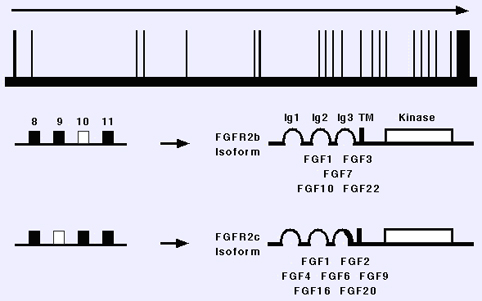
Structure and alternative splicing of FGFR2 gene.
Description
FGFR2 gene, consisting of at least 21 exons, encodes multiple isoforms due to alternative splicing. FGFR2b and FGFR2c with extracellular three Ig-like domains, transmembrane domain and cytoplasmic tyrosine kinase domain, are representative FGFR2 isoforms almost identical except the latter half of the third Ig-like domain. Exon 9 and 10, corresponding to the latter half of the third Ig-like domain, are incorporated into FGFR2b and FGFR2c in a mutually exclusive manner. Splicing silencer sequence within intron 8 and splicing activator sequence within intron 9 are implicated in the regulation of splicing preferentiality for FGFR2b and FGFR2c. Exons 20 and 21 of FGFR2 gene are alternative last exons encoding the C-terminal region of FGFR2 isoforms. Wild type FGFR2 transcripts with exon 21 are expressed in normal cells and most tumor cells, while aberrant FGFR2 transcripts with exon 20 are overexpressed in cases with FGFR2 gene amplification due to the exclusion of exon 21 from the FGFR2 amplicon. FGFR2 gene also encodes transmembrane-type FGFR2 isoforms lacking the first Ig-like domain, and secreted-type FGFR2 isoforms.
Transcription
FGFR2b isoform is predominantly expressed in epithelial cells, while FGFR2c isoform preferentially in mesenchymal cells. FGFR2 is expressed in undifferentiated human ES cells, and also in ES-derived embryoid body, endodermal precursors, and neural precursors. FGFR2 is relatively highly expressed in fetal brain. Among adult human tissues, FGFR2 is relatively highly expressed in brain, retina, spinal cord, salivary gland, skin, kidney and uterus. FGFR2 is overexpressed in human breast cancer and gastric cancer due to gene amplification.
Proteins
Note
FGFR2 functions as transmembrane receptor for FGF family members, such as FGF1 (aFGF), FGF2 (bFGF), FGF3, FGF4 (Kaposis sarcoma-derived FGF or KFGF), FGF6, FGF7 (keratinocyte growth factor or KGF), FGF9, FGF10, FGF16, FGF20 and FGF22 FGFR2b and FGFR2c are representative FGFR2 isoforms with distinct ligand specificity.
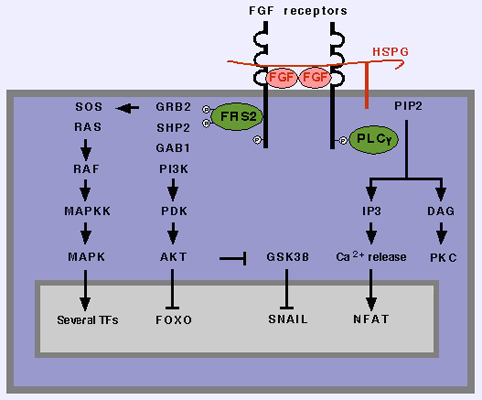
Schematic representation of FGF signaling cascades.
Description
FGFR2b and FGFR2c are representative FGFR2 isoforms, consisting of extracellular three Ig-like domains, transmembrane domain, and cytoplasmic tyrosine kinase domain. FGFR2b and FGFR2c are almost identical except the latter half of the third Ig-like domain. The divergence in the latter half of the third Ig-like domain leads to distinct ligand specificity between FGFR2b and FGFR2c. FGFR2b is a high affinity receptor for FGF1, FGF3, FGF7, FGF10 and FGF22, while FGFR2c is a high affinity receptor for FGF1, FGF2, FGF4, FGF6, FGF9, FGF16 and FGF20.
Localisation
FGFR2b and FGFR2c with the N-terminal signal peptide and a single transmembrane domain are localized to the plasma membrane.
Function
FGFR2 is a high affinity receptor for FGFs associated with heparan sulfate proteoglycans (HSPGs). Ligand-dependent FGFR2 dimerization releases FGFR2 from autoinhibition due to autophosphorylation of a key tyrosine residue within the activation loop of kinase domain. FRS2 (FRS2A) and FRS3 (FRS2B) are tyrosine phosphorylated by FGFR2 to recruit GRB2 and PTPN11 for the activation of SOS - RAS - RAF- MAP3K - MAP2K - MAPK and GAB1 - PI3K - AKT signaling cascades. Phospholipase C-gamma (PLCgamma) is recruited to FGFR2 through its interaction with phosphotyrosine residues on the C-terminal tail of activated FGFR2, which results in the catalysis of phosphatidylinositol diphosphate (PIP2) to diacylglycerol (DAG) and inositol triphosphate (IP3). DAG activates protein kinase C (PKC) signaling cascade, while IP3 induces Ca2+ release from endoplasmic reticulum for the following activation of Calmodulin-Calcineurin-NFAT signaling cascade. FGFR2 transduces FGF signals to the MAPK and PI3K-AKT signaling cascades through FRS2 or FGF3, and to the PKC and NFAT signaling cascades through PLCgamma.
Homology
FGFR2b and FGFR2c are almost identical except the latter half of the third Ig-like domain as mentioned above. Among receptor-type tyrosine kinases, FGFR2 isoforms are more homologous to FGFR1 isoforms.
Mutations
Note
Germinal missense mutations of FGFR2 gene occur in congenital skeletal disorders. Intronic single nucleotide polymorphisms (SNPs) of FGFR2 gene are associated with increased cancer risk. Somatic missense mutations or gene amplification of FGFR2 occur in several types of cancer.
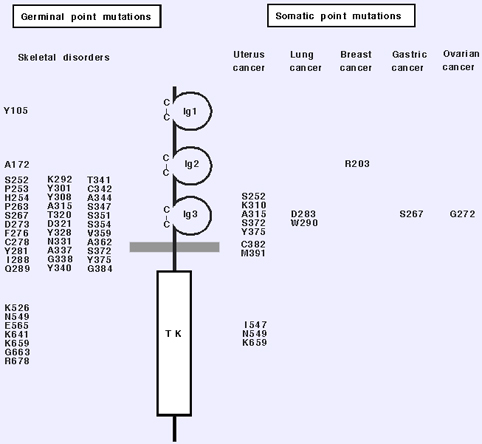
Germinal and somatic point mutations of FGFR2.
Germinal
Germinal missense mutations of FGFR2 gene occur in congenital skeletal disorders, such as Crouzon syndrome, Jackson-Weiss syndrome, Apert syndrome, Pfeiffer syndrome, and Beare-Stevenson syndrome, which are featured by short-limbed bone dysplasia (craniosynostosis), and syndrome-specific abnormalities, such as Crouzonoid facies, bone syndactyly, limb abnormalities, and cutis gyrata. FGFR2 missense mutations around the third Ig-like domain result in altered ligand-receptor specificity to create the autocrine signaling loop. FGFR2 missense mutations within the tyrosine kinase domain lead to ligand independent activation of FGFR2. Germinal FGFR2 missense mutations cause congenital skeletal disorders due to aberrant FGFR2 signaling activation.
In addition, SNPs within intron 2 of FGFR2 gene are associated with increased risk of breast cancer, partly due to transcriptional upregulation of FGFR2.
In addition, SNPs within intron 2 of FGFR2 gene are associated with increased risk of breast cancer, partly due to transcriptional upregulation of FGFR2.
Somatic
Somatic missense mutations or gene amplification of FGFR2 occur in uterus cancer (endometrial cancer), lung cancer, breast cancer, gastric cancer, and ovarian cancer. Genetic alterations of FGFR2 lead to aberrant activation of FGFR2 signaling cascades due to the creation of autocrine signaling loop or the release of FGFR2 from autoinhibition.
Implicated in
Entity name
Cancer
Disease
Somatic missense mutations or gene amplification of FGFR2 occur in endometrial cancer, lung cancer, breast cancer, gastric cancer, and ovarian cancer as mentioned above. In addition, class switch from FGFR2b to FGFR2c occurs during malignant progression of prostate cancer and bladder cancer. Somatic mutations and class switch of FGFR2 isoforms induce aberrant FGFR2 signaling activation in tumor cells.
Prognosis
FGFR2 gene amplification accompanied by FGFR2 overexpression in breast cancer and gastric cancer is associated with poor prognosis. Class switch from FGFR2b to FGFR2c is associated with more malignant phenotype in prostate cancer and bladder cancer.
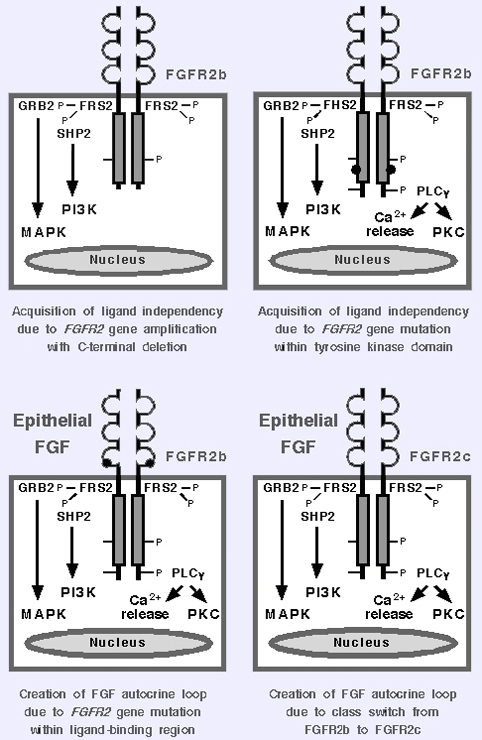
Mechanisms of oncogenic FGFR2 signaling activation.
Entity name
Congenital skeletal disorder
Disease
Germinal mutations of FGFR2 gene occur in Crouzon syndrome, Jackson-Weiss syndrome, Apert syndrome, Pfeiffer syndrome, and Beare-Stevenson syndrome. FGFR2 missense mutations cause congenital skeletal disorders due to aberrant FGFR2 signaling activation as mentioned above.
Breakpoints
Article Bibliography
| Pubmed ID | Last Year | Title | Authors |
|---|---|---|---|
| 1851551 | 1991 | BEK and FLG, two receptors to members of the FGF family, are amplified in subsets of human breast cancers. | Adnane J et al |
| 2165484 | 1990 | Characterization of the receptor for keratinocyte growth factor. Evidence for multiple fibroblast growth factor receptors. | Bottaro DP et al |
| 11596961 | 2001 | Negative autoregulation of fibroblast growth factor receptor 2 expression characterizing cranial development in cases of Apert (P253R mutation) and Pfeiffer (C278F mutation) syndromes and suggesting a basis for differences in their cranial phenotypes. | Britto JA et al |
| 10982855 | 2000 | An intronic splicing silencer causes skipping of the IIIb exon of fibroblast growth factor receptor 2 through involvement of polypyrimidine tract binding protein. | Carstens RP et al |
| 18337450 | 2008 | Involvement of fibroblast growth factor receptor 2 isoform switching in mammary oncogenesis. | Cha JY et al |
| 17697126 | 2007 | Aberrant fibroblast growth factor receptor signaling in bladder and other cancers. | Chaffer CL et al |
| 1648704 | 1991 | Multiple mRNAs code for proteins related to the BEK fibroblast growth factor receptor. | Champion-Arnaud P et al |
| 17803937 | 2007 | A molecular brake in the kinase hinge region regulates the activity of receptor tyrosine kinases. | Chen H et al |
| 16502419 | 2006 | Twist1 dimer selection regulates cranial suture patterning and fusion. | Connerney J et al |
| 16140923 | 2005 | Somatic mutations of the protein kinase gene family in human lung cancer. | Davies H et al |
| 1400433 | 1992 | A novel form of fibroblast growth factor receptor 2. Alternative splicing of the third immunoglobulin-like domain confers ligand binding specificity. | Dell KR et al |
| 9018118 | 1997 | Decreased expression of keratinocyte growth factor receptor in a subset of human transitional cell bladder carcinomas. | Diez de Medina SG et al |
| 1697263 | 1990 | Cloning and expression of two distinct high-affinity receptors cross-reacting with acidic and basic fibroblast growth factors. | Dionne CA et al |
| 1582255 | 1992 | BEK, a receptor for multiple members of the fibroblast growth factor (FGF) family, maps to human chromosome 10q25.3----q26. | Dionne CA et al |
| 18552176 | 2008 | Drug-sensitive FGFR2 mutations in endometrial carcinoma. | Dutt A et al |
| 17529967 | 2007 | Genome-wide association study identifies novel breast cancer susceptibility loci. | Easton DF et al |
| 15863030 | 2005 | Cellular signaling by fibroblast growth factor receptors. | Eswarakumar VP et al |
| 8355693 | 1993 | Control of BEK and K-SAM splice sites in alternative splicing of the fibroblast growth factor receptor 2 pre-mRNA. | Gilbert E et al |
| 11564899 | 2001 | CGH, cDNA and tissue microarray analyses implicate FGFR2 amplification in a small subset of breast tumors. | Heiskanen M et al |
| 2172978 | 1990 | Related fibroblast growth factor receptor genes exist in the human genome. | Houssaint E et al |
| 17997823 | 2007 | Clinical correlates of low-risk variants in FGFR2, TNRC9, MAP3K1, LSP1 and 8q24 in a Dutch cohort of incident breast cancer cases. | Huijts PE et al |
| 17529973 | 2007 | A genome-wide association study identifies alleles in FGFR2 associated with risk of sporadic postmenopausal breast cancer. | Hunter DJ et al |
| 11856867 | 2001 | Fibroblast growth factor receptor 2 (FGFR2): genomic sequence and variations. | Ingersoll RG et al |
| 7874170 | 1994 | Jackson-Weiss and Crouzon syndromes are allelic with mutations in fibroblast growth factor receptor 2. | Jabs EW et al |
| 11325814 | 2001 | Mutations in fibroblast growth factor receptor 2 and fibroblast growth factor receptor 3 genes associated with human gastric and colorectal cancers. | Jang JH et al |
| 11781872 | 2002 | Genomic screening of fibroblast growth-factor receptor 2 reveals a wide spectrum of mutations in patients with syndromic craniosynostosis. | Kan SH et al |
| 1313574 | 1992 | K-sam gene encodes secreted as well as transmembrane receptor tyrosine kinase. | Katoh M et al |
| 16773196 | 2006 | FGF signaling network in the gastrointestinal tract (review). | Katoh M et al |
| 18636142 | 2008 | Cancer genomics and genetics of FGFR2 (Review). | Katoh M et al |
| 18332103 | 2008 | Fibroblast growth factor receptor 2 phosphorylation on serine 779 couples to 14-3-3 and regulates cell survival and proliferation. | Lonic A et al |
| 8814701 | 1996 | Expression of FGFR2 BEK and K-SAM mRNA variants in normal and malignant human breast. | Luqmani YA et al |
| 9537256 | 1998 | Inhibition of growth of malignant rat prostate tumor cells by restoration of fibroblast growth factor receptor 2. | Matsubara A et al |
| 18462018 | 2008 | Allele-specific up-regulation of FGFR2 increases susceptibility to breast cancer. | Meyer KB et al |
| 1846048 | 1991 | Expression cDNA cloning of the KGF receptor by creation of a transforming autocrine loop. | Miki T et al |
| 15561780 | 2004 | Transforming potential of alternatively spliced variants of fibroblast growth factor receptor 2 in human mammary epithelial cells. | Moffa AB et al |
| 8453595 | 1993 | DNA amplification in human gastric carcinomas. | Mor O et al |
| 8663044 | 1996 | Receptor specificity of the fibroblast growth factor family. | Ornitz DM et al |
| 10425034 | 1999 | Clinical spectrum of fibroblast growth factor receptor mutations. | Passos-Bueno MR et al |
| 9585583 | 1998 | Genetic heterogeneity of Saethre-Chotzen syndrome, due to TWIST and FGFR mutations. | Paznekas WA et al |
| 7705943 | 1995 | Expression of FGF and FGF receptor genes in human breast cancer. | Penault-Llorca F et al |
| 17525745 | 2007 | Frequent activating FGFR2 mutations in endometrial carcinomas parallel germline mutations associated with craniosynostosis and skeletal dysplasia syndromes. | Pollock PM et al |
| 18483326 | 2008 | FGFR2 is a breast cancer susceptibility gene in Jewish and Arab Israeli populations. | Raskin L et al |
| 1711190 | 1991 | PCR-based identification of new receptors: molecular cloning of a receptor for fibroblast growth factors. | Raz V et al |
| 7987400 | 1994 | Mutations in the fibroblast growth factor receptor 2 gene cause Crouzon syndrome. | Reardon W et al |
| 10602477 | 1999 | Tumour suppressive properties of fibroblast growth factor receptor 2-IIIb in human bladder cancer. | Ricol D et al |
| 8527895 | 1995 | Keratinocyte growth factor as a cytokine that mediates mesenchymal-epithelial interaction. | Rubin JS et al |
| 7528517 | 1994 | Characteristics of FGF-receptors expressed by stromal and epithelial cells cultured from normal and hyperplastic prostates. | Story MT et al |
| 12900900 | 2003 | Beare-Stevenson syndrome: Two South American patients with FGFR2 analysis. | Vargas RA et al |
| 9300656 | 1997 | Craniosynostosis: genes and mechanisms. | Wilkie AO et al |
| 7719344 | 1995 | Apert syndrome results from localized mutations of FGFR2 and is allelic with Crouzon syndrome. | Wilkie AO et al |
| 12357470 | 2002 | FGFs, their receptors, and human limb malformations: clinical and molecular correlations. | Wilkie AO et al |
| 15863034 | 2005 | Bad bones, absent smell, selfish testes: the pleiotropic consequences of human FGF receptor mutations. | Wilkie AO et al |
| 7687739 | 1993 | Exon switching and activation of stromal and embryonic fibroblast growth factor (FGF)-FGF receptor genes in prostate epithelial cells accompany stromal independence and malignancy. | Yan G et al |
| 1316275 | 1992 | A confined variable region confers ligand specificity on fibroblast growth factor receptors: implications for the origin of the immunoglobulin fold. | Yayon A et al |
| 12591959 | 2003 | Structural basis by which alternative splicing confers specificity in fibroblast growth factor receptors. | Yeh BK et al |
| 11274381 | 2001 | Uncoupling fibroblast growth factor receptor 2 ligand binding specificity leads to Apert syndrome-like phenotypes. | Yu K et al |
| 16597617 | 2006 | Receptor specificity of the fibroblast growth factor family. The complete mammalian FGF family. | Zhang X et al |
Other Information
Locus ID:
NCBI: 2263
MIM: 176943
HGNC: 3689
Ensembl: ENSG00000066468
Variants:
dbSNP: 2263
ClinVar: 2263
TCGA: ENSG00000066468
COSMIC: FGFR2
RNA/Proteins
Expression (GTEx)
Pathways
Protein levels (Protein atlas)
PharmGKB
| Entity ID | Name | Type | Evidence | Association | PK | PD | PMIDs |
|---|---|---|---|---|---|---|---|
| PA164924492 | brivanib | Chemical | Pathway | associated | 20124951 | ||
| PA166182720 | erdafitinib | Chemical | LabelAnnotation | associated | |||
| PA26880 | CRK | Gene | Pathway | associated | 20124951 | ||
| PA28115 | FGF2 | Gene | Pathway | associated | 20124951 | ||
| PA33304 | PIK3C2A | Gene | Pathway | associated | 20124951 | ||
| PA33305 | PIK3C2B | Gene | Pathway | associated | 20124951 |
References
| Pubmed ID | Year | Title | Citations |
|---|---|---|---|
| 38265560 | 2024 | Expansion of the complex genotypic and phenotypic spectrum of FGFR2-associated neurocutaneous syndromes. | 0 |
| 38302798 | 2024 | Investigating FGFR2 gene as a blood-based epigenetic biomarker in gastric cancer. | 1 |
| 38328983 | 2024 | Superficial acral calcified chondroid mesenchymal neoplasm harboring an FN1::FGFR2 fusion and review of the literature. | 0 |
| 38532197 | 2024 | Expression of fibroblast growth factor receptor 2 (FGFR2) in combined hepatocellular-cholangiocarcinoma and intrahepatic cholangiocarcinoma: clinicopathological study. | 0 |
| 38561822 | 2024 | Genetic insights into the 'sandwich fusion' subtype of Klippel-Feil syndrome: novel FGFR2 mutations identified by 21 cases of whole-exome sequencing. | 0 |
| 38674107 | 2024 | Elucidating the Role of Wildtype and Variant FGFR2 Structural Dynamics in (Dys)Function and Disorder. | 0 |
| 38802203 | 2024 | Perinatal imaging findings of a fetus with Pfeiffer syndrome and a heterozygous c.1019A>G, p.Tyr340Cys (Y340C) mutation in FGFR2 presenting a cloverleaf skull, craniosynostosis and short limbs on prenatal ultrasound mimicking thanatophoric dysplasia type II. | 0 |
| 38265560 | 2024 | Expansion of the complex genotypic and phenotypic spectrum of FGFR2-associated neurocutaneous syndromes. | 0 |
| 38302798 | 2024 | Investigating FGFR2 gene as a blood-based epigenetic biomarker in gastric cancer. | 1 |
| 38328983 | 2024 | Superficial acral calcified chondroid mesenchymal neoplasm harboring an FN1::FGFR2 fusion and review of the literature. | 0 |
| 38532197 | 2024 | Expression of fibroblast growth factor receptor 2 (FGFR2) in combined hepatocellular-cholangiocarcinoma and intrahepatic cholangiocarcinoma: clinicopathological study. | 0 |
| 38561822 | 2024 | Genetic insights into the 'sandwich fusion' subtype of Klippel-Feil syndrome: novel FGFR2 mutations identified by 21 cases of whole-exome sequencing. | 0 |
| 38674107 | 2024 | Elucidating the Role of Wildtype and Variant FGFR2 Structural Dynamics in (Dys)Function and Disorder. | 0 |
| 38802203 | 2024 | Perinatal imaging findings of a fetus with Pfeiffer syndrome and a heterozygous c.1019A>G, p.Tyr340Cys (Y340C) mutation in FGFR2 presenting a cloverleaf skull, craniosynostosis and short limbs on prenatal ultrasound mimicking thanatophoric dysplasia type II. | 0 |
| 35029520 | 2023 | miRNA-381-3p Functions as a Tumor Suppressor to Inhibit Gastric Cancer by Targeting Fibroblast Growth Factor Receptor-2. | 3 |
Citation
Masaru Katoh
FGFR2 (fibroblast growth factor receptor 2)
Atlas Genet Cytogenet Oncol Haematol. 2008-08-01
Online version: http://atlasgeneticsoncology.org/gene/40570/fgfr2-(fibroblast-growth-factor-receptor-2)
