COL1A2 (collagen, type I, alpha 2)
2008-04-01 Elizabeth M Perruccio , David D Roberts AffiliationBiochemical Pathology Section, Laboratory of Pathology, CCR, NCI, Building 10, Room 2A27, 10 Center Drive MSC1500, Bethesda, MD 20892, USA
Identity
HGNC
LOCATION
7q21.3
LOCUSID
ALIAS
EDSARTH2,EDSCV,OI4
FUSION GENES
DNA/RNA
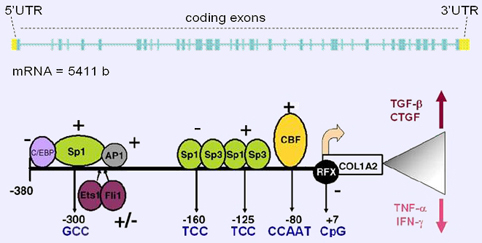
Factors regulating baseline transcription of COL1A2 (reprinted with permission from F. Ramirez). Top panel: organization of the COLIA2 gene. Lower panel: COLIA2 promoter.
Description
The COL1A2 gene is 36.67 kb and is composed of 52 exons that encode a 5411 base mRNA and a protein of 1366 amino acids.
Transcription
See figure summarizing basal transcription for COL1A2.
Cis-acting elements and trans-acting factors found within the proximal promoter, upstream enhancer and downstream repressor regions regulate the constitutive, cytokine-mediated and tissue-specific expression of this gene. The most 5 element around -300, is bound by C/EBP, Ets, AP1 and Sp1. This location contains the GCC-rich sequences which bind Sp1 and upon which COL1A2 promoter activity is highly dependent. Additionally, Ets1 and related Fli1, have differential effects on transcription within this region. Two TCC-rich boxes at -160 and -125 interact with Sp1 and Sp3. The TCC-rich box at -160 acts as a repressor and negatively modulates the downstream TCC-rich box as well as the upstream GCC-rich sequences. The CBF/NFY trimer is a transcriptional activator and binds to the canonical CCAAT motif at -80. RFX proteins bind the promoter at a methylation-sensitive CpG site at +7 and repress COL1A2 promoter activity.
The cytokine, TGF-β is an important regulator of tissue fibrosis and ECM remodeling and resides in the matrix as a latent complex until it is activated. TGF-β upregulates COL1A2 as well as CCN2/CTGF, PAI-1 and TIMP-1 thereby promoting matrix deposition. The TGF-β stimulation of the COL1A2 promoter depends on Sp1, Smad3 / Smad4 and the co-activators of p300/ CBP. In dermal fibroblasts, 5-Fluoruracil (5-FU) was shown to be an inhibitor of TGF-β / SMAD mediated COL1A2 transcription. The anti-fibrotic actions of TNF-α and IFN-γ result in the quenching of the TGB-β response as well as inhibiting the basal transcription of COL1A2.
The tumor suppressor p53, is a modulator of the COL1A2 gene. p53-dependent stress response genes were analyzed in normal cells and tissues that were irradiated against a background of differential p53 expression. In gamma irradiated fibroblasts, Komarova et. al. showed that COL1A2 was upregulated in a p53-dependent manner and functions as a growth repressor. Production of COL1A2 therefore may be partly responsible for the growth suppression that characterizes the "bystander effect" of p53-dependent gene therapy.
In studies using adenovirally-mediated Fli 1 siRNA in human dermal fibroblasts, reduction of Fli1 expression resulted in significant upregulation of both COL1A1 and COL1A2 genes, as well as proteins,and confirmed that Fli 1 is a repressor for collagen type 1. In comparison, TGFβ stimulation resulted in a 2-fold increase of the collagen mRNAs
Stuiver et al (1991) determined that the COL1A2 promoter contains a response element sensitive to the phorbol ester, TPA, an activator of PKC. TPA increased COL1A2 at the transcriptional and protein level only in TPA-responsive 3T3-L1 fibroblasts but not in VT-1 fibroblasts, a variant cell line that is non-responsive to TPA due to the inability of PKC translocation to the membrane.
Cis-acting elements and trans-acting factors found within the proximal promoter, upstream enhancer and downstream repressor regions regulate the constitutive, cytokine-mediated and tissue-specific expression of this gene. The most 5 element around -300, is bound by C/EBP, Ets, AP1 and Sp1. This location contains the GCC-rich sequences which bind Sp1 and upon which COL1A2 promoter activity is highly dependent. Additionally, Ets1 and related Fli1, have differential effects on transcription within this region. Two TCC-rich boxes at -160 and -125 interact with Sp1 and Sp3. The TCC-rich box at -160 acts as a repressor and negatively modulates the downstream TCC-rich box as well as the upstream GCC-rich sequences. The CBF/NFY trimer is a transcriptional activator and binds to the canonical CCAAT motif at -80. RFX proteins bind the promoter at a methylation-sensitive CpG site at +7 and repress COL1A2 promoter activity.
The cytokine, TGF-β is an important regulator of tissue fibrosis and ECM remodeling and resides in the matrix as a latent complex until it is activated. TGF-β upregulates COL1A2 as well as CCN2/CTGF, PAI-1 and TIMP-1 thereby promoting matrix deposition. The TGF-β stimulation of the COL1A2 promoter depends on Sp1, Smad3 / Smad4 and the co-activators of p300/ CBP. In dermal fibroblasts, 5-Fluoruracil (5-FU) was shown to be an inhibitor of TGF-β / SMAD mediated COL1A2 transcription. The anti-fibrotic actions of TNF-α and IFN-γ result in the quenching of the TGB-β response as well as inhibiting the basal transcription of COL1A2.
The tumor suppressor p53, is a modulator of the COL1A2 gene. p53-dependent stress response genes were analyzed in normal cells and tissues that were irradiated against a background of differential p53 expression. In gamma irradiated fibroblasts, Komarova et. al. showed that COL1A2 was upregulated in a p53-dependent manner and functions as a growth repressor. Production of COL1A2 therefore may be partly responsible for the growth suppression that characterizes the "bystander effect" of p53-dependent gene therapy.
In studies using adenovirally-mediated Fli 1 siRNA in human dermal fibroblasts, reduction of Fli1 expression resulted in significant upregulation of both COL1A1 and COL1A2 genes, as well as proteins,and confirmed that Fli 1 is a repressor for collagen type 1. In comparison, TGFβ stimulation resulted in a 2-fold increase of the collagen mRNAs
Stuiver et al (1991) determined that the COL1A2 promoter contains a response element sensitive to the phorbol ester, TPA, an activator of PKC. TPA increased COL1A2 at the transcriptional and protein level only in TPA-responsive 3T3-L1 fibroblasts but not in VT-1 fibroblasts, a variant cell line that is non-responsive to TPA due to the inability of PKC translocation to the membrane.
Proteins
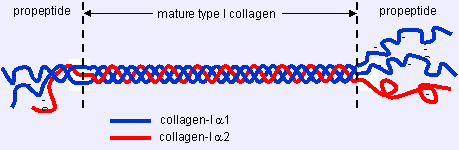
One subunit of procollagen Iα2 assembles with two subunits of procollagen Iα1 to form type I procollagen. Proteolytic removal of the N and C terminal propeptides yields mature type I collagen.
Description
One alpha2 chain pairs with two alpha1 chains to form the triple helix of type I collagen.
Expression
Type I collagen is an abundant structural component of healthy connective tissue. In addition, it is expressed by tumor stromal fibroblasts and vascular cells.
Localisation
Type I collagen is a secreted extracellular matrix protein. It is a major structural component of cartilage, bone, dermis and tendons. In cancers, expression is typically seen by stromal fibroblasts and vascular cells infiltrating the tumor.
Function
As a structural protein, type I collagen interacts with other matrix proteins including proteoglycans and fibronectin. By binding to the cell surface integrins alpha-1 / beta-1 and alpha-2 / beta-1 type I collagen can anchor cells into the matrix. In addition to its structural roles, type I collagen signaling to cells through its integrin receptors and other cell surface collagen receptors (CD36, inhibitory leukocyte-associated Ig-like receptor (LAIR)-1 (CD305), Endo180 (CD280), and discoidin domain receptors, DDR1 and DDR2) can regulate cell growth, motility, and differentiation.
Mutations
Germinal
Multiple independent mutations in COL1A2 occur in patients with osteogenesis imperfecta and in one form of Ehlers-Danlos syndrome. These mutations cause skeletal and cardiovascular defects but are not associated with malignancy.
Somatic
In tumors from patients with esophageal squamous carcinoma, loss of heterozygosity was found at a 9% frequency for a nucleotide repeat in the promoter of COL1A2 and at a 12% frequency for a repeat in the first intron of the gene. The effect, if any, of these mutations on tumor progression remains unclear.
Epigenetic regulation of COL1A2 in cancer has been described. Aberrant methylation of COL1A2 was found in about half of primary hepatoma tissues examined.
Epigenetic regulation of COL1A2 in cancer has been described. Aberrant methylation of COL1A2 was found in about half of primary hepatoma tissues examined.
Implicated in
Entity name
Tumorigenesis
Note
Up- or down-regulation of COL1A2 has been reported in certain cancers. Prior to widespread use of microdissection methods, it was impossible to distinguish changes in tumor cell versus stromal cell expression of COL1A2. In vitro studies have generally shown inhibitory
Roles of tumor cell COL1A2 expression and, as discussed below, promoting roles of stromal cell expression. Thus some of the conflicting data concerning tumor expression may be resolved with better localization of the cells responsible for COL1A2 expression in specific tumors.
Roles of tumor cell COL1A2 expression and, as discussed below, promoting roles of stromal cell expression. Thus some of the conflicting data concerning tumor expression may be resolved with better localization of the cells responsible for COL1A2 expression in specific tumors.
Disease
Tbx2 is a member of T-box family of transcription factors whose expression is de-regulated in some melanoma, breast and pancreatic cancers. It has been reported by Teng et al (2007) that endogenousTbx2 expression correlates with Col1A2 in several fibroblast cell lines and that overexpression of Tbx2 represses the human COL1A2 in transformed WI-38 fibroblasts and HT1080 human fibrosarcoma cells. Tbx2 appears to act as a co-repressor at a site -107 to +50 on the human COL1A2 promoter. In studies overexpressing murine Tbx2 in NIH3T3 fibroblasts and a rat osteoblastic cell line, Col1α gene was upregulated and downregulated respectively .
In primary infiltrating ductal carcinomas, COL1A2 expression in fibroblasts adjacent to breast tumor cells was increased with stage I tumors compared to nearby normal tissue while in stage II and III tumors a decrease in COL1A2 was observed in adjacent stromal fibroblasts. Additionally, co-culture of normal fibroblasts with breast tumor cell lines resulted in down-regulation of collagen mRNA and protein in fibroblasts.
Microarray analysis of medulloblastoma and primitive neuroectodermal tumor (PNET) specimens reveal overexpression of COL1A2 compared to normal brain tissue. Increased collagen type I protein was also found in medulloblastoma .
Expression profiling of microarray data showed an increased COL1A2 expression in gastric adenocarcinomas compared to normal tissue.
Gene silencing as a result of epigenetic modifications such as histone deacetylation and CpG methylation is increasingly being recognized as an important player in cancer development. Treatment with agents that reverse these processes is an emerging area for cancer therapy. In several human hepatoma cell lines, treatment with the histone deacetylase inhibitor, trichostatin A (TSA), upregulated COL1A2 as demonstrated by microarray and qRT-PCR analysis. Several reports have demonstrated the silencing of COL1A2 due to aberrant methylation within the promoter region of COL1A2 and at CpG islands in primary cancer tissues and from several cancer lines including breast cancer, fibrosarcoma, hepatoma and colorectal carcinoma cells. COL1A2 gene transcription was reestablished upon application of the demethylating agent, 5Aza-dC. Studies such as these that correlate the anticancer effects of TSA and 5Aza-dC with the upregulation of COL1A2 point to a role for COL1A2 as a candidate tumor suppressor gene.
Upregulation of both COL1A2 gene and protein expression has been shown in several studies by cDNA array, tumor tissue microarray and qRT-PCR analysis in subtypes of malignant pleural mesothelioma tumors as compared to normal mesothelial cell lines and pleural mesothelium.
Serial analysis of gene expression from five samples of gastric cancer by Yasui et al (2004) demonstrated that COL1A1 and COL1A2 were upregulated in these tissues compared to normal epithelium. Also, differential expression of COL1A2 occurred with tumor stage and therefore may be marker for invasion and metastasis.
Expression of COL1A2 was analyzed in different stages of large B-cell lymphomas with cDNA microarrays. Downregulation of COL1A2 was observed in more advanced stages of the disease.
Screening of esophageal squamous cancer patients versus normal controls revealed a loss of heterozygosity in one or two of the polymorphic loci located within the promoter or first intron region of the COL1A2 gene in a total of three patients.
The association between the development of oral submucous fibrosis (OSF), a precancerous condition of the oral cavity, and polymorphisms of collagen genes was examined in patients with a history of betal quid chewing, a habit that is a risk factor for this collagen related disorder. Polymorphisms for both COL1A1 and COL1A2 were noted and correlated with an individual propensity for development of OSF depending on the level of exposure to betal quid.
Increased Ets expression is implicated in ECM remodeling, especially within the context of tumor invasion and metastasis. Overexpression of Ets in human dermal fibroblast cultures suppressed the TGFβ-induced activation of the COL1A2 promoter toward a phenotype of increased matrix breakdown and decreased matrix deposition indicative of several diseases including cancer.
Rearrangements in chromosome band 8q12 are characteristic of lipoblastomas and drive the promoter swapping events in the PLAG1 oncogene. In four lipoblastomas that were examined by Hibbard et al (2000), fusion genes between COL1A2-PLAG1 were identified in each case. Fusion of COL1A2 occurred along the entire coding sequence of PLAG1 and results in a full-length PLAG1 protein and truncated COL1A2 protein product with undetermined functionality. Collagen fibers surround the nodular arrangement of lipoblastomas, and it is possible that the lipoblastoma cells are responsible for the production of this capsule. The COL1A2 promoter, therefore, may play a significant role in lipoblastoma.
A finding in RAS - and EGF -transformed cells is that a variety of genes associated with ECM molecules are repressed including COL1A2. Farnesyltransferase inhibitors were found to upregulate the COL1A2 gene and reverse the phenotype of RAS- transformed NIH3T3 fibroblasts. Consistent with this are studies demonstrating that overexpression of COL1A2 suppresses tumorigenesis in RAS-transformed NIH3T3 cells. It appears then that COL1A2 functions as an EGF/RAS regulated growth repressor.
In primary infiltrating ductal carcinomas, COL1A2 expression in fibroblasts adjacent to breast tumor cells was increased with stage I tumors compared to nearby normal tissue while in stage II and III tumors a decrease in COL1A2 was observed in adjacent stromal fibroblasts. Additionally, co-culture of normal fibroblasts with breast tumor cell lines resulted in down-regulation of collagen mRNA and protein in fibroblasts.
Microarray analysis of medulloblastoma and primitive neuroectodermal tumor (PNET) specimens reveal overexpression of COL1A2 compared to normal brain tissue. Increased collagen type I protein was also found in medulloblastoma .
Expression profiling of microarray data showed an increased COL1A2 expression in gastric adenocarcinomas compared to normal tissue.
Gene silencing as a result of epigenetic modifications such as histone deacetylation and CpG methylation is increasingly being recognized as an important player in cancer development. Treatment with agents that reverse these processes is an emerging area for cancer therapy. In several human hepatoma cell lines, treatment with the histone deacetylase inhibitor, trichostatin A (TSA), upregulated COL1A2 as demonstrated by microarray and qRT-PCR analysis. Several reports have demonstrated the silencing of COL1A2 due to aberrant methylation within the promoter region of COL1A2 and at CpG islands in primary cancer tissues and from several cancer lines including breast cancer, fibrosarcoma, hepatoma and colorectal carcinoma cells. COL1A2 gene transcription was reestablished upon application of the demethylating agent, 5Aza-dC. Studies such as these that correlate the anticancer effects of TSA and 5Aza-dC with the upregulation of COL1A2 point to a role for COL1A2 as a candidate tumor suppressor gene.
Upregulation of both COL1A2 gene and protein expression has been shown in several studies by cDNA array, tumor tissue microarray and qRT-PCR analysis in subtypes of malignant pleural mesothelioma tumors as compared to normal mesothelial cell lines and pleural mesothelium.
Serial analysis of gene expression from five samples of gastric cancer by Yasui et al (2004) demonstrated that COL1A1 and COL1A2 were upregulated in these tissues compared to normal epithelium. Also, differential expression of COL1A2 occurred with tumor stage and therefore may be marker for invasion and metastasis.
Expression of COL1A2 was analyzed in different stages of large B-cell lymphomas with cDNA microarrays. Downregulation of COL1A2 was observed in more advanced stages of the disease.
Screening of esophageal squamous cancer patients versus normal controls revealed a loss of heterozygosity in one or two of the polymorphic loci located within the promoter or first intron region of the COL1A2 gene in a total of three patients.
The association between the development of oral submucous fibrosis (OSF), a precancerous condition of the oral cavity, and polymorphisms of collagen genes was examined in patients with a history of betal quid chewing, a habit that is a risk factor for this collagen related disorder. Polymorphisms for both COL1A1 and COL1A2 were noted and correlated with an individual propensity for development of OSF depending on the level of exposure to betal quid.
Increased Ets expression is implicated in ECM remodeling, especially within the context of tumor invasion and metastasis. Overexpression of Ets in human dermal fibroblast cultures suppressed the TGFβ-induced activation of the COL1A2 promoter toward a phenotype of increased matrix breakdown and decreased matrix deposition indicative of several diseases including cancer.
Rearrangements in chromosome band 8q12 are characteristic of lipoblastomas and drive the promoter swapping events in the PLAG1 oncogene. In four lipoblastomas that were examined by Hibbard et al (2000), fusion genes between COL1A2-PLAG1 were identified in each case. Fusion of COL1A2 occurred along the entire coding sequence of PLAG1 and results in a full-length PLAG1 protein and truncated COL1A2 protein product with undetermined functionality. Collagen fibers surround the nodular arrangement of lipoblastomas, and it is possible that the lipoblastoma cells are responsible for the production of this capsule. The COL1A2 promoter, therefore, may play a significant role in lipoblastoma.
A finding in RAS - and EGF -transformed cells is that a variety of genes associated with ECM molecules are repressed including COL1A2. Farnesyltransferase inhibitors were found to upregulate the COL1A2 gene and reverse the phenotype of RAS- transformed NIH3T3 fibroblasts. Consistent with this are studies demonstrating that overexpression of COL1A2 suppresses tumorigenesis in RAS-transformed NIH3T3 cells. It appears then that COL1A2 functions as an EGF/RAS regulated growth repressor.
Oncogenesis
The mechanism by which COL1A2 alters tumor growth may involve interactions with collagen receptors on both tumor cells and tumor stromal cells. Studies of the collagen receptor Endo180 have identified roles in tumor growth mediated by its expression on both stromal fibroblasts and breast carcinoma cells. In the latter case, expression of Endo180 enhanced tumor growth. An additional role of stromal collagen is in regulation of tumor angiogenesis as discussed in more detail below.
Entity name
Tumor angiogenesis
Note
Three serial analysis of gene expression (SAGE) tags for COL1A2 were significantly more abundant in an analysis of tumor endothelium isolated from human colon carcinomas versus normal endothelium. COL1A1 was also strongly upregulated in tumor endothelium, identifying type I collagen as a potential tumor-endothelium marker. The functional significance of this increased expression was unclear, although early in vitro studies had found that type I collagen is induced during sprouting of post-confluent endothelial cell monolayers. COL1A2 (and COL1A1) was subsequently identified as an important target of the angiogenesis inhibitor thrombospondin-1 (TSP1).
Type I collagen was identified as up-regulated in metabolically labeled proteins secreted by vascular outgrowths from TSP1 null muscle tissue explanted into a 3D collagen gel compared to equivalent explants from wild type mice. Using quantitative RT-PCR, endogenous TSP1 was confirmed to specifically decrease mRNA levels for COL1A1 and COL1A2. Thus, increased angiogenic responses in tissues lacking the angiogenesis inhibitor TSP1 were associated with increased COL1A2 expression. A functional role for this gene expression in the angiogenic switch was then shown using antisense morpholino oligonucleotides to suppress the increased COL1A2 expression in TSP1 null explants. Suppressing either COL1A1 or COL1A2 using antisense morpholino oligonucleotides decreased vascular outgrowth. Therefore, type I collagen gene expression appears to be necessary for angiogenesis, and inhibitors of their expression may inhibit pathological angiogenesis. This is consistent with the known roles of collagen-binding integrins in angiogenesis , up-regulated type I collagen during tube formation in post-confluent 2D endothelial cell cultures, and the hypothesis of Folkman and colleagues that collagen is used as a "mandrill" to organize new blood vessels. Regulation of COL1A1 and COL1A2 via TSP1 may explain the reciprocal regulation of these genes in leiomyomas.
Type I collagen was identified as up-regulated in metabolically labeled proteins secreted by vascular outgrowths from TSP1 null muscle tissue explanted into a 3D collagen gel compared to equivalent explants from wild type mice. Using quantitative RT-PCR, endogenous TSP1 was confirmed to specifically decrease mRNA levels for COL1A1 and COL1A2. Thus, increased angiogenic responses in tissues lacking the angiogenesis inhibitor TSP1 were associated with increased COL1A2 expression. A functional role for this gene expression in the angiogenic switch was then shown using antisense morpholino oligonucleotides to suppress the increased COL1A2 expression in TSP1 null explants. Suppressing either COL1A1 or COL1A2 using antisense morpholino oligonucleotides decreased vascular outgrowth. Therefore, type I collagen gene expression appears to be necessary for angiogenesis, and inhibitors of their expression may inhibit pathological angiogenesis. This is consistent with the known roles of collagen-binding integrins in angiogenesis , up-regulated type I collagen during tube formation in post-confluent 2D endothelial cell cultures, and the hypothesis of Folkman and colleagues that collagen is used as a "mandrill" to organize new blood vessels. Regulation of COL1A1 and COL1A2 via TSP1 may explain the reciprocal regulation of these genes in leiomyomas.
Entity name
Cancer Metastasis
Note
COL1A2 was independently identified as one of 17 genes highly correlated with metastatic potential from gene expression profiling applied to a set of 279 tumors of diverse types. COL1A2 was up-regulated in metastatic tumors. Subsequent studies showed that the significance of COL1A2 to this signature is limited to certain cancer sites, but the significance of a microenvironment gene signature that includes COL1A2 for predicting disease-free survival has been confirmed in breast cancers. The COL1A1 gene, which encodes the other subunit of type I collagen, was also found in these metastasis signatures, implying that increased type I collagen protein expression would be associated with increased metastasis. This has been confirmed in human and porcine cutaneous melanomas, where increased expression was found in fibroblasts associated with invasive melanomas. Furthermore, pharmacological inhibition of collagen gene expression in the porcine model limited invasive growth and vascularization of the tumors. Increased COL1A2 and COL1A1 expression were also found in gastric carcinomas. Increased COL1A2 expression was significantly associated with tumor stage in this study. Increased COL1A2 expression was also associated with invasion and metastasis in gastric carcinoma.
Oncogenesis
As in regulating tumor growth, the mechanism by which increased COL1A2 expression increases metastasis may involve interactions with collagen receptors on both tumor cells and tumor stromal cells. LNCaP prostate carcinoma cells expressing elevated alpha-2 integrin / beta-1 integrin showed enhanced motility to type I collagen in vitro and developed more frequent bone metastases in vivo.
Article Bibliography
| Pubmed ID | Last Year | Title | Authors |
|---|---|---|---|
| 11168802 | 2001 | Differential stromal regulation of MMP-1 expression in benign and malignant keratinocytes. | Airola K et al |
| 18046511 | 2008 | Metastasis signatures: genes regulating tumor-microenvironment interactions predict metastatic behavior. | Albini A et al |
| 9593730 | 1998 | Gene trapping identifies inhibitors of oncogenic transformation. The tissue inhibitor of metalloproteinases-3 (TIMP3) and collagen type I alpha2 (COL1A2) are epidermal growth factor-regulated growth repressors. | Andreú T et al |
| 18089612 | 2007 | Thrombospondin-1 and thrombospondin-2 mRNA and TSP-1 and TSP-2 protein expression in uterine fibroids and correlation to the genes COL1A1 and COL3A1 and to the collagen cross-link hydroxyproline. | Behera MA et al |
| 16730707 | 2006 | Cell cycle regulation of the T-box transcription factor tbx2. | Bilican B et al |
| 11377819 | 2001 | Microarray analysis of Tbx2-directed gene expression: a possible role in osteogenesis. | Chen J et al |
| 15911243 | 2005 | Identification and investigation of methylated genes in hepatoma. | Chiba T et al |
| 12101112 | 2002 | Interaction of collagen-related genes and susceptibility to betel quid-induced oral submucous fibrosis. | Chiu CJ et al |
| 11919190 | 2002 | Ets1 is an effector of the transforming growth factor beta (TGF-beta ) signaling pathway and an antagonist of the profibrotic effects of TGF-beta. | Czuwara-Ladykowska J et al |
| 12435113 | 2002 | Infrequent somatic deletion of the 5' region of the COL1A2 gene in oesophageal squamous cell cancer patients. | Dietzsch E et al |
| 10232587 | 1999 | Elevation of alpha2(I) collagen, a suppressor of Ras transformation, is required for stable phenotypic reversion by farnesyltransferase inhibitors. | Du W et al |
| 10584874 | 1999 | Breast tumour cell-induced down-regulation of type I collagen mRNA in fibroblasts. | Fenhalls G et al |
| 6160403 | 1980 | Angiogenesis in vitro. | Folkman J et al |
| 1917959 | 1991 | Transcriptional activity of the alpha 1(I)-collagen promoter is correlated with the formation of capillary-like structures by endothelial cells in vitro. | Fouser L et al |
| 17024100 | 2007 | Functional implications of the IL-6 signaling pathway in keloid pathogenesis. | Ghazizadeh M et al |
| 16951179 | 2006 | Type I collagen receptor (alpha 2 beta 1) signaling promotes the growth of human prostate cancer cells within the bone. | Hall CL et al |
| 10987300 | 2000 | PLAG1 fusion oncogenes in lipoblastoma. | Hibbard MK et al |
| 15447976 | 2005 | L1CAM, INP10, P-cadherin, tPA and ITGB4 over-expression in malignant pleural mesotheliomas revealed by combined use of cDNA and tissue microarray. | Kettunen E et al |
| 9764819 | 1998 | Stress-induced secretion of growth inhibitors: a novel tumor suppressor function of p53. | Komarova EA et al |
| 17653508 | 2008 | Type I collagen is overexpressed in medulloblastoma as a component of tumor microenvironment. | Liang Y et al |
| 16829517 | 2006 | Fli1 and Ets1 have distinct roles in connective tissue growth factor/CCN2 gene regulation and induction of the profibrotic gene program. | Nakerakanti SS et al |
| 12716467 | 2002 | Microarray analysis of gene-expression profiles in diffuse large B-cell lymphoma: identification of genes related to disease progression. | Nishiu M et al |
| 15059891 | 2004 | Gene expression profile of gastric carcinoma: identification of genes and tags potentially involved in invasion, metastasis, and carcinogenesis by serial analysis of gene expression. | Oue N et al |
| 12469122 | 2003 | A molecular signature of metastasis in primary solid tumors. | Ramaswamy S et al |
| 16815696 | 2006 | Transcriptional regulation of the human alpha2(I) collagen gene (COL1A2), an informative model system to study fibrotic diseases. | Ramirez F et al |
| 11786413 | 2002 | The alpha(1)beta(1) and alpha(2)beta(1) integrins provide critical support for vascular endothelial growth factor signaling, endothelial cell migration, and tumor angiogenesis. | Senger DR et al |
| 15788405 | 2005 | Collagen alpha1(I) gene (COL1A1) is repressed by RFX family. | Sengupta P et al |
| 12912960 | 2003 | Gene expression profiling of malignant mesothelioma. | Singhal S et al |
| 12095482 | 2002 | Interactions of cytokines, growth factors, and the extracellular matrix in the cellular biology of uterine leiomyomata. | Sozen I et al |
| 10947988 | 2000 | Genes expressed in human tumor endothelium. | St Croix B et al |
| 1898329 | 1991 | Phorbol-ester-mediated expression of the collagen type I pro-alpha 2 gene in mouse 3T3-L1 cells and its absence in a phorbol 12-myristate 13-acetate-non-responsive variant. | Stuiver I et al |
| 17407139 | 2007 | A role for Tbx2 in the regulation of the alpha2(1) collagen gene in human fibroblasts. | Teng H et al |
| 8891339 | 1996 | Suppression of tumorigenicity in Ras-transformed fibroblasts by alpha 2(I) collagen. | Travers H et al |
| 11861221 | 2002 | Molecular aspects of scleroderma. | Trojanowska M et al |
| 17943178 | 2008 | Human skin keloid fibroblasts display bioenergetics of cancer cells. | Vincent AS et al |
| 12920208 | 2003 | 5-fluorouracil blocks transforming growth factor-beta-induced alpha 2 type I collagen gene (COL1A2) expression in human fibroblasts via c-Jun NH2-terminal kinase/activator protein-1 activation. | Wendling J et al |
| 17974964 | 2007 | The collagen receptor Endo180 (CD280) Is expressed on basal-like breast tumor cells and promotes tumor growth in vivo. | Wienke D et al |
| 17601708 | 2007 | Molecular basis of the differences between normal and tumor tissues of gastric cancer. | Yang S et al |
| 15864715 | 2005 | Molecular-pathological prognostic factors of gastric cancer: a review. | Yasui W et al |
| 16247480 | 2006 | Type I collagen is a molecular target for inhibition of angiogenesis by endogenous thrombospondin-1. | Zhou L et al |
| 17957794 | 2008 | Type I collagen expression contributes to angiogenesis and the development of deeply invasive cutaneous melanoma. | van Kempen LC et al |
Other Information
Locus ID:
NCBI: 1278
MIM: 120160
HGNC: 2198
Ensembl: ENSG00000164692
Variants:
dbSNP: 1278
ClinVar: 1278
TCGA: ENSG00000164692
COSMIC: COL1A2
RNA/Proteins
| Gene ID | Transcript ID | Uniprot |
|---|---|---|
| ENSG00000164692 | ENST00000297268 | P08123 |
| ENSG00000164692 | ENST00000297268 | A0A0S2Z3H5 |
| ENSG00000164692 | ENST00000620463 | A0A087WTA8 |
Expression (GTEx)
Pathways
Protein levels (Protein atlas)
PharmGKB
| Entity ID | Name | Type | Evidence | Association | PK | PD | PMIDs |
|---|---|---|---|---|---|---|---|
| PA179 | GP1BB | Gene | Pathway | associated | 20938371 | ||
| PA204 | ITGA2 | Gene | Pathway | associated | 20938371 | ||
| PA26212 | CD36 | Gene | Pathway | associated | 20938371 | ||
| PA28823 | GP5 | Gene | Pathway | associated | 20938371 | ||
| PA28824 | GP6 | Gene | Pathway | associated | 20938371 | ||
| PA28825 | GP9 | Gene | Pathway | associated | 20938371 |
References
| Pubmed ID | Year | Title | Citations |
|---|---|---|---|
| 38059912 | 2024 | Exosome miR-4738-3p-mediated regulation of COL1A2 through the NF-κB and inflammation signaling pathway alleviates osteoarthritis low-grade inflammation symptoms. | 0 |
| 38519884 | 2024 | The association between Dental Fluorosis and COL1A2 gene polymorphism among a Tunisian Population. | 0 |
| 38536562 | 2024 | Exome sequencing identified mutations in the WNT1 and COL1A2 genes in osteogenesis imperfecta cases. | 0 |
| 38059912 | 2024 | Exosome miR-4738-3p-mediated regulation of COL1A2 through the NF-κB and inflammation signaling pathway alleviates osteoarthritis low-grade inflammation symptoms. | 0 |
| 38519884 | 2024 | The association between Dental Fluorosis and COL1A2 gene polymorphism among a Tunisian Population. | 0 |
| 38536562 | 2024 | Exome sequencing identified mutations in the WNT1 and COL1A2 genes in osteogenesis imperfecta cases. | 0 |
| 35932265 | 2023 | COL1A2 inhibition suppresses glioblastoma cell proliferation and invasion. | 12 |
| 36853784 | 2023 | Identification of COL1A1/2 Mutations and Fusions With Noncoding RNA Genes in Bizarre Parosteal Osteochondromatous Proliferation (Nora Lesion). | 1 |
| 36896471 | 2023 | COL1A1 and COL1A2 variants in Ehlers-Danlos syndrome phenotypes and COL1-related overlap disorder. | 1 |
| 36930067 | 2023 | COL3A1, CXCL8, VCAN, THBS2, and COL1A2 are correlated with the onset of biliary atresia. | 1 |
| 36951356 | 2023 | Unequal Impact of COL1A1 and COL1A2 Variants on Dentinogenesis Imperfecta. | 1 |
| 37079269 | 2023 | Circular RNA COL1A2 Mediates High Glucose-Induced Oxidative Stress and Pyroptosis by Regulating MiR-424-5p/SGK1 in Diabetic Nephropathy. | 2 |
| 37354488 | 2023 | An integrated bioinformatic investigation of focal adhesion-related genes in glioma followed by preliminary validation of COL1A2 in tumorigenesis. | 0 |
| 37368383 | 2023 | [Analysis of COL1A1 and COL1A2 gene variants in two fetuses with osteogenesis imperfecta]. | 0 |
| 35932265 | 2023 | COL1A2 inhibition suppresses glioblastoma cell proliferation and invasion. | 12 |
Citation
Elizabeth M Perruccio ; David D Roberts
COL1A2 (collagen, type I, alpha 2)
Atlas Genet Cytogenet Oncol Haematol. 2008-04-01
Online version: http://atlasgeneticsoncology.org/gene/411
