MMP19 (matrix metallopeptidase 19)
2013-10-01 King Chi Chan , Maria Li Lung AffiliationDepartment of Clinical Oncology, Center for Nasopharyngeal Carcinoma Research, University of Hong Kong, Hong Kong, P.R. China
DNA/RNA

Alternative splicing results in multiple transcript variants for this gene (provided by RefSeq, Jan 2013). With reference to UniProtKB database, variant 1 represents the longest transcript and encodes isoform 1 (508 aa, 57 kDa, also known as RASI-1). Variant 2 encoded protein isoform 2 (222 aa, 25 kDa, also known as RASI-9). Variant 3 encoded protein isoform 3 (63 aa, 6 kDa, also known as RASI-6). Isoform 1 has been described as the canonical sequence and all the information described here, unless stated, refers to isoform 1.
Description
MMP-19 can be found at chromosome 12q13.2 at location 56229214-56236767. The DNA sequence contains nine exons and eight introns, spanning 7,55 kb.
Proteins
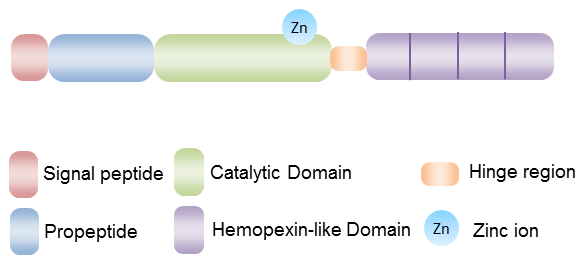
MMP-19 shares a typical MMP structural domain, containing the signal peptide, propeptide, catalytic domain, hinge region, and four hemopexin repeats (Pendás et al., 1997).
Description
MMP-19 is a secreted protein. It contains a signal peptide for targeting to secretory vesicles. Like most secreted MMPs, MMP-19 is translated and secreted as catalytic inactive proproteins (zymogens), which needed to be activated by proteolytic cleavage of the propeptide region by other extracellular matrix (EMC) proteinases (Ra and Parks, 2007).
MMP-19 is a zinc-dependent endopeptidase. The catalytic domain contains the active site for zinc ion binding and functions in catalytic activity such as substrate degradation. The hemopexin domain is responsible for substrate recognition (Ra and Parks, 2007).
The catalytic activities of MMPs were reported to be regulated by tissue inhibitor of metalloproteinases (TIMPs). MMP-19 is reported to be strongly inhibited by TIMP-2, TIMP-3, and TIMP-4, and less efficiently by TIMP-1 (Clark et al., 2008).
MMP-19 is a zinc-dependent endopeptidase. The catalytic domain contains the active site for zinc ion binding and functions in catalytic activity such as substrate degradation. The hemopexin domain is responsible for substrate recognition (Ra and Parks, 2007).
The catalytic activities of MMPs were reported to be regulated by tissue inhibitor of metalloproteinases (TIMPs). MMP-19 is reported to be strongly inhibited by TIMP-2, TIMP-3, and TIMP-4, and less efficiently by TIMP-1 (Clark et al., 2008).
Expression
MMP-19 was found to be expressed in a wide range of normal tissue types, such as nasopharyngeal epithelial cells, lung, breast, skin, intestine, pancreas, spleen, and ovary. MMP-19 was down-regulated or lost during neoplastic progression in nasopharyngeal carcinoma (NPC), mammary gland tumor, skin neoplasm, intestine, and colon cancers (Pendás et al., 1997; Djonov et al., 2001; Impola et al., 2003; Bister et al., 2004; Chan et al., 2011).
Localisation
MMP-19 is located in the cytoplasm and secreted into the extracellular matrix.
Function
MMP-19 is a member of the MMP family of zinc-dependent endopeptidases. The catalytic domain responsible for degradation of various components of the ECM include collagen type IV, nidogen-1, fibronectin, tenascin-C isoform, aggrecan, and laminin-5-gamma-2-chain (Stracke et al., 2000; Shiomi et al., 2010). MMP-19 is involved in many physiological activities such as cell proliferation, migration, and anti-angiogenesis.
Implicated in
Entity name
Various cancers
Note
Due to the ability of MMPs to degrade a variety of substrates, which may be involved in both cancer progression and repression, the role of MMP-19 in cancer development is as controversial as for all other MMPs.
MMP-19 is reported to cleave insulin-like growth factor binding protein-3 (IGFBP-3), thereby causing the release of IGF-1 and enhanced human keratinocyte cell proliferation, migration, and adhesion on type I collagen (Sadowski et al., 2003). Also, MMP-19 was reported to process the laminin-5-gamma-2-chain in keratinocyte cells, which leads to the integrin switch favoring epithelial cell migration (Sadowski et al., 2005).
On the other hand, a MMP-19 deficiency mouse model increased the onset of skin tumor invasion and vascularization, implicating the role of MMP-19 in inhibition of tumor invasion and anti-angiogenesis (Jost et al., 2006).
The anti-angiogenic role of MMP-19 was demonstrated in the tube formation assay in human microvascular endothelial cells (HMEC-1). MMP-19 inhibited tube formation by degradation of nidogen-1, which is a scaffolding protein required for stabilizing new capillary formation (Titz et al., 2004). Further studies of MMP-19 on endothelial cells suggested other mechanisms of MMP-19 in inhibition of angiogenesis. MMP-19 digests plasminogen to generate angiostatin-like fragments, which are antagonists of angiogenesis and inhibit migration and proliferation of endothelial cells (Brauer et al., 2011).
Functional studies of MMP-19 demonstrated its tumor suppressive and anti-angiogenesis functions in nasopharyngeal carcinoma (NPC). MMP-19 reduces colony-forming ability of NPC cells and suppresses tumor formation in nude mice. Also, MMP-19 reduces tube-forming ability in human umbilical vein endothelial cells (HuVEC) and human microvascular endothelial cells (HMEC-1). The anti-angiogenic activity of MMP-19 in NPC is associated with reduction of secreted vascular endothelial growth factor (VEGF) in the conditioned media (Chan et al., 2011). Recent study in NPC cells demonstrated MMP-19 increased cisplatin sensitivity through production of γ-H2AX and attenuation of NER activity to repair cisplatin-induced DNA damage, therefore increasing the cisplatin-induced apoptosis in NPC (Liu et al., 2013).
MMP-19 is reported to cleave insulin-like growth factor binding protein-3 (IGFBP-3), thereby causing the release of IGF-1 and enhanced human keratinocyte cell proliferation, migration, and adhesion on type I collagen (Sadowski et al., 2003). Also, MMP-19 was reported to process the laminin-5-gamma-2-chain in keratinocyte cells, which leads to the integrin switch favoring epithelial cell migration (Sadowski et al., 2005).
On the other hand, a MMP-19 deficiency mouse model increased the onset of skin tumor invasion and vascularization, implicating the role of MMP-19 in inhibition of tumor invasion and anti-angiogenesis (Jost et al., 2006).
The anti-angiogenic role of MMP-19 was demonstrated in the tube formation assay in human microvascular endothelial cells (HMEC-1). MMP-19 inhibited tube formation by degradation of nidogen-1, which is a scaffolding protein required for stabilizing new capillary formation (Titz et al., 2004). Further studies of MMP-19 on endothelial cells suggested other mechanisms of MMP-19 in inhibition of angiogenesis. MMP-19 digests plasminogen to generate angiostatin-like fragments, which are antagonists of angiogenesis and inhibit migration and proliferation of endothelial cells (Brauer et al., 2011).
Functional studies of MMP-19 demonstrated its tumor suppressive and anti-angiogenesis functions in nasopharyngeal carcinoma (NPC). MMP-19 reduces colony-forming ability of NPC cells and suppresses tumor formation in nude mice. Also, MMP-19 reduces tube-forming ability in human umbilical vein endothelial cells (HuVEC) and human microvascular endothelial cells (HMEC-1). The anti-angiogenic activity of MMP-19 in NPC is associated with reduction of secreted vascular endothelial growth factor (VEGF) in the conditioned media (Chan et al., 2011). Recent study in NPC cells demonstrated MMP-19 increased cisplatin sensitivity through production of γ-H2AX and attenuation of NER activity to repair cisplatin-induced DNA damage, therefore increasing the cisplatin-induced apoptosis in NPC (Liu et al., 2013).
Entity name
Rheumatoid arthritis (RA)
Note
MMP-19 was first isolated as an autoantigen from the synovium of a rheumatoid arthritis patient suggesting its role in RA-associated joint tissue destruction (Sedlacek et al., 1998).
Article Bibliography
| Pubmed ID | Last Year | Title | Authors |
|---|---|---|---|
| 15185874 | 2004 | Differential expression of three matrix metalloproteinases, MMP-19, MMP-26, and MMP-28, in normal and inflamed intestine and colon cancer. | Bister VO et al |
| 21787393 | 2011 | Matrix metalloproteinase-19 inhibits growth of endothelial cells by generating angiostatin-like fragments from plasminogen. | Brauer R et al |
| 21165953 | 2011 | Catalytic activity of Matrix metalloproteinase-19 is essential for tumor suppressor and anti-angiogenic activities in nasopharyngeal carcinoma. | Chan KC et al |
| 18258475 | 2008 | The regulation of matrix metalloproteinases and their inhibitors. | Clark IM et al |
| 11592092 | 2001 | MMP-19: cellular localization of a novel metalloproteinase within normal breast tissue and mammary gland tumours. | Djonov V et al |
| 12516088 | 2003 | Matrix metalloproteinase-19 is expressed by proliferating epithelium but disappears with neoplastic dedifferentiation. | Impola U et al |
| 16707448 | 2006 | Earlier onset of tumoral angiogenesis in matrix metalloproteinase-19-deficient mice. | Jost M et al |
| 23956056 | 2013 | Overexpression of asparagine synthetase and matrix metalloproteinase 19 confers cisplatin sensitivity in nasopharyngeal carcinoma cells. | Liu RY et al |
| 10903435 | 2000 | Structure of the human MMP-19 gene. | Mueller MS et al |
| 9020145 | 1997 | Identification and characterization of a novel human matrix metalloproteinase with unique structural characteristics, chromosomal location, and tissue distribution. | Pendás AM et al |
| 17669641 | 2007 | Control of matrix metalloproteinase catalytic activity. | Ra HJ et al |
| 15868410 | 2005 | Matrix metalloproteinase 19 processes the laminin 5 gamma 2 chain and induces epithelial cell migration. | Sadowski T et al |
| 9562866 | 1998 | Matrix metalloproteinase MMP-19 (RASI-1) is expressed on the surface of activated peripheral blood mononuclear cells and is detected as an autoantigen in rheumatoid arthritis. | Sedlacek R et al |
| 20594269 | 2010 | Matrix metalloproteinases, a disintegrin and metalloproteinases, and a disintegrin and metalloproteinases with thrombospondin motifs in non-neoplastic diseases. | Shiomi T et al |
| 10922468 | 2000 | Matrix metalloproteinases 19 and 20 cleave aggrecan and cartilage oligomeric matrix protein (COMP). | Stracke JO et al |
| 15241558 | 2004 | Activity of MMP-19 inhibits capillary-like formation due to processing of nidogen-1. | Titz B et al |
Other Information
Locus ID:
NCBI: 4327
MIM: 601807
HGNC: 7165
Ensembl: ENSG00000123342
Variants:
dbSNP: 4327
ClinVar: 4327
TCGA: ENSG00000123342
COSMIC: MMP19
RNA/Proteins
Expression (GTEx)
Pathways
| Pathway | Source | External ID |
|---|---|---|
| Extracellular matrix organization | REACTOME | R-HSA-1474244 |
| Degradation of the extracellular matrix | REACTOME | R-HSA-1474228 |
| Collagen degradation | REACTOME | R-HSA-1442490 |
References
| Pubmed ID | Year | Title | Citations |
|---|---|---|---|
| 36915092 | 2023 | Endothelial cell-derived MMP19 promotes pulmonary fibrosis by inducing E(nd)MT and monocyte infiltration. | 4 |
| 37971547 | 2023 | MMP19 Variants in Familial and Sporadic Idiopathic Pulmonary Fibrosis. | 0 |
| 36915092 | 2023 | Endothelial cell-derived MMP19 promotes pulmonary fibrosis by inducing E(nd)MT and monocyte infiltration. | 4 |
| 37971547 | 2023 | MMP19 Variants in Familial and Sporadic Idiopathic Pulmonary Fibrosis. | 0 |
| 35352707 | 2022 | Potential novel markers in IBD and CRC diagnostics. Are MMP-19 and RAGE promising candidates? | 0 |
| 35352707 | 2022 | Potential novel markers in IBD and CRC diagnostics. Are MMP-19 and RAGE promising candidates? | 0 |
| 33151424 | 2021 | Long noncoding RNA ZEB1-AS1 affects paclitaxel and cisplatin resistance by regulating MMP19 in epithelial ovarian cancer cells. | 6 |
| 33151424 | 2021 | Long noncoding RNA ZEB1-AS1 affects paclitaxel and cisplatin resistance by regulating MMP19 in epithelial ovarian cancer cells. | 6 |
| 31088409 | 2019 | High expression of MMP19 is associated with poor prognosis in patients with colorectal cancer. | 11 |
| 31298377 | 2019 | MicroRNA-16 inhibits the proliferation, migration and invasion of non-small cell lung carcinoma cells by down-regulating matrix metalloproteinase-19 expression. | 3 |
| 31088409 | 2019 | High expression of MMP19 is associated with poor prognosis in patients with colorectal cancer. | 11 |
| 31298377 | 2019 | MicroRNA-16 inhibits the proliferation, migration and invasion of non-small cell lung carcinoma cells by down-regulating matrix metalloproteinase-19 expression. | 3 |
| 29323744 | 2018 | MicroRNA-193b-3p regulates matrix metalloproteinase 19 expression in interleukin-1β-induced human chondrocytes. | 21 |
| 29323744 | 2018 | MicroRNA-193b-3p regulates matrix metalloproteinase 19 expression in interleukin-1β-induced human chondrocytes. | 21 |
| 26548962 | 2016 | Downregulation of matrix metalloproteinase‑19 induced by respiratory syncytial viral infection affects the interaction between epithelial cells and fibroblasts. | 3 |
Citation
King Chi Chan ; Maria Li Lung
MMP19 (matrix metallopeptidase 19)
Atlas Genet Cytogenet Oncol Haematol. 2013-10-01
Online version: http://atlasgeneticsoncology.org/gene/41395/mmp19-(matrix-metallopeptidase-19)
