PIK3R1 (phosphoinositide-3-kinase, regulatory subunit 1 (alpha))
2012-05-01 Daphne W Bell AffiliationNational Human Genome Research Institute, Cancer Genetics Branch, National Institutes of Health, Bethesda, MD, USA
Identity
DNA/RNA
Description
Transcription
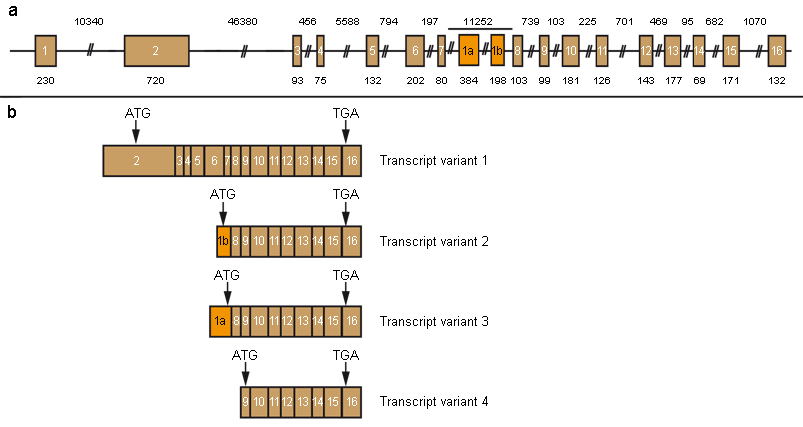
Transcript variant 1: 7011 bp in length; the open-reading frame of the coding sequence is 2175 bp.
Transcript variant 2: 2439 bp in length; the open-reading frame of the coding sequence is 1365 bp.
Transcript variant 3: 2625 bp in length; the open-reading frame of the coding sequence is 1275 bp.
Transcript variant 4: 2473 bp in length; the open-reading frame of the coding sequence is 1086 bp.
Pseudogene
Proteins
Note
Description
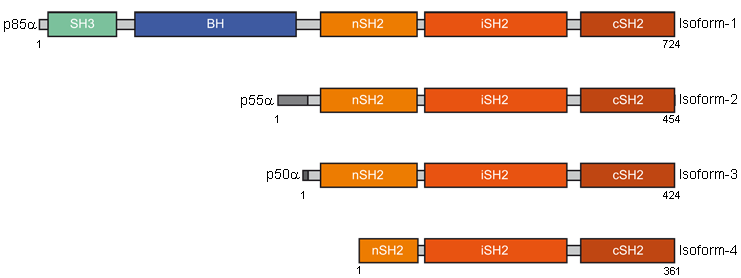
p85α: p85α has an SH3 domain, a BCR-homology (BH) domain, and nSH2, iSH2, and cSH2 domains. The SH3 domain of p85α mediates binding to FAK, CAS, Apoptin, Ruk, SNX9, Dynamin, Cbl, and BCR-ABL (reviewed in Mellor et al., 2012). The BH domain of p85α mediates binding to XB-1, Rac, Cdc42, Rab5, PTEN (reviewed in Mellor et al., 2012). The nSH2 domain of p85α interacts with the helical domain of p110α (Miled et al., 2007). The iSH2 domain of p85α interacts with both the ABD and C2 domains of p110α leading, respectively, to stabilization and inhibition of p110α (Dhand et al., 1994; Fu et al., 2004; Elis et al., 2006; Huang et al., 2007). Residues D560 and N564 in the p85α-iSH2 domain are within hydrogen bonding distance of residue N345 of the p110α-C2 domain (Huang et al., 2007). This interaction is required for the inhibition of p110α (Wu et al., 2009). It has been suggested that residues 447-561 within the iSH2 might form contact with the plasma membrane (Huang et al., 2007). The nSH2 and cSH2 domains of p85α mediate binding to phosphotyrosine residues in certain receptor tyrosine kinase and adaptor proteins, in the context of a pYXXM motif.
p55α: Has a unique amino terminal region of 34 amino acids. Compared to p85α, p55α lacks the amino terminal SH3 and BH domains but shares the C-terminal nSH2, iSH2, and cSH2 domains (Inuki et al., 1997).
p50α: Has a unique amino terminal region of 6 amino acids. Compared to p85α, p50α lacks the amino terminal SH3 and BH domains but shares the C-terminal nSH2, iSH2, and cSH2 domains (Inuki et al., 1997).
Isoform-4: The shortest isoform. Lacks the first 398 amino acids of p85α but is identical to p85α throughout the remainder of the protein.
Expression
Localisation
Function
Under conditions of nutrient deprivation, p85α is phosphorylated by IKK on serine-690. Consequently, the ability of p85α to bind phosphotyrosine proteins is reduced and PI3K-AKT signaling is diminished (Comb et al., 2012). Similarly, the activation of PKC family members by phorbol ester stimulation results in phosphorylation of p85α on serine-361 and serine-652, and leads to reduced binding of p85α to phosphotyrosines and inhibition of PI3K-AKT signaling (Lee et al., 2011).
Regulation of PTEN by p85α: The PI3K-AKT signal transduction pathway is antagonized by the activity of the PTEN phosphatase, which dephosphorylates PIP3 to generate PIP2. Chagpar et al., (2010) demonstrated that p85α binds directly to PTEN via the p85α-SH3-BH domains. Cells expressing a synthetic mutant of p85α that abolished the p85α-PTEN interaction exhibited increased AKT activation following stimulation by growth factors. Chagpar et al., thus proposed that p85α can bind to PTEN and enhance PTEN activity. Subsequently, Cheung et al., (2011) demonstrated that compared to wildtype p85α, a tumor-associated mutant (p85α-E160X) that introduces a premature stop codon within the BH domain, was associated with reduced stability of the PTEN protein. Treatment of cells expressing the p85α-E160X mutant with a proteosome inhibitor lead to a modest increase in PTEN levels, further suggesting that the p85α-PTEN interaction prevents proteosomal degradation of PTEN and thus increases PTEN stability. The regulation of PTEN activity by p85α accounts for the increased insulin sensitivity observed in PIK3R1-/- or p85α-/- mice (Mauvais-Jarvis et al., 2002; Brachmann et al., 2005; Taniguchi et al., 2006; Taniguchi et al., 2010; Chagpar et al., 2010).
Receptor trafficking: p85α has GAP (GTP-ase Activating Protein) activity towards the Rab4, Rab5, Rac1, and Cdc42 small GTPases and, to a lesser extent, towards the Rab6 GTPase. The GAP activity of p85α resides within the BH domain. Within the BH domain, Arg151 and Arg274 are important for maximal GAP activity of p85α. The regulation of Rab4 and Rab5 activity by p85α has been implicated in the endosomal trafficking of activated PDGFR; cells expressing a synthetic mutant (p85α-Arg274A) exhibited delayed degradation of activated PDGFR, prolonged activation of the MAPK and AKT signalling pathways, and the capacity to transform NIH 3T3 cells (Chamberlain et al., 2004; Chamberlain et al., 2008; Chamberlain et al., 2010).
Regulation of the unfolded protein response: p85α interacts with XBP-1s, a transcription factor that regulates the unfolded protein response following endoplasmic reticulum stress, and facilitates the relocation of XBP-1s to the nucleus (Park et al., 2010a; Winnay et al., 2010).
p55α and p50α isoforms: Involved in insulin signaling (Inuki et al., 1997; Chen et al., 2004).
Homology
Mutations
Note
Germinal
Somatic
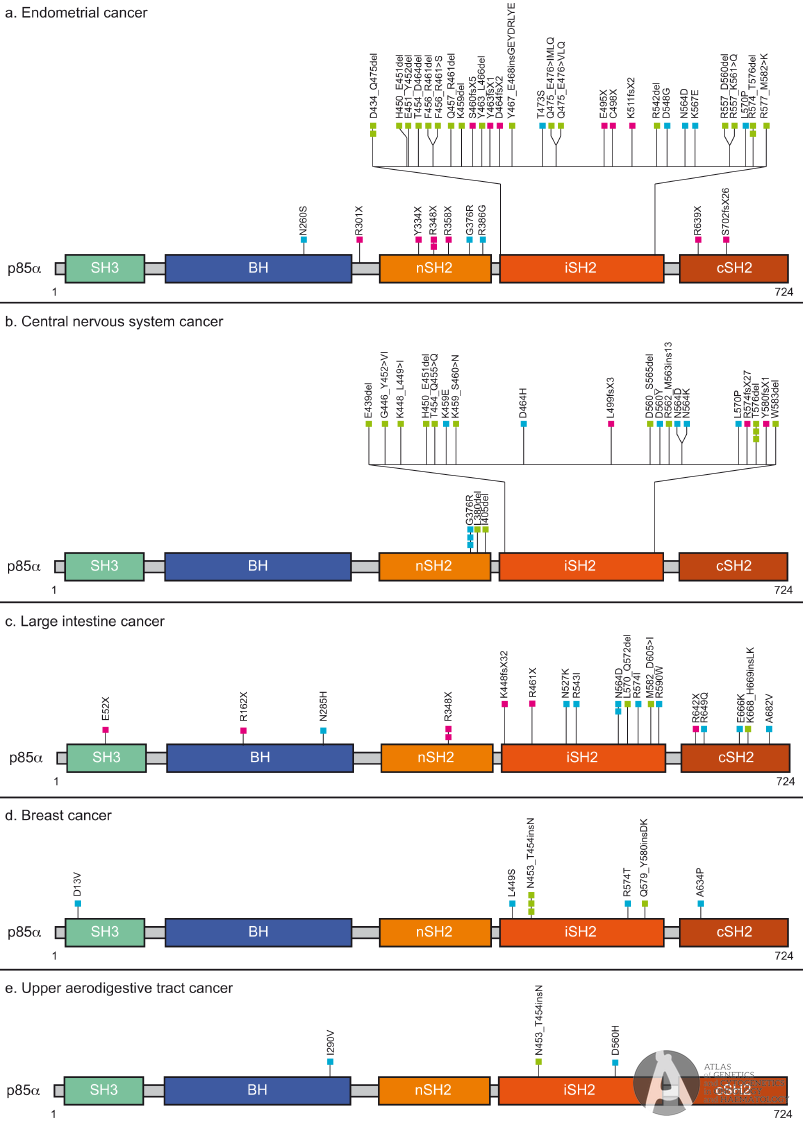
Mutation spectrum: Among 107 nonsynonymous, somatic mutations of PIK3R1 catalogued in the COSMIC database (v59 release, May 23rd, 2012) (Forbes et al., 2010), 43% (46 of 107) of mutations are in-frame insertions/deletions, 14% (15 of 107) are nonsense mutations, 11.2% (12 of 107) are frameshift mutations, 31.8% (34 of 107) are missense mutations. The majority (68.2%, 73 of 107) of all somatic mutations in PIK3R1 localize to animo acid residues within the iSH2 domain, which is shared by all four protein isoforms encoded by PIK3R1.
Altered functional properties of mutant proteins: Biochemical and cellular studies of tumor-associated p85α mutants have revealed functional differences between mutant p85α and wild type p85α, as well as functional differences among various p85α mutants (Philp et al., 2001; Jaiswal et al., 2009; Sun et al., 2010; Cheung et al., 2011; Urick et al., 2011).
- Transforming properties: Sun et al., (2010) evaluated the ability of nine tumor-associated mutant p85α proteins to transform chicken embryo fibroblasts. The p85α-KS459delN and p85α-DKRMNS560del mutants had the highest efficiency of transformation, the p85α-R574fs and p85α-T576del mutants had intermediate efficiency of transformation, and the p85α-D560Y, p85α-N564K p85α-W583del, p85α-E439del, and p85α-G376R mutants were only weakly tansforming (Sun et al., 2010). Transformation was mediated by p110α but not by p110α, p110α, or p110α (Sun et al., 2010). Each of the nine p85α mutants analyzed by Sun et al., retained the ability to bind p110α and resulted in hyperphosphorylation of AKT (T308) and 4E-BP1 when exogenously expressed in CEF cells (Sun et al., 2010). Eight of the tumor-associated mutants analyzed by Sun et al., (2010) localized to the iSH2 domain; one mutant (p85α-G376R) localized to the nSH2 domain. Jaiswal et al., showed that the p85α-D560Y, p85α-N564D, and p85α-QYL579delL mutants were capable of promoting both the IL-3 independent growth and anchorage-independent growth of BaF3 cells (Jaiswal et al., 2009). Similarily, Cheung et al., showed that the p85α-R574fs, p85α-T576del, p85α-E160X, p85α-R348X, and p85α-R503W mutants induced IL3-independent growth of BaF3 cells (Cheung et al., 2011).
- Altered p110α-binding: Truncating mutants of p85α that lack all or part of the the iSH2 domain (p85α-E160X, p85α-R162X, p85α-L380fs, p85α-R348X, p85α-K511VfsX2) fail to bind to p110α (Jaiswal et al., 2009; Cheung et al., 2011; Urick et al., 2011). In contrast, small in-frame deletions or missense mutations within the iSH2 domain retained the ability to bind p110α (Jaiswal et al., 2009; Cheung et al., 2011; Urick et al., 2011).
- Increased PI3K activity: Jaiswal et al., (2009) showed that p85α mutants that were capable of binding p110α were able to stabilize p110α. p85α/p110α holoenzymes composed of the p85α-N564 or p85α-QYL579delL mutants had increased lipid kinase activity compared with the wildtype-p85α/p110α holoenzyme (Jaiswal et al., 2009). Holoenzymes consisting of mutant p85α and p110α or p110α also exhibited increased kinase activity (Jaiswal et al., 2009). Philp et al. (2001) described a recurrent intronic PIK3R1 mutation in ovarian cancer cells; the mutation caused skipping of exon 13, resulting in deletion of residues 551-670 within the iSH2/cSH2 domains of p85α, and was associated with increased PI3K activity.
- Hyperphosphorylation of AKT: Mutants of p85α that retained the ability to bind p110α also lead to increased phosphorylation of AKT (Jaiswal et al., 2009; Cheung et al., 2011; Urick et al., 2011).
- Dysregulation of PTEN stability: Cheung et al., (2011) showed that the p85α-E160X mutant, which was present in an endometrial tumor and truncates p85α within the BH domain, is associated with reduced stability of the PTEN protein.
Implicated in
Article Bibliography
| Pubmed ID | Last Year | Title | Authors |
|---|---|---|---|
| 11842213 | 2002 | Characterization of the Met326Ile variant of phosphatidylinositol 3-kinase p85alpha. | Almind K et al |
| 8628286 | 1996 | Insulin receptor substrate 1 binds two novel splice variants of the regulatory subunit of phosphatidylinositol 3-kinase in muscle and brain. | Antonetti DA et al |
| 9604878 | 1998 | Variant in the regulatory subunit of phosphatidylinositol 3-kinase (p85alpha): preliminary evidence indicates a potential role of this variant in the acute insulin response and type 2 diabetes in Pima women. | Baier LJ et al |
| 21817013 | 2011 | Mutations in CIC and FUBP1 contribute to human oligodendroglioma. | Bettegowda C et al |
| 19407556 | 2009 | Expression status and mutational analysis of the PTEN and P13K subunit genes in ovarian granulosa cell tumors. | Bittinger S et al |
| 15713620 | 2005 | Phosphoinositide 3-kinase catalytic subunit deletion and regulatory subunit deletion have opposite effects on insulin sensitivity in mice. | Brachmann SM et al |
| 21720365 | 2011 | Integrated genomic analyses of ovarian carcinoma. | |
| 20212113 | 2010 | Direct positive regulation of PTEN by the p85 subunit of phosphatidylinositol 3-kinase. | Chagpar RB et al |
| 20570729 | 2010 | Deregulation of Rab5 and Rab4 proteins in p85R274A-expressing cells alters PDGFR trafficking. | Chamberlain MD et al |
| 14673165 | 2004 | p50alpha/p55alpha phosphoinositide 3-kinase knockout mice exhibit enhanced insulin sensitivity. | Chen D et al |
| 21984976 | 2011 | High frequency of PIK3R1 and PIK3R2 mutations in endometrial cancer elucidates a novel mechanism for regulation of PTEN protein stability. | Cheung LW et al |
| 22342344 | 2012 | p85α SH2 domain phosphorylation by IKK promotes feedback inhibition of PI3K and Akt in response to cellular starvation. | Comb WC et al |
| 22351933 | 2012 | Agammaglobulinemia and absent B lineage cells in a patient lacking the p85α subunit of PI3K. | Conley ME et al |
| 8313896 | 1994 | PI 3-kinase: structural and functional analysis of intersubunit interactions. | Dhand R et al |
| 17132102 | 2006 | Mutations in the inter-SH2 domain of the regulatory subunit of phosphoinositide 3-kinase: effects on catalytic subunit binding and holoenzyme function. | Elis W et al |
| 19906727 | 2010 | COSMIC (the Catalogue of Somatic Mutations in Cancer): a resource to investigate acquired mutations in human cancer. | Forbes SA et al |
| 15542063 | 2004 | The iSH2 domain of PI 3-kinase is a rigid tether for p110 and not a conformational switch. | Fu Z et al |
| 17470792 | 2007 | Class IA phosphoinositide 3-kinases are obligate p85-p110 heterodimers. | Geering B et al |
| 10525402 | 1999 | Crystal structure of the C-terminal SH2 domain of the p85alpha regulatory subunit of phosphoinositide 3-kinase: an SH2 domain mimicking its own substrate. | Hoedemaeker FJ et al |
| 18079394 | 2007 | The structure of a human p110alpha/p85alpha complex elucidates the effects of oncogenic PI3Kalpha mutations. | Huang CH et al |
| 8621382 | 1996 | A novel 55-kDa regulatory subunit for phosphatidylinositol 3-kinase structurally similar to p55PIK Is generated by alternative splicing of the p85alpha gene. | Inukai K et al |
| 9065454 | 1997 | p85alpha gene generates three isoforms of regulatory subunit for phosphatidylinositol 3-kinase (PI 3-Kinase), p50alpha, p55alpha, and p85alpha, with different PI 3-kinase activity elevating responses to insulin. | Inukai K et al |
| 19962665 | 2009 | Somatic mutations in p85alpha promote tumorigenesis through class IA PI3K activation. | Jaiswal BS et al |
| 22302350 | 2012 | Somatic mutations in the Notch, NF-KB, PIK3CA, and Hedgehog pathways in human breast cancers. | Jiao X et al |
| 18772397 | 2008 | Core signaling pathways in human pancreatic cancers revealed by global genomic analyses. | Jones S et al |
| 20668451 | 2010 | Diverse somatic mutation patterns and pathway alterations in human cancers. | Kan Z et al |
| 14655756 | 2003 | Genetic alterations and aberrant expression of genes related to the phosphatidyl-inositol-3'-kinase/protein kinase B (Akt) signal transduction pathway in glioblastomas. | Knobbe CB et al |
| 21825134 | 2011 | Inhibition of PI3K binding to activators by serine phosphorylation of PI3K regulatory subunit p85alpha Src homology-2 domains. | Lee JY et al |
| 18245521 | 2008 | Association between phosphatidylinositol 3-kinase regulatory subunit p85alpha Met326Ile genetic polymorphism and colon cancer risk. | Li L et al |
| 8648629 | 1996 | Crystal structure of P13K SH3 domain at 20 angstroms resolution. | Liang J et al |
| 22327622 | 2012 | Identification of new ALK and RET gene fusions from colorectal and lung cancer biopsies. | Lipson D et al |
| 11781359 | 2002 | Reduced expression of the murine p85alpha subunit of phosphoinositide 3-kinase improves insulin signaling and ameliorates diabetes. | Mauvais-Jarvis F et al |
| 22168437 | 2012 | Multiple roles for the p85α isoform in the regulation and function of PI3K signalling and receptor trafficking. | Mellor P et al |
| 17626883 | 2007 | Mechanism of two classes of cancer mutations in the phosphoinositide 3-kinase catalytic subunit. | Miled N et al |
| 15605984 | 2004 | Genetic alterations of phosphoinositide 3-kinase subunit genes in human glioblastomas. | Mizoguchi M et al |
| 8962058 | 1996 | Crystal structure of the breakpoint cluster region-homology domain from phosphoinositide 3-kinase p85 alpha subunit. | Musacchio A et al |
| 8599763 | 1996 | Crystal structure of the PI 3-kinase p85 amino-terminal SH2 domain and its phosphopeptide complexes. | Nolte RT et al |
| 19634059 | 2010 | Somatic mutation of PIK3R1 gene is rare in common human cancers. | Park SW et al |
| 20348926 | 2010 | The regulatory subunits of PI3K, p85alpha and p85beta, interact with XBP-1 and increase its nuclear translocation. | Park SW et al |
| 21163964 | 2011 | The genetic landscape of the childhood cancer medulloblastoma. | Parsons DW et al |
| 11606375 | 2001 | The phosphatidylinositol 3'-kinase p85alpha gene is an oncogene in human ovarian and colon tumors. | Philp AJ et al |
| 22495314 | 2012 | The clonal and mutational evolution spectrum of primary triple-negative breast cancers. | Shah SP et al |
| 16848681 | 2006 | Mutation of the PI3' kinase gene in a human colon carcinoma cell line, HCC2998. | Shi BH et al |
| 16959974 | 2006 | The consensus coding sequences of human breast and colorectal cancers. | Sjöblom T et al |
| 21533174 | 2011 | A systematic study of gene mutations in urothelial carcinoma; inactivating mutations in TSC2 and PIK3R1. | Sjödahl G et al |
| 20713702 | 2010 | Cancer-derived mutations in the regulatory subunit p85alpha of phosphoinositide 3-kinase function through the catalytic subunit p110alpha. | Sun M et al |
| 20530665 | 2010 | The phosphoinositide 3-kinase regulatory subunit p85alpha can exert tumor suppressor properties through negative regulation of growth factor signaling. | Taniguchi CM et al |
| 21478295 | 2011 | PIK3R1 (p85α) is somatically mutated at high frequency in primary endometrial cancer. | Urick ME et al |
| 20379207 | 2010 | The emerging mechanisms of isoform-specific PI3K signalling. | Vanhaesebroeck B et al |
| 20348923 | 2010 | A regulatory subunit of phosphoinositide 3-kinase increases the nuclear accumulation of X-box-binding protein-1 to modulate the unfolded protein response. | Winnay JN et al |
| 19915146 | 2009 | Regulation of Class IA PI 3-kinases: C2 domain-iSH2 domain contacts inhibit p85/p110alpha and are disrupted in oncogenic p85 mutants. | Wu H et al |
Other Information
Locus ID:
NCBI: 5295
MIM: 171833
HGNC: 8979
Ensembl: ENSG00000145675
Variants:
dbSNP: 5295
ClinVar: 5295
TCGA: ENSG00000145675
COSMIC: PIK3R1
RNA/Proteins
Expression (GTEx)
Pathways
Protein levels (Protein atlas)
PharmGKB
| Entity ID | Name | Type | Evidence | Association | PK | PD | PMIDs |
|---|---|---|---|---|---|---|---|
| PA164746311 | everolimus | Chemical | ClinicalAnnotation | associated | PD | ||
| PA24684 | AKT1 | Gene | Pathway | associated | 28362716 | ||
| PA27844 | ERBB2 | Gene | Pathway | associated | |||
| PA27846 | ERBB3 | Gene | Pathway | associated | |||
| PA27847 | ERBB4 | Gene | Pathway | associated | |||
| PA28180 | FLT1 | Gene | Pathway | associated | 28362716 | ||
| PA28183 | FLT4 | Gene | Pathway | associated | 28362716 | ||
| PA30086 | KDR | Gene | Pathway | associated | 28362716 | ||
| PA33308 | PIK3CA | Gene | MultilinkAnnotation | associated | 26807692 | ||
| PA33942 | PTEN | Gene | MultilinkAnnotation | associated | 26807692 | ||
| PA443560 | Breast Neoplasms | Disease | ClinicalAnnotation | associated | PD | ||
| PA444522 | Hyperglycemia | Disease | ClinicalAnnotation | associated | PD | ||
| PA444773 | Leukopenia | Disease | ClinicalAnnotation | associated | PD | ||
| PA445062 | Neoplasms | Disease | MultilinkAnnotation | associated | 26807692 | ||
| PA7360 | EGFR | Gene | Pathway | associated |
References
| Pubmed ID | Year | Title | Citations |
|---|---|---|---|
| 37479901 | 2024 | Tumor-suppressive action of miR-30a-5p in lung adenocarcinoma correlates with ABL2 inhibition and PI3K/AKT pathway inactivation. | 0 |
| 38141889 | 2024 | SOD3 regulates FLT1 to affect bone metabolism by promoting osteogenesis and inhibiting adipogenesis through PI3K/AKT and MAPK pathways. | 0 |
| 38153569 | 2024 | Comparative genomic analysis of PIK3R1-mutated and wild-type breast cancers. | 0 |
| 38388383 | 2024 | Clinicopathological analysis of rosette-forming glioneuronal tumors. | 0 |
| 38630589 | 2024 | A p85 isoform switch enhances PI3K activation on endosomes by a MAP4- and PI3P-dependent mechanism. | 0 |
| 38744342 | 2024 | Lnc-PIK3R1, transcriptionally suppressed by YY1, inhibits hepatocellular carcinoma progression via the Lnc-PIK3R1/miR-1286/GSK3β axis. | 0 |
| 37479901 | 2024 | Tumor-suppressive action of miR-30a-5p in lung adenocarcinoma correlates with ABL2 inhibition and PI3K/AKT pathway inactivation. | 0 |
| 38141889 | 2024 | SOD3 regulates FLT1 to affect bone metabolism by promoting osteogenesis and inhibiting adipogenesis through PI3K/AKT and MAPK pathways. | 0 |
| 38153569 | 2024 | Comparative genomic analysis of PIK3R1-mutated and wild-type breast cancers. | 0 |
| 38388383 | 2024 | Clinicopathological analysis of rosette-forming glioneuronal tumors. | 0 |
| 38630589 | 2024 | A p85 isoform switch enhances PI3K activation on endosomes by a MAP4- and PI3P-dependent mechanism. | 0 |
| 38744342 | 2024 | Lnc-PIK3R1, transcriptionally suppressed by YY1, inhibits hepatocellular carcinoma progression via the Lnc-PIK3R1/miR-1286/GSK3β axis. | 0 |
| 36934165 | 2023 | PIK3CA and PIK3R1 tumor mutational landscape in a pan-cancer patient cohort and its association with pathway activation and treatment efficacy. | 5 |
| 36943234 | 2023 | Human PIK3R1 mutations disrupt lymphocyte differentiation to cause activated PI3Kδ syndrome 2. | 7 |
| 37628845 | 2023 | The Role of PIK3R1 in Metabolic Function and Insulin Sensitivity. | 4 |
Citation
Daphne W Bell
PIK3R1 (phosphoinositide-3-kinase, regulatory subunit 1 (alpha))
Atlas Genet Cytogenet Oncol Haematol. 2012-05-01
Online version: http://atlasgeneticsoncology.org/gene/41717
