TPBG (trophoblast glycoprotein)
2013-11-01 Swetha Yadav , Robert J Amato , Virginia Mohlere AffiliationDepartment of Internal Medicine\\\/Division of Oncology, The University of Texas Health Science Center at Houston, Houston, TX, USA
Identity

DNA/RNA
Description
Transcription
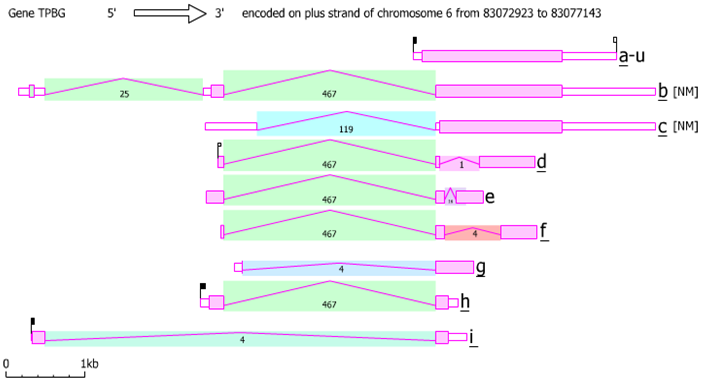
The mRNA differ by truncation of the 5 prime end, presence or absence of 2 cassette exons, overlapping exons with different boundaries, splicing versus retention of 3 introns.
The mRNA aAug10 variant has 2590 bp and the premessenger has a single exon. bAug10 has 3395 bp and the premessenger has 3 exons, cAug10 has 3446 bp and the premessenger has 2 exons, dAug10 has 817 bp and the premessenger has 3 exons, eAug10 has 687 bp and the premessenger has 3 exons, fAug10 has 607 bp and the premessenger has 3 exons, gAug10 has 591 bp and the premessenger has 2 exons, hAug10 has 564 bp and the premessenger has 2 exons, iAug10 has 568 bp and the premessenger has 2 exons.
The gene has 3 transcripts or 3 splice variants as per Ensembl. These 3 variants are subsets of the 8 spliced variants as per GenBAnk, bdEST, Trace and SRA databases supervised by the AceView program.
Proteins
Note
Description
Genomic sequence analysis reveals that the gene has 2 exons, the second of which encodes the protein (King et al., 1999).
Sequence
The sequence has 420 amino acids and a molecular weight of 46032 (UniProt).
Isoforms
There are 9 different isoforms (NCBI AceView).
Of the 9 different isoforms, 6 are considered to be very good quality proteins and 3 are good quality proteins.
The 9 isoforms are:
- aAug 10, predicted protein is 593 aa long and 65,1 kDa, and it has one leucine rich repeat N terminal domain, 3 leucine rich repeat domains, one leucine rich repeat C terminal domian and a transmembrane domain;
- bAug10, predicted protein is 588 aa long and 64,3 kDa and it has has one leucine rich repeat N terminal domain, 3 leucine rich repeat domains, one leucine rich repeat C terminal domain and a transmembrane domain;
- cAug10 518 aa and 56,6 kDa and has one leucine rich repeat N terminal domain, 3 leucine rich repeat domains, one leucine rich repeat C terminal domain and a transmembrane domain;
- dAug10 272 aa and 30,2 kDa and contains 3 leucine rich repeat domains;
- eAug10 229 aa and 23 kDa and contains no protein domain;
- faug10 201 aa and 22,6 kDa and has 2 leucine rich repeat domains;
- gAug10 161 aa and 17 kDa and contains no protein domain;
- hAug10 117 aa and 13,2 kDa and contains no protein domain;
- iAug10 105aa and 11,9 kDa and contains no protein domain.
There are 2 phosphorylation sites that have been identified based on information summarized in Phosphosite Plus.
The first is threonine 99 which was identified by mass spectrometry in the HeLa cervical cancer cell lines (Chen et al., 2009).
The second site of phosphorylation is Serine 418 identified via mass spectrometry in cervical cancer and identified in HeLa cervical cancer cell lines (Olsen et al., 2010).
Expression
It has a molecular weight of 72 kD.
It is a glycoprotein with a 42-kDa core protein with extensive N-linked glycosylation.
It exists on the cell surface as a monomeric protein.
The mature protein is membrane bound and consists of 310 amino acid extracellular regions with 7 N-linked glycosylation sites and a short 44-amino acid cytoplasmic tails.
There are 7 leucine rich repeats in the extracellular portion.
The LRRs are believed to mediate protein-protein interactions (Carsberg et al., 1995).
Localisation
Function
Transduction into cell lines enhances cell motility and decreases cell-to-cell contact, thereby playing a role in tumor invasion and metastases. This has been demonstarated in mouse fibroblasts (Carsberg et al., 1996).
- Chemotaxis
It has also been demonstrated that CXCR4-mediated chemotaxis is regulated by 5T4 as shown in mouse embryonic cells. CXCR4 mediates the migration of cells to tissues rich in CXCL12 (Southgate et al., 2010).
- EMT
The 5T4 antigen has been shown to play an important role in the epithelial-to-mesenchymal transition. The EMT is a process that occurs in early embryonic cells as well as metastases of certain cancers. The main events that occur during this process are a switch from E cadherin to N cadherin, increased vimentin expression, up-regulation of E cadherin repressor molecules such as snail and slug proteins, increased matrix metalloproteinases such as MMP2 and MMP9, and cellular motility.
The role of 5T4 in the process of EMT has been demonstrated in experiments on embryonic stem cells (Ensembl).
- Pathways and interaction
There is 1 interacting protein for TPBG-GIPC1 (MINT).
Full expression of 5T4 is found to transform mouse mammary epithelial cells to dendritic morphology. This is accompanied by loss of actin/adherin junctions, down regulation of ecadherin and changes in the cytoskeleton. These changes do not occur in the absence of the cytoplasmic tail portion of 5T4. G1PC is a scaffolding protein that interacts with the cytoplasmic tail of 5T4 and it contains the PDZ protein (Lee et al., 2008). PDZ domains mediate protein-protein interactions.The interaction between GIPC1 and 5T4 was demonstrated in HeLa cells using the yeast two hybrid approach by Awan et al. (2002). This interaction indicates a role for 5T4 in mediating changes within the cytoskeleton and thereby its role in invasion and metastases.
Homology
The greatest homology was with Pan troglotydes species (chimpanzee) with 99,68% homology based on the nucleic acids and 99,52% homology based on amino acids comparison to the human gene (Ensembl).
There is 1 paralogue (Ensembl).
Mutations
Note
There are a total of 921 variant sequences and 33 structural variations as summarized by the Ensembl data base.
This includes 6 frameshift mutations, 6 stop gained mutations, 3 inframe deletions, 153 misense variants, 2 splice region variants,111 synonymous variants,26 - 5 prime UTR variants,117- 3 prime UTR variants,22 intron variants, 179 upstream gene variants and 298 downstream gene variants.
Structural variations: there are 12 copy number variations, 2 insertions, 2 inversions, 4 tandem duplications and 13 intrachromosomal breakpoints.
Implicated in
Drugs and compounds: TroVax
The first study of TroVax in colorectal cancer was in patients who had been previously treated with chemotherapy. In this dose-escalation study, TroVax was given to 22 colorectal cancer patients in an open-label phase I/II trial. Sixteen of 17 immunologically evaluable patients showed a 5T4-specific response. Fourteen patients demonstrated detectable antibody levels following vaccination. There was a positive association between the development of the antibody response and patient survival or time to disease progression (Mulryan et al., 2002).
TroVax has been studied as a single agent in patients scheduled for surgical resection of colon cancer. Sixteen patients were enrolled in this phase 2 study. They received 2 vaccinations prior to surgery and 2 vaccinations after surgery. Nine patients had no disease recurrence at 8.4 months, and 13 patients mounted a 5T4-specific antibody response (Elkord et al., 2008).
The second study had a total of 11 patients who recived TroVax in combination with 5-FU/folinic acid and irinotecan. Six patients had either a complete response or stable disease, and 10 patients had 5-T4-specific antibody responses (Harrop et al., 2008).
Drugs and compounds: TroVax
Open-label phase1/2 trial of TroVax administration along with interferon alpha in 11 patients with metastatic RCC. All 11 patients mounted an antibody response to 5T4. The median time to progression was 9 months which was longer than that with interferon alone (Hawkins et al., 2009).
A second open-label, phase 2 trial involved 23 metatstatic RCC patients. TroVax was administered alone or in combination with IFN-alpha. In that study, 96% of patients mounted a 5T4-specific antibody response. One patient in the TroVax/IFN arm achieved a PR; 7 patients in the TroVax/interferon combination arm and 7 patients in the TroVax-alone arm achieved stable disease. The median PFS was 3.8 months, and the median OS was 12.1 months (Amato et al., 2009).
Another phase 2 trial looked at the combination of TroVax with low-dose IL-2 in metastatic RCC patients. Twenty-five patients were enrolled in that study, 21 of whom mounted 5T4-specific antibody response. Two patients demonstrated a complete reponse of >36 months, 1 patient demonstrated a PR of 12 months, and 6 patients demonstrated stable disease for between 6 and 21 months. Median PFS was 3.37 months, and median OS was 12.87 months (Amato et al., 2008b).
There has been only 1 phase 3 trial to date that has studied TroVax in metastatic RCC patients. Amato et al. (2010) enrolled 733 patients in a study to compare TroVax with sunitib, IFN, or IL-2. Immune response was assessed in 590 patients, 56% of whom had a positive 5T4-specific antibody response. A high 5T4 antibody response was associated with longer survival in the TroVax arm.
Two phase 2 trials have studied TroVax in castration-resistant prostate cancer patients.
An open-label phase 2 trial by evaluated TroVax alone or in combination with GM-CSF in 27 patients with castration-resistant prostate cancer. All 24 immunologically evaluable patients mounted a 5T4 antibody response. Time to progression was significantly greater in those who mounted a 5T4-specific cellular response (5.6 vs. 2.3 months) (Amato et al., 2008a).
A second phase 2 randomized study enrolled 25 patients, 12 of whom were randomzied to receive TroVax plus docetaxel and 13 to receive docetaxel alone. Patients treated with TroVax plus docetaxel had a longer PFS (9.67 months) than those in the docetaxel-alone arm (5.10 months). Six of the 10 immunologically evaluable patients mounted a 5T4 antibody response (Harrop et al., 2013).
Article Bibliography
| Pubmed ID | Last Year | Title | Authors |
|---|---|---|---|
| 18528296 | 2008 | Vaccination of prostate cancer patients with modified vaccinia ankara delivering the tumor antigen 5T4 (TroVax): a phase 2 trial. | Amato RJ et al |
| 20881001 | 2010 | Vaccination of metastatic renal cancer patients with MVA-5T4: a randomized, double-blind, placebo-controlled phase III study. | Amato RJ et al |
| 19561532 | 2009 | Vaccination of renal cell cancer patients with modified vaccinia Ankara delivering the tumor antigen 5T4 (TroVax) alone or administered in combination with interferon-alpha (IFN-alpha): a phase 2 trial. | Amato RJ et al |
| 11798178 | 2002 | 5T4 interacts with TIP-2/GIPC, a PDZ protein, with implications for metastasis. | Awan A et al |
| 8895545 | 1996 | Metastasis-associated 5T4 antigen disrupts cell-cell contacts and induces cellular motility in epithelial cells. | Carsberg CJ et al |
| 19276368 | 2009 | CDC25B mediates rapamycin-induced oncogenic responses in cancer cells. | Chen RQ et al |
| 21540235 | 2011 | Delineation of a cellular hierarchy in lung cancer reveals an oncofetal antigen expressed on tumor-initiating cells. | Damelin M et al |
| 18056451 | 2007 | Epithelial-mesenchymal transition events during human embryonic stem cell differentiation. | Eastham AM et al |
| 18833005 | 2008 | An MVA-based vaccine targeting the oncofetal antigen 5T4 in patients undergoing surgical resection of colorectal cancer liver metastases. | Elkord E et al |
| 16222313 | 2005 | Expression of the 5T4 oncofoetal antigen in renal cell carcinoma: a potential target for T-cell-based immunotherapy. | Griffiths RW et al |
| 23877659 | 2013 | Vaccination of castration-resistant prostate cancer patients with TroVax (MVA-5T4) in combination with docetaxel: a randomized phase II trial. | Harrop R et al |
| 18060404 | 2008 | Vaccination of colorectal cancer patients with TroVax given alongside chemotherapy (5-fluorouracil, leukovorin and irinotecan) is safe and induces potent immune responses. | Harrop R et al |
| 19342962 | 2009 | Vaccination of patients with metastatic renal cancer with modified vaccinia Ankara encoding the tumor antigen 5T4 (TroVax) given alongside interferon-alpha. | Hawkins RE et al |
| 3355761 | 1988 | A 72 kD trophoblast glycoprotein defined by a monoclonal antibody. | Hole N et al |
| 2404512 | 1990 | Investigation of expression of 5T4 antigen in cervical cancer. | Jones H et al |
| 10366710 | 1999 | Organisation of the mouse and human 5T4 oncofoetal leucine-rich glycoprotein genes and expression in foetal and adult murine tissues. | King KW et al |
| 18775991 | 2008 | Endoglin promotes transforming growth factor beta-mediated Smad 1/5/8 signaling and inhibits endothelial cell migration through its association with GIPC. | Lee NY et al |
| 9815581 | 1997 | Low intercellular adhesion molecule 1 and high 5T4 expression on tumor cells correlate with reduced disease-free survival in colorectal carcinoma patients. | Mulder WM et al |
| 12481437 | 2002 | Attenuated recombinant vaccinia virus expressing oncofetal antigen (tumor-associated antigen) 5T4 induces active therapy of established tumors. | Mulryan K et al |
| 8132670 | 1994 | Isolation of a cDNA encoding 5T4 oncofetal trophoblast glycoprotein. An antigen associated with metastasis contains leucine-rich repeats. | Myers KA et al |
| 20068231 | 2010 | Quantitative phosphoproteomics reveals widespread full phosphorylation site occupancy during mitosis. | Olsen JV et al |
| 2404511 | 1990 | Immunohistological distribution of 5T4 antigen in normal and malignant tissues. | Southall PJ et al |
| 20376365 | 2010 | CXCR4 mediated chemotaxis is regulated by 5T4 oncofetal glycoprotein in mouse embryonic cells. | Southgate TD et al |
| 1419629 | 1992 | The expression of 5T4 antigen in colorectal and gastric carcinoma. | Starzynska T et al |
| 11578488 | 1995 | 5T4 oncofetal antigen expression in ovarian carcinoma. | Wrigley E et al |
Other Information
Locus ID:
NCBI: 7162
MIM: 190920
HGNC: 12004
Ensembl: ENSG00000146242
Variants:
dbSNP: 7162
ClinVar: 7162
TCGA: ENSG00000146242
COSMIC: TPBG
RNA/Proteins
| Gene ID | Transcript ID | Uniprot |
|---|---|---|
| ENSG00000146242 | ENST00000369750 | Q13641 |
| ENSG00000146242 | ENST00000535040 | Q13641 |
| ENSG00000146242 | ENST00000543496 | Q13641 |
Expression (GTEx)
Protein levels (Protein atlas)
References
| Pubmed ID | Year | Title | Citations |
|---|---|---|---|
| 35452205 | 2022 | LINC00342 induces metastasis of lung adenocarcinoma by targeting miR-15b/TPBG. | 4 |
| 35452205 | 2022 | LINC00342 induces metastasis of lung adenocarcinoma by targeting miR-15b/TPBG. | 4 |
| 31018661 | 2019 | Role of TPBG (Trophoblast Glycoprotein) Antigen in Human Pericyte Migratory and Angiogenic Activity. | 9 |
| 31018661 | 2019 | Role of TPBG (Trophoblast Glycoprotein) Antigen in Human Pericyte Migratory and Angiogenic Activity. | 9 |
| 28481180 | 2018 | Trophoblast Glycoprotein (TPGB/5T4) in Human Placenta: Expression, Regulation, and Presence in Extracellular Microvesicles and Exosomes. | 14 |
| 28481180 | 2018 | Trophoblast Glycoprotein (TPGB/5T4) in Human Placenta: Expression, Regulation, and Presence in Extracellular Microvesicles and Exosomes. | 14 |
| 27780858 | 2017 | 5T4-Targeted Therapy Ablates Cancer Stem Cells and Prevents Recurrence of Head and Neck Squamous Cell Carcinoma. | 24 |
| 28183528 | 2017 | Transethnic genome-wide scan identifies novel Alzheimer's disease loci. | 111 |
| 27780858 | 2017 | 5T4-Targeted Therapy Ablates Cancer Stem Cells and Prevents Recurrence of Head and Neck Squamous Cell Carcinoma. | 24 |
| 28183528 | 2017 | Transethnic genome-wide scan identifies novel Alzheimer's disease loci. | 111 |
| 25738465 | 2015 | Trophoblast glycoprotein promotes pancreatic ductal adenocarcinoma cell metastasis through Wnt/planar cell polarity signaling. | 7 |
| 25738465 | 2015 | Trophoblast glycoprotein promotes pancreatic ductal adenocarcinoma cell metastasis through Wnt/planar cell polarity signaling. | 7 |
| 24582434 | 2014 | Structural insights into the inhibition of Wnt signaling by cancer antigen 5T4/Wnt-activated inhibitory factor 1. | 20 |
| 25066861 | 2014 | Understanding and exploiting 5T4 oncofoetal glycoprotein expression. | 16 |
| 24582434 | 2014 | Structural insights into the inhibition of Wnt signaling by cancer antigen 5T4/Wnt-activated inhibitory factor 1. | 20 |
Citation
Swetha Yadav ; Robert J Amato ; Virginia Mohlere
TPBG (trophoblast glycoprotein)
Atlas Genet Cytogenet Oncol Haematol. 2013-11-01
Online version: http://atlasgeneticsoncology.org/gene/42675/
