BCLAF1 (BCL2-associated transcription factor 1)
2011-06-01 John Peter McPherson AffiliationDepartment of Pharmacology, Toxicology, University of Toronto, Toronto, Ontario, M5S 1A8 Canada
Identity
DNA/RNA
Description
Transcription
Pseudogene
Proteins
Description
Expression
Localisation
Bclaf1 was identified as a protein component of interchromatin granular clusters, subnuclear structures that appear to serve as repositories for pre-mRNA splicing factors (Misteli and Spector, 1998; Sutherland et al., 2001; Saitoh et al., 2004).
Function
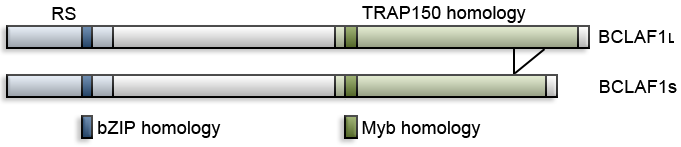
Recent studies have implicated BCLAF1 in processes linked to RNA metabolism. BCLAF1 contains an RS domain, a feature of many factors that facilitate pre-mRNA splicing and mRNA processing. BCLAF1 was found to be a component of ribonucleoprotein complexes (Merz et al., 2007; Sarras et al., 2010). Bclaf1-deficient cells were found to exhibit altered preferences for alternative splicing of a model substrate (Sarras et al., 2010). BCLAF1 was found associated with SkIP, TRAP150 and Pinin in a complex known as SNIP1. SNIP1 was found to regulate cyclin D1 mRNA processing by facilitating the recruitment of the RNA processing factor U2AF65 to cyclin D1 mRNA (Bracken et al., 2008).
BCLAF1 has been shown to complex with the RNA export factor TAP/NXF1 (Sarras et al., 2010). This property has also recently been reported for TRAP150, a protein showing structural similarity to BCLAF1 that also is found in ribonucleoprotein complexes (Lee et al., 2010). TRAP150 has been shown to promote pre-mRNA splicing of reporter substrates and promotes mRNA decay in a manner that is independent of nonsense-mediated decay of mRNA (Lee et al., 2010).
Regulation
Sirt1 has been shown to exert transcriptional control of BCLAF1 at the promoter level (Kong et al., 2011). Sirt1 was found to form a complex with the histone acetyltransferase p300 and NF-kB transcription factor Rel-A, bind the BCLAF1 promoter and suppress BCLAF1 transcription via H3K56 deacetylation (Kong et al., 2011).
BCLAF1 protein levels fluctuate according to cell cycle position, with levels highest during the G1 phase, but lower during S and G2 phases (Bracken et al., 2008). BCLAF1 protein levels also fluctuate in a cell-lineage and temporal manner during differentiation of certain tissues and organs (McPherson et al., 2009).
Several studies have determined that Bclaf1 is extensively phosphorylated, although the functional significance of this modification is unclear. BCLAF1 has been proposed as a substrate of GSK-3 kinase (Linding et al., 2007). Vasopressin action in kidney cells has been reported to simulate BCLAF1 phosphorylation (Hoffert et al., 2006).
BCLAF1 has been shown to be one of the cellular targets for microRNAs (miRNAs) encoded by Kaposis sarcoma-associated herpesvirus (KSHV). KSHV triggers certain acquired immune deficiency syndrome-related malignancies such as Kaposis sarcoma, primary effusion lymphoma and variants of multicentric Castleman disease. A miRNA cluster within the KSHV genome is expressed during viral latency. During induction of lytic KSHV growth, inhibition of miRNAs was associated with increased BCLAF1 expression and decreased KSHV virion production (Ziegelbauer et al., 2009).
Interactions
E1B 19K. By yeast two-hybrid analysis, BCLAF1 was shown to directly interact with adenoviral E1B 19K via a BH3 domain and another region immediately adjacent to BH3 in E1B 19K (Kasof et al., 1999). In vitro binding assays reported BCLAF1 associates with BCL-2 and BCL2L1.
emerin. By yeast-two hybrid analysis and microtiter well binding assays, BCLAF1 was shown to directly interact with emerin, a nuclear membrane protein. Mutations that result in a loss of functional emerin cause X-linked recessive Emery-Dreifuss muscular dystrophy. The residues of emerin required for binding to BCLAF1 mapped to two regions that flank its lamin-binding domain. Two disease-causing mutations in emerin, S54F and Delta95-99, disrupted binding to BCLAF1. BCLAF1 and emerin were observed to co-localize in the vicinity of the nuclear envelope following induction of apoptosis by Fas antibody (Haraguchi et al., 2004).
MAN1. The C-terminal domain of MAN1, a nuclear inner membrane protein that inhibits Smad signaling downstream of transforming growth factor beta, was observed to bind BCLAF1, as well as the transcriptional regulators GCL, and barrier-to-autointegration factor (BAF) (Mansharamani and Wilson, 2005).
Factors that participate in RNA metabolism. BCLAF1 and TRAP150 have been identified to be protein components of ribonucleoprotein complexes that participate in pre-mRNA splicing and other mRNA processing events (Merz et al., 2007; Sarras et al., 2010; Lee et al., 2010). Both BCLAF1 and TRAP150 have been reported to reside in protein complexes that contain the mRNA export factor NXF1/TAP (Sarras et al., 2010; Lee et al., 2010). Both BCLAF1 and TRAP150, together with Pinin and SkIP, have been found in a protein complex that regulates cyclin D1 mRNA stability.
Homology
Mutations
Note
Implicated in
Article Bibliography
| Pubmed ID | Last Year | Title | Authors |
|---|---|---|---|
| 7894480 | 1994 | Identification of a novel X-linked gene responsible for Emery-Dreifuss muscular dystrophy. | Bione S et al |
| 18794151 | 2008 | Regulation of cyclin D1 RNA stability by SNIP1. | Bracken CP et al |
| 16481476 | 2006 | Lamin A/C and emerin are critical for skeletal muscle satellite cell differentiation. | Frock RL et al |
| 15009215 | 2004 | Emerin binding to Btf, a death-promoting transcriptional repressor, is disrupted by a missense mutation that causes Emery-Dreifuss muscular dystrophy. | Haraguchi T et al |
| 19276370 | 2009 | TWIST-1 is overexpressed in neoplastic choroid plexus epithelial cells and promotes proliferation and invasion. | Hasselblatt M et al |
| 16641100 | 2006 | Quantitative phosphoproteomics of vasopressin-sensitive renal cells: regulation of aquaporin-2 phosphorylation at two sites. | Hoffert JD et al |
| 10330179 | 1999 | Btf, a novel death-promoting transcriptional repressor that interacts with Bcl-2-related proteins. | Kasof GM et al |
| 20855536 | 2010 | Germline variation in apoptosis pathway genes and risk of non-Hodgkin's lymphoma. | Kelly JL et al |
| 21454709 | 2011 | The type III histone deacetylase Sirt1 protein suppresses p300-mediated histone H3 lysine 56 acetylation at Bclaf1 promoter to inhibit T cell activation. | Kong S et al |
| 20123736 | 2010 | TRAP150 activates pre-mRNA splicing and promotes nuclear mRNA degradation. | Lee KM et al |
| 17570479 | 2007 | Systematic discovery of in vivo phosphorylation networks. | Linding R et al |
| 17938203 | 2007 | Protein kinase C delta induces transcription of the TP53 tumor suppressor gene by controlling death-promoting factor Btf in the apoptotic response to DNA damage. | Liu H et al |
| 12684533 | 2003 | MAN1 and emerin have overlapping function(s) essential for chromosome segregation and cell division in Caenorhabditis elegans. | Liu J et al |
| 15681850 | 2005 | Direct binding of nuclear membrane protein MAN1 to emerin in vitro and two modes of binding to barrier-to-autointegration factor. | Mansharamani M et al |
| 19008920 | 2009 | Essential role for Bclaf1 in lung development and immune system function. | McPherson JP et al |
| 17095540 | 2007 | Protein composition of human mRNPs spliced in vitro and differential requirements for mRNP protein recruitment. | Merz C et al |
| 9640532 | 1998 | The cellular organization of gene expression. | Misteli T et al |
| 14038586 | 1962 | Chondromyxoid fibroma of bone. | RALPH LL et al |
| 19705920 | 2009 | The proapoptotic C16-ceramide-dependent pathway requires the death-promoting factor Btf in colon adenocarcinoma cells. | Rénert AF et al |
| 20696777 | 2010 | Heterogeneous and complex rearrangements of chromosome arm 6q in chondromyxoid fibroma: delineation of breakpoints and analysis of candidate target genes. | Romeo S et al |
| 19700940 | 2009 | Benign cartilaginous tumors of bone: from morphology to somatic and germ-line genetics. | Romeo S et al |
| 15169873 | 2004 | Proteomic analysis of interchromatin granule clusters. | Saitoh N et al |
| 20661537 | 2010 | In search of a function for BCLAF1. | Sarras H et al |
| 21654386 | 2011 | New therapeutic targets and drugs in non-Hodgkin's lymphoma. | Sawas A et al |
| 11555636 | 2001 | Large-scale identification of mammalian proteins localized to nuclear sub-compartments. | Sutherland HG et al |
| 19098914 | 2009 | Tandem array-based expression screens identify host mRNA targets of virus-encoded microRNAs. | Ziegelbauer JM et al |
Other Information
Locus ID:
NCBI: 9774
MIM: 612588
HGNC: 16863
Ensembl: ENSG00000029363
Variants:
dbSNP: 9774
ClinVar: 9774
TCGA: ENSG00000029363
COSMIC: BCLAF1
RNA/Proteins
Expression (GTEx)
Protein levels (Protein atlas)
References
| Pubmed ID | Year | Title | Citations |
|---|---|---|---|
| 38340178 | 2024 | BCLAF1 binds SPOP to stabilize PD-L1 and promotes the development and immune escape of hepatocellular carcinoma. | 0 |
| 38340178 | 2024 | BCLAF1 binds SPOP to stabilize PD-L1 and promotes the development and immune escape of hepatocellular carcinoma. | 0 |
| 37906282 | 2023 | BCLAF1-induced HIF-1α accumulation under normoxia enhances PD-L1 treatment resistances via BCLAF1-CUL3 complex. | 2 |
| 37906282 | 2023 | BCLAF1-induced HIF-1α accumulation under normoxia enhances PD-L1 treatment resistances via BCLAF1-CUL3 complex. | 2 |
| 35660018 | 2022 | TET2-BCLAF1 transcription repression complex epigenetically regulates the expression of colorectal cancer gene Ascl2 via methylation of its promoter. | 2 |
| 35660018 | 2022 | TET2-BCLAF1 transcription repression complex epigenetically regulates the expression of colorectal cancer gene Ascl2 via methylation of its promoter. | 2 |
| 34251713 | 2021 | Role of BCLAF-1 in PD-L1 stabilization in response to ionizing irradiation. | 7 |
| 34490482 | 2021 | New insights from Whole Genome Sequencing: BCLAF1 deletion as a structural variant that predisposes cells towards cellular transformation. | 1 |
| 34251713 | 2021 | Role of BCLAF-1 in PD-L1 stabilization in response to ionizing irradiation. | 7 |
| 34490482 | 2021 | New insights from Whole Genome Sequencing: BCLAF1 deletion as a structural variant that predisposes cells towards cellular transformation. | 1 |
| 31870774 | 2020 | BCLAF1 promotes cell proliferation, invasion and drug-resistance though targeting lncRNA NEAT1 in hepatocellular carcinoma. | 22 |
| 32029898 | 2020 | Bclaf1 is a direct target of HIF-1 and critically regulates the stability of HIF-1α under hypoxia. | 12 |
| 31870774 | 2020 | BCLAF1 promotes cell proliferation, invasion and drug-resistance though targeting lncRNA NEAT1 in hepatocellular carcinoma. | 22 |
| 32029898 | 2020 | Bclaf1 is a direct target of HIF-1 and critically regulates the stability of HIF-1α under hypoxia. | 12 |
| 30015413 | 2019 | Heat Shock Protein 90α-Dependent B-Cell-2-Associated Transcription Factor 1 Promotes Hepatocellular Carcinoma Proliferation by Regulating MYC Proto-Oncogene c-MYC mRNA Stability. | 28 |
Citation
John Peter McPherson
BCLAF1 (BCL2-associated transcription factor 1)
Atlas Genet Cytogenet Oncol Haematol. 2011-06-01
Online version: http://atlasgeneticsoncology.org/gene/43164/bclaf1-(bcl2-associated-transcription-factor-1)
