BEX1 (brain expressed, X-linked 1)
2012-01-01 Biaoyang Lin , Jing Zhang , Greg Foltz AffiliationSwedish Medical Center, Seattle, WA, USA (BL, GF); Zhejiang-California International NanoSystems Institute, Zhejiang Univ Hangzhou, China (BL, JZ)
DNA/RNA
Note
There was some confusion in the nomenclature of the human BEX genes. The BEX1 referred in the publications (Quentmeier et al., 2005; Yang et al., 2002) is actually BEX2. BEX2, represented by the Genbank accession number AF220189, was called BEX1 by Yang et al. and others (Quentmeier et al., 2005; Yang et al., 2002). Later on, Alvarez et al. found that AF220189 is more similar to mouse Bex2 than to mouse Bex1 (74% and 68% identical, respectively) and that its chromosomal localization matches that of mouse Bex2 (Alvarez et al., 2005). Therefore, AF220189 is considered the human homologue of mouse Bex2, and is human BEX2.
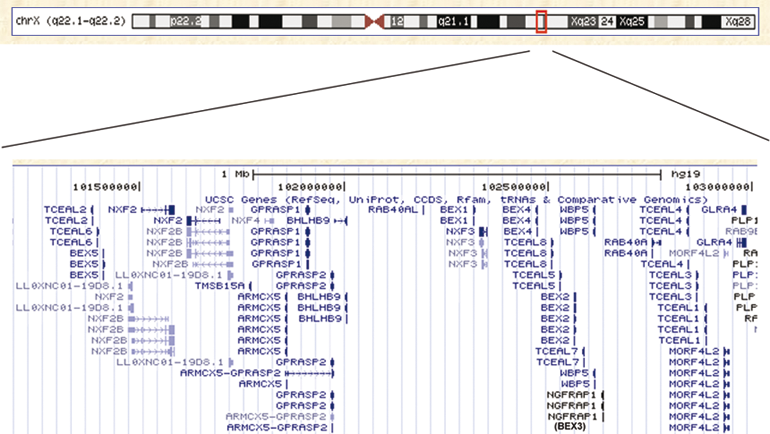
A diagram using the UCSC genome browser showing the locations of the five BEX members in the order of BEX5-BEX1-BEX4-BEX2-NGFRAP1 (nerve growth factor receptor (TNFRSF16) associated protein 1, BEX3) on the X chromosome at Xq22.1-2, along with other genes in the region.
Description
BEX1 encodes a gene belonging to the brain expressed X-linked gene family. It is a putative tumor suppressor as it is silenced in human glioma (Foltz et al., 2006). The BEX1 gene contains three exons, but the coding region is contained in one single exon.
Proteins
Note
Interacts with neurotrophin receptor p75NTR/NGFR (Naderi et al., 2007). Interacts with olfactory marker protein (OMP) (Koo et al., 2004).
Description
The BEX1 protein (NP_060946.3) has 125 amino acid residues.
Expression
Koo et al. assessed the expression pattern of Bex proteins in several different mouse tissues by western blot analysis (Koo et al., 2004). They used a polyclonal chicken antibody directed against a peptide common to the C-terminal region of mouse Bex1 and -2, which are 87% identical and 90% similar in amino acid sequences. They found that Bex1 and -2 proteins are expressed in mouse whole brain without olfactory bulb, olfactory bulb, olfactory epithelium and at a lower level in the heart, kidney, and liver but, not in the lung (Koo et al., 2004).
Localisation
Nucleus and cytoplasm (Koo et al., 2004).
Function
BEX1 plays a role in cell cycle progression as Bex1 levels oscillated during the cell cycle (Vilar et al., 2006). BEX1 also participates in neuronal differentiation (Vilar et al., 2006). Nerve growth factor (NGF) is a member of the neurotrophin family proteins that mediate survival, growth and differentiation of neuronal and glial cells by binding to two different types of cell surface receptors, the Trk tyrosine kinases - TrkA, TrkB and TrkC - and the p75 neurotrophin receptor (p75NTR). Vilar et al. showed that Bex1 competed with RIP2 (receptor-interacting serine-threonine kinase 2) for binding to the p75NTR intracellular domain, and elevating RIP2 levels restored the ability of cells overexpressing Bex1 to differentiate in response to NGF (Vilar et al., 2006). They further demonstrated that, in PC12 cells, Bex1 overexpression inhibited the induction of NF-kappaB activity by NGF without affecting activation of Erk1/Erk2 and AKT, while Bex1 knockdown accelerated neuronal differentiation and potentiated NF-kappaB activity in response to NGF (Vilar et al., 2006).
Homology
Five BEX members have been identified in human. They are BEX1, BEX2, NGFRAP1 (nerve growth factor receptor (TNFRSF16) associated protein 1, BEX3), BEX4, and BEX5. They are all clustered on the X chromosome at Xq22.1-2 (Alvarez et al., 2005).
Mutations
Note
None identified.
Implicated in
Entity name
Glioma
Note
We showed that BEX1 and BEX2 are candidate tumor suppressor genes in malignant glioma in a genome-wide analysis of epigenetic silencing in gliomas (Foltz et al., 2006). We found that BEX1 and BEX2 were reactivated by trichostatin A (TSA), a histone deacetylase inhibitor, or 5-aza-2-deoxycytidine (5-AzaC), a DNA methyltransferase inhibitor in glioma cell line T98 and U87, and 10 patient-derived primary glioma cell lines (Foltz et al., 2006). We demonstrated that BEX1 and BEX2s expression were silenced in GBM specimens because of extensive promoter hypermethylation at their promoters. Re-expression of either BEX1 or BEX2 led to increased sensitivity to chemotherapy-induced apoptosis and potent tumor suppressor effects in vitro and in a xenograft mouse model (Foltz et al., 2006). We further showed that BEX1 and BEX2 in GBM cells were down regulated by SOX2, a key gene implicated in maintaining the stemness of embryonic and adult stem cells (Fang et al., 2011).
Disease
Gliomas are the primary cancers derived from glial cells in the brain. It is the most frequent cerebral neoplasias. Astrocytomas are the most common type of gliomas. They are slow-growing, and can be found anywhere in the brain, but most often found in the cerebrum. They can be clinically divided into four grades, with glioblastoma (World Health Organization grade IV) being the most common and aggressive.
Article Bibliography
| Pubmed ID | Last Year | Title | Authors |
|---|---|---|---|
| 15958283 | 2005 | Characterization of the Bex gene family in humans, mice, and rats. | Alvarez E et al |
| 21211035 | 2011 | The SOX2 response program in glioblastoma multiforme: an integrated ChIP-seq, expression microarray, and microRNA analysis. | Fang X et al |
| 16818640 | 2006 | Genome-wide analysis of epigenetic silencing identifies BEX1 and BEX2 as candidate tumor suppressor genes in malignant glioma. | Foltz G et al |
| 15198671 | 2004 | The interaction of Bex and OMP reveals a dimer of OMP with a short half-life. | Koo JH et al |
| 17638883 | 2007 | BEX2 is overexpressed in a subset of primary breast cancers and mediates nerve growth factor/nuclear factor-kappaB inhibition of apoptosis in breast cancer cell lines. | Naderi A et al |
| 15920485 | 2005 | Expression of BEX1 in acute myeloid leukemia with MLL rearrangements. | Quentmeier H et al |
| 16498402 | 2006 | Bex1, a novel interactor of the p75 neurotrophin receptor, links neurotrophin signaling to the cell cycle. | Vilar M et al |
| 11989783 | 2002 | Cloning and expression pattern of a spermatogenesis-related gene, BEX1, mapped to chromosome Xq22. | Yang QS et al |
Other Information
Locus ID:
NCBI: 55859
MIM: 300690
HGNC: 1036
Ensembl: ENSG00000133169
Variants:
dbSNP: 55859
ClinVar: 55859
TCGA: ENSG00000133169
COSMIC: BEX1
RNA/Proteins
| Gene ID | Transcript ID | Uniprot |
|---|---|---|
| ENSG00000133169 | ENST00000372728 | Q9HBH7 |
Expression (GTEx)
Protein levels (Protein atlas)
References
| Pubmed ID | Year | Title | Citations |
|---|---|---|---|
| 37209973 | 2023 | BEX1 mediates sorafenib resistance in hepatocellular carcinoma by regulating AKT signaling. | 1 |
| 37715024 | 2023 | BEX1 supports the stemness of hepatoblastoma by facilitating Warburg effect in a PPARγ/PDK1 dependent manner. | 0 |
| 37209973 | 2023 | BEX1 mediates sorafenib resistance in hepatocellular carcinoma by regulating AKT signaling. | 1 |
| 37715024 | 2023 | BEX1 supports the stemness of hepatoblastoma by facilitating Warburg effect in a PPARγ/PDK1 dependent manner. | 0 |
| 33745298 | 2021 | BEX1 Is Differentially Expressed in Aldosterone-Producing Adenomas and Protects Human Adrenocortical Cells From Ferroptosis. | 6 |
| 34217777 | 2021 | DNMT1-mediated methylation of BEX1 regulates stemness and tumorigenicity in liver cancer. | 52 |
| 34576008 | 2021 | BEX1 and BEX4 Induce GBM Progression through Regulation of Actin Polymerization and Activation of YAP/TAZ Signaling. | 10 |
| 33745298 | 2021 | BEX1 Is Differentially Expressed in Aldosterone-Producing Adenomas and Protects Human Adrenocortical Cells From Ferroptosis. | 6 |
| 34217777 | 2021 | DNMT1-mediated methylation of BEX1 regulates stemness and tumorigenicity in liver cancer. | 52 |
| 34576008 | 2021 | BEX1 and BEX4 Induce GBM Progression through Regulation of Actin Polymerization and Activation of YAP/TAZ Signaling. | 10 |
| 30132532 | 2018 | Low expression of BEX1 predicts poor prognosis in patients with esophageal squamous cell cancer. | 5 |
| 30132532 | 2018 | Low expression of BEX1 predicts poor prognosis in patients with esophageal squamous cell cancer. | 5 |
| 29192139 | 2017 | BEX1 is an RNA-dependent mediator of cardiomyopathy. | 24 |
| 29192139 | 2017 | BEX1 is an RNA-dependent mediator of cardiomyopathy. | 24 |
| 25612294 | 2015 | Brain expressed and X-linked (Bex) proteins are intrinsically disordered proteins (IDPs) and form new signaling hubs. | 21 |
Citation
Biaoyang Lin ; Jing Zhang ; Greg Foltz
BEX1 (brain expressed, X-linked 1)
Atlas Genet Cytogenet Oncol Haematol. 2012-01-01
Online version: http://atlasgeneticsoncology.org/gene/44161/bex1-(brain-expressed-x-linked-1)
