NGFR (nerve growth factor receptor)
2015-12-01 Nobuyuki Tanaka AffiliationCancer Immunobiology, Miyagi Cancer Center Research Institute; [email protected]
Identity
HGNC
LOCATION
17q21.33 Size: 19,728 bases; orientation: plus strand.
LOCUSID
ALIAS
CD271,Gp80-LNGFR,TNFRSF16,p75(NTR),p75NTR
FUSION GENES
Abstract
Review on NGFR, with data on DNA, on the protein encoded, and where the gene is implicated.
DNA/RNA
Note
NGFR is a member of the Tumor Necrosis Factor receptor (TNFR) superfamily. It serves as a low-affinity common receptor subunit for multiple neurotrohins (NGF, BDNF, NTF3 (NT-3) and NTF4 (NT-4/5)) (Tomellini et al. et al., 2014). It lacks any enzymatic activity, and mediates signals through interacting protein partners.
Transcription
The transcript encodes 427 amino acids, including a signal peptide sequence.
Proteins
Description
Nerve growth factor receptor (NGFR) is a low affinity cell surface receptor for NGF. It is a member of the Tumor Necrosis Factor receptor (TNFR) superfamily, and thus anonymously called TNFRSF16. NGFR not only serves as a common receptor subunit for neurotrophins (NGF, BDNF, NT-3 and NT-4/5), but also binds their precursors (pro-neurotrophins), pro-NGF, pro-BDNF, pro-NT-3 and pro-NT-4/5. It also works as a co-receptor with other receptor partners, such as SORT1 (Sortilin), LINGO1 and RTN4R (Nogo receptor/NOGO-R)(Wang et al. et al., 2002; Bronfman et al. et al., 2004; Mi et al. et al., 2004; Meabon et al. et al., 2015).
NGFR consists of 427-amino-acid in overall length, and possesses an extracellular region with four 40 amino acid repeats with 6 cysteins at conserved positions followed by a serine/threonine-rich region, a single transmembrane domain, and a 155 amino acid cytoplasmic domain. The extracellular receives N- and O- glycosylations, and the cysteine-rich region conserved among the TNFR superfamily is licensing it as a similar receptor. The intracellular region lacks any catalytic domain, instead it possesses a death domain implicated in protein-protein interaction. Therefore, its signaling potential is dependent on protein-protein interactions.
NGFR receives proteolytic processing. Extracellular cleavage is mediated by ADAM17/TACE, which modifies NGFR to a smaller 28-kDa membrane-bound C-terminal fragment (p75-CTF). Further processing of p75-CTF by γ-secretase releases the intracellular domain (p75-ICD), which is implicated in cell death (Underwood et al. et al., 2008). Recent report indicates that the most abundant homotypic arrangement for NGFR is a trimer, and both of the monomers and trimers coexist (Anastasia et al. et al., 2015). In neurons, the trimers are not required for NGFR activation irrespective of ligand stimulation, whereas monomers are capable of conferring acute responses. Activation of NGFR is context-dependent, where the oligomerization status and expression amount determine the biological effect, and the trimers seem to sequester NGFR from an active form.
NGFR consists of 427-amino-acid in overall length, and possesses an extracellular region with four 40 amino acid repeats with 6 cysteins at conserved positions followed by a serine/threonine-rich region, a single transmembrane domain, and a 155 amino acid cytoplasmic domain. The extracellular receives N- and O- glycosylations, and the cysteine-rich region conserved among the TNFR superfamily is licensing it as a similar receptor. The intracellular region lacks any catalytic domain, instead it possesses a death domain implicated in protein-protein interaction. Therefore, its signaling potential is dependent on protein-protein interactions.
NGFR receives proteolytic processing. Extracellular cleavage is mediated by ADAM17/TACE, which modifies NGFR to a smaller 28-kDa membrane-bound C-terminal fragment (p75-CTF). Further processing of p75-CTF by γ-secretase releases the intracellular domain (p75-ICD), which is implicated in cell death (Underwood et al. et al., 2008). Recent report indicates that the most abundant homotypic arrangement for NGFR is a trimer, and both of the monomers and trimers coexist (Anastasia et al. et al., 2015). In neurons, the trimers are not required for NGFR activation irrespective of ligand stimulation, whereas monomers are capable of conferring acute responses. Activation of NGFR is context-dependent, where the oligomerization status and expression amount determine the biological effect, and the trimers seem to sequester NGFR from an active form.
Expression
NGFR is expressed in a wide variety of tissues, such as brain, peripheral neurons, schwann cells, liver, esophagus and oral epithelium and the mesenchyme. In development, it is expressed in neural crest stem cells, and is regarded as a neural crest stem (NCS) cell marker. NGFR is also expressed in adult tissue stem cells and cancer stem cells, derived from ectoderm, neural crest and mesoderm.
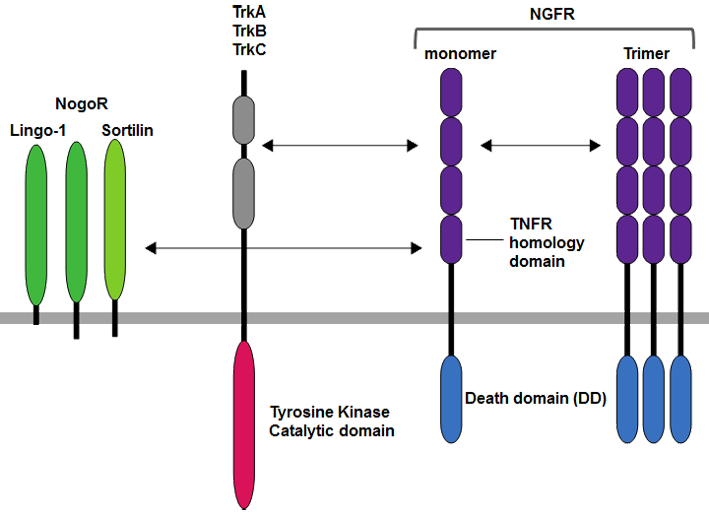
NGFR is localized on cellular membrane, either as a monomer or a trimer. NGFR forms a receptor heterodomer complex with TrkA, TrkB and TrkC. Also, NGFR associates with cell surface receptors such as Lingo-1, NogoR and Sortilin.
Localisation
NGFR is localized on the cell surface, endosomes and caveolae (Bilderback et al. et al., 1999; Huang et al. et al., 1999). It also shows cytoplasmic and nuclear localization. Intracellular domain (ICD), a cleaved product of NGFR, is present in intracellular compartments (Parkhurst et al. et al., 2010).
Function
NGFR forms disulfide-linked dimers independently of ligand binding (Vilar et al. et al., 2009). Variety of functions mediated by NGFR owes to co-receptors. NGFR cooperates with tyrosine kinase receptors of neurophilins; NTRK1 (TrkA) for NGF binding, NTRK2 (TrkB) for BDNF and NT-4/5 and NTRK3 (TrkC) for NT-3. NGFR also cooperates with non-tyrosine kinase receptors, sortilin, Lingo-1 and NOGO-R. A trimetric receptor complex with Lingo-1 and NOGO-R binds RTN4 (Nogo-66), MAG (myelin associated glycoprotein) and OMG (oligodendrocyte myelin glycoprotein).
NGFR confers diverse functions to cells, which is totally dependent on cell types, differentiation status, binding to neurotrophins, neurotrophin maturation status, availability of co-receptors, accessibility to intracytoplasmic effectors, post-translation modification and cleavages. A variety of NGFR-mediated signals mediate cell proliferation and survival (Gentry et al. et al., 2000), differentiation, cell cycle progression (Chittka et al. et al., 2004), apoptosis (Rabizadeh et al. et al., 1993) (Nykjaer et al. et al., 2004), neurite outgrowth and retraction (Rabizadeh et al. et al., 1999), myelination (Notterpek et al., 2003), cell migration and invasion.
Signaling:
NGFR lacks its own enzymatic activity. Instead, it associates with a variety of intracellular proteins to mediate signals. TRAF2 , TRAF4 and TRAF6 mediate NF-κB activation (Khursigara et al. et al., 1999; Ye et al. et al., 1999). NGFR, through its death domain (DD), binds RIPK2 (RIP2) by a neurotrophin-dependent manner, activates NF-κB and supports Schwann cell survival (Khursigara et al. et al., 2001). Similarly, PTPN13 (Fas-associated phosphatase-1/FAP-1) and FAIM (Fas apoptosis inhibitory molecule) associate NGFR, and activates NF-κB and mediate neurite outgrowth (Irie et al. et al., 1999) (Sole et al. et al., 2004). NGFR activates RAC1, which leads to JNK activation and cell death (Harrington et al. et al., 2002). Pro-neurotrophin such as pro-BDNF activates CASP3 (Caspase-3) and JNK, leading to neuronal cell death (Charalampopoulos et al. et al., 2012). JNK is necessary but not sufficient for NGFR-mediated cell death. NGFR constitutively associates with ARHGDIA (RhoGDI), preventing its inhibition towards RHOA. RIP2 recruitment to DD and RhoGDI release from it, is mechanistically linked, and RhoGDI prevents RhoA activity upon release from NGFR. RIP2 has another competitor BEX1 for NGFR binding; BEX1 inhibits NF-κB activation and cell cycle progression. Association of MAGED1 (Neurotrophin receptor-interacting MAGE homolog/NRAGE), NGFRAP1 (p75NTR-associated cell death executor/NADE) and neurotrophin receptor interacting factor (NRIF) is related with pro-apoptotic signaling (Sasaki et al. et al., 2005; Bertrand et al. et al., 2008) (Mukai et al. et al., 2000) (Linggi et al. et al., 2005). Other binding partners include Schwann cell factor 1 (SC1) (Chittka et al. et al., 2004) and SALL2 (Pincheira et al. et al., 2009) both inducing cell cycle arrest, PARD3 (Par-3) which is involved in polarized myelination, and PDE4A4/5 implicated in enhanced cAMP degradation (Sachs et al. et al., 2007). NGFR also binds MAGI1 , which induces neurite outgrowth (Ito et al. et al., 2013). SHC1 is constitutively bound with NGFR, which may play a role in activation of phosphoinositide 3-kinase (PI3K) and Akt (protein kinase B) (Epa et al. et al., 2004). PI3K-Akt pathway supports survival of many types of cells (So et al. et al., 2013). Rab5 Family GTPases RAB5A and RAB31 directly associate with the DD of NGFR, and NGFR regulates glucose homeostasis and insulin sensitivity.
Stem cell Marker:
A variety of stem/progenitor cells express NGFR (Tomellini et al. et al., 2014). Inner cell mass of blastocysts is NGFR-positive, indicating that embryonic stem cells express NGFR. Later in the development, neural crest stem cells (NCSC) express NGFR (Schuldiner et al. et al., 2000), where three neutrophins, BDNF, NT-3 and NT-4, mediate their survival (Pyle et al. et al., 2006). NGFR also marks adult stem cells. Tissue stem cells originating from NCSCs express NGFR, and NGFR seemingly maintains their undifferentiated phenotypes and survival via NT-3(Kruger et al. et al., 2002) (Chalazonitis et al., 2004). Mesenchymal stem cells (MSCs) also express NGFR, where NGFR inhibits the differentiation of MSCs into osteogenic, adipogenic, chondrogenic and myogenic lineages (Mikami et al. et al., 2011). NGFR is a marker for precursors of hepatic stellate cells and portal fibloblast in the liver (Suzuki et al. et al., 2008). Likewise, keratinocyte of the basal layer of epidermis, and esophageal and oropharyngeal mucosas basal layer cells possessing tissue stem cell properties, are NGFR-positive.
NGFR confers diverse functions to cells, which is totally dependent on cell types, differentiation status, binding to neurotrophins, neurotrophin maturation status, availability of co-receptors, accessibility to intracytoplasmic effectors, post-translation modification and cleavages. A variety of NGFR-mediated signals mediate cell proliferation and survival (Gentry et al. et al., 2000), differentiation, cell cycle progression (Chittka et al. et al., 2004), apoptosis (Rabizadeh et al. et al., 1993) (Nykjaer et al. et al., 2004), neurite outgrowth and retraction (Rabizadeh et al. et al., 1999), myelination (Notterpek et al., 2003), cell migration and invasion.
Signaling:
NGFR lacks its own enzymatic activity. Instead, it associates with a variety of intracellular proteins to mediate signals. TRAF2 , TRAF4 and TRAF6 mediate NF-κB activation (Khursigara et al. et al., 1999; Ye et al. et al., 1999). NGFR, through its death domain (DD), binds RIPK2 (RIP2) by a neurotrophin-dependent manner, activates NF-κB and supports Schwann cell survival (Khursigara et al. et al., 2001). Similarly, PTPN13 (Fas-associated phosphatase-1/FAP-1) and FAIM (Fas apoptosis inhibitory molecule) associate NGFR, and activates NF-κB and mediate neurite outgrowth (Irie et al. et al., 1999) (Sole et al. et al., 2004). NGFR activates RAC1, which leads to JNK activation and cell death (Harrington et al. et al., 2002). Pro-neurotrophin such as pro-BDNF activates CASP3 (Caspase-3) and JNK, leading to neuronal cell death (Charalampopoulos et al. et al., 2012). JNK is necessary but not sufficient for NGFR-mediated cell death. NGFR constitutively associates with ARHGDIA (RhoGDI), preventing its inhibition towards RHOA. RIP2 recruitment to DD and RhoGDI release from it, is mechanistically linked, and RhoGDI prevents RhoA activity upon release from NGFR. RIP2 has another competitor BEX1 for NGFR binding; BEX1 inhibits NF-κB activation and cell cycle progression. Association of MAGED1 (Neurotrophin receptor-interacting MAGE homolog/NRAGE), NGFRAP1 (p75NTR-associated cell death executor/NADE) and neurotrophin receptor interacting factor (NRIF) is related with pro-apoptotic signaling (Sasaki et al. et al., 2005; Bertrand et al. et al., 2008) (Mukai et al. et al., 2000) (Linggi et al. et al., 2005). Other binding partners include Schwann cell factor 1 (SC1) (Chittka et al. et al., 2004) and SALL2 (Pincheira et al. et al., 2009) both inducing cell cycle arrest, PARD3 (Par-3) which is involved in polarized myelination, and PDE4A4/5 implicated in enhanced cAMP degradation (Sachs et al. et al., 2007). NGFR also binds MAGI1 , which induces neurite outgrowth (Ito et al. et al., 2013). SHC1 is constitutively bound with NGFR, which may play a role in activation of phosphoinositide 3-kinase (PI3K) and Akt (protein kinase B) (Epa et al. et al., 2004). PI3K-Akt pathway supports survival of many types of cells (So et al. et al., 2013). Rab5 Family GTPases RAB5A and RAB31 directly associate with the DD of NGFR, and NGFR regulates glucose homeostasis and insulin sensitivity.
Stem cell Marker:
A variety of stem/progenitor cells express NGFR (Tomellini et al. et al., 2014). Inner cell mass of blastocysts is NGFR-positive, indicating that embryonic stem cells express NGFR. Later in the development, neural crest stem cells (NCSC) express NGFR (Schuldiner et al. et al., 2000), where three neutrophins, BDNF, NT-3 and NT-4, mediate their survival (Pyle et al. et al., 2006). NGFR also marks adult stem cells. Tissue stem cells originating from NCSCs express NGFR, and NGFR seemingly maintains their undifferentiated phenotypes and survival via NT-3(Kruger et al. et al., 2002) (Chalazonitis et al., 2004). Mesenchymal stem cells (MSCs) also express NGFR, where NGFR inhibits the differentiation of MSCs into osteogenic, adipogenic, chondrogenic and myogenic lineages (Mikami et al. et al., 2011). NGFR is a marker for precursors of hepatic stellate cells and portal fibloblast in the liver (Suzuki et al. et al., 2008). Likewise, keratinocyte of the basal layer of epidermis, and esophageal and oropharyngeal mucosas basal layer cells possessing tissue stem cell properties, are NGFR-positive.
Implicated in
Entity name
Melanoma
Note
Tumor tissues are often heterogeneous and contain a population of cells with stem-like properties, referred as cancer stem cells (CSCs). NGFR is a CSC-marker of Melanoma which arise from Melanocytes, neural crest derived cells (Boiko et al. et al., 2010). NGFR+ Melanoma CSCs are not only tumorigenic, but also prone to make metastasis.
Entity name
Hypopharyngeal cancer
Note
Squamous cell carcinoma (SCS) is also tightly associated with NGFR. NGFR defines CSC-like cells in hypopharyngeal cancer (Imai et al. et al., 2013).
Prognosis
The degree of NGFR+ cells within a tumor is significantly associated with patients prognosis
Entity name
Head and neck squamous cancer and esophageal cancer
Note
Squamous cell carcinoma arising in the oral cancer is also tightly associated with NGFR. Higher NGFR expression is also associated with poor prognosis of other SCCs such as esophageal, oral and head and neck cancers, suggesting its CSC-like phenotypes (Okumura et al. et al., 2006; Murillo-Sauca et al. et al., 2014).
Entity name
Breast cancer
Note
GFR mediates breast CSC self-renewal by regulating the expression of pluripotency transcription factors (Tomellini et al. et al., 2015).
Article Bibliography
| Pubmed ID | Last Year | Title | Authors |
|---|---|---|---|
| 26311773 | 2015 | Detection of p75NTR Trimers: Implications for Receptor Stoichiometry and Activation. | Anastasia A et al |
| 18772898 | 2008 | NRAGE, a p75NTR adaptor protein, is required for developmental apoptosis in vivo. | Bertrand MJ et al |
| 9867838 | 1999 | Caveolin interacts with Trk A and p75(NTR) and regulates neurotrophin signaling pathways. | Bilderback TR et al |
| 20596026 | 2010 | Human melanoma-initiating cells express neural crest nerve growth factor receptor CD271. | Boiko AD et al |
| 15470383 | 2004 | Multi-tasking by the p75 neurotrophin receptor: sortilin things out? | Bronfman FC et al |
| 14699968 | 2004 | Neurotrophin-3 in the development of the enteric nervous system. | Chalazonitis A et al |
| 23260665 | 2012 | Genetic dissection of neurotrophin signaling through the p75 neurotrophin receptor. | Charalampopoulos I et al |
| 15051733 | 2004 | The p75NTR-interacting protein SC1 inhibits cell cycle progression by transcriptional repression of cyclin E. | Chittka A et al |
| 15056278 | 2004 | The p75 neurotrophin receptor enhances TrkA signalling by binding to Shc and augmenting its phosphorylation. | Epa WR et al |
| 10713062 | 2000 | Nerve growth factor activation of nuclear factor kappaB through its p75 receptor is an anti-apoptotic signal in RN22 schwannoma cells. | Gentry JJ et al |
| 11756498 | 2002 | Activation of Rac GTPase by p75 is necessary for c-jun N-terminal kinase-mediated apoptosis. | Harrington AW et al |
| 10593976 | 1999 | Nerve growth factor signaling in caveolae-like domains at the plasma membrane. | Huang CS et al |
| 23626764 | 2013 | CD271 defines a stem cell-like population in hypopharyngeal cancer. | Imai T et al |
| 10544233 | 1999 | Functional interaction of Fas-associated phosphatase-1 (FAP-1) with p75(NTR) and their effect on NF-kappaB activation. | Irie S et al |
| 23769981 | 2013 | MAGI-1 acts as a scaffolding molecule for NGF receptor-mediated signaling pathway. | Ito H et al |
| 11487608 | 2001 | A prosurvival function for the p75 receptor death domain mediated via the caspase recruitment domain receptor-interacting protein 2. | Khursigara G et al |
| 12194866 | 2002 | Neural crest stem cells persist in the adult gut but undergo changes in self-renewal, neuronal subtype potential, and factor responsiveness. | Kruger GM et al |
| 15668238 | 2005 | Neurotrophin receptor interacting factor (NRIF) is an essential mediator of apoptotic signaling by the p75 neurotrophin receptor. | Linggi MS et al |
| 25666623 | 2015 | LINGO-1 protein interacts with the p75 neurotrophin receptor in intracellular membrane compartments. | Meabon JS et al |
| 14966521 | 2004 | LINGO-1 is a component of the Nogo-66 receptor/p75 signaling complex. | Mi S et al |
| 21142793 | 2011 | CD271/p75(NTR) inhibits the differentiation of mesenchymal stem cells into osteogenic, adipogenic, chondrogenic, and myogenic lineages. | Mikami Y et al |
| 10764727 | 2000 | NADE, a p75NTR-associated cell death executor, is involved in signal transduction mediated by the common neurotrophin receptor p75NTR. | Mukai J et al |
| 25149537 | 2014 | CD271 is a functional and targetable marker of tumor-initiating cells in head and neck squamous cell carcinoma. | Murillo-Sauca O et al |
| 12744836 | 2003 | Neurotrophins in myelination: a new role for a puzzling receptor. | Notterpek L et al |
| 14985763 | 2004 | Sortilin is essential for proNGF-induced neuronal cell death. | Nykjaer A et al |
| 16951226 | 2006 | The biological role of the low-affinity p75 neurotrophin receptor in esophageal squamous cell carcinoma. | Okumura T et al |
| 20022966 | 2010 | Nuclear localization of the p75 neurotrophin receptor intracellular domain. | Parkhurst CN et al |
| 19131967 | 2009 | Sall2 is a novel p75NTR-interacting protein that links NGF signalling to cell cycle progression and neurite outgrowth. | Pincheira R et al |
| 16444268 | 2006 | Neurotrophins mediate human embryonic stem cell survival. | Pyle AD et al |
| 10637439 | 1999 | Neurotrophin dependence mediated by p75NTR: contrast between rescue by BDNF and NGF. | Rabizadeh S et al |
| 17576803 | 2007 | p75 neurotrophin receptor regulates tissue fibrosis through inhibition of plasminogen activation via a PDE4/cAMP/PKA pathway. | Sachs BD et al |
| 16194933 | 2005 | RumMAGE-D the members: structure and function of a new adaptor family of MAGE-D proteins. | Sasaki A et al |
| 11027332 | 2000 | Effects of eight growth factors on the differentiation of cells derived from human embryonic stem cells. | Schuldiner M et al |
| 23760533 | 2013 | Regulation of PI-3-Kinase and Akt Signaling in T Lymphocytes and Other Cells by TNFR Family Molecules. | So T et al |
| 15520226 | 2004 | The death receptor antagonist FAIM promotes neurite outgrowth by a mechanism that depends on ERK and NF-kapp B signaling. | Sole C et al |
| 18515089 | 2008 | p75 Neurotrophin receptor is a marker for precursors of stellate cells and portal fibroblasts in mouse fetal liver. | Suzuki K et al |
| 25286822 | 2015 | Nerve growth factor and proNGF simultaneously promote symmetric self-renewal, quiescence, and epithelial to mesenchymal transition to enlarge the breast cancer stem cell compartment. | Tomellini E et al |
| 18055214 | 2008 | Palmitoylation of the C-terminal fragment of p75(NTR) regulates death signaling and is required for subsequent cleavage by gamma-secretase. | Underwood CK et al |
| 19376068 | 2009 | Activation of the p75 neurotrophin receptor through conformational rearrangement of disulphide-linked receptor dimers. | Vilar M et al |
| 12422217 | 2002 | P75 interacts with the Nogo receptor as a co-receptor for Nogo, MAG and OMgp. | Wang KC et al |
| 10514511 | 1999 | TRAF family proteins interact with the common neurotrophin receptor and modulate apoptosis induction. | Ye X et al |
Other Information
Locus ID:
NCBI: 4804
MIM: 162010
HGNC: 7809
Ensembl: ENSG00000064300
Variants:
dbSNP: 4804
ClinVar: 4804
TCGA: ENSG00000064300
COSMIC: NGFR
RNA/Proteins
| Gene ID | Transcript ID | Uniprot |
|---|---|---|
| ENSG00000064300 | ENST00000172229 | P08138 |
| ENSG00000064300 | ENST00000504201 | P08138 |
Expression (GTEx)
Pathways
Protein levels (Protein atlas)
References
| Pubmed ID | Year | Title | Citations |
|---|---|---|---|
| 38016691 | 2024 | CD271 promotes proliferation and migration in bladder cancer. | 0 |
| 38339011 | 2024 | Joint CB1 and NGF Receptor Activation Suppresses TRPM8 Activation in Etoposide-Resistant Retinoblastoma Cells. | 1 |
| 38016691 | 2024 | CD271 promotes proliferation and migration in bladder cancer. | 0 |
| 38339011 | 2024 | Joint CB1 and NGF Receptor Activation Suppresses TRPM8 Activation in Etoposide-Resistant Retinoblastoma Cells. | 1 |
| 36834612 | 2023 | The Nerve Growth Factor Receptor (NGFR/p75(NTR)): A Major Player in Alzheimer's Disease. | 6 |
| 36856547 | 2023 | Neural cell adhesion molecule 1 is a cellular target engaged plasma biomarker in demyelinating Charcot-Marie-Tooth disease. | 0 |
| 36834612 | 2023 | The Nerve Growth Factor Receptor (NGFR/p75(NTR)): A Major Player in Alzheimer's Disease. | 6 |
| 36856547 | 2023 | Neural cell adhesion molecule 1 is a cellular target engaged plasma biomarker in demyelinating Charcot-Marie-Tooth disease. | 0 |
| 34755264 | 2022 | Upregulation of CD271 transcriptome in breast cancer promotes cell survival via NFκB pathway. | 2 |
| 35129860 | 2022 | proBDNF/p75NTR promotes rheumatoid arthritis and inflammatory response by activating proinflammatory cytokines. | 0 |
| 35309353 | 2022 | Pro Nerve Growth Factor and Its Receptor p75NTR Activate Inflammatory Responses in Synovial Fibroblasts: A Novel Targetable Mechanism in Arthritis. | 5 |
| 35524485 | 2022 | Age-related decrease in responsiveness of CD271-positive skin stem cells to growth factors. | 0 |
| 35925599 | 2022 | Neurotrophin Pathway Receptors NGFR and TrkA Control Perineural Invasion, Metastasis, and Pain in Oral Cancer. | 5 |
| 36037263 | 2022 | Isolation of an "Early" Transit Amplifying Keratinocyte Population in Human Epidermis: A Role for the Low Affinity Neurotrophin Receptor CD271. | 4 |
| 36074475 | 2022 | Association of rs2072446 in the NGFR gene with the risk of Alzheimer's disease and amyloid-β deposition in the brain. | 4 |
Citation
Nobuyuki Tanaka
NGFR (nerve growth factor receptor)
Atlas Genet Cytogenet Oncol Haematol. 2015-12-01
Online version: http://atlasgeneticsoncology.org/gene/41535/ngfr-(nerve-growth-factor-receptor)
