RAB31 (Ras-related protein in brain 31)
2016-02-01 Matthias Kotzsch , Peter Goettig , Susanne Soelch , Viktor Magdolen AffiliationAbstract
Rab31 is a member of the large Rab protein family (66 human members) of the Ras superfamily of small GTPases. Rab31 is expressed fairly ubiquitously in normal human tissue and regulates membrane traffic between the Golgi\/TGN and the plasma membrane and\/or endosomes. Dysregulated expression of Rab31 has not only been observed in several types of cancer, including breast, ovarian, cervical and liver cancer as well as glioblastoma, but also in skin diseases such as psoriasis and atopic dermatitis.
DNA/RNA
Note
Rodriguez-Gabin et al. (2001) identified a Rab sequence (rRab22B) cloned from a rat oligodendrocyte cDNA library with a high identity to human Rab31. Since comparison of the rRab22B sequence with human Rab31 (on the protein level) showed 88% identity it has been suggested that rRab22b encodes the rat homolog of human Rab31. In view of the fact that a segment of the carboxy-terminal domain shows 9 differences among the last 18 residues, one must, however, consider that rRab22B (and also murine Rab22B which is 97.9% identical with rRab22B) still may encode a new member of the Rab family, especially, because the carboxy-terminal end is part of the motif responsible for the targeting of Rab proteins to specific membrane compartments (Rodriguez-Gabin et al. 2001). Despite of this notion the authors refer to rRab22B as Rab31 (Rodriguez-Gabin et al. 2009).
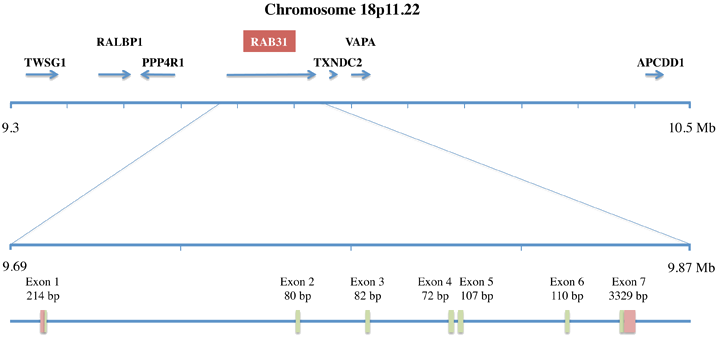
Description
Proteins
Description
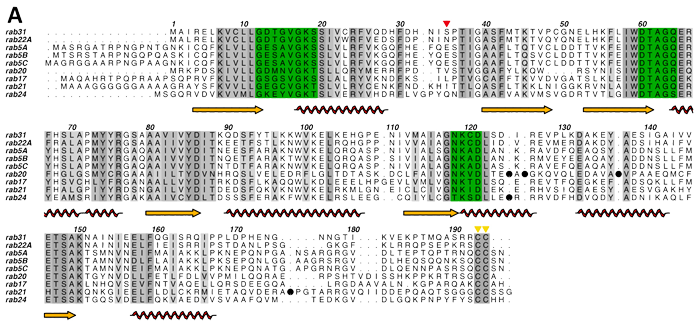
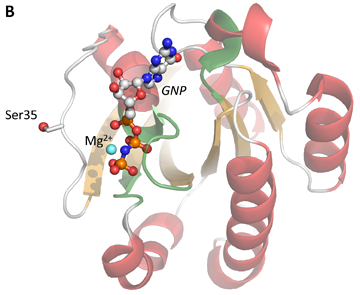
The crystal structure of human Rab31 bound to a non-hydrolyzable GTP analog, guanosine-5-(β γ)-imidotriphosphate (GppNHp) at 2.8 Å was described by Tempel et al. (2006) and is presented in Fig. 2A. Rab31 possesses a typically GTPase fold, composed of a six-stranded β-sheet core flanked by five α-helices. The binding site for guanine nucleotides and Mg2+ is well conserved among Rab proteins (Fig. 2B; aa 12-19, 60-64, and 118-121). The GTPase fold is followed by a hypervariable region, which harbors two cysteine residues to which geranylgeranyl moieties are covalently attached. Modification by geranylgeranylation is required for its proper subcellular localization, mainly the trans-Golgi network (Chua and Tang 2015).
Expression
Cancer tissue. Highest Rab31 immunoexpression was observed in malignant tissue of glioma, breast, and thyroid cancer as well as melanoma (Human Protein Atlas).
Localisation
Function
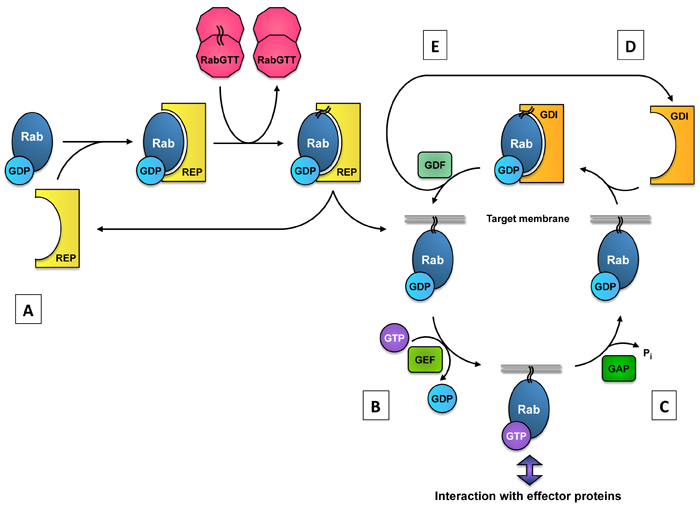
Rab proteins cycle between two alternate conformational states, inactive (GDP-bound) and active (GTP-bound) (Fig. 3). The activity of the Rab proteins is controlled by several regulatory factors: (i) Rab escort proteins (REPs), which transport newly synthesized Rab proteins to geranylgeranyl transferases for C-terminal prenylation enabling specific membrane association; (ii) guanine exchange factors (GEFs) which catalyze the exchange of GDP for GTP, turning the GTPase into the active state; (iii) GTPase activating proteins (GAPs), which promote efficient GTP hydrolysis resulting in an inactive state; (iv) GDP dissociation inhibitors (GDIs), which extracts GDP-Rab from the membrane; (v) GDI displacement factors (GDFs), which assist re-targeting and re-insertion of Rab into the appropriate membrane (Stenmark 2009; Hutagalung and Novick, 2011; Chua and Tang 2015).
Rab31 interacting proteins
GEFs.
Activation of Rab31 is mediated by several GEFs. Interaction of Rab31 with the different GEFs is mediated by the so-called Vps9 domain (Carney et al. 2006). Using pull-down assays, Lodhi et al. (2007) demonstrated that Gapex-5 (alternative name: GAPVD1, GTPase activating protein and Vps9 domain 1) directly interacts with Rab31. Another study (Kajiho et al. 2011) found that two members of the RIN family (RIN2, RIN3; Ras and Rab interactor) as well as ALS2 (amyotrophic lateral sclerosis 2) and ALS2CL (ALS2 C-terminal like), but not RIN1 or Rabex-5 (also known as RABGEF1) can act as GEFs for Rab31.
Cation-dependent mannose-6-phosphate-receptors (CD-M6PRs).
Rab31 is present in small tubulovesicular organelles trafficking from the Golgi/trans-Golgi network (TGN) to endosomes and is involved in the regulation of the formation these vesicles (Rodriguez-Gabin et al. 2001). Besides its role in the Golgi/TGN organization, Rab31 regulates the transport of CD-M6PRs from the TGN to endosomes (Rodriguez-Gabin et al. 2009). Here, RIN3 likely acts as a GEF to regulate Rab31 dependent CD-M6PR-transport (Kajiho et al. 2011). The M6PR system is one of the membrane transport pathways delivering newly synthesized proteins from the TGN to various endocytic compartments. Thus, this transport links biosynthetic to endocytic pathways and, therefore, is majorly involved in the biogenesis of endosomes, lysosomes, and the plasma membrane (Rodriguez-Gabin et al. 2010). Rab31 was also shown to interact with OCRL, a phosphatidylinositol 4,5-diphosphate 5-phosphatase (PI(4,5)P2 5-phosphatase) that regulates the levels of PI(4,5)P2 and PI(4)P, molecules involved in transport and Golgi/TGN organization. Co-localization of Rab31 and OCRL-1 in carriers transporting M6PRs as well as in endosomes may indicate that both proteins are also involved in the targeting and/or fusion of the carriers with endosomes (Rodriguez-Gabin et al. 2010).
EGF receptor (EGFR).
In addition to its function in the anterograde CD-M6PR-transport, Rab31 plays an important role in the regulation of retrograde EGFR trafficking. Direct interaction of Rab31 with internalized ligand-bound EGFR was demonstrated by co-immunoprecipitation and affinity pull-down assays (Ng et al. 2009). Silencing of Rab31 did not impact internalization of EGFR or its entry in early endosomes, but strongly affected EGFR-transition between early and late endosomes (Chua and Tang 2014). Furthermore, EEA1, a multi-domain tethering factor involved in the fusion of endosomes, also colocalizes with Rab31 suggesting that EEA1 is directly involved in Rab31/EGFR interaction and, by this, is important for Rab31-regulated trafficking of the EGFR between early and late endosomes. Interestingly, silencing of GAPVD1 (Gapex-5), a Rab GEF, reduced Rab31/EGFR interaction and abrogated Rab31-mediated enhancement of EGFR trafficking (Chua and Tang 2014).
Membrane curvature protein APPL2
Additionally, Rab31, together with other members of the Rab5 subfamily (Rab5a, Rab22a, Rab24, see Fig. 2B), has also been shown to bind the membrane-curving protein APPL2 (adaptor protein, phosphotyrosine interaction, pleckstrin homology (PH) domain, and leucine zipper-containing protein). APPL2 is associated with a distinct subpopulation of early endosomes that link cell surface signaling and endocytosis (King et al. 2012). In macrophages, Rab31 and its effector APPL2 are largely confined to phagosomal membranes displaying important roles in phagosome closure and FcγR signaling (Yeo et al. 2015)
Rab31 and glucose uptake.
In adipocytes, insulin-stimulated glucose uptake is mediated by the glucose transporter SLC2A4 (GLUT4). In the absence of insulin, Gapex-5 appears to function as a Rab31-GEF maintaining Rab31 in its active state which leads to intracellular retention of GLUT4. Upon insulin stimulation, Gapex-5 in complex with another protein, the membrane curvature protein TRIP10 (CIP4), translocates to the plasma membrane resulting in decreased activity of TGN-associated Rab31. In consequence, GLUT4 is translocated to the plasma membrane, where it enables increased glucose uptake into the cell (Lodhi et al. 2007). Recently, another Rab31-regulating protein, NGFR (the p75 neutrophin receptor (p75NTR)), has been identified (Baeza-Raja et al. 2012). Similar to Gapex-5, p75NTR supports retention of GLUT4 in intracellular vesicles, thus decreasing glucose uptake. Whereas Gapex-5 acts as a GEF, p75NTR may function as a GDI displacement factor, which activates Rab31 by displacing it from its GDIs.
Factors regulating Rab expression
mRNA binding protein HuR.
The ubiquitously expressed mRNA binding protein ELAVL1 (HuR) is a member of the Hu/ELAV-family encompassing four members, HuR, ELAVL2 (HuB or HelN1), ELAVL3 (HuC), and ELAVL4 (HuD). It has been proposed to interact with a series of cancer-relevant genes, thereby stabilizing and translationally enhancing its mRNA targets and, furthermore, modulating their transport between the nucleus and the cytoplasm (Cataluce et al. 2010). In fact, overexpression and/or high cytoplasmic HuR levels (representing the functional pool) are associated with poor outcome in several types of cancer including breast cancer (Wang et al 2013, Heinonen et al 2005). In addition, increased cytoplasmic HuR expression was found to be linked to tamoxifen resistance of MCF7 breast cancer cells (Hostetter et al. 2008). Silencing of HuR leads to the downregulation of Rab31 protein in breast epithelial 184B5Me cells. Furthermore, HuR was demonstrated to directly bind to Rab31 mRNA both in 184B5Me and breast cancer MCF7 cells (Heinonen et al. 2011).
Mucin 1 C-terminal subunit (MUC1-C).
MUC1 (Mucin 1), which is overexpressed in most human breast cancers, is a heterodimeric transmembrane glycoprotein, generated by autocleavage of a single polypeptide (Kufe 2009; 2013). The extracellular N-terminal chain, MUC1-N, contains the O-glycosylated tandem repeats, which are typical for mucin family members. MUC1-N is linked to the cell surface via formation of a non-covalent complex with the C-terminal subunit, MUC1-C, comprising a short 58 aa extracellular region, a 28 aa transmembrane domain, and a 72 aa cytoplasmic tail. The cytoplasmic domain of MUC1-C interacts with various receptor tyrosine kinases such as EGFR and ERBB2 (HER2) and, by this, may modulate downstream signaling pathways (Kufe 2009; 2013). MUC1-C has been demonstrated to be internalized by clathrin-mediated endocytosis. Overexpression of mucin 1 in breast cancer is associated with targeting of the cytoplasmic MUC1-C to the nucleus, where it interacts with ESR1 (estrogen receptor α ERα) and stimulates ERα-mediated gene transcription. One of the target genes activated by the ERα/MUC1-C complex is RAB31, the promotor of which contains an ER-responsive element (Jin et al. 2012). Interestingly, Rab31 in turn stimulates upregulation of MUC1-C, likely by attenuating degradation of MUC1-C in lysosomes. In line with these results, Rab31 and MUC1-C are significantly co-expressed in ER-positive tissues of breast cancer patients (Jin et al. 2012). In a more recent study, MUC1-C was reported to block inhibitory effects of tamoxifen on ERα-mediated Rab31 promoter activity in breast cancer cells (Kharbanda et al. 2013).
Homology
Implicated in
Cellular localization. Protein expression of Rab31 was shown in breast cancer tissue by immunohistochemistry using highly specific antibodies for Rab31 (Grismayer et al. 2012). A weak to moderate cytoplasmic staining for Rab31 and, occasionally, strong perinuclear and/or nuclear staining of cancer cells was observed, whereas stromal cells were less frequently stained. Using immunocytochemistry, a pronounced perinuclear staining in MDA-MB-231 breast cancer cells overexpressing Rab31 was found, which was similar to other immunocytochemical studies, showing a perinuclear patch of Rab31 in the trans-Golgi region in different cell types (Grismayer et al. 2012, Ng et al. 2007, Ng et al. 2009).
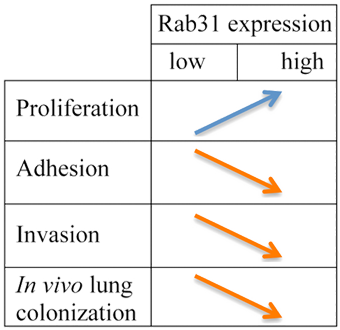
Modulation of tumorbiological-relevant processes. Grismayer et al. (2012) characterized the phenotype of breast cancer cell transfectants with different Rab31 expression levels in vitro. Elevated Rab31 protein levels were associated with enhanced cell proliferation. Interestingly, weak to moderate overexpression of Rab31 in cell lines with no detectable endogenous Rab31 expression was already sufficient to elicit distinct effects on cell proliferation (Grismayer et al. 2012). Inversely, when Rab31 mRNA levels were stably knocked down by short hairpin RNA interference (shRNAi) in breast cancer cells, which express moderate endogenous Rab31 levels, reduction of Rab31 mRNA/protein expression led to lower cell proliferation rates (S. Soelch and V. Magdolen, unpublished). Additionally, increased expression of Rab31 led to reduced adhesion of cells towards extracellular matrix proteins and decreased invasive capacity through MatrigelTM (Grismayer et al. 2012). In contrast to wild-type Rab31, overexpression of a Rab31 mutant unable to insert into the Golgi membrane, due to deletion of the two C-terminal cysteine residues (Rab31-ΔCC), did not affect in vitro proliferation, adhesion, or invasion (S. Soelch and V. Magdolen, unpublished).
In a xenograft mouse model, the number of lung metastases was found to be significantly reduced in those mice which were inoculated into the tail vein with Rab31-overexpressing cells compared to mice injected with vector control cells expressing basal levels of Rab31 (Grismayer et al. 2012). Considering the fact that high levels of Rab31 mRNA in tumor tissue of breast cancer patients are significantly associated with poor prognosis, this finding at first sight is unexpected. During tumor progression, however, cancer cells typically acquire different malignant phenotypes: (i) in the initial phase, the growth of the primary tumor, a high proliferation rate is observed and angiogenesis takes place; (ii) then, in order to metastasize, tumor cells switch to an invasive and motile phenotype leaving their site of origin to generate micrometastases; (iii) finally, at the metastatic site, the proliferative phenotype has to be recovered to trigger growth again (Gao et al. 2005). Rab31, depending on its expression level, may thus modulate a switch between a more proliferative vs. invasive phenotype in breast cancer cells (Tab. 1). Interestingly, it was reported that high levels of the mRNA binding protein HuR which binds and stabilizes Rab31 mRNA (see above), on one hand, lead to increased proliferation and altered cell cycle kinetics in breast cancer cells. On the other, HuR overexpression significantly reduced tumor growth in orthotopic mouse models (Gubin et al. 2010), observations, which are in line with the reported effects of Rab31 overexpression in breast cancer cells.
Using microarray analyses, Rab31 overexpression in breast cancer cells was recently shown to modulate expression of other tumor biologically relevant genes, especially genes of the TGF-β superfamily (Soelch and Magdolen, unpublished). Thus, Rab31 may represent a major player in the change of the cell biological phenotype of breast cancer cells by affecting mainly (non-)canonical TGF-β signaling pathways.
Rab31 protein is rather specifically expressed in GFAP-positive mature astrocytes of adult rodent brains, and is localized mainly in the cell body of astrocytes, and not in the astrocytic processes (Ng et al. 2009). Whereas elevated levels of Rab31 promote cell proliferation in breast or liver cancer cells, in the astroglial cell line A431, Rab31 silencing increased cell proliferation rates compared to the vector control, and vice versa, moderate overexpression of Rab31 led a reduced cell proliferation (Ng et al. 2009). Since Rab31 in A431 cells also plays a role in regulating EGFR trafficking, one may suggest that altering Rab31 levels affect EGFR traffic leading to an influence on cell proliferation (Ng et al. 2009).
Rebane et al. (2012) analyzed the differential expression profile of apoptosis-related genes in keratinocytes of atopic dermatitis (AD) vs. normal skin, and the upregulation of immune system-related genes in tissue of chronic AD lesions. RAB31 was one of eight differentially expressed genes that were found upregulated in lesional skin tissue of AD patients suggesting the involvement of Rab31, among other new apoptosis- and inflammation-related factors, in the pathogenesis of AD, especially in long-lasting and refractory cases of the disease (Rebane et al. 2012).
Cancer-associated fibroblasts. Bozóky et al. (2013) characterized differentially expressed proteins in the stroma of basal cell carcinoma vs. normal skin fibroblasts. Rab31 was found as one from a panel of twelve proteins that were differentially expressed in cancer-associated fibroblasts (CAF) of basal cell carcinoma but not in normal skin fibroblasts. Besides basal cell carcinoma, Rab31-expressing CAFs were found in a relatively high percentage of tumor samples originating from different tumor types such as squamous cell carcinoma, colorectal, breast, and - to lower extent - lung cancer. Rab31 was not expressed in several types of normal fibroblasts or myofibroblast-like cells in normal tissues (breast, bone marrow, kidney) except for subepithelial fibroblasts of small intestine villi (Bozóky et al. 2013).
Article Bibliography
| Pubmed ID | Last Year | Title | Authors |
|---|---|---|---|
| 15762987 | 2005 | Gene expression signature of estrogen receptor alpha status in breast cancer. | Abba MC et al |
| 22460790 | 2012 | p75 neurotrophin receptor regulates glucose homeostasis and insulin sensitivity. | Baeza-Raja B et al |
| 23319410 | 2013 | Novel signatures of cancer-associated fibroblasts. | Bozóky B et al |
| 20370918 | 2010 | The RNA binding protein HuR differentially regulates unique subsets of mRNAs in estrogen receptor negative and estrogen receptor positive breast cancer. | Calaluce R et al |
| 16330212 | 2006 | Vps9 domain-containing proteins: activators of Rab5 GTPases from yeast to neurons. | Carney DS et al |
| 8863739 | 1996 | Molecular cloning of two novel rab genes from human melanocytes. | Chen D et al |
| 24999186 | 2014 | Rab31 is expressed in neural progenitor cells and plays a role in their differentiation. | Chua CE et al |
| 25690707 | 2015 | Role of Rab GTPases and their interacting proteins in mediating metabolic signalling and regulation. | Chua CE et al |
| 16024725 | 2005 | Proliferation and invasion: plasticity in tumor cells. | Gao CF et al |
| 22920728 | 2012 | Rab31 expression levels modulate tumor-relevant characteristics of breast cancer cells. | Grismayer B et al |
| 20724828 | 2010 | Overexpression of the RNA binding protein HuR impairs tumor growth in triple negative breast cancer associated with deficient angiogenesis. | Gubin MM et al |
| 21480233 | 2011 | Role of RNA binding protein HuR in ductal carcinoma in situ of the breast. | Heinonen M et al |
| 18769129 | 2008 | Cytoplasmic accumulation of the RNA binding protein HuR is central to tamoxifen resistance in estrogen receptor positive breast cancer cells. | Hostetter C et al |
| 21248164 | 2011 | Role of Rab GTPases in membrane traffic and cell physiology. | Hutagalung AH et al |
| 21826169 | 2011 | Gene alterations of ovarian cancer cells expressing estrogen receptors by estrogen and bisphenol a using microarray analysis. | Hwang KA et al |
| 22792175 | 2012 | Cooperative interaction between the MUC1-C oncoprotein and the Rab31 GTPase in estrogen receptor-positive breast cancer cells. | Jin C et al |
| 21586568 | 2011 | Characterization of RIN3 as a guanine nucleotide exchange factor for the Rab5 subfamily GTPase Rab31. | Kajiho H et al |
| 23538857 | 2013 | Oncogenic MUC1-C promotes tamoxifen resistance in human breast cancer. | Kharbanda A et al |
| 23055524 | 2012 | Membrane curvature protein exhibits interdomain flexibility and binds a small GTPase. | King GJ et al |
| 22873208 | 2012 | Untangling the evolution of Rab G proteins: implications of a comprehensive genomic analysis. | Klöpper TH et al |
| 21848504 | 2011 | mRNA expression levels of the biological factors uPAR, uPAR-del4/5, and rab31, displaying prognostic value in breast cancer, are not clinically relevant in advanced ovarian cancer. | Kotzsch M et al |
| 17952591 | 2008 | Urokinase receptor splice variant uPAR-del4/5-associated gene expression in breast cancer: identification of rab31 as an independent prognostic factor. | Kotzsch M et al |
| 12665524 | 2003 | Binding of urokinase-type plasminogen activator receptor (uPAR) to the mannose 6-phosphate/insulin-like growth factor II receptor: contrasting interactions of full-length and soluble forms of uPAR. | Kreiling JL et al |
| 22580612 | 2013 | MUC1-C oncoprotein as a target in breast cancer: activation of signaling pathways and therapeutic approaches. | Kufe DW et al |
| 23737970 | 2013 | Reverse engineering of modified genes by Bayesian network analysis defines molecular determinants critical to the development of glioblastoma. | Kunkle BW et al |
| 26165933 | 2015 | miR-184 and miR-150 promote renal glomerular mesangial cell aging by targeting Rab1a and Rab31. | Liu X et al |
| 17189207 | 2007 | Gapex-5, a Rab31 guanine nucleotide exchange factor that regulates Glut4 trafficking in adipocytes. | Lodhi IJ et al |
| 19725050 | 2009 | Rab22B is expressed in the CNS astroglia lineage and plays a role in epidermal growth factor receptor trafficking in A431 cells. | Ng EL et al |
| 17678623 | 2007 | Rab22B's role in trans-Golgi network membrane dynamics. | Ng EL et al |
| 9566979 | 1998 | Mannose 6-phosphate/insulin-like growth factor-II receptor targets the urokinase receptor to lysosomes via a novel binding interaction. | Nykjaer A et al |
| 26245486 | 2016 | The Critical Role of Rab31 in Cell Proliferation and Apoptosis in Cancer Progression. | Pan Y et al |
| 22445417 | 2012 | Mechanisms of IFN-γ-induced apoptosis of human skin keratinocytes in patients with atopic dermatitis. | Rebane A et al |
| 19795375 | 2010 | Interaction of Rab31 and OCRL-1 in oligodendrocytes: its role in transport of mannose 6-phosphate receptors. | Rodriguez-Gabin AG et al |
| 21649900 | 2011 | Cell cycle and aging, morphogenesis, and response to stimuli genes are individualized biomarkers of glioblastoma progression and survival. | Serão NV et al |
| 19603039 | 2009 | Rab GTPases as coordinators of vesicle traffic. | Stenmark H et al |
| 20861854 | 2011 | Resolved psoriasis lesions retain expression of a subset of disease-related genes. | Suárez-Fariñas M et al |
| 26044564 | 2015 | Rab31 promoted hepatocellular carcinoma (HCC) progression via inhibition of cell apoptosis induced by PI3K/AKT/Bcl-2/BAX pathway. | Sui Y et al |
| 14517288 | 2003 | Stabilization of urokinase and urokinase receptor mRNAs by HuR is linked to its cytoplasmic accumulation induced by activated mitogen-activated protein kinase-activated protein kinase 2. | Tran H et al |
| 25613900 | 2015 | Proteomics. Tissue-based map of the human proteome. | Uhlén M et al |
| 23665903 | 2013 | Multiple functions of the RNA-binding protein HuR in cancer progression, treatment responses and prognosis. | Wang J et al |
| 25568335 | 2015 | Rab31 and APPL2 enhance FcγR-mediated phagocytosis through PI3K/Akt signaling in macrophages. | Yeo JC et al |
| 19148534 | 2009 | Anticancer effects on TACC3 by treatment of paclitaxel in HPV-18 positive cervical carcinoma cells. | Yim EK et al |
Other Information
Locus ID:
NCBI: 11031
MIM: 605694
HGNC: 9771
Ensembl: ENSG00000168461
Variants:
dbSNP: 11031
ClinVar: 11031
TCGA: ENSG00000168461
COSMIC: RAB31
RNA/Proteins
| Gene ID | Transcript ID | Uniprot |
|---|---|---|
| ENSG00000168461 | ENST00000578734 | J3KRU3 |
| ENSG00000168461 | ENST00000578921 | Q13636 |
| ENSG00000168461 | ENST00000581109 | J3QR51 |
| ENSG00000168461 | ENST00000583137 | J3KSM8 |
Expression (GTEx)
Pathways
Protein levels (Protein atlas)
References
| Pubmed ID | Year | Title | Citations |
|---|---|---|---|
| 37953466 | 2024 | RAB31 in glioma-derived endothelial cells promotes glioma cell invasion via extracellular vesicle-mediated enrichment of MYO1C. | 1 |
| 37953466 | 2024 | RAB31 in glioma-derived endothelial cells promotes glioma cell invasion via extracellular vesicle-mediated enrichment of MYO1C. | 1 |
| 36781842 | 2023 | Rab31 promotes metastasis and cisplatin resistance in stomach adenocarcinoma through Twist1-mediated EMT. | 6 |
| 36889366 | 2023 | lncRNA MAGI2-AS3 suppresses castration-resistant prostate cancer proliferation and migration via the miR-106a-5p/RAB31 axis. | 2 |
| 37222416 | 2023 | Overexpression of RAB31 in gastric cancer is associated with released exosomes and increased tumor cell invasion and metastasis. | 1 |
| 36781842 | 2023 | Rab31 promotes metastasis and cisplatin resistance in stomach adenocarcinoma through Twist1-mediated EMT. | 6 |
| 36889366 | 2023 | lncRNA MAGI2-AS3 suppresses castration-resistant prostate cancer proliferation and migration via the miR-106a-5p/RAB31 axis. | 2 |
| 37222416 | 2023 | Overexpression of RAB31 in gastric cancer is associated with released exosomes and increased tumor cell invasion and metastasis. | 1 |
| 35072529 | 2022 | LncRNA HOXA10-AS Activated by E2F1 Facilitates Proliferation and Migration of Nasopharyngeal Carcinoma Cells Through Sponging miR-582-3p to Upregulate RAB31. | 3 |
| 35839075 | 2022 | Defective RAB31-mediated megakaryocytic early endosomal trafficking of VWF, EGFR, and M6PR in RUNX1 deficiency. | 5 |
| 35863437 | 2022 | A novel membrane targeting domain mediates the endosomal or Golgi localization specificity of small GTPases Rab22 and Rab31. | 0 |
| 35072529 | 2022 | LncRNA HOXA10-AS Activated by E2F1 Facilitates Proliferation and Migration of Nasopharyngeal Carcinoma Cells Through Sponging miR-582-3p to Upregulate RAB31. | 3 |
| 35839075 | 2022 | Defective RAB31-mediated megakaryocytic early endosomal trafficking of VWF, EGFR, and M6PR in RUNX1 deficiency. | 5 |
| 35863437 | 2022 | A novel membrane targeting domain mediates the endosomal or Golgi localization specificity of small GTPases Rab22 and Rab31. | 0 |
| 32958903 | 2021 | RAB31 marks and controls an ESCRT-independent exosome pathway. | 166 |
Citation
Matthias Kotzsch ; Peter Goettig ; Susanne Soelch ; Viktor Magdolen
RAB31 (Ras-related protein in brain 31)
Atlas Genet Cytogenet Oncol Haematol. 2016-02-01
Online version: http://atlasgeneticsoncology.org/gene/41978/rab31-(ras-related-protein-in-brain-31)
