MIR150
2016-12-01 Monireh Arjmand AffiliationDepartment of Biology, Faculty of Science, Payame Noor University, Tehran, Iran. [email protected]

Abstract
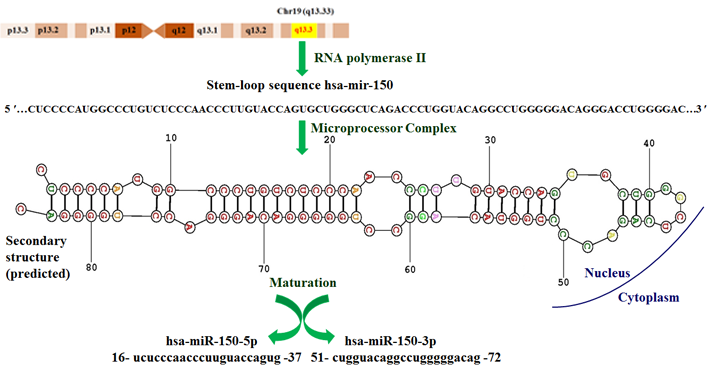
MicroRNAs (miRNAs) are a class of small regulatory RNAs (20-23 nucleotides long) that have been found to play a critical role in the wide spectrum of biological processes. These small endogenous noncoding RNAs are able to negatively regulate gene expression by pairing with the 3-untranslated region (3-UTR) of their target mRNA. miR-150 is a short and single-stranded miRNA, encoded by a gene located at 19q13.33 in Homo sapiens, which is processed to two mature forms (miR-150-5p and miR-150-3p). It has proven to be a pivotal miRNA engaged in the development of hematologic malignancies, normal haematopoiesis, differentiation of B and T cells, and a number of tumours including breast, osteosarcoma, lung, gastric cancer and etc.
DNA/RNA
Description
Proteins
Note
Implicated in
Article Bibliography
| Pubmed ID | Last Year | Title | Authors |
|---|---|---|---|
| 23415231 | 2013 | Beyond secondary structure: primary-sequence determinants license pri-miRNA hairpins for processing. | Auyeung VC et al |
| 24197738 | 2014 | Human RNAi pathway: crosstalk with organelles and cells. | Azimzadeh Jamalkandi S et al |
| 18814950 | 2008 | Thrombopoietin regulates c-Myb expression by modulating micro RNA 150 expression. | Barroga CF et al |
| 24637927 | 2014 | A microRNA signature predicts survival in early stage small-cell lung cancer treated with surgery and adjuvant chemotherapy. | Bi N et al |
| 15525708 | 2004 | Human microRNAs are processed from capped, polyadenylated transcripts that can also function as mRNAs. | Cai X et al |
| 24456795 | 2014 | miR-150 promotes the proliferation and migration of lung cancer cells by targeting SRC kinase signalling inhibitor 1. | Cao M et al |
| 24907421 | 2014 | Augmented miR-150 expression associated with depressed SOCS1 expression involved in dengue haemorrhagic fever. | Chen RF et al |
| 23521217 | 2013 | Re-expression of microRNA-150 induces EBV-positive Burkitt lymphoma differentiation by modulating c-Myb in vitro. | Chen S et al |
| 23547171 | 2013 | MicroRNA-150: a novel marker of left ventricular remodeling after acute myocardial infarction. | Devaux Y et al |
| 25778313 | 2015 | miR-150 is a factor of survival in prostate cancer patients. | Dezhong L et al |
| 20937217 | 2010 | Characterization of HuH6, Hep3B, HepG2 and HLE liver cancer cell lines by WNT/β - catenin pathway, microRNA expression and protein expression profile. | Di Masi A et al |
| 23211718 | 2013 | miR-150 regulates high glucose-induced cardiomyocyte hypertrophy by targeting the transcriptional co-activator p300. | Duan Y et al |
| 23696613 | 2013 | Circulating microRNAs as candidate markers to distinguish heart failure in breathless patients. | Ellis KL et al |
| 18197166 | 2008 | Mechanisms of post-transcriptional regulation by microRNAs: are the answers in sight? | Filipowicz W et al |
| 16957365 | 2006 | MicroRNA biogenesis: isolation and characterization of the microprocessor complex. | Gregory RI et al |
| 24532468 | 2014 | Down-regulation of miR-150 induces cell proliferation inhibition and apoptosis in non-small-cell lung cancer by targeting BAK1 in vitro. | Gu XY et al |
| 23159943 | 2013 | miR-150 down-regulation contributes to the constitutive type I collagen overexpression in scleroderma dermal fibroblasts via the induction of integrin β3. | Honda N et al |
| 24312495 | 2013 | miR-150 promotes human breast cancer growth and malignant behavior by targeting the pro-apoptotic purinergic P2X7 receptor. | Huang S et al |
| 23895517 | 2013 | MicroRNA regulate immune pathways in T-cells in multiple sclerosis (MS). | Jernås M et al |
| 25090005 | 2014 | MicroRNA-150 predicts a favorable prognosis in patients with epithelial ovarian cancer, and inhibits cell invasion and metastasis by suppressing transcriptional repressor ZEB1. | Jin M et al |
| 19148490 | 2009 | microRNA expression profile in undifferentiated gastric cancer. | Katada T et al |
| 14508493 | 2003 | The nuclear RNase III Drosha initiates microRNA processing. | Lee Y et al |
| 15372072 | 2004 | MicroRNA genes are transcribed by RNA polymerase II. | Lee Y et al |
| 25287716 | 2014 | miR-150 modulates cisplatin chemosensitivity and invasiveness of muscle-invasive bladder cancer cells via targeting PDCD4 in vitro. | Lei Y et al |
| 26715362 | 2015 | microRNA-150 promotes cervical cancer cell growth and survival by targeting FOXO4. | Li J et al |
| 25549355 | 2014 | RETRACTED: miR-150-5p inhibits hepatoma cell migration and invasion by targeting MMP14. | Li T et al |
| 26361218 | 2015 | MicroRNA-150 Inhibits Cell Invasion and Migration and Is Downregulated in Human Osteosarcoma. | Li X et al |
| 21935578 | 2012 | Regression of A549 lung cancer tumors by anti-miR-150 vector. | Li YJ et al |
| 26636522 | 2015 | MIR-150 promotes prostate cancer stem cell development via suppressing p27Kip1. | Liu DZ et al |
| 23028671 | 2012 | The expression levels of plasma micoRNAs in atrial fibrillation patients. | Liu Z et al |
| 18539114 | 2008 | MicroRNA-mediated control of cell fate in megakaryocyte-erythrocyte progenitors. | Lu J et al |
| 21789031 | 2011 | Identification of Differentially Expressed MicroRNAs in Osteosarcoma. | Lulla RR et al |
| 17381281 | 2006 | Substrate selectivity of exportin 5 and Dicer in the biogenesis of microRNAs. | Lund E et al |
| 22052060 | 2012 | miR-150 as a potential biomarker associated with prognosis and therapeutic outcome in colorectal cancer. | Ma Y et al |
| 22108567 | 2012 | MicroRNA and mRNA expression profile screening in multiple sclerosis patients to unravel novel pathogenic steps and identify potential biomarkers. | Martinelli-Boneschi F et al |
| 26148929 | 2015 | Circulating levels of miR-150 are associated with poorer outcomes of A/H1N1 infection. | Morán J et al |
| 24828336 | 2014 | MicroRNA-150 is a potential biomarker of HIV/AIDS disease progression and therapy. | Munshi SU et al |
| 15145345 | 2004 | miRNAs on the move: miRNA biogenesis and the RNAi machinery. | Murchison EP et al |
| 24705249 | 2014 | Circulating exosomal microRNAs as biomarkers of colon cancer. | Ogata-Kawata H et al |
| 21753850 | 2011 | Dicer recognizes the 5' end of RNA for efficient and accurate processing. | Park JE et al |
| 26561465 | 2016 | MicroRNA-150 functions as a tumor suppressor in osteosarcoma by targeting IGF2BP1. | Qu Y et al |
| 20230624 | 2010 | RNAstructure: software for RNA secondary structure prediction and analysis. | Reuter JS et al |
| 23220912 | 2013 | Reduced microRNA-150 is associated with poor survival in pulmonary arterial hypertension. | Rhodes CJ et al |
| 24366298 | 2014 | Circulating biomarkers for detection of ovarian cancer and predicting cancer outcomes. | Shapira I et al |
| 14744777 | 2004 | Inhibition of MUC4 expression suppresses pancreatic tumor cell growth and metastasis. | Singh AP et al |
| 21983127 | 2011 | MicroRNA-150 directly targets MUC4 and suppresses growth and malignant behavior of pancreatic cancer cells. | Srivastava SK et al |
| 19443673 | 2009 | Does the presence of anti-HIV miRNAs in monocytes explain their resistance to HIV-1 infection? | Swaminathan S et al |
| 25824147 | 2015 | MicroRNA-150 protects the mouse heart from ischaemic injury by regulating cell death. | Tang Y et al |
| 17293865 | 2007 | High-throughput oncogene mutation profiling in human cancer. | Thomas RK et al |
| 21431305 | 2011 | Role of microRNAs in cardiac remodeling and heart failure. | Topkara VK et al |
| 23554878 | 2013 | Identification of ovarian cancer metastatic miRNAs. | Vang S et al |
| 26170969 | 2015 | Role of microRNA-150 in solid tumors. | Wang F et al |
| 24613688 | 2014 | Low expression of miR-150 in pediatric intestinal Burkitt lymphoma. | Wang M et al |
| 25482320 | 2015 | Upregulated circulating miR-150 is associated with the risk of intrahepatic cholangiocarcinoma. | Wang S et al |
| 19015395 | 2009 | Cellular microRNA expression correlates with susceptibility of monocytes/macrophages to HIV-1 infection. | Wang X et al |
| 22240256 | 2012 | Relationships of PBMC microRNA expression, plasma viral load, and CD4+ T-cell count in HIV-1-infected elite suppressors and viremic patients. | Witwer KW et al |
| 20067763 | 2010 | MiR-150 promotes gastric cancer proliferation by negatively regulating the pro-apoptotic gene EGR2. | Wu Q et al |
| 17923094 | 2007 | MiR-150 controls B cell differentiation by targeting the transcription factor c-Myb. | Xiao C et al |
| 23013135 | 2013 | MiR-150 is associated with poor prognosis in esophageal squamous cell carcinoma via targeting the EMT inducer ZEB1. | Yokobori T et al |
| 22025269 | 2012 | microRNA-150 inhibits human CD133-positive liver cancer stem cells through negative regulation of the transcription factor c-Myb. | Zhang J et al |
| 23747308 | 2013 | miR-150 promotes the proliferation of lung cancer cells by targeting P53. | Zhang N et al |
| 20603081 | 2010 | Secreted monocytic miR-150 enhances targeted endothelial cell migration. | Zhang Y et al |
Other Information
Locus ID:
NCBI: 406942
MIM: 611114
HGNC: 31537
Ensembl: ENSG00000207782
miRBase:
Variants:
dbSNP: 406942
ClinVar: 406942
TCGA: ENSG00000207782
COSMIC: MIR150
RNA/Proteins
Pathways
| Pathway | Source | External ID |
|---|---|---|
| MicroRNAs in cancer | KEGG | hsa05206 |
| MicroRNAs in cancer | KEGG | ko05206 |
References
| Pubmed ID | Year | Title | Citations |
|---|---|---|---|
| 37921969 | 2024 | MiR-150-5p contributes to unexplained recurrent spontaneous abortion by targeting VEGFA and downregulating the PI3K/AKT/mTOR signaling pathway. | 0 |
| 37965810 | 2024 | Salivary miR-150-5p as an indicator of periodontitis severity and regulator of human periodontal ligament fibroblast behavior by targeting AIFM2. | 0 |
| 37980653 | 2024 | Renal ischaemia-reperfusion injury is promoted by transcription factor NF-kB p65, which inhibits TRPC6 expression by activating miR-150. | 0 |
| 38084627 | 2024 | Circ-SATB2 (hsa_circ_0008928) and miR-150-5p are regulators of TRIM66 in the regulation of NSCLC cell growth and metastasis of NSCLC cells via the ceRNA pathway. | 1 |
| 38165680 | 2024 | MicroRNA-150-5P regulates Th1/Th2 cytokines expression levels by targeting EGR2 in allergic rhinitis. | 0 |
| 38471665 | 2024 | MiR-150 levels are related to in-hospital mortality in non-HIV Pneumocystis pneumonia patients. | 0 |
| 38627588 | 2024 | Circular ZDHHC11 supports Burkitt lymphoma growth independent of its miR-150 binding capacity. | 0 |
| 38679361 | 2024 | CircZNF609 inhibits miR-150-5p to promote high glucose-induced damage to retinal microvascular endothelial cells. | 0 |
| 38692535 | 2024 | lncRNA SNHG4 inhibits ferroptosis by orchestrating miR-150-5p/c-Myb axis in colorectal cancer. | 0 |
| 38910572 | 2024 | MicroRNA-150-5p-mediated Inhibition of Cell Proliferation, G1/S Transition, and Migration in Bladder Cancer through Targeting NEDD4-binding Protein 2-like 1 Gene. | 0 |
| 37921969 | 2024 | MiR-150-5p contributes to unexplained recurrent spontaneous abortion by targeting VEGFA and downregulating the PI3K/AKT/mTOR signaling pathway. | 0 |
| 37965810 | 2024 | Salivary miR-150-5p as an indicator of periodontitis severity and regulator of human periodontal ligament fibroblast behavior by targeting AIFM2. | 0 |
| 37980653 | 2024 | Renal ischaemia-reperfusion injury is promoted by transcription factor NF-kB p65, which inhibits TRPC6 expression by activating miR-150. | 0 |
| 38084627 | 2024 | Circ-SATB2 (hsa_circ_0008928) and miR-150-5p are regulators of TRIM66 in the regulation of NSCLC cell growth and metastasis of NSCLC cells via the ceRNA pathway. | 1 |
| 38165680 | 2024 | MicroRNA-150-5P regulates Th1/Th2 cytokines expression levels by targeting EGR2 in allergic rhinitis. | 0 |
Citation
Monireh Arjmand
MIR150
Atlas Genet Cytogenet Oncol Haematol. 2016-12-01
Online version: http://atlasgeneticsoncology.org/gene/50556/mir150
