KLF4 (Kruppel-like factor 4 (gut))
2008-10-01 Amr M Ghaleb , Vincent W Yang AffiliationDivision of Digestive Diseases, Department of Medicine, Emory University School of Medicine Atlanta, Georgia, USA
DNA/RNA
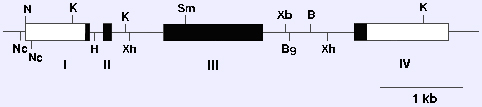
The structure of the murine KLF4 gene. The four exons of the murine GKLF gene are identified by Roman numerals. The translated region or open reading frame is depicted in black. The locations of restriction sites for several endonucleases are labeled: Nc, NcoI; N, NotI; K, KpnI; H, HindIII; Xh, XhoI; Sm, SmaI; Xb, XbaI; Bg, BglII; B, BamHI.
Description
A full-length mouse cDNA clone encoding KLF4 was initially isolated from a NIH3T3 cDNA library by reduced stringency screening with a DNA probe containing the zinc finger region of an immediate early gene product, Zif268 or Egr1. A distinct feature of the KLF4 gene is the highly GC-rich nature of the sequence near its 5-end. Thus, the G+C content of the 1000 nt 5-flanking region is 67% and that of the 5-untranslated region is 63%. Moreover, the bulk of the GC residues are concentrated in the region between nt -600 and +300 of the gene where the G+C content is 82%. The gene has four exons, each containing a portion of the translated region.
Transcription
The open-reading frame of the Klf4 gene encodes a polypeptide of 483 amino acids with a predicted molecular weight of 53 kDa. The entire polypeptide sequence of Klf4 with the exception of the first amino acid is encoded by exons 2, 3 and 4.
Proteins
Description
KLF4 encodes a polypeptide of 483 aa and similar to KLFs, contains three Kruppel-type zinc fingers in the very C-terminal end. The region immediately N terminal to the three zinc fingers is a 20-aa peptide containing a cluster of basic aa residues, which is essential for the nuclear localization of the protein.
Expression
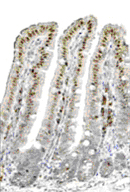
KLF4 is a nuclear protein whose cellular address depends on two nuclear localization signals. Expression of the KLF4 gene is developmentally regulated, with a higher level of expression occurring toward the later stage of fetal development. In adults, KLF4 is highly enriched in epithelial tissues, including the skin, lung, and intestine. In the intestinal tract, KLF4 is predominantly present in the terminally differentiated, postmitotic epithelial cells lining the villus border of the small intestine and the upper crypt region of the large intestine. In cultured cells, the level of KLF4 mRNA is associated with the growth-arrested state in a manner similar to that observed in the intestinal epithelium. Expression of KLF4 can also be found in a select number of other organs including the lung, testis, skin and thymus, and in vascular endothelial cells.
Localisation
KLF4 is a nuclear protein that contains two potent nuclear localization signals (NLSs), one within the three zinc fingers and the other in a cluster of basic amino acids immediately adjacent to the first zinc finger. These two NLSs define a subfamily of three closely related KLFs: KLF1, KLF2, and KLF4.
Function
KLF4 binds to DNA sequence elements that are GC-rich. A consensus DNA binding sequence was empirically determined and is present in the promoters of many genes, including the CACCC element and the basic transcription element (BTE). KLF4 inhibits the promoter of the cytochrome P-450IA1 ( CYP1A1 ) gene in a BTE-dependent manner.
In cultured cells, the level of KLF4 mRNA is associated with the growth-arrested state in a manner similar to that observed in the intestinal epithelium. Forced expression of KLF4 in cultured cells results in the inhibition of DNA synthesis. The induction of KLF4 is also correlated with an increase in the level of p21WAF1/CIP1, a critical checkpoint protein that inhibits cell cycle progression and is essential in mediating the cell cycle arrest at both the G1/S and G2/M boundaries. Importantly, KLF4 is essential in the induction of expression of the p21WAF1/CIP1 gene in response to DNA damage by binding to a specific cis-DNA element in the p21WAF1/CIP1 proximal promoter to activate p21WAF1/CIP1 expression. cDNA microarray analysis of the transcriptional profiles of KLF4 demonstrates that KLF4 inhibits the cell cycle by coordinately regulating expression of numerous cell cycle regulatory genes.
KLF4 mediates the cell cycle checkpoint function of the tumor suppressor p53 suggesting that it may itself act as a tumor suppressor. Its mRNA are reduced in intestinal adenomas of ApcMin/+ mice and colonic adenomas of patients with familial adenomatous polyposis (FAP) when compared with surrounding normal tissues. Conversely, overexpression of KLF4 in the human colon cancer cell line RKO, which does not express endogenous KLF4, results in reduced tumorigenesis in vitro and in vivo. KLF4 plays a role in mediating the tumor-suppressive function of APC. KLF4 can down-regulate the level of beta-catenin and can bind directly to the transcriptional activation domain of beta-catenin to inhibit beta-catenin-mediated transcription. KLF4 haploinsufficiency in ApcMin/+ mice lead to significantly more intestinal adenomas than ApcMin/+ mice alone.
In vivo, KLF4 is required for goblet cell differentiation in the intestine and eye conjuctiva. KLF4 has been shown to be down-regulated by Notch pathway and is important in maintaining the normal skin barrier.
Induction of KLF4 significantly reduces the percentage of apoptotic cells following g-irradiation. Upregulation of KLF4 also inhibits expression of the gene encoding the pro-apoptotic protein Bax following DNA damage.
Taken together, these studies place KLF4 in an interesting and important position between the Wnt and Notch signaling pathways, both of which are crucial for intestinal tumorigenesis. Additional studies are likely to further reveal the exact mechanism by which KLF4 mediates the crosstalk functions of these two key pathways in CRC.
In cultured cells, the level of KLF4 mRNA is associated with the growth-arrested state in a manner similar to that observed in the intestinal epithelium. Forced expression of KLF4 in cultured cells results in the inhibition of DNA synthesis. The induction of KLF4 is also correlated with an increase in the level of p21WAF1/CIP1, a critical checkpoint protein that inhibits cell cycle progression and is essential in mediating the cell cycle arrest at both the G1/S and G2/M boundaries. Importantly, KLF4 is essential in the induction of expression of the p21WAF1/CIP1 gene in response to DNA damage by binding to a specific cis-DNA element in the p21WAF1/CIP1 proximal promoter to activate p21WAF1/CIP1 expression. cDNA microarray analysis of the transcriptional profiles of KLF4 demonstrates that KLF4 inhibits the cell cycle by coordinately regulating expression of numerous cell cycle regulatory genes.
KLF4 mediates the cell cycle checkpoint function of the tumor suppressor p53 suggesting that it may itself act as a tumor suppressor. Its mRNA are reduced in intestinal adenomas of ApcMin/+ mice and colonic adenomas of patients with familial adenomatous polyposis (FAP) when compared with surrounding normal tissues. Conversely, overexpression of KLF4 in the human colon cancer cell line RKO, which does not express endogenous KLF4, results in reduced tumorigenesis in vitro and in vivo. KLF4 plays a role in mediating the tumor-suppressive function of APC. KLF4 can down-regulate the level of beta-catenin and can bind directly to the transcriptional activation domain of beta-catenin to inhibit beta-catenin-mediated transcription. KLF4 haploinsufficiency in ApcMin/+ mice lead to significantly more intestinal adenomas than ApcMin/+ mice alone.
In vivo, KLF4 is required for goblet cell differentiation in the intestine and eye conjuctiva. KLF4 has been shown to be down-regulated by Notch pathway and is important in maintaining the normal skin barrier.
Induction of KLF4 significantly reduces the percentage of apoptotic cells following g-irradiation. Upregulation of KLF4 also inhibits expression of the gene encoding the pro-apoptotic protein Bax following DNA damage.
Taken together, these studies place KLF4 in an interesting and important position between the Wnt and Notch signaling pathways, both of which are crucial for intestinal tumorigenesis. Additional studies are likely to further reveal the exact mechanism by which KLF4 mediates the crosstalk functions of these two key pathways in CRC.
Homology
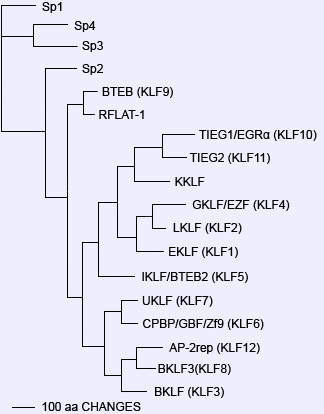
KLF4 belongs to the SP1 / KLF transcription factor family that is highly conserved among species (from Drosophila to human). Mouse KLF4 and is 90% identical to human KLF4. The carboxyl terminus of KLF4 contains three C2H2-zinc fingers that are most closely related to another member of the family, KLF2.
Mutations
Note
A number of colon cancer cell lines contain point mutations in the coding region of KLF4 that resulted in a diminished ability to activate the p21WAF1/Cip1 promoter. Also there is evidence for LOH of the KLF4 locus and of hypermethylation of the 5-UTR in resected CRC specimens and colon cancer cell lines.
Implicated in
Entity name
Colorectal Cancer (CRC)
Disease
The relevance of KLF4 in the pathogenesis of human CRC is demonstrated by a significant reduction of KLF4 mRNA levels in colorectal adenoma and adenocarcinoma compared with matched normal colonic tissues. There is also evidence for LOH in a subset of CRC and in a panel of CRC cell lines. Moreover, the 5-untranslated region of the KLF4 gene is found to be hypermethylated in a subset of CRC. Lastly, several point mutations are identified in KLF4 that result in a diminished ability to activate the p21WAF1/CIP1 promoter in some of the CRC cell lines. These studies suggest that KLF4 is a tumor suppressor, at least in a fraction of patients with CRC. Recent studies demonstrating that KLF4 is involved in maintaining centrosome duplication and thus genomic stability further illustrate the mechanism by which KLF4 may be involved in tumor suppression.
Entity name
Goblet cells hypoplasia.
Disease
Mice homozygous for a null mutation in the Klf4 gene die shortly after birth, for unknown reasons. Immediately following birth, Klf4-/- mice have a 90% reduction in the number of goblet cells in their colon, show abnormal expression of the goblet cell-specific marker Muc2, and have abnormal goblet cell morphology.
Entity name
Gastric cancer
Disease
Mutational analysis indicates that the KLF4 gene is subject to deletion, mutation and methylation silencing in a significant proportion of colon and gastric cancers. Conditional Klf4-knockout mouse specific for the gastric epithelium, loss of Klf4 results in increased proliferation and differentiation in the stomach, culminating in precancerous changes altered.
Entity name
Breast cancer
Disease
KLF4 levels are elevated in up to 70% of mammary carcinomas.
Prognosis
Nuclear localization of KLF4 is associated with an aggressive phenotype in early stage breast cancer.
Oncogenesis
Oncogene.
Entity name
Dysplastic oral squamous-cell carcinomas
Disease
KLF4 levels are elevated in oropharyngial dysplastic squamous-cell carcinomas.
Entity name
Squamous cell carcinoma
Disease
Ectopic expression of KLF4 in basal keratinocytes of transgenic mice results in dysplastic lesions that resemble squamous cell carcinoma in situ.
Article Bibliography
| Pubmed ID | Last Year | Title | Authors |
|---|---|---|---|
| 11390382 | 2001 | Krüppel-like factor 4 (gut-enriched Krüppel-like factor) inhibits cell proliferation by blocking G1/S progression of the cell cycle. | Chen X et al |
| 12581631 | 2003 | Transcriptional profiling of Krüppel-like factor 4 reveals a function in cell cycle regulation and epithelial differentiation. | Chen X et al |
| 3141919 | 1988 | A gene activated in mouse 3T3 cells by serum growth factors encodes a protein with "zinc finger" sequences. | Christy BA et al |
| 10913614 | 2000 | Decreased expression of the gut-enriched Krüppel-like factor gene in intestinal adenomas of multiple intestinal neoplasia mice and in colonic adenomas of familial adenomatous polyposis patients. | Dang DT et al |
| 12776194 | 2003 | Overexpression of Krüppel-like factor 4 in the human colon cancer cell line RKO leads to reduced tumorigenecity. | Dang DT et al |
| 11137451 | 2000 | The biology of the mammalian Krüppel-like family of transcription factors. | Dang DT et al |
| 11103818 | 2000 | Increase of GKLF messenger RNA and protein expression during progression of breast cancer. | Foster KW et al |
| 15674344 | 2005 | Induction of KLF4 in basal keratinocytes blocks the proliferation-differentiation switch and initiates squamous epithelial dysplasia. | Foster KW et al |
| 8940147 | 1996 | A gene for a novel zinc-finger protein expressed in differentiated epithelial cells and transiently in certain mesenchymal cells. | Garrett-Sinha LA et al |
| 17016435 | 2007 | Krüppel-like factor 4 exhibits antiapoptotic activity following gamma-radiation-induced DNA damage. | Ghaleb AM et al |
| 17671182 | 2007 | Haploinsufficiency of Krüppel-like factor 4 promotes adenomatous polyposis coli dependent intestinal tumorigenesis. | Ghaleb AM et al |
| 15740636 | 2005 | Krüppel-like factors 4 and 5: the yin and yang regulators of cellular proliferation. | Ghaleb AM et al |
| 18504508 | 2008 | The Pathobiology of Krüppel-like Factors in Colorectal Cancer. | Ghaleb AM et al |
| 9553140 | 1998 | Transactivation of the human keratin 4 and Epstein-Barr virus ED-L2 promoters by gut-enriched Krüppel-like factor. | Jenkins TD et al |
| 12015290 | 2002 | The zinc-finger transcription factor Klf4 is required for terminal differentiation of goblet cells in the colon. | Katz JP et al |
| 9083102 | 1997 | A novel human zinc finger protein that interacts with the core promoter element of a TATA box-less gene. | Koritschoner NP et al |
| 10556311 | 1999 | Characterization of the structure and regulation of the murine gene encoding gut-enriched Krüppel-like factor (Krüppel-like factor 4). | Mahatan CS et al |
| 17508399 | 2007 | The diverse functions of Krüppel-like factors 4 and 5 in epithelial biology and pathobiology. | McConnell BB et al |
| 15102675 | 2004 | Nuclear localization of KLF4 is associated with an aggressive phenotype in early-stage breast cancer. | Pandya AY et al |
| 10330488 | 1999 | GKLF in thymus epithelium as a developmentally regulated element of thymocyte-stroma cross-talk. | Panigada M et al |
| 16244670 | 2005 | The KLF4 tumour suppressor is a transcriptional repressor of p53 that acts as a context-dependent oncogene. | Rowland BD et al |
| 3096579 | 1986 | A conserved family of nuclear proteins containing structural elements of the finger protein encoded by Krüppel, a Drosophila segmentation gene. | Schuh R et al |
| 10431239 | 1999 | Klf4 is a transcription factor required for establishing the barrier function of the skin. | Segre JA et al |
| 11005769 | 2000 | Role of gut-enriched Krüppel-like factor in colonic cell growth and differentiation. | Shie JL et al |
| 9443972 | 1998 | Identification of the DNA sequence that interacts with the gut-enriched Krüppel-like factor. | Shields JM et al |
| 8479902 | 1993 | cDNA cloning and transcriptional properties of a novel GC box-binding protein, BTEB2. | Sogawa K et al |
| 9428642 | 1997 | Expression of the gut-enriched Krüppel-like factor gene during development and intestinal tumorigenesis. | Ton-That H et al |
| 15805274 | 2005 | Drastic down-regulation of Krüppel-like factor 4 expression is critical in human gastric cancer development and progression. | Wei D et al |
| 9422764 | 1998 | Human EZF, a Krüppel-like zinc finger protein, is expressed in vascular endothelial cells and contains transcriptional activation and repression domains. | Yet SF et al |
| 12427745 | 2003 | Kruppel-like factor 4 mediates p53-dependent G1/S cell cycle arrest in response to DNA damage. | Yoon HS et al |
| 15806166 | 2005 | Krüppel-like factor 4 prevents centrosome amplification following gamma-irradiation-induced DNA damage. | Yoon HS et al |
| 14627709 | 2004 | Requirement of Krüppel-like factor 4 in preventing entry into mitosis following DNA damage. | Yoon HS et al |
| 16507986 | 2006 | Novel cross talk of Kruppel-like factor 4 and beta-catenin regulates normal intestinal homeostasis and tumor repression. | Zhang W et al |
| 10749849 | 2000 | The gut-enriched Kruppel-like factor (Kruppel-like factor 4) mediates the transactivating effect of p53 on the p21WAF1/Cip1 promoter. | Zhang W et al |
| 9651398 | 1998 | The gut-enriched Krüppel-like factor suppresses the activity of the CYP1A1 promoter in an Sp1-dependent fashion. | Zhang W et al |
| 14724568 | 2004 | Identification of Krüppel-like factor 4 as a potential tumor suppressor gene in colorectal cancer. | Zhao W et al |
| 17127311 | 2007 | WNT signaling in the normal intestine and colorectal cancer. | de Lau W et al |
| 15959515 | 2005 | Notch/gamma-secretase inhibition turns proliferative cells in intestinal crypts and adenomas into goblet cells. | van Es JH et al |
Other Information
Locus ID:
NCBI: 9314
MIM: 602253
HGNC: 6348
Ensembl: ENSG00000136826
Variants:
dbSNP: 9314
ClinVar: 9314
TCGA: ENSG00000136826
COSMIC: KLF4
RNA/Proteins
| Gene ID | Transcript ID | Uniprot |
|---|---|---|
| ENSG00000136826 | ENST00000374672 | O43474 |
| ENSG00000136826 | ENST00000420475 | B7ZBT2 |
| ENSG00000136826 | ENST00000610832 | A0A087X0S4 |
Expression (GTEx)
Pathways
Protein levels (Protein atlas)
References
| Pubmed ID | Year | Title | Citations |
|---|---|---|---|
| 37608136 | 2024 | Role of lipid metabolism gene KLF4 in osteoarthritis. | 0 |
| 37884729 | 2024 | Divergent Roles of KLF4 During Primordial Germ Cell Fate Induction from Human Embryonic Stem Cells. | 0 |
| 38099436 | 2024 | HEG1 Protects Against Atherosclerosis by Regulating Stable Flow-Induced KLF2/4 Expression in Endothelial Cells. | 2 |
| 38102337 | 2024 | Suppression of super-enhancer-driven TAL1 expression by KLF4 in T-cell acute lymphoblastic leukemia. | 1 |
| 38163580 | 2024 | Krupple-like factor 4 (KLF4) methylation signature in host cell in active viral keratitis with epithelial manifestation. | 0 |
| 38198357 | 2024 | Endothelium-specific SIRT7 targeting ameliorates pulmonary hypertension through Krüpple-like factor 4 deacetylation. | 1 |
| 38234046 | 2024 | LncRNA SNHG1 alleviates myocardial ischaemia-reperfusion injury by regulating the miR-137-3p/KLF4/TRPV1 axis. | 2 |
| 38411328 | 2024 | KLF4 interacts with TXNIP to modulate the pyroptosis in ulcerative colitis via regulating NLRP3 signaling. | 0 |
| 38442582 | 2024 | miR-29a-KLF4 signaling inhibits breast tumor initiation by regulating cancer stem cells. | 0 |
| 38789819 | 2024 | KLF4 Inhibits the Activation of Human Hepatic Stellate Cell In Vitro. | 0 |
| 38879589 | 2024 | METTL3-mediated N(6)-methyladenosine modification of STAT5A promotes gastric cancer progression by regulating KLF4. | 0 |
| 38916835 | 2024 | EphA2 promotes the transcription of KLF4 to facilitate stemness in oral squamous cell carcinoma. | 0 |
| 39000273 | 2024 | KLF4 Suppresses the Progression of Hepatocellular Carcinoma by Reducing Tumor ATP Synthesis through Targeting the Mir-206/RICTOR Axis. | 0 |
| 37608136 | 2024 | Role of lipid metabolism gene KLF4 in osteoarthritis. | 0 |
| 37884729 | 2024 | Divergent Roles of KLF4 During Primordial Germ Cell Fate Induction from Human Embryonic Stem Cells. | 0 |
Citation
Amr M Ghaleb ; Vincent W Yang
KLF4 (Kruppel-like factor 4 (gut))
Atlas Genet Cytogenet Oncol Haematol. 2008-10-01
Online version: http://atlasgeneticsoncology.org/gene/44316/klf4-(kruppel-like-factor-4-(gut))
