MAP3K7 (mitogen-activated protein kinase kinase kinase 7)
2009-03-01 Hui Hui Tang , Kam C Yeung AffiliationDepartment of Cancer Biology, Biochemistry, College of Medicine, Univeristy of Toledo, Health Science Campus, 3035 Arlington Ave., Toledo, OH 43614, USA
Identity
DNA/RNA
Description
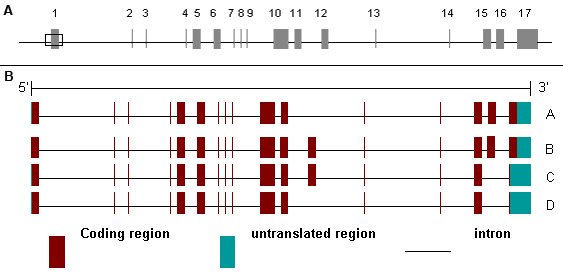
The promoter is located between 799 bp and 1215 bp upsteam of the exon 1. The promoter has the character of housekeeping genes: the absence of TATA box, the presence of CpG island and SP1 binding sites.
Transcription
Variant A: It lacks an in-frame coding segment, exon 12.
Variant B: This variant contains both alternative exons 12 and 16 and encodes the longest isoform.
Variant C: Variant C lacks the exon 16 resulting in a frame shift in exon 17. The resulting isoform C has a distinct and shorter C terminus when compared with variants A and B.
Variant D: Variant D lacks both exons 12 and 16.
The regulation of the TAK1 mRNA alternative splicing is tissue specific. The different variants of TAK1 may have specialized functions.
Pseudogene
Proteins
Note
Description
The kinase domain has approximately 30% identity to the catalytic domains of Raf-1 and MEKK1. Kondo et al. (1998) cloned human TAK1 from lung cDNA library by screening with mouse TAK1 sequence. Human TAK1 gene encodes a 579-amino-acid protein. The hTAK1 gene has 91.8% identity with the mTAK1 gene at the nucleotide level and has 99.3% to that at the amino acid level. Human TAK1 mRNA with a size of 3.0 kb was observed to express in all the tissues examined by Northern blotting. Kondo et al. (1998) found 2 isoforms of TAK1. Isoform 2 had an insertion of 27 amino acids between amino acids 403 and 404 of isoform 1 which corresponded to the mTAK1 sequence previously identified by Yamaguchi et al. (1995). The two isoforms were expressed at different ratios. Isoform 1 (Variant A) was predominantly expressed in brain, heart and spleen while the isoform 2 (Variant B) was preferentially in the kidney.
Independently, Sakurai et al. (1998) cloned hTAK1 as well as two alternatively spliced isoforms. Human TAK1a (Variant A) has 99.3% identity to murine TAK1. TAK1b (Variant B) had an insertion of 27 amino acids and TAK1c had a deletion of 39 amino acids in the carboxyl-terminal region. The catalytic domains of these three isoforms were 100% identical to that of murine TAK1. The mRNA for TAK1a and TAK1b were expressed in Hela, Jurkat and THP1 cells and TAK1a mRNA expessed predominantly in these cell lines. TAK1c mRNA (Variant C) was expressed only in Hela cells. Northern blot analysis revealed the expression of TAK1 mRNA in all the human tissues examined with the size of 3.2 and 5.7 kb. Dempsey et al. (2000) identified a fourth splice variant of TAK1 called TAK1d (Variant D). TAK1d lacked the two alternative exons and encoded a 491 amino acid protein. TAK1a and b were the most abundant forms in most tissues examined. The carboxyl-end variant TAK1 proteins were unlikely to interfere with the catalytic activity of TAK1 or its interaction with TAB1 since both of which involve the N terminus, but may affect its interaction with TAB2 which associates with the carboxyl-ends of the TAK1 proteins.
Expression
Localisation
Function
The activation of TAK1 kinase complex is dependent on its polyubiquitination by the TRAF6-Ubc complex and phosphorylation of several residues within the kinase activation loop by yet-to-be identified kinases. The ubiquitinated TAK1 can phosphorylate IKKbeta specifically at S177 and S181. Mutation analysis revealed that a point mutation in the ATP-binding domain of TAK1 (K63W), which abolished its kinase activity, was unable to activate IKK. TAK1 was activated by auto-phosphorylation on Ser192 and dual phosphorylation of Thr-178 and Thr-184 residues within the activation loop. Mutation of a conserved serine residue (Ser192) in the activation loop between kinase domain VII and VIII abrogated the phosphorylation and activation of TAK1. TAK1 is linked to TRAFs by two adaptor proteins TAB2 and TAB3. The interaction of TAB2/TAB3 with TAK1 is essential for the activation of signaling pathway mediated by IL-1.
It was shown that protein phosphatase 2Cepsilon (PP2Cepsilon) inhibited the IL-1 and TAK1 induced activation of MKK4-JNK or MKK3-p38 signaling pathway. PP2Cepsilon inactivated TAK1 by associating with and dephosphorylating TAK1. A type-2A phosphatase, protein phosphatase 6 (PP6), was also identified as a TAK1-binding protein. PP6 repressed TAK1 activity by dephosphorylating Thr187.
Homology
Mutations
Note
Implicated in
TAK1 and NFkB are required for the human MCF10A-CA1a breast cancer cells to undergo invasion in response to TGF-b. A novel TAB1:TAK1: IKKb: NFkB signaling axis forms aberrantly in breast cancer cells and enables oncogenic signaling by TGF-b.
TAK1 variant D activated by siRNAs of specific sequences leads to down stream activation of p38 MAPK and JNK but not NFkB pathway. In human lung cancer cell line NCI-H460 the activation of these pathway cause cell cycle arrest and apoptosis. It suggests that TAK1 D may be a new and promising therapeutic target for the treatment of non-small cell lung cancer.
Telomeres are essential elements at the ends of chromosomes that contribute to chromosomal stability. The length of the telomere is maintained by the telomerase holoenzyme, which contains the reverse transcriptase hTERT as a major enzymatic subunit. The activity of telomerase is absent in most normal human cells because of the downregulation of the hTERT transcript resulting in the shortening of telomeres after each replicative cycle. However, in immortalized cells and cancer cells, the telomere lengths are maintained through an increase in hTERT expression. TAK1 can repress the transcription of hTERT in A549 human lung adenocarcinoma cell line and this repression is caused by recruitment of HDAC to the hTERT promoter.
JNK is essential for metalloproteinase (MMP) gene expression and joint destruction in inflammatory arthritis. TAK1 is an upstream kinase of JNK. TAK1 play an important role for the IL1b induced JNK activation and the JNK induced gene expression in fibroblast-like synoviocytes (FLSs). It suggests that TAK1 is a potential therapeutic target to modulate synoviocyte activation in rheumatoid arthritis (RA).
Article Bibliography
| Pubmed ID | Last Year | Title | Authors |
|---|---|---|---|
| 17158449 | 2007 | TAK1-dependent signaling requires functional interaction with TAB2/TAB3. | Besse A et al |
| 17172402 | 2006 | Blockade of transforming growth factor-beta-activated kinase 1 activity enhances TRAIL-induced apoptosis through activation of a caspase cascade. | Choo MK et al |
| 11118615 | 2000 | Alternative splicing and gene structure of the transforming growth factor beta-activated kinase 1. | Dempsey CE et al |
| 17559674 | 2007 | Regulation of the JNK pathway by TGF-beta activated kinase 1 in rheumatoid arthritis synoviocytes. | Hammaker DR et al |
| 7708055 | 1994 | TAK1: molecular cloning and characterization of a new member of the nuclear receptor superfamily. | Hirose T et al |
| 16953224 | 2007 | Evidence that TNF-TNFR1-TRADD-TRAF2-RIP-TAK1-IKK pathway mediates constitutive NF-kappaB activation and proliferation in human head and neck squamous cell carcinoma. | Jackson-Bernitsas DG et al |
| 17079228 | 2006 | Protein phosphatase 6 down-regulates TAK1 kinase activation in the IL-1 signaling pathway. | Kajino T et al |
| 15836773 | 2005 | TAK1-binding protein 2 facilitates ubiquitination of TRAF6 and assembly of TRAF6 with IKK in the IL-1 signaling pathway. | Kishida S et al |
| 10702308 | 2000 | TAK1 mitogen-activated protein kinase kinase kinase is activated by autophosphorylation within its activation loop. | Kishimoto K et al |
| 18230764 | 2008 | Sequence-specific activation of TAK1-D by short double-stranded RNAs induces apoptosis in NCI-H460 cells. | Kodym R et al |
| 9466656 | 1998 | Molecular cloning of human TAK1 and its mutational analysis in human lung cancer. | Kondo M et al |
| 11129660 | 2000 | TAK1 regulates multiple protein kinase cascades activated by bacterial lipopolysaccharide. | Lee J et al |
| 15168726 | 2004 | Cloning and characterization of a novel human TGF-beta activated kinase-like gene. | Li J et al |
| 12556533 | 2003 | Regulation of the interleukin-1-induced signaling pathways by a novel member of the protein phosphatase 2C family (PP2Cepsilon). | Li MG et al |
| 17947700 | 2007 | Biomechanical signals suppress TAK1 activation to inhibit NF-kappaB transcriptional activation in fibrochondrocytes. | Madhavan S et al |
| 18316610 | 2008 | Altered TAB1:I kappaB kinase interaction promotes transforming growth factor beta-mediated nuclear factor-kappaB activation during breast cancer progression. | Neil JR et al |
| 17828308 | 2008 | TAK1 is required for TGF-beta 1-mediated regulation of matrix metalloproteinase-9 and metastasis. | Safina A et al |
| 9480845 | 1998 | TGF-beta-activated kinase 1 stimulates NF-kappa B activation by an NF-kappa B-inducing kinase-independent mechanism. | Sakurai H et al |
| 12547194 | 2003 | TAK1 is critical for IkappaB kinase-mediated activation of the NF-kappaB pathway. | Takaesu G et al |
| 11460167 | 2001 | TAK1 is a ubiquitin-dependent kinase of MKK and IKK. | Wang C et al |
| 8533096 | 1995 | Identification of a member of the MAPKKK family as a potential mediator of TGF-beta signal transduction. | Yamaguchi K et al |
| 18617512 | 2008 | Phosphorylation of Thr-178 and Thr-184 in the TAK1 T-loop is required for interleukin (IL)-1-mediated optimal NFkappaB and AP-1 activation as well as IL-6 gene expression. | Yu Y et al |
Other Information
Locus ID:
NCBI: 6885
MIM: 602614
HGNC: 6859
Ensembl: ENSG00000135341
Variants:
dbSNP: 6885
ClinVar: 6885
TCGA: ENSG00000135341
COSMIC: MAP3K7
RNA/Proteins
Expression (GTEx)
Pathways
Protein levels (Protein atlas)
PharmGKB
| Entity ID | Name | Type | Evidence | Association | PK | PD | PMIDs |
|---|---|---|---|---|---|---|---|
| PA30588 | MAP2K3 | Gene | Pathway | associated | 23922006 | ||
| PA30591 | MAP2K6 | Gene | Pathway | associated | 23922006 |
References
| Pubmed ID | Year | Title | Citations |
|---|---|---|---|
| 38632238 | 2024 | TAK1 inhibition leads to RIPK1-dependent apoptosis in immune-activated cancers. | 0 |
| 38632238 | 2024 | TAK1 inhibition leads to RIPK1-dependent apoptosis in immune-activated cancers. | 0 |
| 36789559 | 2023 | Emerging role of TAK1 in the regulation of skeletal muscle mass. | 0 |
| 36974751 | 2023 | SWAP70 Overexpression Protects Against Pathological Cardiac Hypertrophy in a TAK1-Dependent Manner. | 1 |
| 37306632 | 2023 | Pharmacological inhibition of TAK1 prevents and induces regression of experimental organ fibrosis. | 3 |
| 37578655 | 2023 | The Effects and Mechanisms of Xanthones in Alzheimer's Disease: A Systematic Review. | 0 |
| 37914735 | 2023 | Association of XIST/miRNA155/Gab2/TAK1 cascade with the pathogenesis of anti-phospholipid syndrome and its effect on cell adhesion molecules and inflammatory mediators. | 0 |
| 37949874 | 2023 | USP4 promotes the proliferation, migration, and invasion of esophageal squamous cell carcinoma by targeting TAK1. | 2 |
| 36789559 | 2023 | Emerging role of TAK1 in the regulation of skeletal muscle mass. | 0 |
| 36974751 | 2023 | SWAP70 Overexpression Protects Against Pathological Cardiac Hypertrophy in a TAK1-Dependent Manner. | 1 |
| 37306632 | 2023 | Pharmacological inhibition of TAK1 prevents and induces regression of experimental organ fibrosis. | 3 |
| 37578655 | 2023 | The Effects and Mechanisms of Xanthones in Alzheimer's Disease: A Systematic Review. | 0 |
| 37914735 | 2023 | Association of XIST/miRNA155/Gab2/TAK1 cascade with the pathogenesis of anti-phospholipid syndrome and its effect on cell adhesion molecules and inflammatory mediators. | 0 |
| 37949874 | 2023 | USP4 promotes the proliferation, migration, and invasion of esophageal squamous cell carcinoma by targeting TAK1. | 2 |
| 34930825 | 2022 | SF3B1 mutant-induced missplicing of MAP3K7 causes anemia in myelodysplastic syndromes. | 24 |
Citation
Hui Hui Tang ; Kam C Yeung
MAP3K7 (mitogen-activated protein kinase kinase kinase 7)
Atlas Genet Cytogenet Oncol Haematol. 2009-03-01
Online version: http://atlasgeneticsoncology.org/gene/454/map3k7
