PIAS1 (protein inhibitor of activated STAT, 1)
2013-07-01 Andrea Rabellino , Pier Paolo Scaglioni AffiliationDivision of Hematology, Oncology, Simmons Cancer Center, University of Texas Southwestern Medical Center, Dallas, TX, USA
Identity
HGNC
LOCATION
15q23
IMAGE

LEGEND
Chromosomal mapping of PIAS1. Modified from Weiskirchen et al., 2001.
LOCUSID
ALIAS
DDXBP1,GBP,GU/RH-II,ZMIZ3
FUSION GENES
DNA/RNA
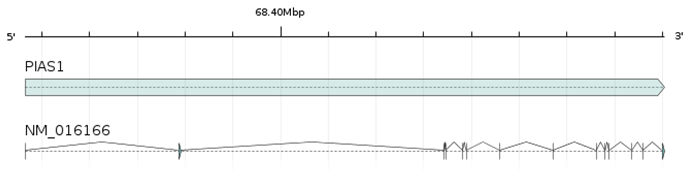
Structural organization of PIAS1 human gene.
Description
PIAS1 gene is composed of 14 exons and spans approximately 134,8 kb of genomic DNA.
Transcription
PIAS1 gene encodes a 2309 bp mRNA transcript.
Pseudogene
No pseudogenes have been reported.
Proteins

Schematic representation of PIAS1 protein. The different domains are illustrated. A purple square represents the SUMO binding domain (SBD).
Description
The human PIAS1 protein is composed of 651 amino acids, with a predicted molecular weight of 71,85 kDa. PIAS1 has five distinct functional domains, with different functions: the SAP (scaffold attachment factor-A/B, Acinus and PIAS), the PINIT motif, the RING-type zinc-binding domain, the SBD (SUMO binding domain, also indicated as SIM, SUMO interacting motif) and a C-terminal serine/threonine rich region. The SAP domain contains a LXXLL motif which is involved in direct-DNA binding or in physical interaction with other proteins involved in DNA-binding, such as transcription factors, co-regulators and nuclear receptors (Aravind and Koonin, 2000). The PINIT motif is involved in the sub-cellular organization of PIAS1 (Duval et al., 2003). The RING domain is essential for the E3 SUMO-ligase activity of PIAS1 and also mediates protein-protein interactions (Hochstrasser, 2001). The SBD domain interact in a non-covalently way with SUMO proteins (Rytinki et al., 2009). The C-terminal portion of PIAS1 is a serine/threonine rich region: this is the most variable region within the PIAS proteins family. PIAS1 undergoes several post-translational modifications, including phosphorylation, acetylation, methylation, SUMOylation and ubiquitination (Liu et al., 2005; Depaux et al., 2007; Rytinki et al., 2009; Stehmeier and Muller, 2009; Weber et al., 2009).
Expression
PIAS1 is ubiquitously expressed.
Localisation
Nuclear.
Function
PIAS1 has been implicated in several cellular functions and most of them have been associated to its SUMO E3-ligase activity (Schimdt and Müller, 2003; Shuai and Liu, 2005; Rytinki et al., 2009).
Transcriptional regulation: PIAS1 is a negative regulator of several transcription factors. PIAS1 was initially described as a negative regulator of the STAT1 signal by blocking the DNA-binding activity of STAT1 (Liu et al., 1998). PIAS1 SUMOylates the TP53 tumor suppressor, inhibiting its activity (Kahyo et al., 2001; Schmidt and Müller, 2002). PIAS1 SUMOylates the androgen receptor (AR) repressing the AR-dependent transcription (Nishida and Yasuda, 2002). PIAS1 also regulates the homeoprotein Msx1 by regulating its subnuclear localization and its DNA-binding specificity in a SUMO E3-ligase independent manner (Lee et al., 2006). PIAS1 SUMOylates the progesterone receptor (PR), and cAMP attenuates ligand-dependent SUMOylation of PR (Jones et al., 2006).
Inflammation and immunity: upon various inflammatory stimuli, IKKa phosphorylates PIAS1 associating it with the promoter of NF-κB target genes (Liu et al., 2007). PIAS1 regulates the natural T regulatory cells by restricting their differentiation through the recruitment of the protein DNA-methyltransferase and CBX5 at the FOXP3 promoter (Liu et al., 2010).
DNA damage: PIAS1 co-operates with PIAS4 promoting double-strand DNA breaks repair (Galanty et al., 2009).
Cancer: PIAS1 SUMOylates the promyelocytic leukemia (PML) gene and promotes its ubiquitin/proteasome-dependent degradation, inhibiting its tumor suppressor functions. PIAS1 also SUMOylates the PML-RARA oncoprotein of acute promyelocytic leukemia (APL); in this case, PIAS1-dependent SUMOylation is required for the degradation of PML-RARA in APL cells treated with arsenic trioxide (Rabellino et al., 2012).
Transcriptional regulation: PIAS1 is a negative regulator of several transcription factors. PIAS1 was initially described as a negative regulator of the STAT1 signal by blocking the DNA-binding activity of STAT1 (Liu et al., 1998). PIAS1 SUMOylates the TP53 tumor suppressor, inhibiting its activity (Kahyo et al., 2001; Schmidt and Müller, 2002). PIAS1 SUMOylates the androgen receptor (AR) repressing the AR-dependent transcription (Nishida and Yasuda, 2002). PIAS1 also regulates the homeoprotein Msx1 by regulating its subnuclear localization and its DNA-binding specificity in a SUMO E3-ligase independent manner (Lee et al., 2006). PIAS1 SUMOylates the progesterone receptor (PR), and cAMP attenuates ligand-dependent SUMOylation of PR (Jones et al., 2006).
Inflammation and immunity: upon various inflammatory stimuli, IKKa phosphorylates PIAS1 associating it with the promoter of NF-κB target genes (Liu et al., 2007). PIAS1 regulates the natural T regulatory cells by restricting their differentiation through the recruitment of the protein DNA-methyltransferase and CBX5 at the FOXP3 promoter (Liu et al., 2010).
DNA damage: PIAS1 co-operates with PIAS4 promoting double-strand DNA breaks repair (Galanty et al., 2009).
Cancer: PIAS1 SUMOylates the promyelocytic leukemia (PML) gene and promotes its ubiquitin/proteasome-dependent degradation, inhibiting its tumor suppressor functions. PIAS1 also SUMOylates the PML-RARA oncoprotein of acute promyelocytic leukemia (APL); in this case, PIAS1-dependent SUMOylation is required for the degradation of PML-RARA in APL cells treated with arsenic trioxide (Rabellino et al., 2012).
Homology
PIAS1 belongs to the PIAS proteins family and is evolutionary conserved from yeast to man. PIAS1 can be found in Saccharomyces cerevisiae, in plants (Arabidopis thaliana and Oryza sativa), Caernorhabditis elegans, Drosophila melanogaster, Danio renio, Xenopus laevis, Gallus gallus and mammals. All PIAS1 orthologues share a high degree of homology. The human PIAS family consists of at least 5 different members: PIAS1, PIAS2 (with two variants called PIASxα and PIASxβ), PIAS3 and PIAS4 (also known as PIASy). All family members share high protein homology, except for the C-terminus (Shuai and Liu, 2005; Rytinki et al., 2009).
Mutations
Note
No translocations involving PIAS1 gene have been reported so far.

Schematic representation of the mutations of human PIAS1 protein found in tumor samples. Notably, most of the mutations reside in the PINIT domain.
Germinal
No germinal mutations of PIAS1 have been reported.
Somatic
At least 25 different somatic mutations have been described in different tumor types. All the informations in this regard can be found at the COSMIC website.
Implicated in
Entity name
Prostate cancer
Note
High expression of PIAS1 is found in malignant areas of prostate cancer as compared to benign areas. Immunohistochemistry staining positively correlates with positive staining for the PCNA and Ki-67 proliferative markers suggesting a pro-proliferative role of PIAS1 in prostate cancer (Hoefer, 2012).
Entity name
Colon cancer
Note
Activated STAT3 signaling has been involved in colon cancer. PIAS1 is a negative regulator of the STAT signaling. Accordingly, PIAS1 expression is high in colonic non-tumor cells and adenomas, and lower in colon cancer cells (Coppola et al., 2009).
Entity name
Gastric cancer
Prognosis
One study shows that 70% of the gastric tumors specimens analyzed show a low level of PIAS1 expression. Moreover, the low expression of PIAS1 significantly correlates with tumor staging (Chen et al., 2012).
Entity name
Non-small cell lung cancer (NSCLC)
Note
PIAS1-dependent SUMOylation of PML leads to its degradation, blocking the tumor suppression activity of PML. Accordingly with this observation obtained with in vitro experiments, a correlation between high level of PIAS1 protein expression and low level of PML was reported in NSCLC specimens. Furthermore, high expression of mRNA levels of PIAS1 in NSCLC specimens correlates with PIAS1 gene amplification (Rabellino et al., 2012).
Article Bibliography
| Pubmed ID | Last Year | Title | Authors |
|---|---|---|---|
| 10694879 | 2000 | SAP - a putative DNA-binding motif involved in chromosomal organization. | Aravind L et al |
| 22972521 | 2012 | Protein inhibitor of activated STAT-1 is downregulated in gastric cancer tissue and involved in cell metastasis. | Chen P et al |
| 19288270 | 2009 | Substantially reduced expression of PIAS1 is associated with colon cancer development. | Coppola D et al |
| 17533377 | 2007 | A crosstalk between hSiah2 and Pias E3-ligases modulates Pias-dependent activation. | Depaux A et al |
| 14596924 | 2003 | The 'PINIT' motif, of a newly identified conserved domain of the PIAS protein family, is essential for nuclear retention of PIAS3L. | Duval D et al |
| 20016603 | 2009 | Mammalian SUMO E3-ligases PIAS1 and PIAS4 promote responses to DNA double-strand breaks. | Galanty Y et al |
| 11595179 | 2001 | SP-RING for SUMO: new functions bloom for a ubiquitin-like protein. | Hochstrasser M et al |
| 22449952 | 2012 | PIAS1 is increased in human prostate cancer and enhances proliferation through inhibition of p21. | Hoefer J et al |
| 17053081 | 2006 | Regulation of the SUMO pathway sensitizes differentiating human endometrial stromal cells to progesterone. | Jones MC et al |
| 11583632 | 2001 | Involvement of PIAS1 in the sumoylation of tumor suppressor p53. | Kahyo T et al |
| 16600910 | 2006 | PIAS1 confers DNA-binding specificity on the Msx1 homeoprotein. | Lee H et al |
| 9724754 | 1998 | Inhibition of Stat1-mediated gene activation by PIAS1. | Liu B et al |
| 20966256 | 2010 | The ligase PIAS1 restricts natural regulatory T cell differentiation by epigenetic repression. | Liu B et al |
| 17540171 | 2007 | Proinflammatory stimuli induce IKKalpha-mediated phosphorylation of PIAS1 to restrict inflammation and immunity. | Liu B et al |
| 12177000 | 2002 | PIAS1 and PIASxalpha function as SUMO-E3 ligases toward androgen receptor and repress androgen receptor-dependent transcription. | Nishida T et al |
| 22406621 | 2012 | The SUMO E3-ligase PIAS1 regulates the tumor suppressor PML and its oncogenic counterpart PML-RARA. | Rabellino A et al |
| 19526197 | 2009 | PIAS proteins: pleiotropic interactors associated with SUMO. | Rytinki MM et al |
| 14685683 | 2003 | PIAS/SUMO: new partners in transcriptional regulation. | Schmidt D et al |
| 16056253 | 2005 | Regulation of gene-activation pathways by PIAS proteins in the immune system. | Shuai K et al |
| 19217413 | 2009 | Phospho-regulated SUMO interaction modules connect the SUMO system to CK2 signaling. | Stehmeier P et al |
| 19136629 | 2009 | PRMT1-mediated arginine methylation of PIAS1 regulates STAT1 signaling. | Weber S et al |
| 11672422 | 2001 | LIM-domain protein cysteine- and glycine-rich protein 2 (CRP2) is a novel marker of hepatic stellate cells and binding partner of the protein inhibitor of activated STAT1. | Weiskirchen R et al |
Other Information
Locus ID:
NCBI: 8554
MIM: 603566
HGNC: 2752
Ensembl: ENSG00000033800
Variants:
dbSNP: 8554
ClinVar: 8554
TCGA: ENSG00000033800
COSMIC: PIAS1
RNA/Proteins
Expression (GTEx)
Pathways
Protein levels (Protein atlas)
PharmGKB
| Entity ID | Name | Type | Evidence | Association | PK | PD | PMIDs |
|---|---|---|---|---|---|---|---|
| PA36183 | STAT1 | Gene | Pathway | associated | 26111151 |
References
| Pubmed ID | Year | Title | Citations |
|---|---|---|---|
| 38102979 | 2024 | SUMOylation and coupling of eNOS mediated by PIAS1 contribute to maintenance of vascular homeostasis. | 0 |
| 38190100 | 2024 | Multi-omics integration identifies cell-state-specific repression by PBRM1-PIAS1 cooperation. | 0 |
| 38802795 | 2024 | CircPIAS1 promotes hepatocellular carcinoma progression by inhibiting ferroptosis via the miR-455-3p/NUPR1/FTH1 axis. | 0 |
| 38102979 | 2024 | SUMOylation and coupling of eNOS mediated by PIAS1 contribute to maintenance of vascular homeostasis. | 0 |
| 38190100 | 2024 | Multi-omics integration identifies cell-state-specific repression by PBRM1-PIAS1 cooperation. | 0 |
| 38802795 | 2024 | CircPIAS1 promotes hepatocellular carcinoma progression by inhibiting ferroptosis via the miR-455-3p/NUPR1/FTH1 axis. | 0 |
| 37664931 | 2023 | SUMOylation of SMAD4 by PIAS1 in Conjunction with Vimentin Upregulation Promotes Migration Potential in Non-Small Cell Lung Cancer. | 0 |
| 37664931 | 2023 | SUMOylation of SMAD4 by PIAS1 in Conjunction with Vimentin Upregulation Promotes Migration Potential in Non-Small Cell Lung Cancer. | 0 |
| 34951052 | 2022 | A PIAS1 Protective Variant S510G Delays polyQ Disease Onset by Modifying Protein Homeostasis. | 4 |
| 35007836 | 2022 | Roles of the SUMO-related enzymes, PIAS1, PIAS4, and RNF4, in DNA double-strand break repair by homologous recombination. | 2 |
| 36050397 | 2022 | Crosstalk between SUMOylation and ubiquitylation controls DNA end resection by maintaining MRE11 homeostasis on chromatin. | 3 |
| 34951052 | 2022 | A PIAS1 Protective Variant S510G Delays polyQ Disease Onset by Modifying Protein Homeostasis. | 4 |
| 35007836 | 2022 | Roles of the SUMO-related enzymes, PIAS1, PIAS4, and RNF4, in DNA double-strand break repair by homologous recombination. | 2 |
| 36050397 | 2022 | Crosstalk between SUMOylation and ubiquitylation controls DNA end resection by maintaining MRE11 homeostasis on chromatin. | 3 |
| 32770107 | 2021 | PIAS1 and TIF1γ collaborate to promote SnoN SUMOylation and suppression of epithelial-mesenchymal transition. | 9 |
Citation
Andrea Rabellino ; Pier Paolo Scaglioni
PIAS1 (protein inhibitor of activated STAT, 1)
Atlas Genet Cytogenet Oncol Haematol. 2013-07-01
Online version: http://atlasgeneticsoncology.org/gene/45688/pias1-(protein-inhibitor-of-activated-stat-1)
