NUAK1 (NUAK family, SNF1-like kinase, 1)
2014-03-01 Fumika Inazuka , Hiroyasu Esumi AffiliationResearch Institute for Biomedical Sciences, Tokyo University of Science, Japan
DNA/RNA
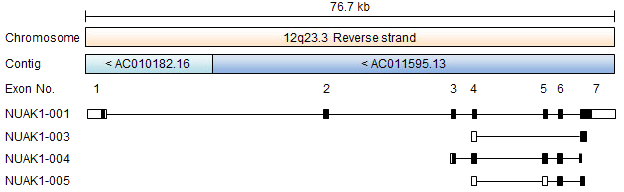
The human NUAK1 gene has four splice variants. NUAK1-001 is composed of seven exons, which spans 6828 bp and encodes a 661-aa protein. NUAK1-003 is composed of two exons including one non-coding exon, which spans 547 bp and encodes a 118-aa protein. NUAK1-004 is composed of five exons, which spans 560 bp and encodes a 152-aa protein. NUAK1-005 is composed of four exons including two non-coding exons, which spans 569 bp and encodes a 74-aa protein (see Ensembl ENSG00000074590). Open boxes indicate untranslated regions and shaded boxes indicate coding regions of the gene.
Description
The human NUAK1 gene is composed of seven exons and spans approximately 76.7 kbp of genomic DNA.
Transcription
The human NUAK1 gene encodes a 6828-bp mRNA. The coding region contains 1986 bp. Three short splice variants (547-569 bp) have been reported.
Pseudogene
No pseudogenes are known.
Proteins

The catalytic domain of NUAK1 protein is located in the N-terminal at residues 55 to 306. K84 is an ATP binding site. T211 is phosphorylated by LKB1, which activates NUAK1 (Lizcano et al., 2004). W305 is required for binding of USP9X (Al-Hakim et al., 2008). The GILK motif is a direct binding site for protein phosphatase PPP1CB (Zagorska et al., 2010).
Description
NUAK1 protein consists of 661 amino acids and has a molecular weight of 74 kDa (Nagase et al., 1998). NUAK1 contains a serine/threonine-protein kinase domain at its N-terminus that is conserved among AMPKalphas and AMPK-related kinases (AMPK-RKs) (Manning et al., 2002). The same as the AMPKalphas and most other AMPK-RKs, NUAK1 can be phosphorylated by tumor suppressor LKB1 at a conserved threonine residue (corresponding to Thr-211 in NUAK1) in the T-loop of the catalytic domain, which activates the kinase activity of NUAK1 (Lizcano et al., 2004). The phosphorylation at Thr-211 is prevented by atypical Lys29/ Lys33-linked polyubiquitin chains, which can be removed by the de-ubiquitinating enzyme USP9X (Al-Hakim et al., 2008).
Expression
NUAK1 is preferentially expressed in highly oxidative tissues such as cerebrum, heart, and soleus muscle in human and mouse (Nagase et al., 1998; Inazuka et al., 2012). In mouse embryogenesis, NUAK1 is prominently expressed in the neuroectoderm during neurulation, and in the cerebral cortex after the late embryonic stage (Ohmura et al., 2012; Courchet et al., 2013). In C2C12 mouse myoblasts, NUAK1 is increasingly expressed as the cells differentiate into myotubes (Niesler et al., 2007). The elevated expression of NUAK1 has been observed in clinical samples obtained from colorectal cancers, pancreatic cancers, hepatocellular carcinomas, gliomas, and angioimmunoblastic T-cell lymphomas (Kusakai et al., 2004a; Morito et al., 2006; Liu et al., 2012; Cui et al., 2013).
Localisation
NUAK1 is found in both the cytoplasm and nucleus.
Function
In HEK293 cells NUAK1 phosphorylates myosin phosphatase regulator MYPT1, which inhibits the activity of a MYPT1-PPP1CB phosphatase complex, enhancing cell detachment (Zagorska et al., 2010). In WI-38 fetal lung fibroblasts and MCF10A immortalized mammary epithelial cells NUAK1 phosphorylates the cyclin-dependent protein kinase regulator LATS1, which leads to destabilization of LATS1 and induces aneuploidy, resulting in cellular senescence in a cellular context-dependent manner (Humbert et al., 2010). In A549 lung adenocarcinoma cells NUAK1 acts as a transcriptional coactivator in a complex with LKB1 and a tumor suppressor p53, which induces cell cycle G1 arrest (Hou et al., 2011).
In mice, NUAK1 is essential for closure of the ventral body wall in developing embryos (Hirano et al., 2006). NUAK1 and NUAK2 function in a complementary manner in the apical constriction and apico-basal elongation during early embryogenesis (Ohmura et al., 2012). The LKB1-NUAK1 pathway regulates cortical axon branching by immobilizing mitochondria at nascent presynaptic sites during postnatal neuronal development (Courchet et al., 2013). NUAK1 has a role in the negative feedback regulation of insulin signaling, which is involved in glucose intolerance under high-fat diet conditions (Inazuka et al., 2012).
In Caenorhabditis elegans, UNC-82, an ortholog of NUAK1 and NUAK2, maintains the organization of cytoskeletal structure during cell-shape change presumably through phosphorylation of myosin and paramyosin (Hoppe et al., 2010).
In mice, NUAK1 is essential for closure of the ventral body wall in developing embryos (Hirano et al., 2006). NUAK1 and NUAK2 function in a complementary manner in the apical constriction and apico-basal elongation during early embryogenesis (Ohmura et al., 2012). The LKB1-NUAK1 pathway regulates cortical axon branching by immobilizing mitochondria at nascent presynaptic sites during postnatal neuronal development (Courchet et al., 2013). NUAK1 has a role in the negative feedback regulation of insulin signaling, which is involved in glucose intolerance under high-fat diet conditions (Inazuka et al., 2012).
In Caenorhabditis elegans, UNC-82, an ortholog of NUAK1 and NUAK2, maintains the organization of cytoskeletal structure during cell-shape change presumably through phosphorylation of myosin and paramyosin (Hoppe et al., 2010).
Homology
NUAK1 has the highest homology to NUAK2, whose similarity in the protein as a whole is 58%, and 82% in the kinase domain in human. Homo sapiens NUAK1 is 91% similar to Mus musculus NUAK1, 75% similar to Xenopus tropicalis NUAK1, and 65% similar to Caenorhabditis elegans UNC-82.
Mutations
Somatic
A C-to-T transition at residues 661 in the NUAK1 gene that results in a Pro-to-Ser substitution at codon 221 (P221S) has been found in tissue samples from human colorectal carcinomas and melanomas (Cancer Genome Atlas Network, 2012; Krauthammer et al., 2012).
Implicated in
Entity name
Glioma
Disease
Malignant gliomas are the most common type of primary brain tumor in adults. Glioma cells are highly proliferative, thereby readily invading surrounding brain structures. Thus, complete surgical resection is practically impossible (Stewart, 2002). Glioma infiltration occurs through the activation of matrix metalloproteinases (MMPs). MMPs also exhibit a function in angiogenesis during tumor neovascularization (Forsyth et al., 1999; Das et al., 2011).
Prognosis
Up-regulation of NUAK1 correlates with the World Health Organization grades of glioma (P < 0.001). High NUAK1 expression was markedly associated with reduced overall survival in grade II glioma (P < 0.01). The median survival time of patients with high NUAK1 expression (18.37 months, 95% confidence interval (CI): 15.95-20.04) was significantly shorter than that of patients with low NUAK1 expression level (43.80 months, 95% CI: 23.47-48.36). The same conclusions were obtained in grades III and IV gliomas, indicating that NUAK1 is a valuable prognostic marker for glioma patients at all disease stages (Lu et al., 2013).
Oncogenesis
In several kinds of glioma cell lines, NUAK1 promotes IGF-1-induced cell invasion, in which NUAK1 mediates cytoskeleton rearrangement through activation of LIMK1 and cofilin and activates MMP-2 and MMP-9 through production of MT1-MMP. Knockdown of NUAK1 reduces brain invasion in mice with glioma xenografts (Lu et al., 2013).
Entity name
Colorectal cancer (CRC)
Disease
CRC is the third leading cancer and the fourth leading cause of cancer deaths worldwide (Karsa et al., 2010). Various genetic changes, including APC mutation, mismatch repair defects, Wnt-activated alterations, RAF-mediated alterations, and p53 alterations are concurrently observed in CRC. These mutations are interconnected to generate diverse pathways of colorectal tumorigenesis (Conlin et al., 2005; Roh et al., 2010). In addition, MMPs are overexpressed in colorectal tumors and involved in degrading components of the basement membrane during the progression of CRC (Collins et al., 2001; Dragutinovic et al., 2011).
Prognosis
Higher expression of NUAK1 is observed in advanced cases, and much higher expression is observed in liver metastases (Kusakai et al., 2004b; Roh et al., 2010). The expression of NUAK1 is closely associated with that of MMP-2 and MMP-9. Enhanced expression of NUAK1 is more frequent in tumors with RAF-mediated alterations (P = 0.001) or crossover pathways carrying both APC/Wnt-activated and mismatch repair/RAF-mediated alterations (P = 0.003) than those without them (Roh et al., 2010).
Oncogenesis
Higher NUAK1 expression is concordant with higher invasion activity in human colorectal cancer cell lines (Kusakai et al., 2004a; Kusakai et al., 2004b). Knockdown of NUAK1 suppresses growth of CRC xenografts in mice (Liu et al., 2012).
Entity name
Hepatocellular carcinoma (HCC)
Disease
HCC is the fifth most common cancer and the third most frequent cause of death of cancer worldwide. Liver resection is considered to be the mainly curative therapy for HCC, with about 50-70% 5-year overall survival after curative hepatectomy. However, the postoperative recurrence rate remains as high as 70-83.7% (Bruix and Sherman, 2005; Llovet, 2005).
Prognosis
In HCC, the high expression of NUAK1 is related to tumor size (P=0.005), histological differentiation (P=0.047), tumor stage (P=0.005), and a significantly poor prognosis. Multivariate analysis identified the level of NUAK1 expression as an independent predictor of the overall survival rate of patients with HCC (Cui et al., 2013).
Oncogenesis
Several cancer cell lines including HCC which are expressed oncogenic levels of MYC establish a dependence on NUAK1 for maintaining metabolic homeostasis and for cell survival, in which NUAK1 restrains mTOR signaling via suppression of proteasomal degradation of AMPKbeta and also maintains expression of mitochondrial respiratory chain complexes. Knockdown of NUAK1 prevents tumorigenesis in MYC-driven mouse models of HCC. Depletion of NUAK1 after tumorigenesis also suppresses tumor growth and provides a survival advantage to the mice (P < 0.01) (Liu et al., 2012).
Article Bibliography
| Pubmed ID | Last Year | Title | Authors |
|---|---|---|---|
| 18254724 | 2008 | Control of AMPK-related kinases by USP9X and atypical Lys(29)/Lys(33)-linked polyubiquitin chains. | Al-Hakim AK et al |
| 16250051 | 2005 | Management of hepatocellular carcinoma. | Bruix J et al |
| 22810696 | 2012 | Comprehensive molecular characterization of human colon and rectal cancer. | |
| 11401321 | 2001 | Spectrum of matrix metalloproteinase expression in primary and metastatic colon cancer: relationship to the tissue inhibitors of metalloproteinases and membrane type-1-matrix metalloproteinase. | Collins HM et al |
| 15843421 | 2005 | The prognostic significance of K-ras, p53, and APC mutations in colorectal carcinoma. | Conlin A et al |
| 23791179 | 2013 | Terminal axon branching is regulated by the LKB1-NUAK1 kinase pathway via presynaptic mitochondrial capture. | Courchet J et al |
| 23516026 | 2013 | Overexpression of ARK5 is associated with poor prognosis in hepatocellular carcinoma. | Cui J et al |
| 21557327 | 2011 | Rictor regulates MMP-9 activity and invasion through Raf-1-MEK-ERK signaling pathway in glioma cells. | Das G et al |
| 21541674 | 2011 | Matrix metalloproteinase-2 (MMP-2) and -9 (MMP-9) in preoperative serum as independent prognostic markers in patients with colorectal cancer. | Dragutinović VV et al |
| 10206300 | 1999 | Gelatinase-A (MMP-2), gelatinase-B (MMP-9) and membrane type matrix metalloproteinase-1 (MT1-MMP) are involved in different aspects of the pathophysiology of malignant gliomas. | Forsyth PA et al |
| 16715502 | 2006 | A new serine/threonine protein kinase, Omphk1, essential to ventral body wall formation. | Hirano M et al |
| 19901071 | 2010 | Caenorhabditis elegans unc-82 encodes a serine/threonine kinase important for myosin filament organization in muscle during growth. | Hoppe PE et al |
| 21317932 | 2011 | A new role of NUAK1: directly phosphorylating p53 and regulating cell proliferation. | Hou X et al |
| 19927127 | 2010 | Regulation of ploidy and senescence by the AMPK-related kinase NUAK1. | Humbert N et al |
| 22418434 | 2012 | Muscle-specific knock-out of NUAK family SNF1-like kinase 1 (NUAK1) prevents high fat diet-induced glucose intolerance. | Inazuka F et al |
| 20833343 | 2010 | The dimensions of the CRC problem. | Karsa LV et al |
| 22842228 | 2012 | Exome sequencing identifies recurrent somatic RAC1 mutations in melanoma. | Krauthammer M et al |
| 14982852 | 2004 | ARK5 expression in colorectal cancer and its implications for tumor progression. | Kusakai G et al |
| 22460906 | 2012 | Deregulated MYC expression induces dependence upon AMPK-related kinase 5. | Liu L et al |
| 14976552 | 2004 | LKB1 is a master kinase that activates 13 kinases of the AMPK subfamily, including MARK/PAR-1. | Lizcano JM et al |
| 15830281 | 2005 | Updated treatment approach to hepatocellular carcinoma. | Llovet JM et al |
| 23063350 | 2013 | ARK5 promotes glioma cell invasion, and its elevated expression is correlated with poor clinical outcome. | Lu S et al |
| 12471243 | 2002 | The protein kinase complement of the human genome. | Manning G et al |
| 16424013 | 2006 | Overexpression of c-Maf contributes to T-cell lymphoma in both mice and human. | Morito N et al |
| 9628581 | 1998 | Prediction of the coding sequences of unidentified human genes. IX. The complete sequences of 100 new cDNA clones from brain which can code for large proteins in vitro. | Nagase T et al |
| 16945942 | 2007 | The changing AMPK expression profile in differentiating mouse skeletal muscle myoblast cells helps confer increasing resistance to apoptosis. | Niesler CU et al |
| 22689267 | 2012 | Neural tube defects by NUAK1 and NUAK2 double mutation. | Ohmura T et al |
| 20191032 | 2010 | Growth and invasion of sporadic colorectal adenocarcinomas in terms of genetic change. | Roh SA et al |
| 11937180 | 2002 | Chemotherapy in adult high-grade glioma: a systematic review and meta-analysis of individual patient data from 12 randomised trials. | Stewart LA et al |
| 20354225 | 2010 | New roles for the LKB1-NUAK pathway in controlling myosin phosphatase complexes and cell adhesion. | Zagórska A et al |
Other Information
Locus ID:
NCBI: 9891
MIM: 608130
HGNC: 14311
Ensembl: ENSG00000074590
Variants:
dbSNP: 9891
ClinVar: 9891
TCGA: ENSG00000074590
COSMIC: NUAK1
RNA/Proteins
Expression (GTEx)
Pathways
References
| Pubmed ID | Year | Title | Citations |
|---|---|---|---|
| 38967580 | 2024 | NUAK1 promotes metabolic dysfunction-associated steatohepatitis progression by activating Caspase 6-driven pyroptosis and inflammation. | 0 |
| 38967580 | 2024 | NUAK1 promotes metabolic dysfunction-associated steatohepatitis progression by activating Caspase 6-driven pyroptosis and inflammation. | 0 |
| 36480792 | 2023 | DKK1 promotes NUAK1 transcriptional expression through the activation Akt in hepatocellular carcinoma. | 1 |
| 36975767 | 2023 | NUAK1 governs centrosome replication in pancreatic cancer via MYPT1/PP1β and GSK3β-dependent regulation of PLK4. | 3 |
| 37996927 | 2023 | Evaluation of ARK5 and SIRT3 expression in renal cell carcinoma and their clinical significance. | 1 |
| 36480792 | 2023 | DKK1 promotes NUAK1 transcriptional expression through the activation Akt in hepatocellular carcinoma. | 1 |
| 36975767 | 2023 | NUAK1 governs centrosome replication in pancreatic cancer via MYPT1/PP1β and GSK3β-dependent regulation of PLK4. | 3 |
| 37996927 | 2023 | Evaluation of ARK5 and SIRT3 expression in renal cell carcinoma and their clinical significance. | 1 |
| 35194062 | 2022 | Loss of LKB1-NUAK1 signalling enhances NF-κB activity in a spheroid model of high-grade serous ovarian cancer. | 8 |
| 36255069 | 2022 | Circ_0003998 upregulates ARK5 expression to elevate 5-Fluorouracil resistance in hepatocellular carcinoma through binding to miR-513a-5p. | 0 |
| 35194062 | 2022 | Loss of LKB1-NUAK1 signalling enhances NF-κB activity in a spheroid model of high-grade serous ovarian cancer. | 8 |
| 36255069 | 2022 | Circ_0003998 upregulates ARK5 expression to elevate 5-Fluorouracil resistance in hepatocellular carcinoma through binding to miR-513a-5p. | 0 |
| 34097192 | 2021 | LINC00922 promotes the proliferation, migration, invasion and EMT process of liver cancer cells by regulating miR-424-5p/ARK5. | 7 |
| 34097192 | 2021 | LINC00922 promotes the proliferation, migration, invasion and EMT process of liver cancer cells by regulating miR-424-5p/ARK5. | 7 |
| 32418991 | 2020 | miR-622 is a novel potential biomarker of breast carcinoma and impairs motility of breast cancer cells through targeting NUAK1 kinase. | 12 |
Citation
Fumika Inazuka ; Hiroyasu Esumi
NUAK1 (NUAK family, SNF1-like kinase, 1)
Atlas Genet Cytogenet Oncol Haematol. 2014-03-01
Online version: http://atlasgeneticsoncology.org/gene/46275/new-content/submit-meetings/
