FUBP1 (far upstream element (FUSE) binding protein 1)
2013-05-01 Katharina Gerlach , Martin Zörnig AffiliationInstitute for Biomedical Research Georg-Speyer-Haus, Paul-Ehrlich-Strasse 42-44, 60596 Frankfurt, Germany
DNA/RNA
Description
FUBP1 is composed of 20 protein-coding exons ranging between approx. 40 bp and 170 bp in length and 19 introns which vary greatly in size (approx. 100 bp - 8800 bp). It has a short (approx. 90 bp) 5 untranslated region (UTR) and a long 3 UTR (approx. 860 bp).
According to the Ensembl genome browser database 14 transcript variants of human FUBP1 have been reported (ENSG00000162613). One of them is composed of 21 exons (ENST00000436586).
Transcription
Pseudogene
Proteins

Description
Expression
Localisation
Function
As the KH motifs were first found to be involved in RNA-binding, it is not surprising that FUBP1 also interacts with specific RNAs. It was shown that FUBP1 interacts with the 3 UTR of GAP-43 mRNA (encoding a membrane phosphoprotein that is important for the development and plasticity of neuronal cells), hepatitis C virus RNA, nucleophosmin mRNA (a nucleolar oncoprotein involved in several cellular processes) and the 5 UTR of the p27 mRNA (a cyclin dependent kinase inhibitor), regulating their stabilities and translation (Irwin et al., 1997; Olanich et al., 2011; Zhang et al., 2008; Zheng and Miskimins, 2011). Although the regulatory mechanisms behind these interactions are still not fully characterized, these results implicate additional functions of FUBP1 in the regulation of neuronal differentiation, viral replication, cell growth and cell cycle progression.
Transcriptional regulation of the c-myc promoter by the FUBP family
Because of the unconventional binding properties of FUBP1 (single stranded DNA (ssDNA) instead of double stranded DNA (dsDNA) as for most other regular transcription factors), its mechanism in the regulation of c-myc transcription has been extensively studied. In the absence of serum, the c-myc locus is transcriptionally inactive. In this state, the FUSE element upstream of the promoter is in a double stranded conformation and masked by a nucleosome. Upon addition of serum, chromatin remodelling occurs, which results in the exposure of the FUSE element (Brooks and Hurley, 2009). Basal transcription of c-myc is initiated and leads to torsional stress and negative supercoiling of the DNA. Under sufficient supercoiling, the DNA of the AT-rich FUSE element melts and enables binding of FUBP3, which later is replaced by FUBP1 (Chung et al., 2006; Kouzine et al., 2008; Kouzine et al., 2004; Michelotti et al., 1996). Upon recruitment, FUBP1 interacts with the general transcription factor TFIIH and enhances its helicase activity, thereby facilitating promoter escape of the polymerase complex which enhances transcription of c-myc (Bazar et al., 1995; Liu et al., 2001). Therefore, c-myc transcription reaches a maximum approx. two hours after serum addition.
Shortly after reaching the maximal transcription rate, FBP interacting repressor (FIR) binds to the FUSE element and FUBP1, forming a stable tripartite FUSE-FUBP1-FIR complex. This complex reverts the activated transcription back to a basal level, due to FIR-mediated inhibition of the 3 to 5 helicase activity of TFIIH (Brooks and Hurley, 2009; Hsiao et al., 2010; Liu et al., 2000). Shorty after formation of the tripartite complex, FUBP1 is ejected while FIR remains bound to the FUSE element. This mechanism results in a sharp peak of c-myc expression upon serum addition (or other c-myc-inducing signals) and ensures the precise control of c-myc expression, which is important in normal cell homeostasis (Kelly and Siebenlist, 1986).
Homology
Mutations
Somatic
Implicated in
Its expression is strongly increased in NSCLC cells compared to non-tumorous lung tissues. Furthermore it was shown that FUBP1 coordinates the expression of the microtubule-destabilizing proteins stathmin and SCLIP eventually leading to increased motility of NSCLC (Singer et al., 2009).
Elevated expression of FUBP1 was also reported for renal cell and prostate carcinomas (Weber et al., 2008).
The oncogenic role of FUBP1 in hepatocellular carcinoma is discussed in the following note.
In contrast to the above described oncogenic role of FUBP1 in the majority of cancer entities it seems to function as a tumor suppressor in oligodendrogliomas, astrocytomas and oligoastrocytomas. In these cancer entities the FUBP1 locus is frequently mutated leading to inactivation of the protein (Bettegowda et al., 2011; Sahm et al., 2012; Jiao et al., 2012; Idbaih et al., 2012).
A decrease in tumor cell viability and proliferation was observed after siRNA mediated knockdown of FUBP1 in HCC cells. mRNA expression analysis revealed that FUBP1 induces the expression of the pro-tumorigenic microtubule-destabilizing protein stathmin (Malz et al., 2009). Elevated stathmin expression has been linked to vascular invasion, increased tumor size and intrahepatic metastasis in HCC (Yuan et al., 2006). Knockdown of FUBP2 resulted in elevated FUBP1 expression, indicating that FUBP family members are coodinately regulated. Based on these findings Malz et al. (2009) proposed that FUBP1 and FUBP2 support the migration and proliferation of human liver cancer cells.
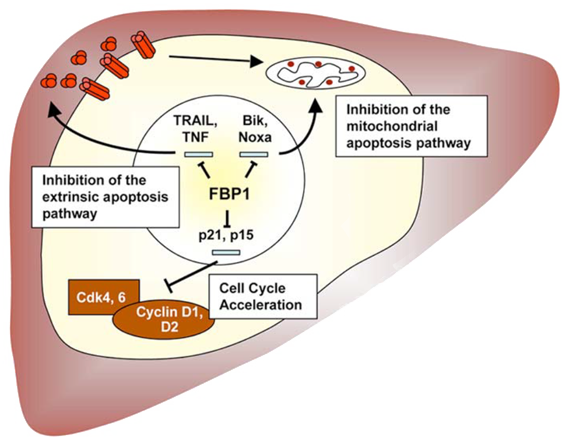
Because of its regulatory effects on apoptosis, cell cycle progression and migration, FUBP1 fulfills an oncogenic potential, which seems to be of importance in hepatocellular carcinoma. A model of the oncogenic function of FUBP1 in HCC proposed by Rabenhorst et al. (2009) is shown in figure 2.
Article Bibliography
| Pubmed ID | Last Year | Title | Authors |
|---|---|---|---|
| 2211718 | 1990 | A far upstream element stimulates c-myc expression in undifferentiated leukemia cells. | Avigan MI et al |
| 7713931 | 1995 | Targeted melting and binding of a DNA regulatory element by a transactivator of c-myc. | Bazar L et al |
| 21817013 | 2011 | Mutations in CIC and FUBP1 contribute to human oligodendroglioma. | Bettegowda C et al |
| 11875576 | 2002 | Structure and dynamics of KH domains from FBP bound to single-stranded DNA. | Braddock DT et al |
| 19907434 | 2009 | The role of supercoiling in transcriptional control of MYC and its importance in molecular therapeutics. | Brooks TA et al |
| 16914741 | 2006 | FBPs are calibrated molecular tools to adjust gene expression. | Chung HJ et al |
| 8940189 | 1996 | The far upstream element-binding proteins comprise an ancient family of single-strand DNA-binding transactivators. | Davis-Smyth T et al |
| 8125259 | 1994 | A sequence-specific, single-strand binding protein activates the far upstream element of c-myc and defines a new DNA-binding motif. | Duncan R et al |
| 8628294 | 1996 | A unique transactivation sequence motif is found in the carboxyl-terminal domain of the single-strand-binding protein FBP. | Duncan R et al |
| 15175153 | 2004 | A KH domain RNA binding protein, KSRP, promotes ARE-directed mRNA turnover by recruiting the degradation machinery. | Gherzi R et al |
| 10698944 | 2000 | Loss of FBP function arrests cellular proliferation and extinguishes c-myc expression. | He L et al |
| 11071946 | 2000 | Nuclear targeting determinants of the far upstream element binding protein, a c-myc transcription factor. | He L et al |
| 20420426 | 2010 | Quantitative characterization of the interactions among c-myc transcriptional regulators FUSE, FBP, and FIR. | Hsiao HH et al |
| 23071531 | 2012 | SNP array analysis reveals novel genomic abnormalities including copy neutral loss of heterozygosity in anaplastic oligodendrogliomas. | Idbaih A et al |
| 9092640 | 1997 | Identification of two proteins that bind to a pyrimidine-rich sequence in the 3'-untranslated region of GAP-43 mRNA. | Irwin N et al |
| 22869205 | 2012 | Frequent ATRX, CIC, FUBP1 and IDH1 mutations refine the classification of malignant gliomas. | Jiao Y et al |
| 3518746 | 1986 | The regulation and expression of c-myc in normal and malignant cells. | Kelly K et al |
| 15502847 | 2004 | The dynamic response of upstream DNA to transcription-generated torsional stress. | Kouzine F et al |
| 18193062 | 2008 | The functional response of upstream DNA to dynamic supercoiling in vivo. | Kouzine F et al |
| 11239393 | 2001 | Defective interplay of activators and repressors with TFIH in xeroderma pigmentosum. | Liu J et al |
| 10882074 | 2000 | The FBP interacting repressor targets TFIIH to inhibit activated transcription. | Liu J et al |
| 19585652 | 2009 | Overexpression of far upstream element binding proteins: a mechanism regulating proliferation and migration in liver cancer cells. | Malz M et al |
| 8649373 | 1996 | Multiple single-stranded cis elements are associated with activated chromatin of the human c-myc gene in vivo. | Michelotti GA et al |
| 9136930 | 1997 | A new regulatory protein, KSRP, mediates exon inclusion through an intronic splicing enhancer. | Min H et al |
| 20802533 | 2011 | Identification of FUSE-binding protein 1 as a regulatory mRNA-binding protein that represses nucleophosmin translation. | Olanich ME et al |
| 19637194 | 2009 | Overexpression of the far upstream element binding protein 1 in hepatocellular carcinoma is required for tumor growth. | Rabenhorst U et al |
| 22588899 | 2012 | CIC and FUBP1 mutations in oligodendrogliomas, oligoastrocytomas and astrocytomas. | Sahm F et al |
| 19258502 | 2009 | Coordinated expression of stathmin family members by far upstream sequence element-binding protein-1 increases motility in non-small cell lung cancer. | Singer S et al |
| 8464704 | 1993 | The pre-mRNA binding K protein contains a novel evolutionarily conserved motif. | Siomi H et al |
| 15075390 | 2004 | A gene atlas of the mouse and human protein-encoding transcriptomes. | Su AI et al |
| 19087307 | 2008 | The FUSE binding proteins FBP1 and FBP3 are potential c-myc regulators in renal, but not in prostate and bladder cancer. | Weber A et al |
| 16739096 | 2006 | Stathmin overexpression cooperates with p53 mutation and osteopontin overexpression, and is associated with tumour progression, early recurrence, and poor prognosis in hepatocellular carcinoma. | Yuan RH et al |
| 18400844 | 2008 | The FUSE binding protein is a cellular factor required for efficient replication of hepatitis C virus. | Zhang Z et al |
| 21855647 | 2011 | Far upstream element binding protein 1 activates translation of p27Kip1 mRNA through its internal ribosomal entry site. | Zheng Y et al |
Other Information
Locus ID:
NCBI: 8880
MIM: 603444
HGNC: 4004
Ensembl: ENSG00000162613
Variants:
dbSNP: 8880
ClinVar: 8880
TCGA: ENSG00000162613
COSMIC: FUBP1
RNA/Proteins
Expression (GTEx)
Protein levels (Protein atlas)
References
| Pubmed ID | Year | Title | Citations |
|---|---|---|---|
| 37506698 | 2023 | FUBP1 is a general splicing factor facilitating 3' splice site recognition and splicing of long introns. | 6 |
| 37932299 | 2023 | Integration of risk variants from GWAS with SARS-CoV-2 RNA interactome prioritizes FUBP1 and RAB2A as risk genes for COVID-19. | 0 |
| 37506698 | 2023 | FUBP1 is a general splicing factor facilitating 3' splice site recognition and splicing of long introns. | 6 |
| 37932299 | 2023 | Integration of risk variants from GWAS with SARS-CoV-2 RNA interactome prioritizes FUBP1 and RAB2A as risk genes for COVID-19. | 0 |
| 35546072 | 2022 | Far upstream element -binding protein 1 (FUBP1) participates in the malignant process and glycolysis of colon cancer cells by combining with c-Myc. | 2 |
| 36086966 | 2022 | FUBP1 promotes the proliferation of lung squamous carcinoma cells and regulates tumor immunity through PD-L1. | 3 |
| 35546072 | 2022 | Far upstream element -binding protein 1 (FUBP1) participates in the malignant process and glycolysis of colon cancer cells by combining with c-Myc. | 2 |
| 36086966 | 2022 | FUBP1 promotes the proliferation of lung squamous carcinoma cells and regulates tumor immunity through PD-L1. | 3 |
| 33476628 | 2021 | Overexpression of FUBP1 is associated with human cervical carcinoma development and prognosis. | 2 |
| 33649780 | 2021 | FUBP1 mediates the growth and metastasis through TGFβ/Smad signaling in pancreatic adenocarcinoma. | 3 |
| 33954195 | 2021 | Differentially Expressed Long Noncoding RNAs Involved in FUBP1 Promoting Hepatocellular Carcinoma Cells Proliferation. | 0 |
| 33987449 | 2021 | TNPO1-Mediated Nuclear Import of FUBP1 Contributes to Tumor Immune Evasion by Increasing NRP1 Expression in Cervical Cancer. | 7 |
| 34116677 | 2021 | The circACTN4 interacts with FUBP1 to promote tumorigenesis and progression of breast cancer by regulating the expression of proto-oncogene MYC. | 40 |
| 34274028 | 2021 | LCAT3, a novel m6A-regulated long non-coding RNA, plays an oncogenic role in lung cancer via binding with FUBP1 to activate c-MYC. | 72 |
| 34288405 | 2021 | FUBP1 promotes colorectal cancer stemness and metastasis via DVL1-mediated activation of Wnt/β-catenin signaling. | 14 |
Citation
Katharina Gerlach ; Martin Zörnig
FUBP1 (far upstream element (FUSE) binding protein 1)
Atlas Genet Cytogenet Oncol Haematol. 2013-05-01
Online version: http://atlasgeneticsoncology.org/gene/50675
