ORAI3 (ORAI calcium release-activated calcium modulator 3)
2014-06-01 Jessy Hasna , Nazim Benzerdjeb , Malika Faouzi , Anne-Sophie Ay , Philippe Kischel , Frédéric Hague , Henri Sevestre , Ahmed Ahidouch , Halima Ouadid-Ahidouch AffiliationDNA/RNA
Description
Transcription
All three ORAI isoforms are widely expressed at the mRNA level and can be incorporated into the plasma membrane when ectopically expressed. Broad expression of ORAI3 transcripts has been shown by Northern blot analysis: ORAI3 transcripts are expressed in heart, brain, kidney, thymus, lung, spleen, skeletal muscle, small intestine, as well as in primary aortic endothelial cells and bone marrow derived mast cells (Gwack et al., 2007). ORAI3 appears to be the only family member that is strongly expressed at the RNA level in brain. (ORAI2 transcripts are prominent in kidney, lung, and spleen (Gwack et al., 2007)).
Transcripts expression
In immune cells, transcripts taken from isolated primary CD3+/CD4+ cells (Th-lymphocytes), CD3+/CD8+ cells (Tc-lymphocytes), CD19+ cells (B-lymphocytes) and BMMC showed that ORAI3 expression is readily detectable in Th-, Tc-, and B- lymphocytes and BMMC (Gross et al., 2007).
mRNA expression in normal tissues has been assessed by different techniques (microarrays, RNAseq, SAGE). Microarrays analyses show that ORAI3 is overexpressed in prostate, lung, monocytes and whole blood (http://biogps.org/#goto=genereport&id=93129, with overexpression defined as 3 times the mean expression observed in the 83 tissues or cells tested in this study). ORAI3 mRNA expression is least important in pancreas, brain (especially the occipital lobe) and T cells (CD4+ as well as CD8+).
Proteins
Description
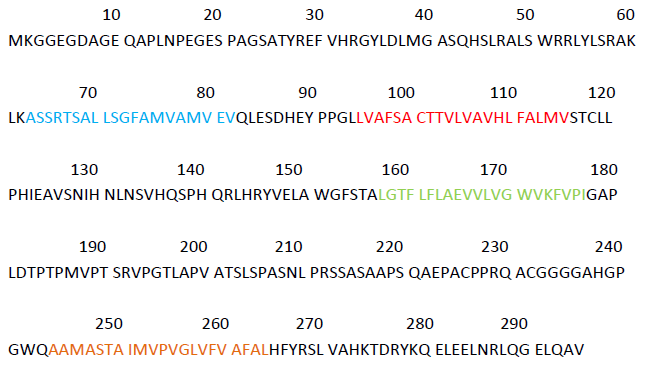
Molecular weight: 31499 Da.
Sequence length: 295 amino acids.
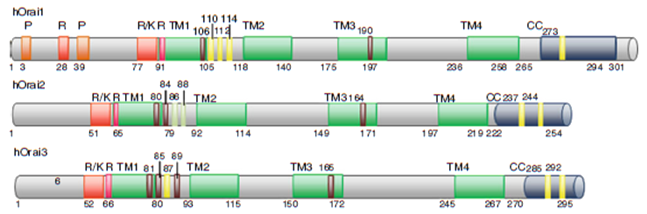
ORAI3 is a plasma membrane protein containing four transmembrane domains with intracellular N- and C-termini. ORAI3 contains a binding domain for calmodulin in its N-terminus, and a coiled-coil domain for protein interaction in its C-terminus.
Examination of the overall protein sequence of ORAI3 reveals high percentage of homology with the family members: 63.2% with ORAI1 and 66.4% with ORAI2 (60.3% between ORAI1 and ORAI2). These homology percentages increase when the comparison concerns the transmembrane domains: 93.8% with both ORAI1 and ORAI2, (92.5% between ORAI1 and ORAI2) (Feske et al., 2006; Hewavitharana et al., 2007). The pore-forming transmembrane domains of all three ORAI proteins show a high degree (~82%) of conservation.
The amino acid sequence of ORAI3 shows marked differences from its isoforms, particularly in the regions outside of the essential pore-forming domains, which might explain its unique properties and the differences with other isoforms in the modes of regulation and modulation from its isoforms (Shuttleworth, 2012).
The sequence identities between ORAI3 and ORAI1 in the cytosolic N- and C-termini are 34% and 46%, respectively, and is 21% in the extracellular loop between transmembrane domains 3 and 4 (Shuttleworth, 2012).
The N-terminus of ORAI3 comprises ~65 amino acids and has no clusters of prolines and arginines seen in ORAI1 (N-terminus domain containing ~90 amino acids and rich in clusters of prolines and arginines) (Takahashi et al., 2007; Frischauf et al., 2008). ORAI3 has a second extracellular loop linking transmembrane domains 3 and 4 which is longer than that of ORAI1 and ORAI2 (~72 amino acids in ORAI3 compared to only 38 amino acids in ORAI1). ORAI3 has a cluster of 22 positively charged amino acid residues immediately prior to the first transmembrane region which is fully conserved among all three ORAI channels (H44-R66 in ORAI3 and H69-R91 in ORAI1), and has three conserved glutamates located at the C-terminus to which is attributed the fast Ca2+-dependent inactivation of ORAI3 (Lee et al., 2009).
The ORAI3 N-terminus appears critical for switching a store-operated channel to an exclusively arachidonate regulated channel (Thompson et al., 2010).
The residues E81 and E165 in the transmembrane domains 1 and 3, and E85, D87 and E89 in the extracellular 1-2 loop are critical determinants of a high Ca2+ selectivity. Other studies using a cysteine-scanning mutagenesis approach in ORAI3 revealed that Ca2+ selectivity was exclusively determined by the E81 residue alone (McNally et al., 2009).
Replacing the N-terminal cytosolic domain of ORAI3 with the corresponding domain of ORAI1 doubles the magnitude of the measured store-operated Ca2+ currents, whilst the reverse exchange virtually eliminates all currents. N-terminal deletion experiments narrow the critical region essential for the activation of ORAI3 to amino acids 42-62 (Lis et al., 2010). The appearance of significant store-operated currents dependes on a single specific lysine residue K60 in ORAI3, the conservation of this residue in ORAI1 and ORAI3 cannot explain the differences in the magnitude of store-operated Ca2+ currents between these two ORAI family members. N-terminal deletions of residues between W51 and Y55 significantly increase store-operated ORAI3-dependent currents (Bergsmann et al., 2011). The only sequence difference between ORAI1 and ORAI3 in this region is the substitution of a lysine in ORAI1 for an arginine at position 53 in ORAI3.
ORAI3 lacks C195, a reactive cysteine present in ORAI1 that serve as a detection system primarily for changes in the extracellular oxidative environment, and contains two additional cysteines within the extracellular loop between TM3 and TM4. The absence of C195 in ORAI3 makes it resistant to H2O2-inactivation, since pre-incubation with H2O2 of ORAI1/STIM1 expressing cells (HEK; T cells) inhibits activation of ORAI1, but not of ORAI3, and reinsertion of C195 within ORAI3 renders ORAI3 channels redox sensitive (Bogeski et al., 2010).
Post-translational modifications of the protein
Glycosylation:
Unlike ORAI1, ORAI3 does not have a glycosylation site on the asparagine residue (N223) situated between the transmembrane domains TM3 et TM4 (Frischauf et al., 2008; Prakriya et al., 2006).
ORAI1 has a putative N-glycosylation motif (NVS) in its extracellular loop between predicted transmembrane segments 3 and 4. This motif is absent in ORAI2 and 3 (Gwack et al., 2007). ORAI3 migration properties do not change by tunicamycin treatment. Indeed, HEK293 cells stably transfected with FLAG-tagged ORAI and treated with 2μg/ml tunicamycin, showed that ORAI3 migrated at positions close to their predicted molecular masse (32.5 kDa).
Phosphorylation:
Since ORAI3 is a tetraspanning plasma membrane protein, it contains three intracellular regions that can potentially be phosphorylated by intracellular protein kinases: the N-terminus, an intracellular loop between transmembrane domains 2 and 3, and the C-terminus, each intracellular region potentially contains one or more phosphorylation sites. Ser-27 and Ser-30 have been identified as the main phosphorylation sites in ORAI1 within its N-terminus. They are conserved throughout evolution in all mammalian ORAI1 proteins. Mutations at these phosphorylation sites increase store-operated Ca2+ entry (SOCE) and CRAC current suggesting that ORAI1 phosphorylation at these residues by protein kinase C (PKC) suppresses SOCE and CRAC channel activation. However, Ser-27 and Ser-30 are not present in ORAI2 and ORAI3.
A phosphorylation of ORAI3 peptide has been revealed by a phosphoproteome analysis of human liver cells (Sui et al., 2008). This phosphorylation site is located in the C-terminus of ORAI3 on a tyrosine residue (Y278). Experimental ORAI3 phosphorylation has also been demonstrated in HEK293 cells (Kawasaki et al., 2010).
To examine in vivo PKC-mediated phosphorylation, HEK293 cells expressing FLAG-tagged ORAI were incubated with 32P monosodium phosphate, and then stimulated with thapsigargin in the presence of extracellular Ca2+. Thapsigargin mobilizes Ca2+ from the ER and the extracellular space and activates Ca2+/DAG-dependent PKC isoforms. ORAI1 phosphorylation is enhanced in response to thapsigargin. The levels of ORAI3 phosphorylation have been less than half of that observed for ORAI1 (Kawasaki et al., 2010).
Other phosphorylation sites on ORAI3 were predicted by NetPhos2.0: 13 serine sites (S20, S45, S50, S57, S64, S65, S68, S86, S191, S203, S213, S214 and S20), 3 threonine sites (T26, T183 and T190) and 2 tyrosine sites (Y146 and Y278).
Expression
Localisation
Function
ORAI3 presents a single putative channel pore and has a role as a store-operated Ca2+ (SOC) channel. SOC channels are the major route for Ca2+ entry in non-excitable cells, and they include ORAI channels characterized by high selectivity for Ca2+ over monovalent cations, low single-channel conductance (
Homology
ORAI3 is the newest ORAI family member in the evolutionary tree (Shuttleworth, 2012). Orthologous ORAI3 genes are found in the following species: chimpanzee (98.98% homology), dog (92.20% homology), cow (90.51% homology), rat (89.83% homology), mice (88.48% homology).
Mutations
Note
Implicated in
The same study showed that ORAI3 contributes to Ca2+ influx in BC cells where both Store Operated Calcium Entry (SOCE) amplitude and resting [Ca2+]i decreased significantly with ORAI3 knockdown. The authors concluded that the ORAI3 involvement in cell proliferation/survival and cell cycle progression may be at least partially linked to the calcium influx through the channels since the reduction of external calcium concentration [Ca2+]o to 0.2 mM decreases significantly BC cell proliferation (Faouzi et al., 2011).
A subsequent study highlighted a correlation between ORAI3 and the oncogene c-myc expression in tumor tissues and in BC cell lines: ORAI3 and c-myc were over-expressed in 70% and 80% cases respectively. Expression of c-myc, as assessed by RT-qPCR, is higher in the MCF-7 cancer cell line than in the non-cancerous MCF-10A cell line. A similar over-expression pattern was shown for ORAI3 in these cell lines (Faouzi et al., 2013). ORAI3 down-regulation reduces both c-myc expression and activity levels exclusively in BC cells, whereas ORAI1 (one of the two mammalian homologs to ORAI3) induced an upregulation of c-myc mRNA. The involvement of c-myc in the ORAI3 signaling was demonstrated when silencing c-myc resulted in closely-similar and non-additive effects to the ones induced by ORAI3 downregulation: decreased cell proliferation, cell cycle arrest with a significant accumulation of the cells in the G0/G1 phase, increased cell mortality (Faouzi et al., 2013).
Authors showed that ORAI3 channels affect c-myc, most likely via the MAP Kinase pathway, as demonstrated by decreased phosphorylation levels of extracellular signal-regulated kinases 1 and 2 (ERK1/ERK2) after ORAI3 downregulation (Faouzi et al., 2013).
Parallel studies also reported that ORAI3 mediates SOCE in estrogen-receptor-positive (ER+) BC cell lines (Motiani et al., 2010), whereas in estrogen-receptor-negative (ER-) BC cell lines, SOCE is mediated by ORAI1. This study was the first to describe SOCE and endogenous calcium release-activated currents (CRAC) that are mediated by native ORAI3 channels and highlights a potential connection between estrogen receptor alpha (ERα) and ORAI3 (Motiani et al., 2010). Authors then reported that knockdown of ERα decreases ORAI3 expression level leading to a decrease in ORAI3-mediated SOCE and CRAC current, while activation of ERα increased ORAI3 expression and SOCE in MCF7 cells (Motiani et al., 2013b). Consistently with the above cited studies, ORAI3 knockdown inhibits SOCE-dependent phosphorylation of both ERK1/2 and focal adhesion kinase (FAK). It also decreases the transcriptional activity of nuclear factor of activated T-cells (NFAT), which was associated with decreased cell growth and Matrigel invasion of ER+ MCF7 cells in contrast to ER- MDA-MB231 cells where no effects were observed (Motiani et al., 2013b).
ORAI3 is also expressed in non small cell lung carcinoma cells (NSCLCC) such as NCI-H23, NCI-H460, A549 and Calu-1. In NCI-H23 and NCI-H460 cells, ORAI3 is a major actor of Store Operated Calcium Entry (Ay et al., 2013). Ay et al. (2013) demonstrated that ORAI3 is involved in NSCLCC proliferation. Indeed, ORAI3 inhibition induces a strong decrease in NSCLCC proliferation, accumulating cells in G0/G1 phase of the cell cycle. This accumulation in G0/G1 phase is associated with a decrease in Cyclin D1/cdk4 and Cyclin E/cdk2 proteins level. No effect is observed on apoptosis. The same study demonstrated that SOCE induces Akt phosphorylation in NSCLCC and ORAI3 inhibition decreases this activation demonstrating ORAI3 can promote proliferation through SOCE by activating Akt pathway. They also showed that neither ORAI1 nor ORAI2 are involved in SOCE in NSCLC cell lines, suggesting that ORAI3 is the main component of SOCE in those cells (Ay et al., 2013).
The same type of mechanism is observed with TRPC1 in NSCLCC. Indeed Tajeddine and Gailly (2012) have demonstrated that TRPC1 is involved in G1/S transition in A549 NSCLC cell line through SOCE. They showed that cell cycle arrest after TRPC1 inhibition induces a decrease in EGFR activation and subsequent signaling (PI3K/Akt, MAPK).
Those two studies suggest that SOCE is an important mechanism in proliferation of NSCLCC. Indeed, EGFR signaling is overactivated in NSCLCC either by constitutive activation of EGFR or K-Ras mutation. ORAI3, able to activate this pathway, hence can be a potential target for anti-cancer drug.
Article Bibliography
| Pubmed ID | Last Year | Title | Authors |
|---|---|---|---|
| 24733836 | 2014 | State-dependent block of Orai3 TM1 and TM3 cysteine mutants: insights into 2-APB activation. | Amcheslavsky A et al |
| 24058448 | 2013 | Orai3 constitutes a native store-operated calcium entry that regulates non small cell lung adenocarcinoma cell proliferation. | Ay AS et al |
| 17075073 | 2006 | Coupling of STIM1 to store-operated Ca2+ entry through its constitutive and inducible movement in the endoplasmic reticulum. | Baba Y et al |
| 21724845 | 2011 | Molecular determinants within N terminus of Orai3 protein that control channel activation and gating. | Bergsmann J et al |
| 12220621 | 2002 | Inhibition of the type 1 inositol 1,4,5-trisphosphate receptor by 2-aminoethoxydiphenylborate. | Bilmen JG et al |
| 20107038 | 2010 | Essential role for STIM1/Orai1-mediated calcium influx in PDGF-induced smooth muscle migration. | Bisaillon JM et al |
| 20354224 | 2010 | Differential redox regulation of ORAI ion channels: a mechanism to tune cellular calcium signaling. | Bogeski I et al |
| 17400243 | 2007 | Molecular evolution and structural analysis of the Ca(2+) release-activated Ca(2+) channel subunit, Orai. | Cai X et al |
| 15175387 | 2004 | 2-aminoethoxydiphenyl borate activates and sensitizes the heat-gated ion channel TRPV3. | Chung MK et al |
| 20607548 | 2011 | Expression of Orai genes and I(CRAC) activation in the human retinal pigment epithelium. | Cordeiro S et al |
| 19088073 | 2009 | STIM1- and Orai1-dependent store-operated calcium entry regulates human myoblast differentiation. | Darbellay B et al |
| 18487204 | 2008 | Complex actions of 2-aminoethyldiphenyl borate on store-operated calcium entry. | DeHaven WI et al |
| 19622747 | 2009 | A Ca2(+ )release-activated Ca2(+) (CRAC) modulatory domain (CMD) within STIM1 mediates fast Ca2(+)-dependent inactivation of ORAI1 channels. | Derler I et al |
| 22453951 | 2012 | Structure, regulation and biophysics of I(CRAC), STIM/Orai1. | Derler I et al |
| 19754892 | 2009 | Mechanistic view on domains mediating STIM1-Orai coupling. | Fahrner M et al |
| 20683915 | 2011 | Down-regulation of Orai3 arrests cell-cycle progression and induces apoptosis in breast cancer cells but not in normal breast epithelial cells. | Faouzi M et al |
| 23266555 | 2013 | ORAI3 silencing alters cell proliferation and cell cycle progression via c-myc pathway in breast cancer cells. | Faouzi M et al |
| 20887894 | 2010 | Store-independent activation of Orai1 by SPCA2 in mammary tumors. | Feng M et al |
| 16582901 | 2006 | A mutation in Orai1 causes immune deficiency by abrogating CRAC channel function. | Feske S et al |
| 21220423 | 2011 | Cooperativeness of Orai cytosolic domains tunes subtype-specific gating. | Frischauf I et al |
| 20630587 | 2010 | Calcium-activated K(+) channel (K(Ca)3.1) activity during Ca(2+) store depletion and store-operated Ca(2+) entry in human macrophages. | Gao YD et al |
| 11171105 | 2001 | Evidence that 2-aminoethyl diphenylborate is a novel inhibitor of store-operated Ca2+ channels in liver cells, and acts through a mechanism which does not involve inositol trisphosphate receptors. | Gregory RB et al |
| 17463004 | 2007 | Murine ORAI2 splice variants form functional Ca2+ release-activated Ca2+ (CRAC) channels. | Gross SA et al |
| 17293345 | 2007 | Biochemical and functional characterization of Orai proteins. | Gwack Y et al |
| 17602740 | 2007 | Role of STIM and Orai proteins in the store-operated calcium signaling pathway. | Hewavitharana T et al |
| 24240085 | 2013 | ICRAC controls the rapid androgen response in human primary prostate epithelial cells and is altered in prostate cancer. | Holzmann C et al |
| 23890118 | 2013 | The neglected CRAC proteins: Orai2, Orai3, and STIM2. | Hoth M et al |
| 19752228 | 2009 | MS4A4B is a GITR-associated membrane adapter, expressed by regulatory T cells, which modulates T cell activation. | Howie D et al |
| 15194687 | 2004 | 2-aminoethoxydiphenyl borate is a common activator of TRPV1, TRPV2, and TRPV3. | Hu HZ et al |
| 11918346 | 2001 | 2-Aminoethoxydiphenyl borate (2-APB) inhibits capacitative calcium entry independently of the function of inositol 1,4,5-trisphosphate receptors. | Iwasaki H et al |
| 18757751 | 2008 | Functional stoichiometry of the unitary calcium-release-activated calcium channel. | Ji W et al |
| 17673572 | 2007 | Pharmacological characterization and molecular determinants of the activation of transient receptor potential V2 channel orthologs by 2-aminoethoxydiphenyl borate. | Juvin V et al |
| 20534587 | 2010 | Protein kinase C-induced phosphorylation of Orai1 regulates the intracellular Ca2+ level via the store-operated Ca2+ channel. | Kawasaki T et al |
| 19483082 | 2009 | Dependence of STIM1/Orai1-mediated calcium entry on plasma membrane phosphoinositides. | Korzeniowski MK et al |
| 19706554 | 2009 | Molecular determinants of fast Ca2+-dependent inactivation and gating of the Orai channels. | Lee KP et al |
| 18706765 | 2008 | Alterations of concentrations of calcium and arachidonic acid and agglutinations of microfilaments in host cells during Toxoplasma gondii invasion. | Li L et al |
| 16636202 | 2006 | Functional characterization of homo- and heteromeric channel kinases TRPM6 and TRPM7. | Li M et al |
| 17702753 | 2007 | Mapping the interacting domains of STIM1 and Orai1 in Ca2+ release-activated Ca2+ channel activation. | Li Z et al |
| 17360584 | 2007 | Orai proteins interact with TRPC channels and confer responsiveness to store depletion. | Liao Y et al |
| 16005298 | 2005 | STIM is a Ca2+ sensor essential for Ca2+-store-depletion-triggered Ca2+ influx. | Liou J et al |
| 17442569 | 2007 | CRACM1, CRACM2, and CRACM3 are store-operated Ca2+ channels with distinct functional properties. | Lis A et al |
| 21115697 | 2010 | A single lysine in the N-terminal region of store-operated channels is critical for STIM1-mediated gating. | Lis A et al |
| 15226409 | 2004 | Fast Ca(2+)-dependent inactivation of the store-operated Ca2+ current (ISOC) in liver cells: a role for calmodulin. | Litjens T et al |
| 18596693 | 2008 | Oligomerization of STIM1 couples ER calcium depletion to CRAC channel activation. | Luik RM et al |
| 16966423 | 2006 | The elementary unit of store-operated Ca2+ entry: local activation of CRAC channels by STIM1 at ER-plasma membrane junctions. | Luik RM et al |
| 19171672 | 2009 | Capacitative Ca2+ entry via Orai1 and stromal interacting molecule 1 (STIM1) regulates adenylyl cyclase type 8. | Martin AC et al |
| 9348075 | 1997 | 2APB, 2-aminoethoxydiphenyl borate, a membrane-penetrable modulator of Ins(1,4,5)P3-induced Ca2+ release. | Maruyama T et al |
| 19289460 | 2009 | Tetrameric Orai1 is a teardrop-shaped molecule with a long, tapered cytoplasmic domain. | Maruyama Y et al |
| 20018736 | 2009 | Structural determinants of ion permeation in CRAC channels. | McNally BA et al |
| 16807233 | 2006 | Large store-operated calcium selective currents due to co-expression of Orai1 or Orai2 with the intracellular calcium sensor, Stim1. | Mercer JC et al |
| 10734044 | 2000 | I(ARC), a novel arachidonate-regulated, noncapacitative Ca(2+) entry channel. | Mignen O et al |
| 19622606 | 2009 | The molecular architecture of the arachidonate-regulated Ca2+-selective ARC channel is a pentameric assembly of Orai1 and Orai3 subunits. | Mignen O et al |
| 11162848 | 2001 | 2-Aminoethoxydiphenyl borate affects the inositol 1,4,5-trisphosphate receptor, the intracellular Ca2+ pump and the non-specific Ca2+ leak from the non-mitochondrial Ca2+ stores in permeabilized A7r5 cells. | Missiaen L et al |
| 22993197 | 2013 | Orai3 is an estrogen receptor α-regulated Ca²⁺ channel that promotes tumorigenesis. | Motiani RK et al |
| 19189966 | 2009 | A Cytosolic Homomerization and a Modulatory Domain within STIM1 C Terminus Determine Coupling to ORAI1 Channels. | Muik M et al |
| 18187424 | 2008 | Dynamic coupling of the putative coiled-coil domain of ORAI1 with STIM1 mediates ORAI1 channel activation. | Muik M et al |
| 19706428 | 2009 | STIM1 and calmodulin interact with Orai1 to induce Ca2+-dependent inactivation of CRAC channels. | Mullins FM et al |
| 22464749 | 2012 | SARAF inactivates the store operated calcium entry machinery to prevent excess calcium refilling. | Palty R et al |
| 15788710 | 2005 | Store-operated calcium channels. | Parekh AB et al |
| 19249086 | 2009 | STIM1 clusters and activates CRAC channels via direct binding of a cytosolic domain to Orai1. | Park CY et al |
| 17905723 | 2008 | STIM2 protein mediates distinct store-dependent and store-independent modes of CRAC channel activation. | Parvez S et al |
| 18239188 | 2008 | ORAI and store-operated calcium influx in human airway smooth muscle cells. | Peel SE et al |
| 18403424 | 2008 | 2-Aminoethoxydiphenyl borate directly facilitates and indirectly inhibits STIM1-dependent gating of CRAC channels. | Peinelt C et al |
| 18820677 | 2008 | The CRAC channel consists of a tetramer formed by Stim-induced dimerization of Orai dimers. | Penna A et al |
| 12767897 | 2003 | 2-Aminoethoxydiphenyl borate (2-APB) antagonises inositol 1,4,5-trisphosphate-induced calcium release, inhibits calcium pumps and has a use-dependent and slowly reversible action on store-operated calcium entry channels. | Peppiatt CM et al |
| 19364762 | 2009 | Evidence for STIM1- and Orai1-dependent store-operated calcium influx through ICRAC in vascular smooth muscle cells: role in proliferation and migration. | Potier M et al |
| 16921383 | 2006 | Orai1 is an essential pore subunit of the CRAC channel. | Prakriya M et al |
| 15866891 | 2005 | STIM1, an essential and conserved component of store-operated Ca2+ channel function. | Roos J et al |
| 18499656 | 2008 | 2-aminoethoxydiphenyl borate alters selectivity of Orai3 channels by increasing their pore size. | Schindl R et al |
| 19887627 | 2009 | Plasticity in Ca2+ selectivity of Orai1/Orai3 heteromeric channel. | Schindl R et al |
| 22041188 | 2012 | Orai3--the 'exceptional' Orai? | Shuttleworth TJ et al |
| 18285445 | 2008 | Ca2+-store-dependent and -independent reversal of Stim1 localization and function. | Smyth JT et al |
| 17084918 | 2006 | Calcium signals mediated by STIM and Orai proteins--a new paradigm in inter-organelle communication. | Soboloff J et al |
| 20007711 | 2010 | The intracellular loop of Orai1 plays a central role in fast inactivation of Ca2+ release-activated Ca2+ channels. | Srikanth S et al |
| 17020874 | 2006 | Stored Ca2+ depletion-induced oligomerization of stromal interaction molecule 1 (STIM1) via the EF-SAM region: An initiation mechanism for capacitive Ca2+ entry. | Stathopulos PB et al |
| 18491316 | 2008 | Phosphoproteome analysis of the human Chang liver cells using SCX and a complementary mass spectrometric strategy. | Sui S et al |
| 22451676 | 2012 | TRPC1 protein channel is major regulator of epidermal growth factor receptor signaling. | Tajeddine N et al |
| 17343823 | 2007 | Essential role of the N-terminus of murine Orai1 in store-operated Ca2+ entry. | Takahashi Y et al |
| 20818184 | 2010 | The N-terminal domain of Orai3 determines selectivity for activation of the store-independent ARC channel by arachidonic acid. | Thompson J et al |
| 11943785 | 2002 | Comparison of human TRPC3 channels in receptor-activated and store-operated modes. Differential sensitivity to channel blockers suggests fundamental differences in channel composition. | Trebak M et al |
| 22641780 | 2012 | STIM/Orai signalling complexes in vascular smooth muscle. | Trebak M et al |
| 17684017 | 2007 | Visualization and manipulation of plasma membrane-endoplasmic reticulum contact sites indicates the presence of additional molecular components within the STIM1-Orai1 Complex. | Várnai P et al |
| 16645049 | 2006 | CRACM1 is a plasma membrane protein essential for store-operated Ca2+ entry. | Vig M et al |
| 11687570 | 2001 | CaT1 and the calcium release-activated calcium channel manifest distinct pore properties. | Voets T et al |
| 19843011 | 2009 | Role of phosphoinositides in STIM1 dynamics and store-operated calcium entry. | Walsh CM et al |
| 20629634 | 2010 | Evidence for an interaction between Golli and STIM1 in store-operated calcium entry. | Walsh CM et al |
| 20929813 | 2010 | The calcium store sensor, STIM1, reciprocally controls Orai and CaV1.2 channels. | Wang Y et al |
| 11463338 | 2001 | Identification and characterization of the STIM (stromal interaction molecule) gene family: coding for a novel class of transmembrane proteins. | Williams RT et al |
| 20808796 | 2010 | Identification of a polycystin-1 cleavage product, P100, that regulates store operated Ca entry through interactions with STIM1. | Woodward OM et al |
| 16966422 | 2006 | Ca2+ store depletion causes STIM1 to accumulate in ER regions closely associated with the plasma membrane. | Wu MM et al |
| 21193399 | 2011 | Competitive modulation of Ca2+ release-activated Ca2+ channel gating by STIM1 and 2-aminoethyldiphenyl borate. | Yamashita M et al |
| 21378206 | 2011 | Tipifarnib-induced apoptosis in acute myeloid leukemia and multiple myeloma cells depends on Ca2+ influx through plasma membrane Ca2+ channels. | Yanamandra N et al |
| 20018371 | 2010 | Arachidonic acid stimulates extracellular Ca(2+) entry in rat pancreatic beta cells via activation of the noncapacitative arachidonate-regulated Ca(2+) (ARC) channels. | Yeung-Yam-Wah V et al |
| 21041445 | 2010 | Constitutive recycling of the store-operated Ca2+ channel Orai1 and its internalization during meiosis. | Yu F et al |
| 19182790 | 2009 | SOAR and the polybasic STIM1 domains gate and regulate Orai channels. | Yuan JP et al |
| 24670147 | 2014 | The ryanodine receptor agonist 4-chloro-3-ethylphenol blocks ORAI store-operated channels. | Zeng B et al |
| 18420579 | 2008 | Store-dependent and -independent modes regulating Ca2+ release-activated Ca2+ channel activity of human Orai1 and Orai3. | Zhang SL et al |
| 16751269 | 2006 | Genome-wide RNAi screen of Ca(2+) influx identifies genes that regulate Ca(2+) release-activated Ca(2+) channel activity. | Zhang SL et al |
| 16208375 | 2005 | STIM1 is a Ca2+ sensor that activates CRAC channels and migrates from the Ca2+ store to the plasma membrane. | Zhang SL et al |
| 23878392 | 2013 | Mechanisms of STIM1 activation of store-independent leukotriene C4-regulated Ca2+ channels. | Zhang X et al |
| 14718545 | 2004 | Potent inhibition of Ca2+ release-activated Ca2+ channels and T-lymphocyte activation by the pyrazole derivative BTP2. | Zitt C et al |
Other Information
Locus ID:
NCBI: 93129
MIM: 610930
HGNC: 28185
Ensembl: ENSG00000175938
Variants:
dbSNP: 93129
ClinVar: 93129
TCGA: ENSG00000175938
COSMIC: ORAI3
RNA/Proteins
Expression (GTEx)
Pathways
| Pathway | Source | External ID |
|---|---|---|
| Calcium signaling pathway | KEGG | ko04020 |
| Calcium signaling pathway | KEGG | hsa04020 |
Protein levels (Protein atlas)
References
| Pubmed ID | Year | Title | Citations |
|---|---|---|---|
| 37759448 | 2023 | Orai3 Calcium Channel Contributes to Oral/Oropharyngeal Cancer Stemness through the Elevation of ID1 Expression. | 0 |
| 37759448 | 2023 | Orai3 Calcium Channel Contributes to Oral/Oropharyngeal Cancer Stemness through the Elevation of ID1 Expression. | 0 |
| 34626722 | 2022 | High ORAI3 expression correlates with good prognosis in human muscle-invasive bladder cancer. | 2 |
| 34626722 | 2022 | High ORAI3 expression correlates with good prognosis in human muscle-invasive bladder cancer. | 2 |
| 33798603 | 2021 | ORAI3 silencing alters cell proliferation and promotes mitotic catastrophe and apoptosis in pancreatic adenocarcinoma. | 8 |
| 34768857 | 2021 | Role of Orai3 in the Pathophysiology of Cancer. | 8 |
| 34943998 | 2021 | Orai3 Calcium Channel Regulates Breast Cancer Cell Migration through Calcium-Dependent and -Independent Mechanisms. | 11 |
| 33798603 | 2021 | ORAI3 silencing alters cell proliferation and promotes mitotic catastrophe and apoptosis in pancreatic adenocarcinoma. | 8 |
| 34768857 | 2021 | Role of Orai3 in the Pathophysiology of Cancer. | 8 |
| 34943998 | 2021 | Orai3 Calcium Channel Regulates Breast Cancer Cell Migration through Calcium-Dependent and -Independent Mechanisms. | 11 |
| 32896813 | 2020 | Distinct pharmacological profiles of ORAI1, ORAI2, and ORAI3 channels. | 53 |
| 32896813 | 2020 | Distinct pharmacological profiles of ORAI1, ORAI2, and ORAI3 channels. | 53 |
| 30943377 | 2019 | Bronchial Epithelial Calcium Metabolism Impairment in Smokers and Chronic Obstructive Pulmonary Disease. Decreased ORAI3 Signaling. | 16 |
| 30943377 | 2019 | Bronchial Epithelial Calcium Metabolism Impairment in Smokers and Chronic Obstructive Pulmonary Disease. Decreased ORAI3 Signaling. | 16 |
| 29237733 | 2018 | Communication between N terminus and loop2 tunes Orai activation. | 30 |
Citation
Jessy Hasna ; Nazim Benzerdjeb ; Malika Faouzi ; Anne-Sophie Ay ; Philippe Kischel ; Frédéric Hague ; Henri Sevestre ; Ahmed Ahidouch ; Halima Ouadid-Ahidouch
ORAI3 (ORAI calcium release-activated calcium modulator 3)
Atlas Genet Cytogenet Oncol Haematol. 2014-06-01
Online version: http://atlasgeneticsoncology.org/gene/51589/orai3-(orai-calcium-release-activated-calcium-modulator-3)
