PFKFB2 (6-phosphofructo-2-kinase/fructose-2,6-biphosphatase 2)
2014-03-01 Ana Rodríguez-García , Pere Fontova , Helga Simon , Anna Manzano , Ramon Bartrons , Àurea Navarro-Sabaté AffiliationDepartament de Ciencies Fisiologiques II, Campus de Bellvitge, Universitat de Barcelona, Feixa Llarga s\\\/n, 08907, LHospitalet de Llobregat, Barcelona, Spain
Identity

DNA/RNA
Description
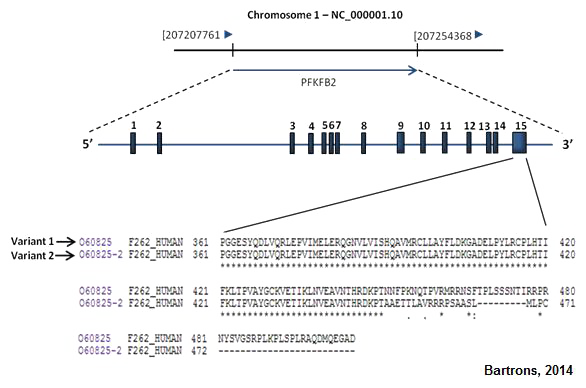
The overall gene structure of the human PFKFB2 gene has exons clustered into three groups. The first group contains exons 1 and 2 that are different from those in other PFKFB2 genes and contain the ATG initiation codon in exon 2. The second group contains exons 3-8 coding for the PFK-2 domain and the third group contains exons 8-15 coding for the FBPase-2 domain and a carboxy-terminal regulatory domain. Gene structure, exon-intron organization, as well as intron sizes, are similar to those of the rat and bovine homologous genes.
Transcription
Pseudogene
Proteins
Description
PFKFB2 is an enzyme of PFKFB family, as it shares different structure and function with the others isoenzymes. PFKFB2 has two distinct catalytic sites in each subunit: one for the 6-phosphofruto-2-kinase (PFK-2) activity and the other for the fructose-2,6-bisphosphatase (FBPase-2) activity (El-Maghrabi et al., 1982; Pilkis et al., 1995; Okar et al., 2001). The sequence of the catalytic core is highly conserved, whereas the N-terminal and C-terminal regions show more divergence (Rider et al., 2004).
PFK-2/FBPase-2 activities control fructose-2,6-bisphosphate (Fru-2,6-P2) synthesis and degradation, regulating the rate of glucose metabolism. More information about PFKFB2 protein can be found in Uniprot O60825.
Expression
According to the RNAseq database, this gene can also be expressed in thyroid, brain, kidney, skeletal muscle, ovary, testis and others.
Localisation
Function
Kinase catalytic activity: ATP + D-fructose-6-phosphate ⇔ ADP + beta-D-fructose-2,6-bisphosphate
Phosphatase catalytic activity: Beta-D-fructose-2,6-bisphosphate + H2O ⇔ D-fructose-6-phosphate + phosphate
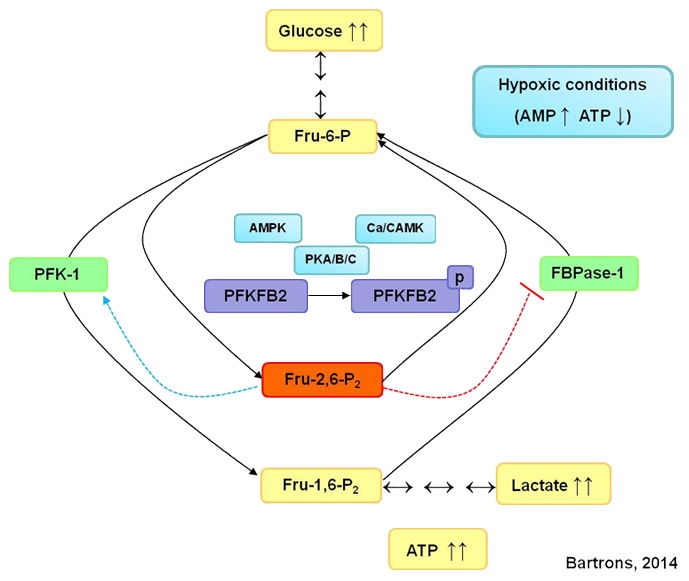
The rate of glycolytic flux is controlled at different levels and by different mechanisms: substrate availability, enzyme concentrations, allosteric effectors and covalent modifications on regulatory enzymes. One of the critically modulated steps is that catalyzed by 6-phosphofructo-1-kinase (PFK-1), in which Fru-2,6-P2 is the most powerful allosteric activator (Van Schaftingen, 1987; Okar and Lange, 1999; Rider et al., 2004). Fru-2,6-P2 relieves ATP inhibition and acts synergistically with adenosine monophosphate (AMP), inhibiting fructose 1,6-bisphosphatase (Fru-1,6-Pase) (Van Schaftingen, 1987). These properties confer to this metabolite a key role in the control of Fru-6-P/Fru-1,6-P2 substrate cycle and hence critically regulates carbohydrate metabolism (Fig. 3).
In vertebrates, there are four different PFKFB genes (PFKFB1, PFKFB2, PFKFB3 and PFKFB4), which encode the PFK-2/FBPase-2 isoenzymes. Each of these enzymes has been originally identified in different mammalian tissues: PFKFB1 in liver and skeletal muscle, PFKFB2 in heart, PFKFB3 in brain, adipose tissue and proliferating cells, and PFKFB4 in testis (Okar et al., 2004; Rider et al., 2004). However, all four are widely expressed throughout the adult organism. These isoenzymes show differences in their distribution and kinetic properties in response to allosteric effectors, hormonal, and growth factors signals (Okar et al., 2001). PFKFB2 enzyme is overexpressed in different cancer cells like melanoma, prostate, pancreatic, gastric and mammary gland cells (Minchenko et al., 2005a; Minchenko et al., 2005b; Bobarykina et al., 2006). For more information about PFKFB genes see: PFKFB3 (6-phosphofructo-2-kinase/fructose-2,6-biphosphatase 3) and PFKFB4 (6-phosphofructo-2-kinase/fructose-2,6-biphosphatase 4).
Regulation
PFKFB2 is an essential enzyme for the regulation of glycolysis in heart. PFKFB2 is multisite-phosphorylated, integrating signaling from many pathways via protein kinase cascades to a single molecule, Fru-2,6-P2, to stimulate glycolysis.
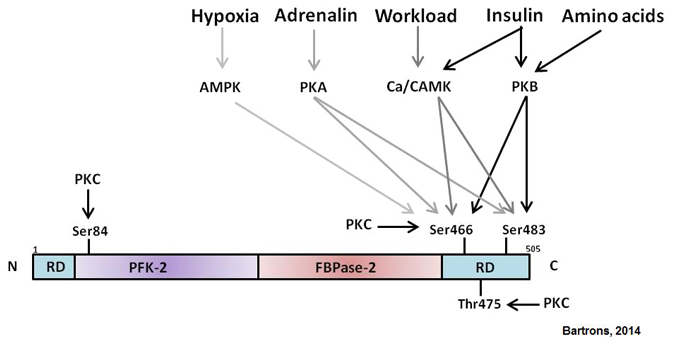
The human PFKFB2 protein contains the Ser 29, Ser 466, Thr 475 and Ser 483 residues that regulate the activity of the enzyme. These residues are located in its C-terminal domain and can be phosphorylated by protein kinases such as AMPK, 3-phosphoinositide-dependent kinase-1 (PDK-1), cAMP-dependent protein kinase (protein kinase A; PKA), protein kinase B (PKB; also known as Akt), p70 ribosomal S6 kinase (S6K1), and mitogen-activated protein kinase 1 (MAPK-1). Phosphorylation of PFKFB2 results in the activation of the enzyme, increasing Vmax of PFK-2 activity. The variations in PFK-2 activity, however, appear to be different with the phosphorylation by the different kinases (Marsin et al., 2000; Rider et al., 2004).
In perfused rat hearts, it has been shown that the concentration of Fru-2,6-P2 is raised by increasing the work load, after hypoxia or stimulation with adrenalin or insulin (Hue et al., 1982; Rider and Hue, 1984; Depre et al., 1993; Deprez et al., 1997). This activation is probably mediated by the phosphorylation of three conserved residues (Ser 466, Thr 475 and Ser 483) by specific protein kinases (Depre et al., 1993; Deprez et al., 1997).
Insulin stimulates glycolysis in heart by a combination of an increase in glucose transport and activation of PFKFB2 (Depré et al., 1998; Hue et al., 2002). Two serine residues, Ser 466 ad Ser 483 can be phosphorylated in vitro by PKB in response to insulin resulting from a 2-fold increase in both Vmax and affinity for Fru-6-P, one of the substrates of PFK-2 (Lefebvre et al., 1996; Deprez et al., 1997).
Rat heart PFKFB2 is activated by insulin in vivo through a 2-fold increase in Vmax with no change in Km for Fru-6-P (Rider and Hue, 1984). Moreover, it has been shown that the insulin-induced activation of PFKFB2 was blocked by wortmannin, a PI3K inhibitor, but was insensitive to rapamycin or PD098059, which prevent the activation of p70S6K and the MAPK cascade, respectively (Lefebvre et al., 1996). These results suggest that PI3K, but not p70S6K, is involved in the activation of PFKFB2 in response to insulin. New in vitro and in vivo experiments show that SGK3 is not required for insulin-induced heart PFK-2 activation and this effect is likely mediated by PKBα (Mouton et al., 2010). Moreover, it has been proposed that 14-3-3s, that have been implicated in promoting cell survival (Masters et al., 2002), bind to PFK-2 at Ser 483 when it is phosphorylated by PKB in vitro in response to insulin or in cells that are stimulated with IGF-1 or transfected with active forms of PKB, mediating the stimulation of glycolysis by growth factors (Pozuelo et al., 2003).
Glycolysis in heart also increases in response to increased the workload (Depre et al., 1993; Beauloye et al., 2002), rising Fru-2.6-P2 due to the activation of PFKFB2. The increase on workload activates PKB but not p70 S6K and this increase is blocked by wortmannin and is rapamycin-insensitive. Ca/CAMK (Ca2+/calmodulin-activated protein kinase) is which phosphorylates and activates PFKFB2 secondarily to a rise in cytoplasmatic Ca22+ (Depre et al., 1993; Beauloye et al., 2002).
Adrenalin administration in perfused rat hearts suggests that PKA may be responsible for the activation of PFKFB2, which accounts for the increased Fru-2,6-P2 levels (Narabayashi et al.,1985). This hormone promotes PFKFB2 phosphorylation by PKA in the residues already described in vitro, which are Ser 466 and Ser 483. These phosphorylations have an impact on PFK-2 activity, decreasing the Km for Fru-6-P (Kitamura et al., 1988; Rider et al., 1992a; Rider et al., 1992b).
PFKFB2 mRNA is induced in organs exposed to hypoxic conditions. Activation of the AMP-activated protein kinase (AMPK) during ischemia or hypoxia leads to phosphorylation of PFKFB2 at Ser 466 which increases the levels of Fru-2,6-P2 and stimulates glycolysis. PFKFB2 phosphorylation leads to an increase in Vmax with no change in Km for Fru-6-P (Marsin et al., 2000). Other studies have described PFKFB2 as a hypoxia-responsive gene in vivo but the regulation of its expression following hypoxic treatments appears to occur in a cell-specific manner. The mechanism underlying the expression of each isoform in different tissues remains unclear (Minchenko et al., 2002).
Moreover, amino acids increase the synthesis of Fru-2,6-P2 in HeLa and MCF7 cell lines by phosphorylation at PFKFB2 at Ser 483. This activation is mediated by PI3K and PKB. Similar effects on Fru-2,6-P2 metabolism were observed in freshly isolated rat cardiomyocytes treated with amino acids, which indicates that these effects are not restricted to human cancer cells. In these cardiomyocytes, PFKFB2 phosphorylation increases glucose consumption and the production of lactate and ATP (Novellasdemunt et al., 2013).
PFKFB2 is also a substrate of PKC which phosphorylates Ser 84, Ser 466 and Thr 475 (Rider and Hue, 1986; Kitamura et al., 1988; Rider et al., 1992a; Rider et al., 1992b). However, the physiological significance of phosphorylation of Ser 84, Ser 466 and Thr 475 of PFKFB2 by PKC is not completely understood. It seems that phosphorylation of Ser 466 or Thr 475 does not change the enzyme activity. This might be due to the fact that the phosphorylation at Ser 84 possibly counteracts the effects of phosphorylation at the activating C-terminal sites (Kitamura et al., 1988; Rider et al., 1992b).
The mechanism of control of PFKFB2 isoenzyme by phosphorylation is also difficult to explain in the absence of a crystal structure of the phosphorylated isoenzyme. Phosphorylation of Ser 466 and Ser 483 at the C-terminal end of the bovine heart isoenzyme by PKA (Kitamura et al., 1988; Rider et al., 1992a; Rider et al., 1992b; Deprez et al., 1997) and insulin-stimulated protein kinases (Deprez et al., 1997) activates PFK-2 by decreasing Km for Fru-6-P and by increasing the Vmax without affecting FBPase-2. Ser 466 phosphorylation is responsible for the increase in Vmax whereas both phosphorylations are necessary to decrease the Km for Fru-6-P (Bertrand et al., 1999).
Regulatory sequences that account for some of the mechanisms involved in the long-term hormonal control and tissue-specific expression of PFKFB2 have been identified. The 5 flanking sequence of PFKFB2 contains regions that are conserved between the human, bovine and rat genes. In these regions, several potential binding sites for the Sp1, HNF-1 and BHLH (helix-loop-helix) (E boxes) transcription factors and for the GR have been described (Tsuchiya and Uyeda, 1994; Chikri and Rousseau, 1995; Heine-Suñer et al., 1998), but a factor binding to these sites has not been reported.
Chromosomal rearrangements: copy number variants
There are three alterations affecting PFKFB2 genome region described in patients. One of them, the gain of 1:195266734-216326885, shows phenotypic effects such us visual impairment, low-set ears, iris coloboma, intellectual disability, defect in the atrial septum, ventricular septal defect and vertical nystagmus. For more information see DECIPHER.
No syndrome or disease was found in OMIM database.
Homology
For a comparison of the gene from Homo sapiens, mouse, rat, cattle, chimpanzee, chicken, zebrafish, rhesus macaque and dog see MGI.
Also for all species known gene tree, see Treefam database.
It appears that the use of Fru-2,6-P2 as a regulatory metabolite is a specifically eukaryotic phenomenon. The most plausible hypothesis for the origin of the PFK-2/FBPase-2 would be the fusion of two ancestral genes coding for a kinase functional unit and a phosphohydrolase/mutase unit, respectively. From protein sequence alignments, it is clear that the bisphosphatase activity located in the C-terminal domain of the PFK-2/FBPase-2, the phosphoglycerate mutases (PGAMs) and the acid phosphatase family diverged from a common ancestor (Jedrzejas, 2000; Okar et al., 2001). Alignments of the bisphosphatase domain with PGM and acid phosphatase can be obtained at EBI. On the other hand, PFK-2 domain is related to a superfamily of mononucleotide binding proteins including adenylate kinase (AK) of E. coli., p21 Ras, EF-tu, the mitochondrial ATPase- β-subunits and myosin ATPase, all of them contain the Walker A and B motifs and have a similar fold (Rider et al., 2004).
Orthologs (from BLAST Local Alignment Tool)
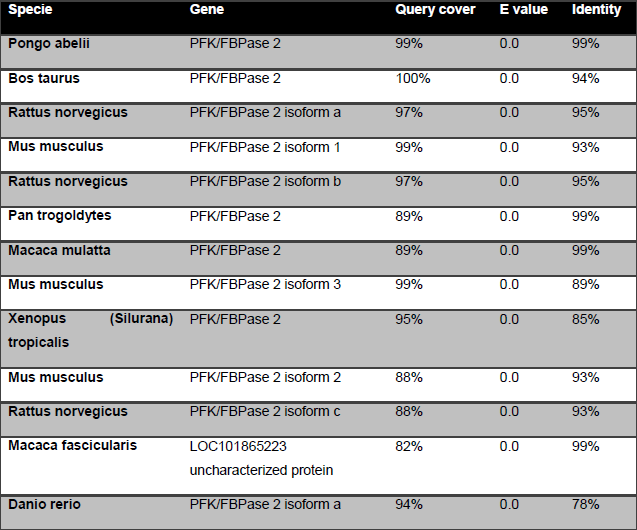
Results from BLAST Local Alignment Tool are shown in Figure 5. Only the annotated proteins are reported, the predicted proteins appearing in the local alignment were excluded.
Comparison of the PFKFB2 cDNA sequence with the bovine and rat 6-phosphofructo-2-kinase/fructose-2,6-bisphosphatase (PFK-2/FBPase-2) heart isoforms shows 87-90% nucleotide and 92-95% amino acid identity (Sakata and Uyeda, 1990; Darville et al., 1991).
Mutations
Note
There are 647 SNP variants described in PFKFB2 (see GeneCards).
The most SNP are found in non coding regions: 418 are presented in introns, 3 in splice donor variant, 107 in 3 UTR and 25 variant within a half kb of the end of gene and others.
Furthermore, 61 SNP are presented with the coding regions. The most of them are missense (31 variants) and also synonymous variants (19 variants) and only one frameshift.
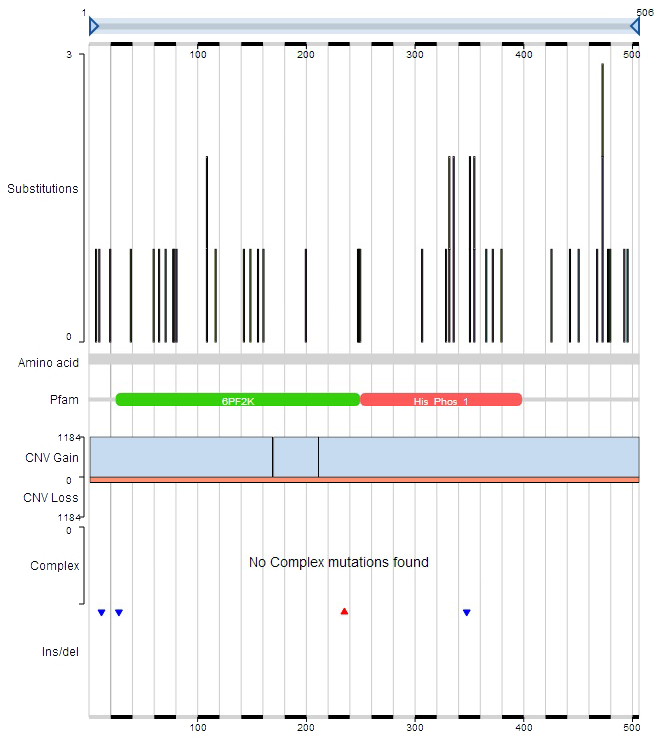
Somatic
Coding silent substitutions: 20, which represent 40.8% of the mutations described among all patients. Two of them have been found in two patients: c.1008C>G (p.T336T) and c.1419G>A (p.S473S).
Nonsense substitutions: 1, located in c.1051C>T (p.R351*).
Missense substitutions: 23, which represent 46.9% of the mutations described among all patients.
Deletions frameshift: 1, located in c.1044delT (p.F348fs*66).
Insertion frameshift: 1, located in c.703_407insT (p.Q235fs*37).
Deletion inframe: 2, located in c.28_30delAAC (p.N12delN) and in in c.82_84delTGT (p.C28delC).
Unknown mutation: 2, one of them located in c.376-2A>T and the other in c.840+1G>A.
No synonymous substitutions or chromosomal fusions in PFKFB2 gene have been described in any tumor sample.
Implicated in
Hypoxia is an important component of the tumor microenvironment. One key mediator of the hypoxic response in animal cells is the hypoxia-inducible factor (HIF) complex, a transcription factor frequently deregulated in cancer cells that induces the expression of glycolytic genes (Bartrons and Caro, 2007).
In culture cells, hypoxia induces PFKFB2 in HeLa and MCF7 cells. These data demonstrate that PFKFB2 is one of the responsive to hypoxia in vivo, indicating a physiological role in the adaptation of the organism to environmental or localized hypoxia/ischemia. Marsin et al. (2000) showed that AMPK phosphorylates PFKFB2 at Ser 466 in hypoxia conditions and this could contribute to maintain the high glycolytic rate that is a characteristic feature of many tumors.
PFKFB2 was identified by microarray analysis of lymphoblasts isolated from glucocorticoid-treated children suffering from ALL (acute lymphoblastic leukemia) as one of the most promising candidate genes as a glucocorticoid (GC)-response gene, since it was regulated in the majority of patients. Its deregulation was proposed to entail disturbances in glucose metabolism which, in turn, have been implicated in cell death induction (Schmidt et al., 2006). These data suggest that cellular metabolism and apoptosis might be intertwined with connections between regulation of cellular bioenergetics and apoptosis. Carlet et al. (2010) demonstrated that both splice variants of PFKFB2 are expressed and specifically induced by GC in malignant lymphoid cells, however, functional analysis of this gene in the human T-ALL cell line model CCRF-CEM revealed that its over-expression does not explain the anti-leukemic effects of GC.
Other studies performing microarray analysis, using total RNA isolated from LNCaP cells treated with or without R1881 (methyltreinolone), a synthetic androgen, showed that androgens induce PFKFB2 expression in LNCaP cells (androgen-sensitive human prostate adenocarcinoma cells) by the direct recruitment of the ligand-activated AR to the PFKFB2 promoter. Moreover, depletion of PFKFB2 expression using siRNA (small interfering RNA) or inhibiting the PFK-2 activity with LY294002 (inhibitor of PI3K) treatment resulted in a reduced glucose uptake and lipogenesis, suggesting that the induction of de novo lipid synthesis by androgens requires the transcriptional up-regulation of PFKFB2 in prostate cancer cells (Moon et al., 2011).
Tetralogy of Fallot (TOF) is a heart defect in children that results in chronic progressive right ventricular pressure overload and shunt hypoxemia. Western blot, RT-qPCR (real time PCR) and immunohystochemical analysis revealed that PKFB2 expression and mRNA of PFKFB2 increased significantly in TOF patients. Like tumors, under pathological stress conditions, cardiomyocytes gradually come to rely on glycolysis to satisfy their main energy requirements. That is why these results suggest that PFKFB2 plays an important role in certain biological processes related to cardiac remodeling, which occurs in response to chronic hypoxia and long-term pressure overload in TOF patients (Xia et al., 2013).
Glycolysis increases in cognitive heart failure (CHF), cardiac hypertrophy and cardiac ischemia (Neely et al., 1975). Some studies producing mice with chronic and stable elevation of cardiac Fru-2,6-P2 showed significant change in cardiac metabolite concentrations, increased glycolysis, reduced palmitate oxidation and protection of isolated myocytes from hypoxia. Taken together, these results show that PFKFB2 is one of the enzymes that control cardiac glycolysis, producing an increase in Fru-2,6-P2, causing detrimental effects and suggesting that the elevation of glycolysis in failing hearts could be injurious to an already compromised heart (Wang et al., 2008).
Article Bibliography
| Pubmed ID | Last Year | Title | Authors |
|---|---|---|---|
| 17661163 | 2007 | Hypoxia, glucose metabolism and the Warburg's effect. | Bartrons R et al |
| 12417335 | 2002 | The stimulation of heart glycolysis by increased workload does not require AMP-activated protein kinase but a wortmannin-sensitive mechanism. | Beauloye C et al |
| 10521487 | 1999 | Heart 6-phosphofructo-2-kinase activation by insulin results from Ser-466 and Ser-483 phosphorylation and requires 3-phosphoinositide-dependent kinase-1, but not protein kinase B. | Bertrand L et al |
| 17143338 | 2006 | Hypoxic regulation of PFKFB-3 and PFKFB-4 gene expression in gastric and pancreatic cancer cell lines and expression of PFKFB genes in gastric cancers. | Bobarykina AY et al |
| 21092265 | 2010 | Expression, regulation and function of phosphofructo-kinase/fructose-biphosphatases (PFKFBs) in glucocorticoid-induced apoptosis of acute lymphoblastic leukemia cells. | Carlet M et al |
| 22782897 | 2012 | The chemokine CCL5 regulates glucose uptake and AMP kinase signaling in activated T cells to facilitate chemotaxis. | Chan O et al |
| 7612629 | 1995 | Rat gene coding for heart 6-phosphofructo-2-kinase/fructose-2,6-bisphosphatase: characterization of an unusual promoter region and identification of four mRNAs. | Chikri M et al |
| 1652483 | 1991 | A rat gene encoding heart 6-phosphofructo-2-kinase/fructose-2,6-bisphosphatase. | Darville MI et al |
| 9874192 | 1998 | Mechanisms of control of heart glycolysis. | Depré C et al |
| 9211863 | 1997 | Phosphorylation and activation of heart 6-phosphofructo-2-kinase by protein kinase B and other protein kinases of the insulin signaling cascades. | Deprez J et al |
| 6282846 | 1982 | Regulation of rat liver fructose 2,6-bisphosphatase. | El-Maghrabi MR et al |
| 9652401 | 1998 | Sequence and structure of the human 6-phosphofructo-2-kinase/fructose-2,6-bisphosphatase heart isoform gene (PFKFB2). | Heine-Suñer D et al |
| 12392881 | 2002 | Insulin and ischemia stimulate glycolysis by acting on the same targets through different and opposing signaling pathways. | Hue L et al |
| 7040382 | 1982 | Regulation of fructose-2,6-bisphosphate content in rat hepatocytes, perfused hearts, and perfused hindlimbs. | Hue L et al |
| 10958932 | 2000 | Structure, function, and evolution of phosphoglycerate mutases: comparison with fructose-2,6-bisphosphatase, acid phosphatase, and alkaline phosphatase. | Jedrzejas MJ et al |
| 24568531 | 2014 | MACC1 expression correlates with PFKFB2 and survival in hepatocellular carcinoma. | Ji D et al |
| 2846551 | 1988 | Phosphorylation of myocardial fructose-6-phosphate,2-kinase: fructose-2,6-bisphosphatase by cAMP-dependent protein kinase and protein kinase C. Activation by phosphorylation and amino acid sequences of the phosphorylation sites. | Kitamura K et al |
| 20106611 | 2010 | Placental gene expression is related to glucose metabolism and fetal cord blood levels of insulin and insulin-like growth factors in intrauterine growth restriction. | Lee MH et al |
| 8798384 | 1996 | Signaling pathway involved in the activation of heart 6-phosphofructo-2-kinase by insulin. | Lefebvre V et al |
| 11069105 | 2000 | Phosphorylation and activation of heart PFK-2 by AMPK has a role in the stimulation of glycolysis during ischaemia. | Marsin AS et al |
| 21602788 | 2011 | The androgen receptor fuels prostate cancer by regulating central metabolism and biosynthesis. | Massie CE et al |
| 12196095 | 2002 | Survival-promoting functions of 14-3-3 proteins. | Masters SC et al |
| 11744734 | 2002 | Hypoxia-inducible factor-1-mediated expression of the 6-phosphofructo-2-kinase/fructose-2,6-bisphosphatase-3 (PFKFB3) gene. Its possible role in the Warburg effect. | Minchenko A et al |
| 16025159 | 2005 | Expression and hypoxia-responsiveness of 6-phosphofructo-2-kinase/fructose-2,6-bisphosphatase 4 in mammary gland malignant cell lines. | Minchenko OH et al |
| 20958264 | 2011 | Androgen stimulates glycolysis for de novo lipid synthesis by increasing the activities of hexokinase 2 and 6-phosphofructo-2-kinase/fructose-2,6-bisphosphatase 2 in prostate cancer cells. | Moon JS et al |
| 20687898 | 2010 | Heart 6-phosphofructo-2-kinase activation by insulin requires PKB (protein kinase B), but not SGK3 (serum- and glucocorticoid-induced protein kinase 3). | Mouton V et al |
| 3160703 | 1985 | Regulation of phosphofructokinase in perfused rat heart. Requirement for fructose 2,6-bisphosphate and a covalent modification. | Narabayashi H et al |
| 156 | 1975 | Effect of coronary blood flow on glycolytic flux and intracellular pH in isolated rat hearts. | Neely JR et al |
| 23457334 | 2013 | Akt-dependent activation of the heart 6-phosphofructo-2-kinase/fructose-2,6-bisphosphatase (PFKFB2) isoenzyme by amino acids. | Novellasdemunt L et al |
| 10475585 | 1999 | Fructose-2,6-bisphosphate and control of carbohydrate metabolism in eukaryotes. | Okar DA et al |
| 11165514 | 2001 | PFK-2/FBPase-2: maker and breaker of the essential biofactor fructose-2,6-bisphosphate. | Okar DA et al |
| 7574501 | 1995 | 6-Phosphofructo-2-kinase/fructose-2,6-bisphosphatase: a metabolic signaling enzyme. | Pilkis SJ et al |
| 12032565 | 2002 | Homeostatic control of lymphocyte survival: potential origins and implications. | Plas DR et al |
| 12853467 | 2003 | 14-3-3s regulate fructose-2,6-bisphosphate levels by binding to PKB-phosphorylated cardiac fructose-2,6-bisphosphate kinase/phosphatase. | Pozuelo Rubio M et al |
| 15170386 | 2004 | 6-phosphofructo-2-kinase/fructose-2,6-bisphosphatase: head-to-head with a bifunctional enzyme that controls glycolysis. | Rider MH et al |
| 6237934 | 1984 | Activation of rat heart phosphofructokinase-2 by insulin in vivo. | Rider MH et al |
| 1322130 | 1992 | The two forms of bovine heart 6-phosphofructo-2-kinase/fructose-2,6-bisphosphatase result from alternative splicing. | Rider MH et al |
| 1327869 | 1992 | Evidence for new phosphorylation sites for protein kinase C and cyclic AMP-dependent protein kinase in bovine heart 6-phosphofructo-2-kinase/fructose-2,6-bisphosphatase. | Rider MH et al |
| 2164212 | 1990 | Bovine heart fructose-6-phosphate 2-kinase/fructose-2,6-bisphosphatase: complete amino acid sequence and localization of phosphorylation sites. | Sakata J et al |
| 16293608 | 2006 | Identification of glucocorticoid-response genes in children with acute lymphoblastic leukemia. | Schmidt S et al |
| 15108172 | 2004 | Evidence for linkage between regulatory enzymes in glycolysis and schizophrenia in a multiplex sample. | Stone WS et al |
| 22591674 | 2012 | Small molecule inhibition of 6-phosphofructo-2-kinase suppresses t cell activation. | Telang S et al |
| 20300106 | 2010 | Targeting metabolic transformation for cancer therapy. | Tennant DA et al |
| 8179334 | 1994 | Bovine heart fructose 6-P,2-kinase:fructose 2,6-bisphosphatase mRNA and gene structure. | Tsuchiya Y et al |
| 3028056 | 1987 | Fructose 2,6-bisphosphate. | Van Schaftingen E et al |
| 20824721 | 2011 | Clinical and molecular features of papillary thyroid cancer in adolescents and young adults. | Vriens MR et al |
| 18456722 | 2008 | Cardiac phosphatase-deficient 6-phosphofructo-2-kinase/fructose-2,6-bisphosphatase increases glycolysis, hypertrophy, and myocyte resistance to hypoxia. | Wang Q et al |
| 9730664 | 1998 | Intrauterine growth restriction: definition and etiology. | Wollmann HA et al |
| 23571024 | 2013 | Label-free quantitative proteomic analysis of right ventricular remodeling in infant Tetralogy of Fallot patients. | Xia Y et al |
Other Information
Locus ID:
NCBI: 5208
MIM: 171835
HGNC: 8873
Ensembl: ENSG00000123836
Variants:
dbSNP: 5208
ClinVar: 5208
TCGA: ENSG00000123836
COSMIC: PFKFB2
RNA/Proteins
Expression (GTEx)
Pathways
Protein levels (Protein atlas)
References
| Pubmed ID | Year | Title | Citations |
|---|---|---|---|
| 37311985 | 2023 | PFKFB2 is a favorable prognostic biomarker for colorectal cancer by suppressing metastasis and tumor glycolysis. | 1 |
| 37864733 | 2023 | miR-21-5p inhibits the growth of brain glioma cells through regulating the glycolysis mediated by PFKFB2. | 0 |
| 37311985 | 2023 | PFKFB2 is a favorable prognostic biomarker for colorectal cancer by suppressing metastasis and tumor glycolysis. | 1 |
| 37864733 | 2023 | miR-21-5p inhibits the growth of brain glioma cells through regulating the glycolysis mediated by PFKFB2. | 0 |
| 35059934 | 2022 | Knockdown circZNF131 Inhibits Cell Progression and Glycolysis in Gastric Cancer Through miR-186-5p/PFKFB2 Axis. | 2 |
| 35059934 | 2022 | Knockdown circZNF131 Inhibits Cell Progression and Glycolysis in Gastric Cancer Through miR-186-5p/PFKFB2 Axis. | 2 |
| 32415418 | 2020 | PFKFB2 regulates glycolysis and proliferation in pancreatic cancer cells. | 23 |
| 32415418 | 2020 | PFKFB2 regulates glycolysis and proliferation in pancreatic cancer cells. | 23 |
| 30819197 | 2019 | Increased expression and phosphorylation of 6-phosphofructo-2-kinase/fructose-2,6-bisphosphatase isoforms in urinary exosomes in pre-eclampsia. | 6 |
| 30884810 | 2019 | PFKFB2 Promoter Hypomethylation as Recurrence Predictive Marker in Well-Differentiated Thyroid Carcinomas. | 8 |
| 31122697 | 2019 | miR-613 inhibits Warburg effect in gastric cancer by targeting PFKFB2. | 15 |
| 30819197 | 2019 | Increased expression and phosphorylation of 6-phosphofructo-2-kinase/fructose-2,6-bisphosphatase isoforms in urinary exosomes in pre-eclampsia. | 6 |
| 30884810 | 2019 | PFKFB2 Promoter Hypomethylation as Recurrence Predictive Marker in Well-Differentiated Thyroid Carcinomas. | 8 |
| 31122697 | 2019 | miR-613 inhibits Warburg effect in gastric cancer by targeting PFKFB2. | 15 |
| 29440170 | 2018 | RSK Regulates PFK-2 Activity to Promote Metabolic Rewiring in Melanoma. | 29 |
Citation
Ana Rodríguez-García ; Pere Fontova ; Helga Simon ; Anna Manzano ; Ramon Bartrons ; Àurea Navarro-Sabaté
PFKFB2 (6-phosphofructo-2-kinase/fructose-2,6-biphosphatase 2)
Atlas Genet Cytogenet Oncol Haematol. 2014-03-01
Online version: http://atlasgeneticsoncology.org/gene/52100/pfkfb2-%286-phosphofructo-2-kinase-fructose-2-6-biphosphatase-2%29
