EIF4B (eukaryotic translation initiation factor 4B)
2014-04-01 Thomas Sbarrato , Emilie Horvilleur , Tuija Pöyry , Anne E Willis AffiliationMedical Research Council Toxicology Unit, Hodgkin Building, PO Box 138, Lancaster Rd, Leicester, LE1 9HN, UK
Identity
Abstract
Review on eIF4B, with data on DNA\/RNA, on the protein encoded and where the gene is implicated.
DNA/RNA
Description
Transcription
Proteins
Description
Expression
Localisation
Function
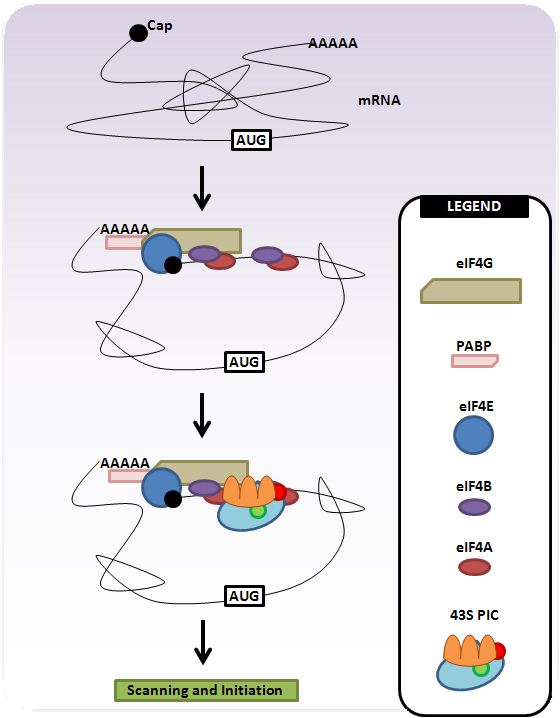
Translation of an mRNA initiates with the binding of eukaryotic initiation factor complex eIF4F comprised of eIF4E, eIF4G and eIF4A (Pestova and Kolupaeva, 2002) (Figure 3):
- eIF4E interacts directly with the cap of the mRNA and helps recruit the machinery to the 5end of the mRNA.
- eIF4G protein provides a scaffold, bridging interactions between eIF4A, eIF4E, eIF3, PABP and RNA.
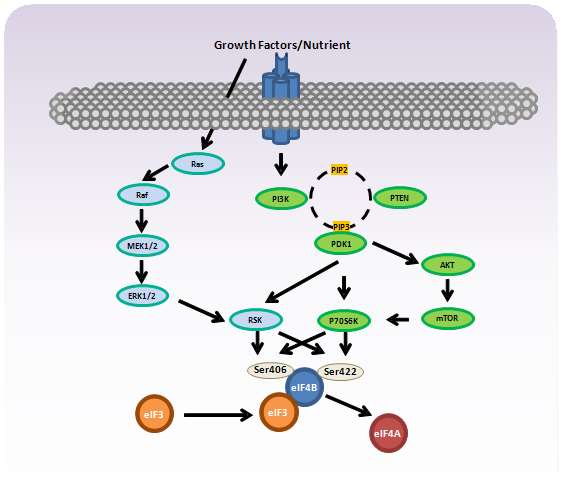
- Secondary structures in the mRNA that can be detrimental to the binding/scanning of the ribosome are unwound by the helicase eIF4A and its cofactors eIF4B and eIF4H (Grifo et al., 1983; Lawson et al., 1989; Rozen et al., 1990).
The binding of this eIF4F complex allows for the circularisation of the mRNA and the subsequent recruitment of the 43S pre-initiation complex (PIC) composed of the small ribosomal subunit (40S), the ternary complex (eIF2/met-tRNA/GTP) and several initiation factors (eIF1, eIF1A, eIF3 and eIF5) (Deo et al., 1999; Imataka et al., 1998; Lamphear et al., 1995; Wells et al., 1998). This complex will then scan the untranslated region (UTR) of the mRNA until a start codon is recognised (Kozak, 2002).
eIF4B acts at different levels to stimulate translation initiation: 1) by enhancing the ATPase and helicase activities of eIF4A and 2) by facilitating the recruitment of the 43S PIC.
1) Role of eIF4B in the stimulation of eIF4A
Although the precise mechanisms of action of eIF4B on the enhanced helicase activity of eIF4F are not fully understood, knockdown/aberrant expression of eIF4B in mammalian cells led to the reduction/stimulation in translation of mRNAs containing highly structured 5UTRs (Horvilleur et al., 2013; Shahbazian et al., 2010). Additionally, the ATPase and helicase activity of free eIF4A was shown to be significantly slower than the rates of translation initiation or the rates of scanning of the PIC (Grifo et al., 1984; Pause et al., 1994; Richter-Cook et al., 1998).
Consequently, one can envisage that eIF4B can help in the substrate (ATP and RNA) recognition by eIF4A. As such, eIF4B can modulate the affinity for ATP and RNA by inducing conformational changes in eIF4A (Bi et al., 2000; Marintchev et al., 2009; Methot et al., 1994; Nielsen et al., 2011; Rogers Jr. et al., 2001; Rozovsky et al., 2008). Additionally, eIF4B can enhance the efficiency of this process by coupling the ATP hydrolysis to duplex unwinding to avoid redundant, energy-consuming events (Ozes et al., 2011). In a manner similar to other single-stranded DNA binding proteins that associate with helicases, one possible mode of action for eIF4B is to stabilize newly unwound single-stranded RNA. In support of this, a direct interaction between eIF4A and eIF4B in the presence of RNA and an ATP analog have been established via the C terminal region of eIF4B (Nielsen et al., 2011; Rozovsky et al., 2008).
2) Role of eIF4B in the recruitment of 43S PIC to mRNAs
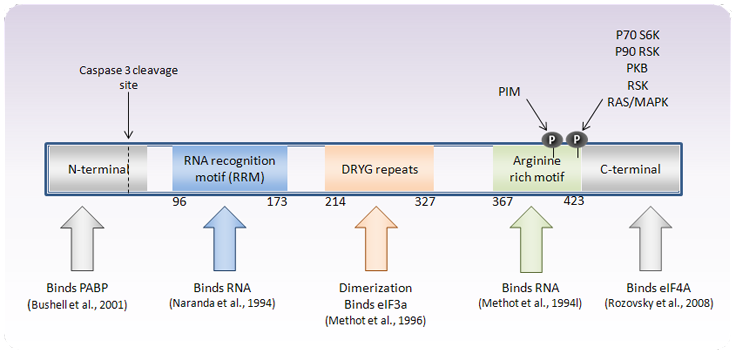
Through its various domains, eIF4B is now known to promote the association of the various players in the recruitment of the 43S PIC to the mRNA. The C terminal RNA binding domain of eIF4B enables its binding to mRNA whereas the RRM motif triggers interaction with the rRNA from the 43S PIC (Methot et al., 1996a; Naranda et al., 1994). The latter is thought to anchor the helicase eIF4A to the scanning ribosome (Methot et al., 1996a). Importantly, mammalian eIF4B dimerises and binds to eIF3a via its DRYG repeats, thus providing a main link between the eIF4F-loaded mRNA and the 43S PIC (Methot et al., 1996b).
These results provide evidence that eIF4B participates in recruitment and assembly of the PIC on mRNAs. Critically, recent findings have now shown that interactions involving eIF4B via its different domains are essential for the effective assembly and efficient scanning of the 43S PIC. Yeast eIF4B together with eIF4F and eIF3 decreased the dependency on high concentrations of eIF4A for the rapid assembly and recruitment of the 43S PIC on endogenous short leader mRNAs (Mitchell et al., 2010; Walker et al., 2013), thus eIF4B can mediate an enhancing effect on the PIC recruitment to an mRNA.
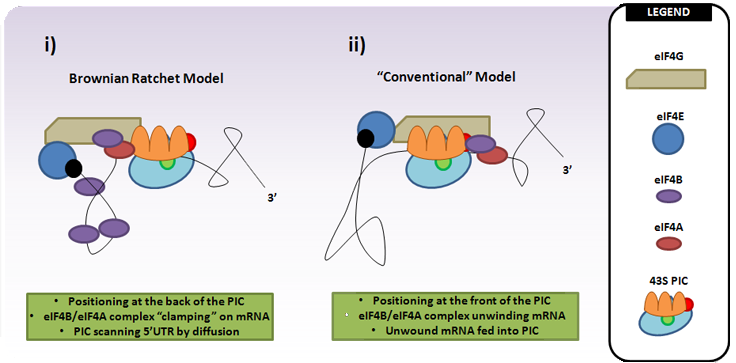
The spatial positioning of eIF4B on the scanning ribosome is poorly understood. The helicase complex eIF4A/eIF4B could be located near the mRNA exit channel (i.e. 5/behind the scanning PIC) or alternatively at the mRNA entry channel (i.e. 3/in front of the scanning PIC) (Figure 4). To support the former hypothesis, a Brownian ratchet model was proposed in which eIF4F is located near the exit channel of the PIC (Spirin, 2009). In this model, eIF4A-unwound and eIF4B-captured single-stranded RNA would be scanned by diffusion by the PIC. Contradictory, new evidence have shown that yeast eIF4B mapped to the head of the PIC near the entry channel (Walker et al., 2013). In such a case, the eIF4F complex would be recruited to the cap and would be located at the forefront of the PIC, thus allowing efficient unwinding and scanning (Marintchev et al., 2009). New experimental approaches, including structures of the human ribosome associated with factors, should be able to shed some light on the matter in the future.
Homology
Implicated in
Article Bibliography
| Pubmed ID | Last Year | Title | Authors |
|---|---|---|---|
| 8404865 | 1993 | A Saccharomyces cerevisiae homologue of mammalian translation initiation factor 4B contributes to RNA helicase activity. | Altmann M et al |
| 10801326 | 2000 | Wheat germ translation initiation factor eIF4B affects eIF4A and eIFiso4F helicase activity by increasing the ATP binding affinity of eIF4A. | Bi X et al |
| 11274152 | 2001 | Disruption of the interaction of mammalian protein synthesis eukaryotic initiation factor 4B with the poly(A)-binding protein by caspase- and viral protease-mediated cleavages. | Bushell M et al |
| 16803875 | 2006 | Wheat eukaryotic initiation factor 4B organizes assembly of RNA and eIFiso4G, eIF4A, and poly(A)-binding protein. | Cheng S et al |
| 22546478 | 2012 | MAPK/ERK-dependent translation factor hyperactivation and dysregulated laminin γ2 expression in oral dysplasia and squamous cell carcinoma. | Degen M et al |
| 10499800 | 1999 | Recognition of polyadenylate RNA by the poly(A)-binding protein. | Deo RC et al |
| 6145716 | 1984 | RNA-stimulated ATPase activity of eukaryotic initiation factors. | Grifo JA et al |
| 6853548 | 1983 | New initiation factor activity required for globin mRNA translation. | Grifo JA et al |
| 23983265 | 2013 | Integration of mTOR and estrogen-ERK2 signaling in lymphangioleiomyomatosis pathogenesis. | Gu X et al |
| 16286006 | 2005 | mTOR and S6K1 mediate assembly of the translation preinitiation complex through dynamic protein interchange and ordered phosphorylation events. | Holz MK et al |
| 24135829 | 2014 | A role for eukaryotic initiation factor 4B overexpression in the pathogenesis of diffuse large B-cell lymphoma. | Horvilleur E et al |
| 9857202 | 1998 | A newly identified N-terminal amino acid sequence of human eIF4G binds poly(A)-binding protein and functions in poly(A)-dependent translation. | Imataka H et al |
| 11956083 | 2002 | Inhibition of protein synthesis in apoptosis: differential requirements by the tumor necrosis factor alpha family and a DNA-damaging agent for caspases and the double-stranded RNA-dependent protein kinase. | Jeffrey IW et al |
| 21364753 | 2011 | A gene expression signature of acquired chemoresistance to cisplatin and fluorouracil combination chemotherapy in gastric cancer patients. | Kim HK et al |
| 12459250 | 2002 | Pushing the limits of the scanning mechanism for initiation of translation. | Kozak M et al |
| 7665619 | 1995 | Mapping of functional domains in eukaryotic protein synthesis initiation factor 4G (eIF4G) with picornaviral proteases. Implications for cap-dependent and cap-independent translational initiation. | Lamphear BJ et al |
| 2548591 | 1989 | Dissociation of double-stranded polynucleotide helical structures by eukaryotic initiation factors, as revealed by a novel assay. | Lawson TG et al |
| 23225332 | 2013 | Analysis of 20 genes at chromosome band 12q13: RACGAP1 and MCRS1 overexpression in nonsmall-cell lung cancer. | Liang Y et al |
| 17429429 | 2007 | Gene expression profiling of precursor T-cell lymphoblastic leukemia/lymphoma identifies oncogenic pathways that are potential therapeutic targets. | Lin YW et al |
| 19203580 | 2009 | Topology and regulation of the human eIF4A/4G/4H helicase complex in translation initiation. | Marintchev A et al |
| 8139536 | 1994 | The translation initiation factor eIF-4B contains an RNA-binding region that is distinct and independent from its ribonucleoprotein consensus sequence. | Méthot N et al |
| 8846295 | 1996 | In vitro RNA selection identifies RNA ligands that specifically bind to eukaryotic translation initiation factor 4B: the role of the RNA remotif. | Methot N et al |
| 8816444 | 1996 | A region rich in aspartic acid, arginine, tyrosine, and glycine (DRYG) mediates eukaryotic initiation factor 4B (eIF4B) self-association and interaction with eIF3. | Méthot N et al |
| 20864040 | 2010 | The 5'-7-methylguanosine cap on eukaryotic mRNAs serves both to stimulate canonical translation initiation and to block an alternative pathway. | Mitchell SF et al |
| 8182051 | 1994 | Two structural domains of initiation factor eIF-4B are involved in binding to RNA. | Naranda T et al |
| 21113024 | 2011 | Synergistic activation of eIF4A by eIF4B and eIF4G. | Nielsen KH et al |
| 21840318 | 2011 | Duplex unwinding and ATPase activities of the DEAD-box helicase eIF4A are coupled by eIF4G and eIF4B. | Özeş AR et al |
| 8131750 | 1994 | Dominant negative mutants of mammalian translation initiation factor eIF-4A define a critical role for eIF-4F in cap-dependent and cap-independent initiation of translation. | Pause A et al |
| 12435632 | 2002 | The roles of individual eukaryotic translation initiation factors in ribosomal scanning and initiation codon selection. | Pestova TV et al |
| 19718509 | 2009 | Human Protein Reference Database and Human Proteinpedia as discovery tools for systems biology. | Prasad TS et al |
| 23813671 | 2013 | The over-expression of Pim-2 promote the tumorigenesis of prostatic carcinoma through phosphorylating eIF4B. | Ren K et al |
| 9516461 | 1998 | Purification and characterization of a new eukaryotic protein translation factor. Eukaryotic initiation factor 4H. | Richter-Cook NJ et al |
| 11418588 | 2001 | Modulation of the helicase activity of eIF4A by eIF4B, eIF4H, and eIF4F. | Rogers GW Jr et al |
| 2304461 | 1990 | Bidirectional RNA helicase activity of eucaryotic translation initiation factors 4A and 4F. | Rozen F et al |
| 18719248 | 2008 | Interactions between eIF4AI and its accessory factors eIF4B and eIF4H. | Rozovsky N et al |
| 20086100 | 2010 | Control of cell survival and proliferation by mammalian eukaryotic initiation factor 4B. | Shahbazian D et al |
| 17184779 | 2007 | Identification of differential proteins in nasopharyngeal carcinoma cells with p53 silence by proteome analysis. | Sun Y et al |
| 21139605 | 2010 | Towards a knowledge-based Human Protein Atlas. | Uhlen M et al |
| 23236192 | 2013 | Yeast eIF4B binds to the head of the 40S ribosomal subunit and promotes mRNA recruitment through its N-terminal and internal repeat domains. | Walker SE et al |
| 9702200 | 1998 | Circularization of mRNA by eukaryotic translation initiation factors. | Wells SE et al |
| 17361185 | 2007 | 14-3-3sigma controls mitotic translation to facilitate cytokinesis. | Wilker EW et al |
| 23749639 | 2013 | eIF4B phosphorylation by pim kinases plays a critical role in cellular transformation by Abl oncogenes. | Yang J et al |
| 21268130 | 2011 | Activation and up-regulation of translation initiation factor 4B contribute to arsenic-induced transformation. | Zhang Y et al |
| 22101421 | 2012 | The novel dual PI3K/mTOR inhibitor GDC-0941 synergizes with the MEK inhibitor U0126 in non-small cell lung cancer cells. | Zou ZQ et al |
| 18836482 | 2009 | AGC kinases regulate phosphorylation and activation of eukaryotic translation initiation factor 4B. | van Gorp AG et al |
Other Information
Locus ID:
NCBI: 1975
MIM: 603928
HGNC: 3285
Ensembl: ENSG00000063046
Variants:
dbSNP: 1975
ClinVar: 1975
TCGA: ENSG00000063046
COSMIC: EIF4B
RNA/Proteins
Expression (GTEx)
Pathways
Protein levels (Protein atlas)
References
| Pubmed ID | Year | Title | Citations |
|---|---|---|---|
| 37368134 | 2023 | Backbone resonance assignments of the C-terminal region of human translation initiation factor eIF4B. | 1 |
| 37895289 | 2023 | DOCK3-Associated Neurodevelopmental Disorder-Clinical Features and Molecular Basis. | 0 |
| 37368134 | 2023 | Backbone resonance assignments of the C-terminal region of human translation initiation factor eIF4B. | 1 |
| 37895289 | 2023 | DOCK3-Associated Neurodevelopmental Disorder-Clinical Features and Molecular Basis. | 0 |
| 35593475 | 2022 | CDKN2AIP-induced cell senescence and apoptosis of testicular seminoma are associated with CARM1 and eIF4β. | 1 |
| 35593475 | 2022 | CDKN2AIP-induced cell senescence and apoptosis of testicular seminoma are associated with CARM1 and eIF4β. | 1 |
| 34403810 | 2021 | eIF4B enhances ATF4 expression and contributes to cellular adaptation to asparagine limitation in BRAF-mutated A375 melanoma. | 4 |
| 34403810 | 2021 | eIF4B enhances ATF4 expression and contributes to cellular adaptation to asparagine limitation in BRAF-mutated A375 melanoma. | 4 |
| 31875526 | 2020 | Long noncoding RNA GMAN promotes hepatocellular carcinoma progression by interacting with eIF4B. | 26 |
| 31875526 | 2020 | Long noncoding RNA GMAN promotes hepatocellular carcinoma progression by interacting with eIF4B. | 26 |
| 29124675 | 2019 | Pim-2 Cooperates with Downstream Factor XIAP to Inhibit Apoptosis and Intensify Malignant Grade in Prostate Cancer. | 8 |
| 31023341 | 2019 | eIF4B and eIF4H mediate GR production from expanded G4C2 in a Drosophila model for C9orf72-associated ALS. | 32 |
| 29124675 | 2019 | Pim-2 Cooperates with Downstream Factor XIAP to Inhibit Apoptosis and Intensify Malignant Grade in Prostate Cancer. | 8 |
| 31023341 | 2019 | eIF4B and eIF4H mediate GR production from expanded G4C2 in a Drosophila model for C9orf72-associated ALS. | 32 |
| 29483509 | 2018 | Fatty Acid Synthase induced S6Kinase facilitates USP11-eIF4B complex formation for sustained oncogenic translation in DLBCL. | 44 |
Citation
Thomas Sbarrato ; Emilie Horvilleur ; Tuija Pöyry ; Anne E Willis
EIF4B (eukaryotic translation initiation factor 4B)
Atlas Genet Cytogenet Oncol Haematol. 2014-04-01
Online version: http://atlasgeneticsoncology.org/gene/53571/gene-fusions/teaching-explorer/
