t(2;11)(q37;q23) KMT2A/SEPT2
2007-09-01 Cecília Correia , Manuel R Teixeira Affiliation1.Department of Genetics, Portuguese Oncology Institute, Rua Dr. Antonio Bernardino de Almeida, 4200-072 Porto, Portugal.
Clinics and Pathology
Disease
Rare type of acute myeloid leukemia (AML) and therapy-related AML.
Phenotype stem cell origin
No specific AML FAB sub-type (two cases M4, one M2, one M5a and one NOS).
Etiology
Either de novo or therapy-related (prior cancer is variable: breast cancer, non-Hodgkin lymphoma and LLA).
Epidemiology
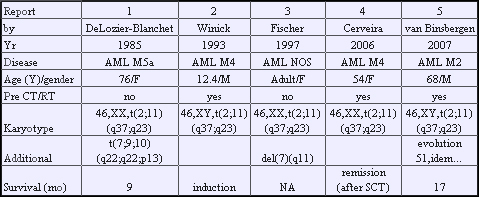
Five cases known in the literature; four adults and one child, sex ratio 2M/3F; (age range 14.4-76).
Prognosis
Two cases showed poor survival, 9 and 17 months respectively, one case achieved remission after stem cell transplantation. The prognosis may be likely to be comparable with that of other entities with 11q23/MLL involvement, and worse in therapy related leukemias.
Genes Involved and Proteins
Gene name
SEPT2 (septin 2)
Location
2q37.3
Dna rna description
The SEPT2 gene has 14 exons.
SEPT2 has four types of transcripts with 3.6 kb, 3.5 kb, 3.4 kb and 3.3 kb encoding the same protein, as a result of alternative splicing.
SEPT2 has four types of transcripts with 3.6 kb, 3.5 kb, 3.4 kb and 3.3 kb encoding the same protein, as a result of alternative splicing.
Protein description
SEPT2 belongs to an evolutionarily conserved family of genes that encode a P loop-based GTP-binding domain flanked by a polybasic domain and (usually) a coiled-coil region, and assemble into homo- and hetero-oligomers and filaments with key roles in cell division cytoskeletal dynamics and secretion. The SEPT2 gene codes for a protein with 361 amino acids and a molecular weight of 41.5 kDa.
SEPT2 was identified as a gene expressed in early embryonic mouse brain and down-regulated during development. It is ubiquitously expressed in cell lines and tissues with the highest protein levels found in brain tissue.
The SEPT2 protein, like other septin family members, is thought to be cytoplasmic. SEPT2 co-localises with actin filaments in interphase cells, and in dividing cells concentrates at the cleavage furrow.
SEPT2 is a multifunctional protein that was shown to be required for cytokinesis and to bind actin and associate with focal adhesions. Recent data support the idea that SEPT2 can have a role in chromosome congression and segregation. Additional functions have also been suggested; for instance, in rat brain lysates SEPT2 is part of a multi-septin complex that interacts with the exocyst complex, which plays a role in secretion and neurite outgrowth. SEPT2 has also been localised to senile plaques of brains in patients with Alzheimer¹s disease suggesting a role in neurodegeneration.
The SEPT2 protein belongs to an evolutionarily family of proteins with at least 14 members and shares a very high homology with septin 1, septin 4 and septin 5.
SEPT2 was identified as a gene expressed in early embryonic mouse brain and down-regulated during development. It is ubiquitously expressed in cell lines and tissues with the highest protein levels found in brain tissue.
The SEPT2 protein, like other septin family members, is thought to be cytoplasmic. SEPT2 co-localises with actin filaments in interphase cells, and in dividing cells concentrates at the cleavage furrow.
SEPT2 is a multifunctional protein that was shown to be required for cytokinesis and to bind actin and associate with focal adhesions. Recent data support the idea that SEPT2 can have a role in chromosome congression and segregation. Additional functions have also been suggested; for instance, in rat brain lysates SEPT2 is part of a multi-septin complex that interacts with the exocyst complex, which plays a role in secretion and neurite outgrowth. SEPT2 has also been localised to senile plaques of brains in patients with Alzheimer¹s disease suggesting a role in neurodegeneration.
The SEPT2 protein belongs to an evolutionarily family of proteins with at least 14 members and shares a very high homology with septin 1, septin 4 and septin 5.
Gene name
KMT2A (myeloid/lymphoid or mixed lineage leukemia)
Location
11q23.3
Dna rna description
37 exons, spanning over 100 kb.
Dna rna description
In a centromeric to telomeric direction; 13 and 15 kb; coding sequence: 11.9 kb.
Protein description
3969 amino acids; 431 KDa; contains from N-term to C-term 3 AT hooks homologous to high mobility group proteins HMGA1 and HMGA2, binding to the minor grove of DNA; 2 speckled nuclear localisation signals; 2 repression domains RD1 and RD2: RD1 or CXXC: cystein methyl transferase, binds CpG rich DNA, has a transcriptional repression activity; RD2 recruits histone desacetylases HDAC1 and HDAC2; 3 plant homeodomains (cystein rich zinc finger domains, with homodimerization properties), 1 bromodomain (may bind acetylated histones), and 1 plant homeodomain; these domains may be involved in protein-protein interaction; a FYRN and a FRYC domain; a transactivation domain which binds CBP ; may acetylates H3 and H4 in the HOX area; a SET domain: methyltransferase; methyltates H3, including histones in the HOX area for allowing chromatin to be open to transcription. MLL is cleaved by taspase 1 into 2 proteins before entering the nucleus: a p300/320 N-term protein called MLL-N, and a p180 C-term protein, called MLL-C. The FYRN and a FRYC domains of native MLL associate MLL-N and MLL-C in a stable complex; they form a multiprotein complex with transcription factor TFIID.
Result of the Chromosomal Anomaly
Description
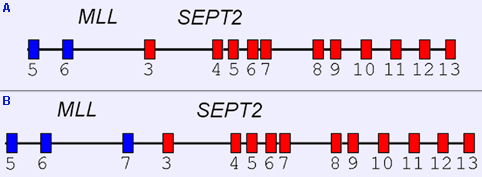
MLLSEPT2. MLL exon 6 or 7 fused with SEPT2 exon 3.
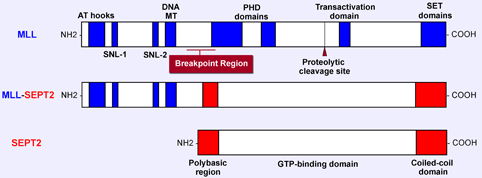
Structure of the normal MLL and SEPT2 proteins and the resulting MLL-SEPT2 fusion protein.
Description
AT hook, SNL-1, SNL-2 and DNA methyltransferase domains from MLL fused to almost the entire open-reading frame of SEPT2, except for the first three aminoacids.
Article Bibliography
| Pubmed ID | Last Year | Title | Authors |
|---|---|---|---|
| 16682951 | 2006 | SEPT2 is a new fusion partner of MLL in acute myeloid leukemia with t(2;11)(q37;q23). | Cerveira N et al |
| 3855693 | 1985 | Translocation 2;11 and other significant chromosome changes in acute monoblastic leukemia (M5) with clonal evolution: sequential clinical and cytogenetic studies. | DeLozier-Blanchet CD et al |
| 9058725 | 1997 | Molecular cytogenetic delineation of deletions and translocations involving chromosome band 7q22 in myeloid leukemias. | Fischer K et al |
| 8426196 | 1993 | Secondary acute myeloid leukemia in children with acute lymphoblastic leukemia treated with etoposide. | Winick NJ et al |
| 17574968 | 2007 | A new subtype of MLL-SEPT2 fusion transcript in therapy-related acute myeloid leukemia with t(2;11)(q37;q23): a case report and literature review. | van Binsbergen E et al |
Summary
Fusion gene
KMT2A/SEPT2 KMT2A (11q23.3) SEPT2 (2q37.3) COF 1972 1973 1974 1975|KMT2A/SEPT2 KMT2A (11q23.3) SEPT2 (2q37.3) TIC
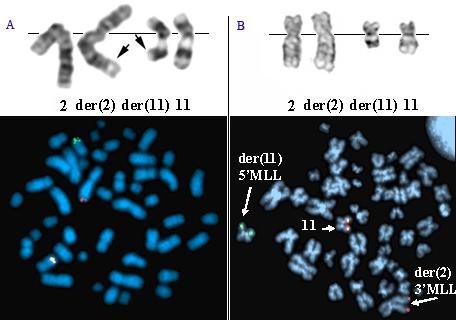
t(2;11)(q37;q23) by G-banding and FISH with dual-color, break-apart MLL probe; Cecília, Manuel R Teixeira (left); partial GTG-banded karyotype of t(2;11)(q37;23) and FISH analysis using probe LSI MLL DCBA demonstrating a 11q23 MLL rearrangement with a fusion signal on the normal chromosome 11, a split 5MLL signal on der(11) and a 3MLL signal on der(2); courtesy Arjan Buijs and Ellen van Binsbergen (right).
Citation
Cecília Correia ; Manuel R Teixeira
t(2;11)(q37;q23) KMT2A/SEPT2
Atlas Genet Cytogenet Oncol Haematol. 2007-09-01
Online version: http://atlasgeneticsoncology.org/haematological/1457/t(2
