i(X)(p10) in female patients
2016-12-01 Tatiana Gindina Affiliation1.R.M. Gorbacheva Research Institute of Pediatric Oncology Hematology and Transplantation at First Saint-Petersburg State Medical University named I.P.Pavlov, Saint-Petersburg, Russia / [email protected]
Abstract
Review on i(X)(p10) in female patients
Clinics and Pathology
Disease
i(X)(p10) occurs in a wide spectrum of hematologic malignancies, in both myeloid and lymphoid disorders, including MDS, CMML, CML, de novo and therapy-related AML, ALL, NHL and Hodgkin lymphoma.
Myelodysplastic syndrome (MDS) was diagnosed in 7 patients (Adeyinka et al., 2007), 2 of them with refractory anaemia with ring sideroblasts (RARS) (Knuutila et al., 1984; Dewald et al., 1989), one patient with refractory anaemia (RA) (Adeyinka et al., 2007) and one with refractory anaemia with excess blasts (RAEB)(Sato et al., 2002).
Chronic myelomonocytic leukaemia (CMML): 3 patients (MacGrogan et al., 2004; Chen et al., 2010; Nacheva et al., 1995).
Chronic myeloid leukemia (CML): 2 patients (Selleri et al., 1989; Barbouti et al., 2002).
Acute myeloid leukemia (AML): there were 8 patients with different variants of AML: 1 AML-M1 (Fitzerald et al., 1983), 1 AML-M2 (Dewald et al., 1989), 1 AML-M4 (Bao et al., 2006), 2 therapy-related AML (Preiss et al., 2010; Adeyinka et al., 2007).
Acute lymphoblastic leukemia (ALL): 3 patients. Two of them with relapse after chemotherapy (Adeyinka et al., 2007) and allo-HSCT (Gindina, own case, table 1, #23), one patient with Down syndrome (Baker et al., 2003).
Hodgkin lymphoma, nodular sclerosis (HL) was diagnosed in 2 patients (Falzetti et al., 2005; Schlegelberger et al., 1994).
Non Hodgkin lymphoma (NHL): 1 patient (Temperani et al., 1995).
Mantle cell lymphoma (MCL): 1 patient (Gindina, own case, table 1, #25).
Cytopenias: 3 patients (Adeyinka et al., 2007), 2 of them with anaemia, one with thrombocytopenia.
Myelodysplastic syndrome (MDS) was diagnosed in 7 patients (Adeyinka et al., 2007), 2 of them with refractory anaemia with ring sideroblasts (RARS) (Knuutila et al., 1984; Dewald et al., 1989), one patient with refractory anaemia (RA) (Adeyinka et al., 2007) and one with refractory anaemia with excess blasts (RAEB)(Sato et al., 2002).
Chronic myelomonocytic leukaemia (CMML): 3 patients (MacGrogan et al., 2004; Chen et al., 2010; Nacheva et al., 1995).
Chronic myeloid leukemia (CML): 2 patients (Selleri et al., 1989; Barbouti et al., 2002).
Acute myeloid leukemia (AML): there were 8 patients with different variants of AML: 1 AML-M1 (Fitzerald et al., 1983), 1 AML-M2 (Dewald et al., 1989), 1 AML-M4 (Bao et al., 2006), 2 therapy-related AML (Preiss et al., 2010; Adeyinka et al., 2007).
Acute lymphoblastic leukemia (ALL): 3 patients. Two of them with relapse after chemotherapy (Adeyinka et al., 2007) and allo-HSCT (Gindina, own case, table 1, #23), one patient with Down syndrome (Baker et al., 2003).
Hodgkin lymphoma, nodular sclerosis (HL) was diagnosed in 2 patients (Falzetti et al., 2005; Schlegelberger et al., 1994).
Non Hodgkin lymphoma (NHL): 1 patient (Temperani et al., 1995).
Mantle cell lymphoma (MCL): 1 patient (Gindina, own case, table 1, #25).
Cytopenias: 3 patients (Adeyinka et al., 2007), 2 of them with anaemia, one with thrombocytopenia.
Epidemiology
i(X)(p10) is observed as the sole abnormality in myeloid malignancies and has been demonstrated in females of advanced age. Nonetheless, this abnormality has been observed seldom in younger patients with AML, ALL, Hodgkin lymphoma, NHL. The median age of female patients is 60 years (range, 3 - 83 years).
Table 1. Reported cases with i(X)(q10).
Table 1. Reported cases with i(X)(q10).
| # | Age, gender | Disease | Karyotype | Author |
| 1 | 32, F | CML | 46,XX,t(9;22)(q34;q11)(8)/47,X,i(X)(p10),t(9;22),+22(8)/48,i(X)(p10)x2,+X,t(9;22),+22(16) | Selleri et al, 1989 |
| 2 | 50, F | CML | 46,X,i(X)(p10),t(9;22)(q34;q11),i(17)(q10)(9)/50,idem,+1,+8,+13,+19(2) | Barbouti et al, 2002 |
| 3 | 62, F | RA | 46,X,i(X)(p10)(5)/46,XX(15) | Adeyinka et al, 2007 |
| 4 | 76, F | RARS | 46,X,i(X)(p10)(22) | Knuutila et al, 1984 |
| 5 | 74, F | RARS | 46,X,i(X)(p10)(3)/47,idem,+idic(X)(q13)(2)/47,X,idic(X),+idic(X)(4)/46,XX(10) | Dewald et al, 1989 |
| 6 | 87, F | RAEB | 46,X,del(X)(q22q26),+i(X)(p10),t(1;3)(p36;p21),der(6)del(6)(p23p25)del(6)(q1?5q2?5),add(7)(q32),-8, add(9)(p?11),add(11)(q23),t(12;13)(q11;q12),-14,+16,-18,inv(19)(p13q11),+mar(2)/47,idem, +add(14)(q32)(3)/46,idem,der(1)t(1;3)t(1;14)(p32;q32),der(3)t(1;3),der(14)t(1;14)(2)/46,idem, der(1),t(1;3), der(3),der(14),add(17)(p1?3)(2)/46,XX(21) | Sato et al, 2002 |
| 7 | 73, F | MDS | 46,X,i(X)(p10),del(5)(q13q33)(6)/46,XX(14) | Adeyinka et al, 2007 |
| 8 | 80, F | MDS | 46,X,i(X)(p10)(2)/46,XX(19) | Adeyinka et al, 2007 |
| 9 | 38, F | MDS | 46,X,i(X)(p10)(2)/46,XX(18) | Adeyinka et al, 2007 |
| 10 | ?, F | CMML | 46,X,i(X)(p10)(20) | MacGrogan et al, 2004 |
| 11 | ?, F | CMML | 46,X,i(X)(p10) | Chen et al, 2010 |
| 12 | 75, F | CMML | 46,X,i(X)(p10)(3)/46,idem,del(20)(q11q13)(28) | Nacheva et al, 1995 |
| 13 | 74, F | AML | 47,X,i(X)(p10)x2(3)/48,idem,+8(21)/49,idem,+20(8) | Hagemeier et al, 1981 |
| 14 | 79, F | AML, M1 | 47,X,i(Xp10)x2(22) | Fitzgerald et al, 1983 |
| 15 | 83, F | AML, M2 | 46,X,idic(X)(q13)(3)/47,idem,+idic(X)(2)/46,X,i(X)(p10)(2)46~50,X,i(X)(p10),+8,+2mar(3)/46,XX(4) | Dewald et al, 1989 |
| 16 | 74, F | AML, M4 | 46,X,i(X)(p10)(5)/46,XX(7) | Bao et al, 2006 |
| 17 | ?, F | AML | 46,XX,inv(3)(q21q26)(1)/45,idem,-7(11)/45,idem,i(X)(p10),-1(8) | Lugthart et al, 2010 |
| 18 | 32, F | AML | 47~50,XX,+i(X)(p10)x2,+8,+9(cp16)/46,XX(5) | Adeyinka et al, 2007 |
| 19 | 68, F | t-AML, M1 | 46,XX,del(20)(q11)(5)/45,X,i(X)(p10),-7,del(20)(q11)(20) | Preiss et al, 2010 |
| 20 | 62, F | t-AML | 46,X,i(X)(p10)(17)/46,XX(3) | Adeyinka et al, 2007 |
| 21 | 3, F | ALL | 48,XX,+i(X)(p10),+21c(12)/47,XX,+21c(10) | Baker et al, 2003 |
| 22 | 17, F | ALL (relapse after CT) | 45,X,-X,r(20)(10)/46,X,i(X)(p10),r(20)(7)/46,XX(3) | Adeyinka et al, 2007 |
| 23 | 25, F | Common ALL (relapse after alloHSCT) | 49,XX.ish+i(X)(p10),+1,t(1;7)(p13;q11),t(2;3)(p?;q?),der(5)t(5;8)(q?;?),+6,der(6)t(6;9)(p?;?)t(6;9)(q?;?)ins(6;13)(q?;q?q?),der(6)t(6;15)(q?;q?),del(7)(p?), +8,der(8)t(2;8)(?;q?), der(8)t(8;14)(p?;q?),-13,der(15)t(5;15)(?;q?),del(15)(q?),der(20)t(15;20)(?;q?)(17)(24XCyte) | Gindina T (own case) |
| 24 | 65, F | NHL | 47,X,i(X)(p10),add(2p),add(14q),-19,+22,+r(5)/47,idem,del(6q),add(16)(q24)(11) | Temperani et al, 1995 |
| 25 | 58, F | MCL | 44,-X,i(X)(p10),del(1)(q31),add(6)(q27),t(11;14)(q13;q32),-13,add(17)(q25),add(21)(p11)(12)/46,XX(8) | Gindina T (own case) |
| 26 | 18, F | Hodgkin disease, nodular sclerosis | 59~83,XXX,-X,i(X)(p10), -1,del(1)(q?),+2,add(2)(q37)x3,+3,del(3)(q26),-6,del(7)(q12q22),del(7)(q35), +8,del(8)(q24),-9,-10,-11,-11,del(11)(q12q13),+12,-13,-13, -14,-15,-16,-17,-17,-18,+20,del(20)(q11q13), add(20)(q13),-21,+4mar(cp6)/46,XX(164) | Falzetti et al, 1999 |
| 27 | 26, F | Hodgkin disease, nodular sclerosis | 81-85,XX,-X,i(X)(p10),del(1)(p21),+i(2)(p10)x2,del(3)(q21),del(4)(q?25),i(4)(p10),i(4)(q10),+5,-6,-7,del(7)(q32),i(7)(q10),del(9)(q21q31),der(12)t (3;12)(q21;q22),-13,-13,-15,+16,del(17)(p11),-18,-18,-20,add(20)(q13),-22,-22,-22,i(22)(q10),+mar(8) | Schlegelberger et al. 1994 |
| 28 | 80, F | ? | 46,X,i(X)(p10)(14) | Adeyinka et al, 2007 |
| 29 | 74, F | ? | 49,XX,+i(X)(p10),+8,+i(11)(q10)(17)/50,idem,+5(cp2)/46,XX(1) | Adeyinka et al, 2007 |
| 30 | 80, F | ? | 46,XX,i(17)(q10)(15)/46,X,i(X)(p10),i(17)(q10)(2)/46,XX(3) | Adeyinka et al, 2007 |
| 31 | 84, F | ? | 46,X,i(X)(p10)(14)/47,X,i(X)(p10),+8(2)/46,XX(2) | Adeyinka et al, 2007 |
| 32 | 49, F | Thrombocytopenia | 46,X,i(X)(p10)(11)/46,XX(9) | Adeyinka et al, 2007 |
| 33 | 76, F | Anemia | 46,X,i(X)(p10)(6)/46,XX(14) | Adeyinka et al, 2007 |
| 34 | 79, F | Anemia, splenomegaly | 46,X,i(X)(p10)(16)/46,XX,t(9;12)(p23;q22)(3)/46,XX(2) | Adeyinka et al, 2007 |
Prognosis
Survival was 8, 25 months (Dewald et al, 1989, cases # 15, #4) and 11+, 12+ months (Gindina, cases #25, #23 , table 1) in the four cases where information was provided.
Cytogenetics
Note
There is a problem of distinguishing i(X)(p10) from del(X)(q24) because of the similarity of X p-arm band pattern and X q-arm band pattern extending from the centromere to band Xq24.
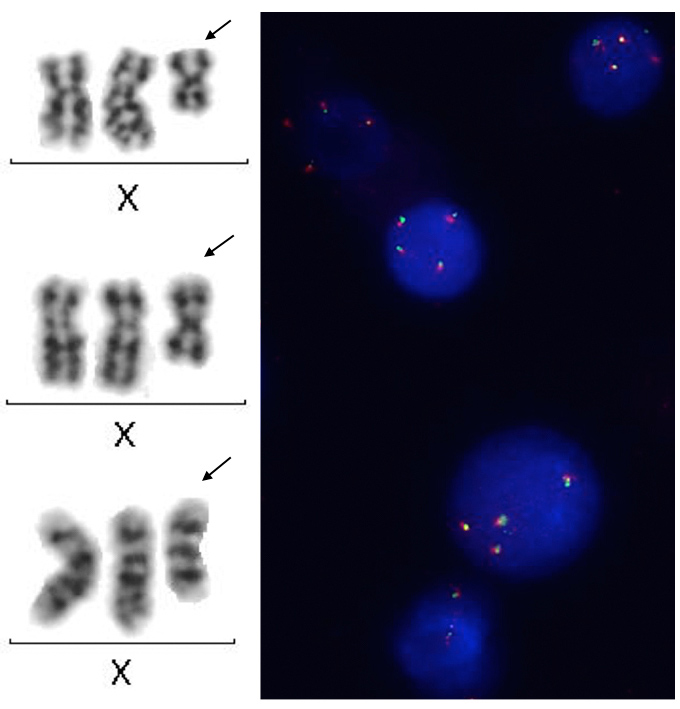
Figure 2. Partial karyotypes with extra i(X)(p10); Fluorescence in situ hybridization (FISH) with BreakApart CRLF2/Xp22.33 (CytoCell, UK) showing two normal X chromosomes and extra i(X)(p10) (4 fusion signals on interphase cells) in female patient with post-transplant relapse of ALL (Gindina, #23, table 1)
Probes
CRLF2 BreakApart (CytoCell, UK)
Additional anomalies
Sole abnormality in 11 patients, mostly in myeloid neoplasms (4 MDS, 3 AML, 2 CMML). Double extra i(X)(p10) was present in 4 patients (Selleri et al., 1989; Adeyinka et al., 2007; Hagemeier et al., 1981; Fitzerald et al., 1983). Additional chromosome anomalies were observed in 2/3 patients. Associated in combination with extra chromosome 8 in 5 females (Barbouti et al., 2002; Hagemeier et al., 1981; Dewald et al., 1989; Adeyinka et al., 2007), idic(X)(q13) in 2 (Dewald et al., 1989), del(20q) in 3 (Nacheva et al., 1995; Preiss et al., 2010; Falzetti et al., 1999), extra chromosome 20in 2 (Hagemeier et al., 1981;), loss of chromosome 7 in 2 (Lugthart et al., 2010; Schlegelberger et al. 1994), del(7q) in 2 (Falzetti et al., 1999; Schlegelberger et al. 1994), ring chromosome in 2 (Adeyinka et al., 2007; Temperani et al, 1995), other isochromosomes in 3 (Barbouti et al., 2002; Schlegelberger et al. 1994, Adeyinka et al., 2007).
In lymphoid malignancies, i(X)(p10) is part of a complex karyotype and seems to be a secondary event.
In lymphoid malignancies, i(X)(p10) is part of a complex karyotype and seems to be a secondary event.
Genes Involved and Proteins
Result of the Chromosomal Anomaly
Oncogenesis
The pathogenetic importance of i(X)(p10) is underscored by its presence as the sole acquired anomaly. The major consequence of this abnormality is loss of the X q-arm and gain of the X p-arm, this would translate to loss of several genes on Xq and gain of several genes on Xp, that leads to genetic imbalance. I(X)(p10) has been reported in occasional males, indicating that this aberration can arise from active X chromosomes. It is not known whether this anomaly arises randomly from the active or inactive X chromosome in female patients (Adeyinka et al, 2007).
Article Bibliography
| Pubmed ID | Last Year | Title | Authors |
|---|---|---|---|
| 17981211 | 2007 | Isochromosome (X)(p10) in hematologic disorders: FISH study of 14 new cases show three types of centromere signal patterns. | Adeyinka A et al |
| 14580775 | 2003 | A case of Down syndrome with acute lymphoblastic leukemia and isochromosome Xp. | Baker JM et al |
| 16573742 | 2006 | Prospective study of 174 de novo acute myelogenous leukemias according to the WHO classification: subtypes, cytogenetic features and FLT3 mutations. | Bao L et al |
| 12203776 | 2002 | Multicolor COBRA-FISH analysis of chronic myeloid leukemia reveals novel cryptic balanced translocations during disease progression. | Barbouti A et al |
| 19631982 | 2010 | Analyses on clinical characteristic and prognoses of 41 patients with chronic myelomonocytic leukemia in China. | Chen B et al |
| 2790752 | 1989 | Twenty-six patients with hematologic disorders and X chromosome abnormalities. Frequent idic(X)(q13) chromosomes and Xq13 anomalies associated with pathologic ringed sideroblasts. | Dewald GW et al |
| 10190942 | 1999 | Genomic instability and recurrent breakpoints are main cytogenetic findings in Hodgkin's disease. | Falzetti D et al |
| 6572548 | 1983 | Nonrandom cytogenetic changes in New Zealand patients with acute myeloid leukemia. | Fitzgerald PH et al |
| 6944153 | 1981 | Cytogenetic follow-up of patients with nonlymphocytic leukemia. II. Acute nonlymphocytic leukemia. | Hagemeijer A et al |
| 6490390 | 1984 | Chromosome instability is associated with hypodiploid clones in myelodysplastic syndromes. | Knuutila S et al |
| 20660833 | 2010 | Clinical, molecular, and prognostic significance of WHO type inv(3)(q21q26.2)/t(3;3)(q21;q26.2) and various other 3q abnormalities in acute myeloid leukemia. | Lugthart S et al |
| 15334543 | 2004 | Structural integrity and expression of the L3MBTL gene in normal and malignant hematopoietic cells. | MacGrogan D et al |
| 7736443 | 1995 | Characterization of 20q deletions in patients with myeloproliferative disorders or myelodysplastic syndromes. | Nacheva E et al |
| 20875873 | 2010 | Cytogenetic findings in adult secondary acute myeloid leukemia (AML): frequency of favorable and adverse chromosomal aberrations do not differ from adult de novo AML. | Preiss BS et al |
| 11979552 | 2002 | t(1;3)(p36;p21) is a recurring therapy-related translocation. | Sato Y et al |
| 8289502 | 1994 | Cytogenetic findings and results of combined immunophenotyping and karyotyping in Hodgkin's disease. | Schlegelberger B et al |
| 2733455 | 1989 | Philadelphia-positive chronic myelogenous leukemia with typical bcr/abl molecular features and atypical, prolonged survival. | Selleri L et al |
| 7553581 | 1995 | Chromosome rearrangements at telomeric level in hematologic disorders. | Temperani P et al |
Summary
Class disease
NHL
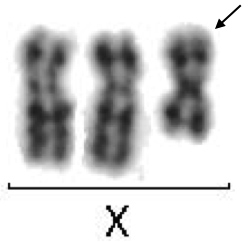
Figure 1 Partial karyotype with extra i(X)(p10)
Citation
Tatiana Gindina
i(X)(p10) in female patients
Atlas Genet Cytogenet Oncol Haematol. 2016-12-01
Online version: http://atlasgeneticsoncology.org/haematological/1500/submit-meetings/haematological-explorer/teaching-explorer/
