t(X;7)(q22;q34) IRS4/TRB
2012-06-01 Kristina Karrman Affiliation1.Department of Clinical Genetics, Lund University Hospital, SE-221 85 Lund, Sweden
Clinics and Pathology
Epidemiology
Very rare.
Clinics
A 12-year-old boy presented with a white blood cell count of 130 x 109/l and haemoglobin of 97g/l. The bone marrow was dominated by lymphoblasts positive for CD2, CD7 and CD3 but negative for CD4 and CD8. A diagnose of T-cell acute lymphoblastic leukaemia was made.
Cytology
Lymphoblasts; positive for CD2/CD3/CD7, negative for CD4/CD8.
Cytogenetics
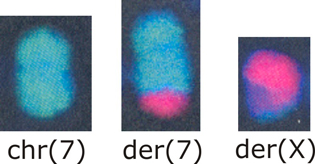
The reciprocal nature of the t(X;7) was confirmed with metaphase FISH using the Poseidon whole chromosome probes (Kreatech Diagnostics, Amsterdam, The Netherlands) for chromosomes 7 (green) and X (red).
Cytogenetics morphological
t(X;7)(q22;q34)
Cytogenetics molecular
Rearrangement of the TRB@ and IRS4 loci was detected by FISH. Probes used for detecting TRB@ rearrangement: RP11-1220K2 and RP11-556I13. Probes used for detecting IRS4 rearrangement: RP11-815E21 and RP11-105F23. RQ-PCR and Western blot analysis confirmed overexpression of IRS4 at the gene and protein level.
Additional anomalies
Deletion of 6q, STIL/TAL1 fusion and NOTCH1 mutation.
Genes Involved and Proteins
Gene name
IRS4 (insulin receptor substrate 4)
Location
Xq22.3
Note
The IRS family includes IRS1-4 which play a central role in maintaining basic cellular functions, e.g., growth and metabolism. They act as mediators between multiple growth factor receptors that possess tyrosine kinase activity, such as the insulin and insulin growth factor receptors, and a complex network of intracellular signalling molecules, resulting in activation of, for example, the PI3K and RAS/ERK pathways and subsequent transcription of target genes. Relatively little is known about the tumorigenic potential of the IRS proteins. Expression of IRS1, IRS2 or IRS4 in the 32D haematopoietic cell line leads to proliferation of the myeloid progenitor cells and expression of activated IRS4 has recently been demonstrated in the human hepatoblastoma cell line HepG2, with inhibition of IRS4 resulting in diminished growth.
Gene name
TRB (T cell Receptor Beta)
Location
7q34
Result of the Chromosomal Anomaly
Note
The translocation does not result in a fusion gene. The t(X;7) results in juxtaposition of the TRB@ to the IRS4 leading to dysregulation of IRS4.
Article Bibliography
| Pubmed ID | Last Year | Title | Authors |
|---|---|---|---|
| 19055661 | 2009 | The t(X;7)(q22;q34) in paediatric T-cell acute lymphoblastic leukaemia results in overexpression of the insulin receptor substrate 4 gene through illegitimate recombination with the T-cell receptor beta locus. | Karrman K et al |
Summary
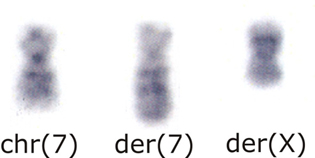
Partial karyotype of the t(X;7)(q22;q34) showing the normal chromosome 7 (chr(7)), the der(7)t(X;7) and the der(X)t(X;7).
Citation
Kristina Karrman
t(X;7)(q22;q34) IRS4/TRB
Atlas Genet Cytogenet Oncol Haematol. 2012-06-01
Online version: http://atlasgeneticsoncology.org/haematological/1610/t(x
