Follicular lymphomas of germinal center (B- or T-cell) origin
2017-09-01 Annunziata Gloghini , Antonino Carbone Affiliation1.Department of Pathology Centro di Riferimento Oncologico Aviano (CRO), Istituto Nazionale Tumori, IRCCS, Aviano, Italy; [email protected] (AC); Department of Diagnostic Pathology and Laboratory Medicine, Fondazione IRCCS Istituto Nazionale dei Tumori, Milano, Italy; [email protected] (AG)
Abstract
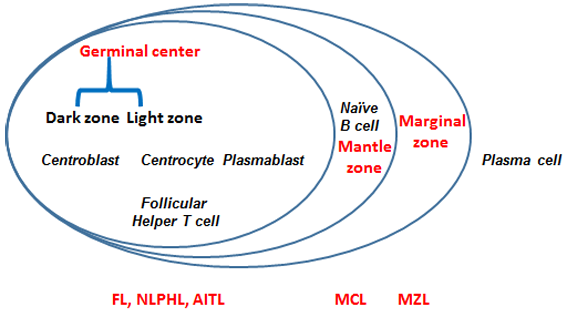
Follicular lymphomas of germinal center (B- or T-cell) origin include follicular lymphoma (FL), nodular lymphocyte predominant Hodgkin lymphoma (NLPHL), and angioimmunoblastic T-cell lymphoma (AITL).Other lymphomas of presumed follicular origin comprise mantle cell lymphoma (MCL) and marginal zone lymphoma (MZL) (Fig. 1). In this article we describe the clinical, pathological and genetic features of follicular lymhomas of germinal center (B- or T-cell) origin.
Clinics and Pathology
Disease
Pathology
In in situ follicular neoplasia the neoplastic cells are localized "in the place" that is occupied by the normal counterpart of the tumour cell, without invasion of surrounding structures (Carbone and Santoro, 2011; Carbone and Gloghini, 2014 A). The abnormal follicles involved by in situ follicular neoplasia have monotonous-appearing GCs surrounded by well-preserved mantle zones. The intrafollicular BCL2 positive GC B cells are located within the meshwork of the CD23+ FDC and coexpress CD10, BCL6 and CD20 and are CD3 negative. The proliferation index rate, as assessed by Ki67, is low. The FDC meshwork usually form a well-developed "spherical" dendritic meshwork with a sharp outline highlighting well-preserved mantle zone. Other patterns that can be seen include contracted/distorted /disintegrated FDC meshworks.
As compared with in situ follicular neoplasia, the follicles involved by overt FL usually have thinner mantle zones and higher proliferation index rate. However, they have a similar FDC pattern with a well-developed round spherical meshwork.
Other features of NLPHL are reported in the specific article/section of the Atlas of Genetics and Cytogenetics in Oncology and Haematology.
Follicular lymphomas of germinal center T-cell origin.
AITL. AITL is a peripheral T-cell lymphoma characterized by a prominent proliferation of high endothelial venules. In early lymph-node involvement by AITL, the neoplastic T cells preferentially occupy the B-cell follicles sometimes mimicking a FL of B-cell origin (Carbone and Gloghini, 2014 B). AITL tumour cells show the phenotype of normal follicular helper T cells. For the designation of AITL, the neoplastic cells should express at least 2 or 3 TFH-related antigens, including CD279/PD1, CD10, BCL6, CXCL13, ICOS, SAP, and CCR5 (reviewed in Swerdlow et al, 2016). Typically, the tumour cells of AITL also express CD3 and CD4. The CD4+ tumour cells represent a minority of the neoplastic cell population, their detection being facilitated by the co-expression of CD10. Neoplastic CD4+ T cells of AITL are admixed with B cells, eosinophils and plasma cells.

Evolution
FL is the most common subtype of indolent lymphomas. It is characterized by relapses and remissions, usually controlled by Rituximab. On clinical progression, whether FL histology remains indolent or has become aggressive is an important issue: the relevant salvage therapy is selected based on histology, and a watchful waiting strategy can be adopted if the histology remains indolent (Tomita, 2017). It has been reported that 30-40% of FL cases transform into an aggressive lymphoma (tFL) with a poor prognosis (Bouska et al., 2017). An analysis of lymphoma cell specimens at histological transformation has identified multiple transformation-associated abnormalities, such as MYC upregulation, TP53 mutation and changes in the tumour microenvironment (Kahl and Yang, 2016). Transformation to aggressive lymphoma is a critical event in the clinical course of patients affected by FL. Yet, it is a challenge to reliably predict transformation at the time of diagnosis. However, we are currently lacking a prognostic index that would specifically address transformation rather than disease progression or overall survival (Kridel et al., 2017).
Regarding NLPHL, clinic and pathologic observations have demonstrated that it may evolve to a completely diffuse T-cell-rich proliferation resembling a THCRLBCL. The 2016 revision of WHO classification has recommended the designation of these cases as THCRLBCL-like transformation of NLPHL (Swerdlow et al., 2016).
Clinical features of AITL are reported in the specific article/section of the Atlas of Genetics and Cytogenetics in Oncology and Haematology.
Note
Table 1 shows genetic alterations of clinical value in follicular lymphoma (FL) and diffuse large B-cell lymphoma (DLBCL), of the GC B-cell origin type).
Table 1.
| Disease subtype | Genes | Normal function | Technology used to detect | Genotype-directed therapy |
| FL/GCB DLBCL | BCL2 | Antiapoptotic | FISH | Venetoclax |
| KMT2D/MLL2 | H3K4 methyltransferase | Sequencing | ||
| CREBBP | Histone acetyltransferase | Sequencing | Trials of HDAC inhibitors | |
| EP300 | Histone acetyltransferase | Sequencing | ||
| EZH2 | H3K27 methyltransferase | Sequencing | Trials of EZH2 inhibitors | |
| MEF2B | Transcription factor | Sequencing |
Modified and adapted from Taylor et al., (2017).
Genetic features of NLPHL are reported in the specific article/section of the Atlas of Genetics and Cytogenetics in Oncology and Haematology.
Recurrent genetic abnormalities in AITL include TET2, IDH2, DNMT3A, RHOA, and CD28 mutations, as well as gene fusions such as ITK/SYK or CTLA4 / CD28 (Leclaire Alirkilicarslan et al., 2017). All these abnormalities have a role in the process of lymphomagenesis and may represent the target of tailored therapies (reviewed in Swerlow et al., 2016).
Genes Involved and Proteins
Article Bibliography
| Pubmed ID | Last Year | Title | Authors |
|---|---|---|---|
| 12881319 | 2003 | Nodular lymphocyte-predominant Hodgkin lymphoma with nodules resembling T-cell/histiocyte-rich B-cell lymphoma: differential diagnosis between nodular lymphocyte-predominant Hodgkin lymphoma and T-cell/histiocyte-rich B-cell lymphoma. | Boudová L et al |
| 27389057 | 2017 | Combined copy number and mutation analysis identifies oncogenic pathways associated with transformation of follicular lymphoma. | Bouska A et al |
| 18794340 | 2008 | Origin and pathogenesis of nodular lymphocyte-predominant Hodgkin lymphoma as revealed by global gene expression analysis. | Brune V et al |
| 21300984 | 2011 | The 2008 WHO classification of lymphoid neoplasms and beyond: evolving concepts and practical applications. | Campo E et al |
| 28621881 | 2017 | Hodgkin lymphoma classification: Are we at a crossroads? | Carbone A et al |
| 23349009 | 2013 | Nodular lymphocyte predominant Hodgkin lymphoma with non-invasive or early invasive growth pattern suggests an early step of the disease with a highly favorable outcome. | Carbone A et al |
| 26989204 | 2016 | Follicular lymphoma: evolving therapeutic strategies. | Kahl BS et al |
| 28408460 | 2017 | Can histologic transformation of follicular lymphoma be predicted and prevented? | Kridel R et al |
| 28945625 | 2017 | Expression of TFH Markers and Detection of RHOA p.G17V and IDH2 p.R172K/S Mutations in Cutaneous Localizations of Angioimmunoblastic T-Cell Lymphomas. | Leclaire Alirkilicarslan A et al |
| 26980727 | 2016 | The 2016 revision of the World Health Organization classification of lymphoid neoplasms. | Swerdlow SH et al |
| 28600336 | 2017 | Diagnosis and classification of hematologic malignancies on the basis of genetics. | Taylor J et al |
Summary
Note
Citation
Annunziata Gloghini ; Antonino Carbone
Follicular lymphomas of germinal center (B- or T-cell) origin
Atlas Genet Cytogenet Oncol Haematol. 2017-09-01
Online version: http://atlasgeneticsoncology.org/haematological/1781/follicular-lymphomas-of-germinal-center-(b-or-t-cell)-origin
