Follicular dendritic cell in lymphomas of follicular origin
2018-06-01 Annunziata Gloghini , Antonino Carbone Affiliation1.Department of Pathology Centro di Riferimento Oncologico Aviano (CRO), Istituto Nazionale Tumori, IRCCS, Aviano, Italy; [email protected] (AC); Department of Diagnostic Pathology and Laboratory Medicine, Fondazione IRCCS Istituto Nazionale dei Tumori, Milano, Italy; [email protected] (AG)
2.Department of Pathology Centro di Riferimento Oncologico Aviano (CRO), Istituto Nazionale Tumori, IRCCS, Aviano, Italy; [email protected] (AC); Department of Diagnostic Pathology and Laboratory Medicine, Fondazione IRCCS Istituto Nazionale dei Tumori, Milano, Italy; [email protected] (AG)
Abstract
B-cell lymphomas of presumed follicular origin include follicular lymphoma (FL), mantle cell lymphoma (MCL) and marginal zone lymphoma (MZL). Within the microenvironment of all these follicle-derived lymphomas tumor cells show a strict topographical and functional relationship with FDCs, together with reactive lymphoid and stromal cells. The FDC patterns, as described for FL and MCL, are reminiscent of the distribution pattern of FDC meshwork seen in the GC or the mantle zone of the secondary lymphoid follicle, respectively.
Clinics and Pathology
Noted
Follicular dendritic cells (FDCs) are stromal cells of mesenchymal origin, located in the peripheral lymphoid tissues, particularly in the B-cell-dependent areas, i.e. in lymphoid primary follicles (primary FDCs) or in secondary follicles (secondary FDCs) (Allen et al., 2008; Rezk et al., 2013). The lymphoid follicle is a structure made of B and T lymphoid cells within a meshwork of FDCs. In the secondary lymphoid follicle, rounded collections of cohesive FDCs are seen in the germinal center (GC), whereas irregularly shaped meshworks of poorly cohesive FDCs are evident in the mantle zone (Tsunoda et al., 1999). Therefore, the patterns of FDC distribution, usually recognizable in secondary lymphoid follicles, include a tight/dense meshwork pattern with a polarized FDC meshwork pattern in the GC, and an expanded FDC meshwork with extension into the mantle zones (Rezk et al., 2013).
Classic FDC immunophenotype includes the expression of CD21, CD23, and CD35. Other markers reported to be highly sensitive but not specific to FDCs include S-100 protein (Carbone et al., 1986), clusterin (Grogg et al., 2004) and podoplanin (Yu et al. 2007). FDCs main functions comprise: histoarchitecture organization of lymphoid follicles, antigen trapping and presentation, organization of apoptotic "waste" removing, and self-immunity prevention. Organizing functions of FDCs are chemokine dependent (Carbone and Gloghini 2014).
B-cell lymphomas of follicular origin: classification
B-cell lymphomas of presumed follicular origin include follicular lymphoma (FL), mantle cell lymphoma (MCL) and marginal zone lymphoma (MZL). Within the microenvironment of all these follicle-derived lymphomas tumor cells show a strict topographical and functional relationship with FDCs, together with reactive lymphoid and stromal cells (Carbone et al. 2009; Rezk et al., 2013). The FDCs are thought to represent newly generated cells arising during lymphoma growth and progression, although they remain non-neoplastic bystander cells (Jin et al., 2011). The FDC patterns, as described for FL and MCL, (Manconi et al., 1988; Gloghini and Carbone 1993) are reminiscent of the distribution pattern of FDC meshwork seen in the GC or the mantle zone of the secondary lymphoid follicle, respectively (Carbone et al., 1988). The FDC patterns shown by FL and the other lymphomas of follicular origin have recently been reviewed (Rek et al., 2013).
Disease
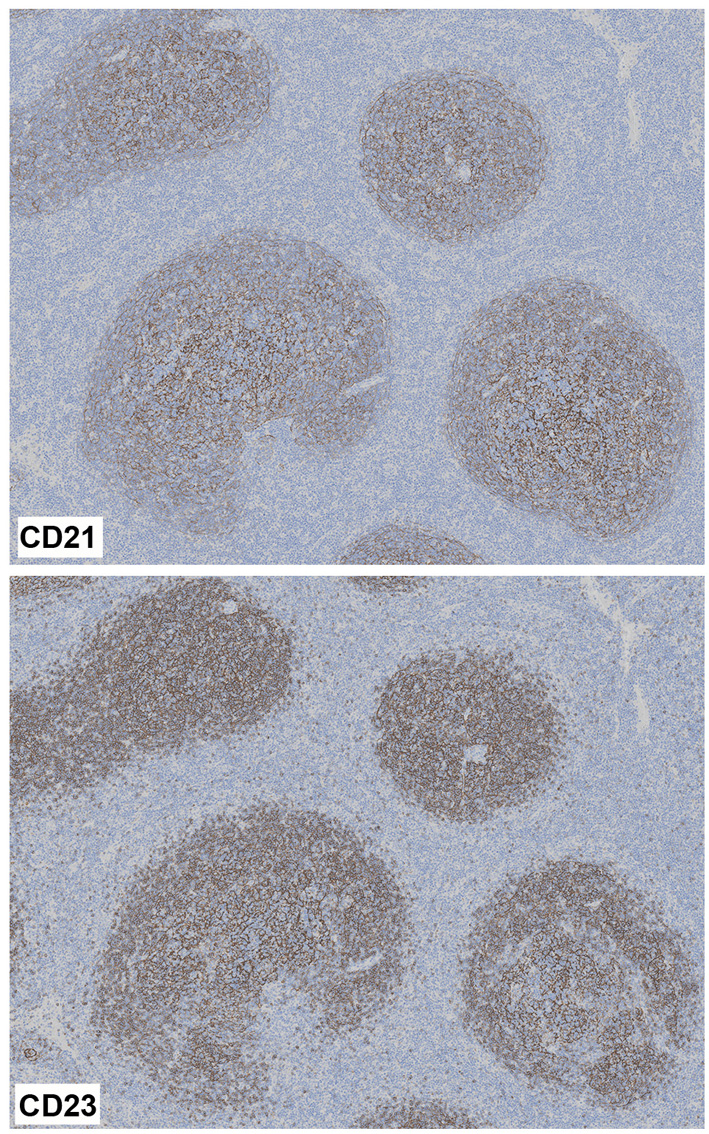
FLs are derived from GC B cells and usually express BCL2 as a result of the characteristic t(14;18)(q32;q21) IGH/ BCL2 translocation. A pathologic diagnosis requires immunohistologic detection of neoplastic B cells that show positive staining for BCL2 and CD10. The FDC meshwork usually form a well-developed "spherical" dendritic meshwork with a sharp outline highlighting an attenuated mantle zone (Figure 1). Other patterns that can be seen include contracted/distorted/disintegrated FDC meshworks (Rezk et al., 2013; Carbone and Gloghini 2014). , When there is a nodular growth pattern with residual GCs, obviously the reactive GCs have preserved tight FDC meshworks, whereas neoplastic zones show a disrupted and fragmented FDC meshwork. Conversely, as the expansion of the neoplastic mantle zones continue outward, MCL neoplastic nodules with absent FDC meshworks and negative staining for CD21 and CD23 are formed (Carbone and Gloghini 2014). , The FDC meshwork is variably distorted and disintegrated when there is a follicular colonization (Rez et al., 2013; Carbone and Gloghini, 2014; Cook et al., 2017; Campo et al., 2017). The presence of remnants of FDC meshwork suggests colonized follicles (Rez et al., 2013; Carbone and Gloghini, 2014).The FDC meshwork is more evident in cases with a nodular/follicular pattern (Figure 3).
Disease
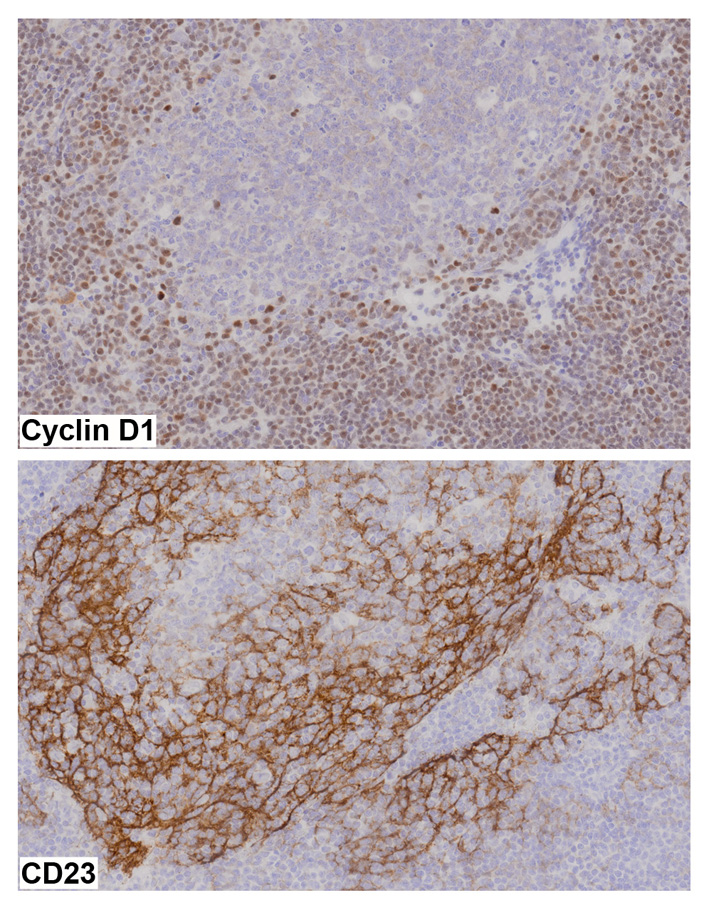
MCL is a B-cell neoplasm that usually carries the characteristic t(11;14)(q13;q32) translocation that juxtaposes the protooncogene CCND1, which encodes cyclin D1, at chromosome 11q13, to the Ig heavy-chain gene at chromosome 14q32.25 The typical antigen profile in this lymphoma includes the coexpression of CD5 and CD20 in the absence of CD3, CD10, and CD23 expresssion. Several growth patterns may be observed in MCL. They include a nodular growth pattern with residual GCs, a nodular growth pattern without residual GCs, a nodular growth pattern due to the colonization of reactive GCs, and a diffuse pattern with or without residual GCs (Campo et al., 2011). The t(11;14) translocation is the primary event of the B lymphocyte transformation that is followed by colonization and expansion of the mantle cell area of the lymphoid follicles (Figure 2).
Disease
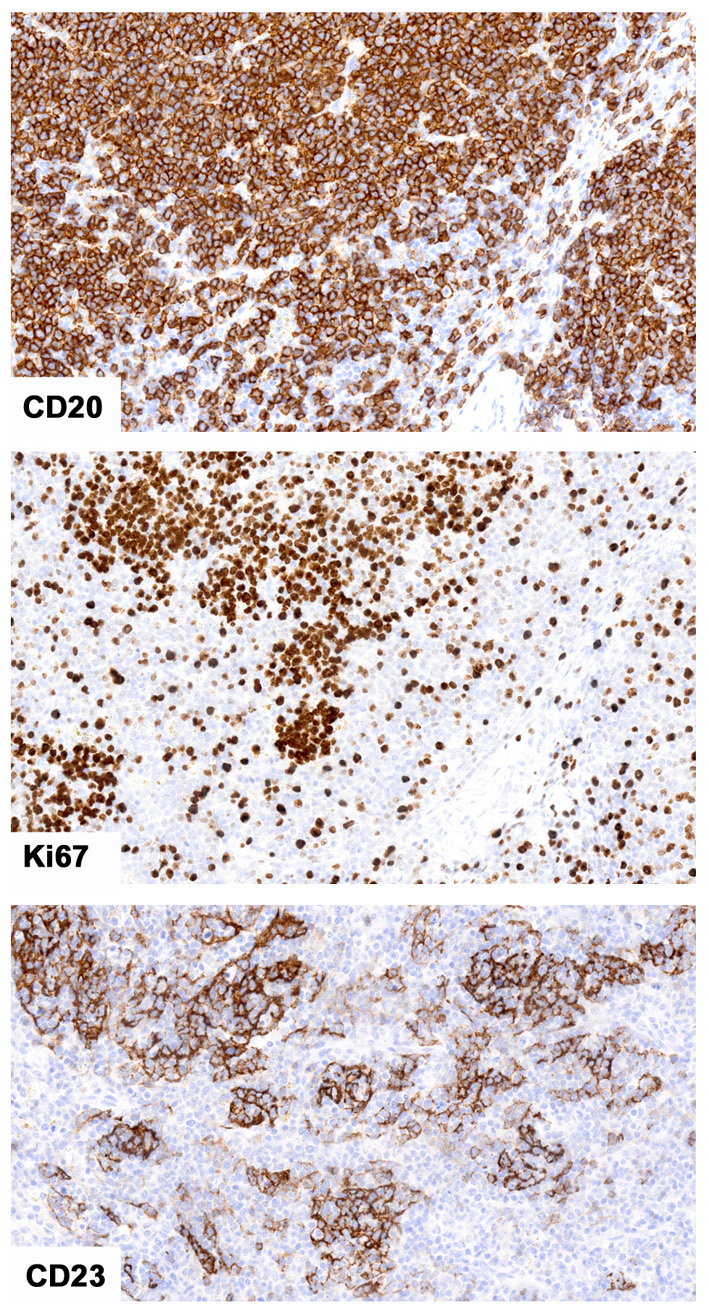
MZL is a B-cell lymphoma that is supposed to derive from the marginal zone. It encompasses 3 distinct entities known as mucosa-associated lymphatic tissue (MALT) lymphoma, nodal MZL (NMZL), and splenic MZL (SMZL) (Cook et al., 2017; Campo et al, 2017). Among these B-cell lymphomas, early lesions may be observed within the subsets of NMZL and SMZL with tumor cells growing inside an attenuated mantle zone and often around a residual GC. Immunohistochemical studies show that in all MZL entities neoplastic B cells express CD20, CD43, and BCL2, but not CD3, CD5, CD10, and CD23 (Carbone et al. 1986; Rezk et al., 2013).
Genes Involved and Proteins
Article Bibliography
| Pubmed ID | Last Year | Title | Authors |
|---|---|---|---|
| 20853499 | 2010 | Characterizing follicular dendritic cells: A progress report. | Aguzzi A et al |
| 18261920 | 2008 | Follicular dendritic cell networks of primary follicles and germinal centers: phenotype and function. | Allen CD et al |
| 21300984 | 2011 | The 2008 WHO classification of lymphoid neoplasms and beyond: evolving concepts and practical applications. | Campo E et al |
| 24911251 | 2014 | Follicular dendritic cell pattern in early lymphomas involving follicles. | Carbone A et al |
| 3530426 | 1986 | S-100 protein, fibronectin, and laminin immunostaining in lymphomas of follicular center cell origin. | Carbone A et al |
| 8418015 | 1993 | The nonlymphoid microenvironment of reactive follicles and lymphomas of follicular origin as defined by immunohistology on paraffin-embedded tissues. | Gloghini A et al |
| 15252304 | 2004 | Clusterin expression distinguishes follicular dendritic cell tumors from other dendritic cell neoplasms: report of a novel follicular dendritic cell marker and clinicopathologic data on 12 additional follicular dendritic cell tumors and 6 additional interdigitating dendritic cell tumors. | Grogg KL et al |
| 21401698 | 2011 | Follicular dendritic cells in follicular lymphoma and types of non-Hodgkin lymphoma show reduced expression of CD23, CD35 and CD54 but no association with clinical outcome. | Jin MK et al |
| 3280004 | 1988 | Dendritic reticulum cell pattern as a microenvironmental indicator for a distinct origin of lymphoma of follicular mantle cells. | Manconi R et al |
| 23332930 | 2013 | Follicular dendritic cells: origin, function, and different disease-associated patterns. | Rezk SA et al |
| 10487838 | 1999 | Differential expression of Ca(2+)-binding proteins on follicular dendritic cells in non-neoplastic and neoplastic lymphoid follicles. | Tsunoda T et al |
| 17951199 | 2007 | Podoplanin (D2-40) is a novel marker for follicular dendritic cell tumors. | Yu H et al |
Citation
Annunziata Gloghini ; Antonino Carbone
Follicular dendritic cell in lymphomas of follicular origin
Atlas Genet Cytogenet Oncol Haematol. 2018-06-01
Online version: http://atlasgeneticsoncology.org/haematological/1783/follicular-dendritic-cell-in-lymphomas-of-follicular-origin
