Abstract
Review on t(5;9)(q35;q34), with data on clinics, and the genes involved.
Clinics and Pathology
Disease
T-cell acute lymphoblastic leukemia and acute myeloid leukemia.
Clinics
The t(5;9)(q35;q34) SQSTM1/NUP214 was found in a 12-year old boy with early T-cell precursor acute lymphoblastic leukaemia (lack of expression of the T-lineage cell surface markers CD1a and CD8, weak or absent expression of CD5, aberrant expression of myeloid and haematopoietic stem cell markers). Outcome: the patient was alive at the time of the report (Zhang et al. 2012), in a 20-year old man, with a chemoresistant pre-T ALL (CD3+, CD7+, CD5+, CD34+, CD33+, cKit+) who died 16 months after diagnosis (Gorello et al., 2010), and in a pediatric acute myeloid leukemia not otherwise specified (AML-NOS) case; outcome was remission (Brown et al., 2017)
Cytogenetics
Cytogenetics morphological
Cryptic unbalanced translocation (Gorello et al., 2010).
Genes Involved and Proteins
Gene name
SQSTM1 (sequestosome 1)
Location
5q35.3
Protein description
440 amino acids (aa). SQSTM1 (sequestosome 1), also called p62, is a scaffolding protein with several interaction domains; it is composed of an OPR domain (octatricopeptide repeat (PB1 dimerization domain)), a Zn finger, a LIM protein-binding region, a TRAF6-binding motif, a PEST sequence (proline, glutamic acid, serine, and threonine rich), a LIR motif (LC3 interaction region, SGGDDDWTHLSS), a second PEST sequence, a KIR (keap1 interacting region), and an UBA (ubiquitin-associated) domain. Interacts with Caspase-8 and the apoptosis, machinery, MAPK kinases such as MAP2K5 (15q23), LCK (1p34), NBR1 (17q21), PRKCI (3q26), PAWR (12q21), RIPK1 (6p25), TRAF6 (11p12) and NTRK1 (1q23) and the NF-kappaB pathway, KEAP1 (19p13), GABARAPL1 (12p13), MAP1LC3A/LC3 (20q11), and ubiquitin. Mediates the interaction between TRAF6 and CYLD (16q12). Implicated in the activation of the transcription factor NF-kappaB. Involved in the autophagy-lysosome pathway. Plays a role in the formation of cytoplasmic proteinaceous inclusions in various pathologic situations where autophagy is inactivated (Geetha and Wooten, 2002; Lamark et al., 2009; Moscat and Diaz-Meco, 2009; Moscat et al., 2009; Ichimura and Komatsu, 2010; Komatsu and Ichimura, 2010; Moscat and Diaz-Meco, 2011).
Germinal mutations
Mutated in Pagets disease of bone.
Gene name
NUP214 (nucleoporin 214kDa)
Location
9q34.13
Note
The previous name of NUP214 was CAN.
Protein description
2090 aa; contains dimerization domains (leucine zippers and FG repeats). The NUP214 N-terminal domain (NTD, aa 1-450) is composed of the seven-bladed β-propeller domain (aa 41-405), with, in particular, the 6D7A loop, an inter-blade connector loop that encompasses 20 residues (aa 342-361: LLEDSSRAELPVTDKSDDSL), followed by the 30-residue C-terminal extension (CTE aa 405-434) that binds to the bottom face of the β-propeller, followed by a flexible linker, the coiled-coil domain (aa 680-1209) with two leucine-zippers (aa 740-768 and 861-882), and the C-terminal region with numerous FG-repeats (phenylalanine-glycine repeat motifs, aa 1809-2090). The CTE contains several putative phosphorylation sites, including Ser-430 and Thr-437. Component of the nuclear pore complex involved in nucleo-cytoplasmic transport. NUP214 is localized in the nuclear membrane, on the cytoplasmic face of the nucleopore complex. NUP214, NUP88 and XPO1 form a subcomplex which anchors the cytoplasmic fibrils to the nuclear pore complex.
Protein description
The N-terminal region of NUP214 is involved in mRNA export: it has been found to interact with the DEAD box helicase DDX19, and mutations in DDX19 that disrupt binding to NUP214 inhibit mRNA export The 6D7A loop of the NUP214 NTD is required for complex formation with DDX19. (Köser et al., 2005; Napetschnig et al., 2007; Napetschnig et al., 2009).
Result of the Chromosomal Anomaly
Description
SQSTM1 nucleotide 849 (exon 5) is fused in-frame to NUP214 nucleotide 6014 (exon 33). Same breakpoints in Zhang et al. 2012 and in Gorello et al., 2010.
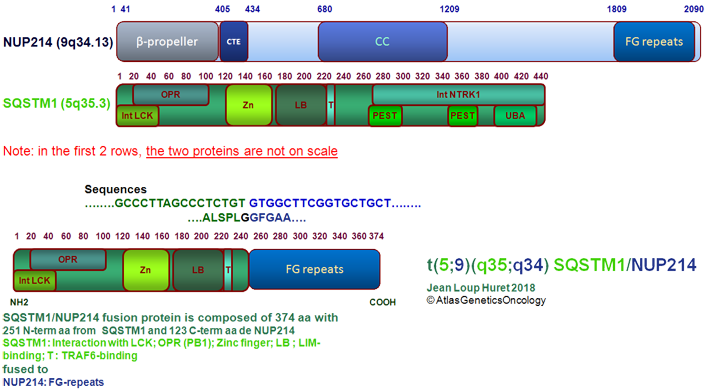
NUP214, SQSTM1, and SQSTM1/NUP214 fusion protein.
Description
SQSTM1/NUP214 fusion protein is composed of 374 aa with 251 N-term aa from SQSTM1 and 123 C-term aa de NUP214. Interaction domain with LCK; OPR; Zinc finger; LIM-binding; and TRAF6-binding domains from SQSTM1 are fused to (only) 14 of the 44 FG repeats of NUP214. SQSTM1/NUP214 had not maintained the entire XPO1 binding domain of NUP214, and other mechanisms might be implicated in the leukemogenic process (Gorello et al., 2010).
Highly cited references
| Pubmed ID | Year | Title | Citations |
|---|---|---|---|
| 30669574 | 2019 | NUP214 in Leukemia: It's More than Transport. | 148 |
| 27613868 | 2016 | The Oncogenic Fusion Proteins SET-Nup214 and Sequestosome-1 (SQSTM1)-Nup214 Form Dynamic Nuclear Bodies and Differentially Affect Nuclear Protein and Poly(A)+ RNA Export. | 66 |
| 25120641 | 2014 | NUP214 fusion genes in acute leukemia (Review). | 52 |
| 32343715 | 2020 | The SQSTM1-NUP214 fusion protein interacts with Crm1, activates Hoxa and Meis1 genes, and drives leukemogenesis in mice. | 42 |
| 20851865 | 2010 | SQSTM1-NUP214: a new gene fusion in adult T-cell acute lymphoblastic leukemia. | 11 |
Article Bibliography
| Pubmed ID | Last Year | Title | Authors |
|---|---|---|---|
| 27766616 | 2017 | Genomics of primary chemoresistance and remission induction failure in paediatric and adult acute myeloid leukaemia. | Brown FC et al |
| 11852044 | 2002 | Structure and functional properties of the ubiquitin binding protein p62. | Geetha T et al |
| 20851865 | 2010 | SQSTM1-NUP214: a new gene fusion in adult T-cell acute lymphoblastic leukemia. | Gorello P et al |
| 20814791 | 2010 | Selective degradation of p62 by autophagy. | Ichimura Y et al |
| 20153326 | 2010 | Physiological significance of selective degradation of p62 by autophagy. | Komatsu M et al |
| 19502794 | 2009 | NBR1 and p62 as cargo receptors for selective autophagy of ubiquitinated targets. | Lamark T et al |
| 19713972 | 2009 | Of the atypical PKCs, Par-4 and p62: recent understandings of the biology and pathology of a PB1-dominated complex. | Moscat J et al |
| 19208808 | 2009 | Structural and functional analysis of the interaction between the nucleoporin Nup214 and the DEAD-box helicase Ddx19. | Napetschnig J et al |
| 22237106 | 2012 | The genetic basis of early T-cell precursor acute lymphoblastic leukaemia. | Zhang J et al |
Summary
Fusion gene
SQSTM1/NUP214
Citation
Jean-Loup Huret
t(5;9)(q35;q34) SQSTM1/NUP214
Atlas Genet Cytogenet Oncol Haematol. 2018-08-01
Online version: http://atlasgeneticsoncology.org/haematological/1833/t(5
