Identity
HGNC
LOCATION
6q21
LOCUSID
ALIAS
HD2,KDAC2,RPD3,YAF1
FUSION GENES
DNA/RNA
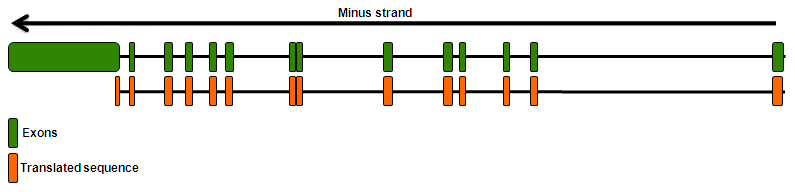
Description
The HDAC2 gene is composed of 14 exons that span 35.029 bp of genomic DNA.
Transcription
The length of the transcribed mRNA is about 6659 bp.
Pseudogene
No pseudogene has been described.
Proteins
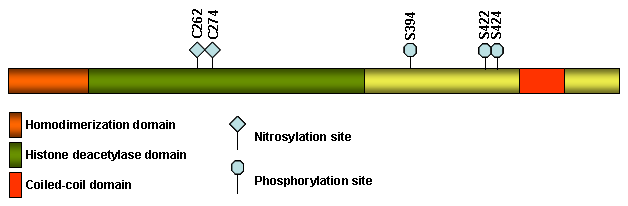
Description
There are two proteins variants of 488 and 582 aa due to distinct pre-mRNA splicing events. The N-terminal tail of the protein contains the catalytic domain that comprises most of the protein. The N-terminal domain also has a HDAC association domain (HAD) essential for homo- and heterodimerization. A coiled-coil domain essential for protein-protein interactions is present at the C-terminal tail. It also contains three phosphorylation sites at Ser394, Ser422 and Ser424, and two S-nitrosylation sites at Cys262 and Cys274.
Expression
Widely expressed.
Localisation
Nucleus.
Function
HDAC2 belongs to class I histone deacetylases that also comprise HDAC1, HDAC3 and HDAC8. HDAC2 acts as a transcriptional repressor through the desacetylation of lysine residues present at the N-terminal tail of histone proteins (H2A, H2B, H3 and H4). HDAC2 heterodimerise with HDAC1, but the heterodimer cannot bind to DNA, so they have to be recruited by transcription factors such as YY1, SP1/SP3, the tumor suppressor genes p53 and BRCA1. HDAC2 can also be tethered to DNA as a part of the multiprotein corepressor complexes CoREST, mSin3 and NuRD. These complexes are targeted to specific genomic sequences by interactions with sequence-specific transcription factors. For example, the HDAC2/HDAC1 containing Sin3-SAP corepressor complex is recruited by E2F family of transcription factors to repress transcription. HDAC2 containing complexes are also implicated in gene transcription-regulation mediated by nuclear receptors. These complexes also contain other epigenetic modifier genes, such as methyl-binding proteins (MeCp2), the DNA methyl transferases DNMT1, DNMT3A and DNMT3B, the histone methyl transferases SUVAR39H1 and G9a and histone demethylases (LSD1), providing another way by which HDAC2 regulates gene expression and chromatin remodelling.
HDAC2 also regulates gene expression through the deacetylation of specific transcription factors that includes STAT3 and SMAD7.
HDAC2 is a key regulator of genes regulating cell cycle, apoptosis, cell adhesion and migration. Together with HDAC1, HDAC2 regulates the transcription of genes implicated in haematopoiesis, epithelial cell differentiation, heart development and neurogenesis. Montgomery et al. (2007) find that HDAC2 and HDAC1 double-null mice show an uncontrolled ventricular proliferation, while Trivedi and collegues (2007) show the lack of cardiac hypertrophy in HDAC2 mutant mice. HDAC2 is also a key regulator of nervous system function acting as a repressor of synaptic plasticity genes that regulates learning and memory formation. HDAC2-deficient mouse have enhanced memory formation.
HDAC2 also regulates gene expression through the deacetylation of specific transcription factors that includes STAT3 and SMAD7.
HDAC2 is a key regulator of genes regulating cell cycle, apoptosis, cell adhesion and migration. Together with HDAC1, HDAC2 regulates the transcription of genes implicated in haematopoiesis, epithelial cell differentiation, heart development and neurogenesis. Montgomery et al. (2007) find that HDAC2 and HDAC1 double-null mice show an uncontrolled ventricular proliferation, while Trivedi and collegues (2007) show the lack of cardiac hypertrophy in HDAC2 mutant mice. HDAC2 is also a key regulator of nervous system function acting as a repressor of synaptic plasticity genes that regulates learning and memory formation. HDAC2-deficient mouse have enhanced memory formation.
Homology
The histone deacetylase domain of HDAC2 is highly homologous to other class I HDACs (HDAC1, HDAC3 and HDAC8) showing the greater homology with HDAC1. This domain is also highly conserved between species (from yeast to human).
Mutations
Germinal
No germinal mutations have been found.
Somatic
HDAC2 is mutated in sporadic tumors with microsatellite instability and in tumors arising in individuals with hereditary non-polyposis colorectal carcinoma. This mutation consists in a deletion of a nine adenines repeat present in Exon1 that produce a truncated and inactive form of the protein. The expression of the mutant form of HDAC2 induces resistance to the proapoptotic and antiproliferative effects of HDAC inhibitors. The lack of HDAC2 expression and function produces the up-regulation of tumor-growth promoting genes.
Implicated in
Entity name
Various cancers
Note
The deregulation of HDAC2 expression and activity has been linked to cancer development. HDAC2 is overexpressed in different tumor types including colon, gastric, cervical, prostate carcinoma, non-small cell lung cancer, and hepatocellular carcinoma. HDAC2 overexpression is implicated in cancer partly through its aberrant recruitment and consequent silencing of tumor suppressor genes. The repression of the tumor suppressor gene p21WAF1 is associated with histone hypoacetylation at the promoter region and can be reversed by the treatment with HDAC inhibitors.
Prognosis
HDAC2 expression is correlated with poor prognosis and advanced stage disease in colorectal, prostate, gastric and hepatocellular carcinomas.
Entity name
Colon cancer
Note
There are a number of studies showing HDAC2 overexpression in colon cancer. The increase of HDAC2 expression has been found at the protein and mRNA level indicating that HDAC2 overexpression is due to transcriptional activation. These studies indicate that in this tumor type HDAC2 transcription is regulated by beta-catenin-TCF-myc signaling pathway that is deregulated in colon cancer. HDAC2 overexpression is correlated with poor prognosis and advanced stage disease in colorectal carcinoma. However, Ropero et al., found an inactivating mutation of HDAC2 in colon cancers with microsatellite instability.
Entity name
Breast cancer
Note
Different studies show an important role of HDAC2 in breast cancer. HDAC2 Knockdown induces senescence in breast cancer cells. Moreover the loss of HDAC2 activity potentiates the apoptotic effect of tamoxifen in estrogen/progesterone positive breast cancer cells.
Entity name
Prostate cancer
Note
Weichert et al., found that HDAC2 was strongly expressed in more than 70% of prostate cancer cases analyzed. The increase in HDAC2 expression was associated with enhanced tumor cell proliferation and poor prognosis in prostate cancer suggesting HDAC2 as a novel prognostic factor in this tumor type.
Entity name
Hepatocellular carcinoma
Note
HDAC2 regulated cell cycle and disruption of HDAC2 caused G1/S arrest in cell cycle. In G1/S transition, targeted-disruption of HDAC2 selectively induced the expression of p16(INK4A) and p21(WAF1/Cip1), and simultaneously suppressed the expression of cyclin D1, CDK4 and CDK2. Consequently, HDAC2 inhibition led to the down-regulation of E2F/DP1 target genes through a reduction in phosphorylation status of pRb protein.
Entity name
Gastric cancer
Note
HDAC2 is aberrantly up-regulated in gastric cancers. HDAC2 inactivation significantly reduced cell motility, cell invasion, clonal expansion, and tumor growth. HDAC2 knockdown-induced G(1)-S cell cycle arrest and restored activity of p16(INK4a) and the proapoptotic factors.
Entity name
Lung cancer
Note
HDAC2 is highly up-regulated in lung cancer. HDAC2 inactivation resulted in regression of tumor cell growth and activation of cellular apoptosis via p53 and Bax activation and Bcl2 suppression. In cell cycle regulation, HDAC2 inactivation caused induction of p21WAF1/CIP1 expression, and simultaneously suppressed the expressions of cyclin E2, cyclin D1, and CDK2, respectively. Consequently, this led to the hypophosphorylation of pRb protein in G1/S transition and thereby inactivated E2F/DP1 target gene transcriptions of A549 cells. HDAC2 directly regulated p21WAF1/CIP1 expression in a p53-independent manner.
Entity name
Chronic obstructive pulmonary disease (COPD)
Note
Reduced HDAC2 activity and expression is found in chronic obstructive pulmonary disease (COPD). The reduced activity of HDAC2 produces the upregulation of genes implicated in the inflammatory response and resistance to corticosteroids in COPD.
Article Bibliography
| Pubmed ID | Last Year | Title | Authors |
|---|---|---|---|
| 18817512 | 2009 | Role of HDAC2 in the pathophysiology of COPD. | Barnes PJ et al |
| 18316616 | 2008 | Selective inhibition of histone deacetylase 2 silences progesterone receptor-mediated signaling. | Biçaku E et al |
| 19412887 | 2009 | Histone deacetylase HDAC1/HDAC2-controlled embryonic development and cell differentiation. | Brunmeir R et al |
| 10409740 | 1999 | Histone deacetylase 1 can repress transcription by binding to Sp1. | Doetzlhofer A et al |
| 11350943 | 2001 | Dnmt3a binds deacetylases and is recruited by a sequence-specific repressor to silence transcription. | Fuks F et al |
| 19424149 | 2009 | HDAC2 negatively regulates memory formation and synaptic plasticity. | Guan JS et al |
| 15665816 | 2005 | Inhibition of histone deacetylase 2 increases apoptosis and p21Cip1/WAF1 expression, independent of histone deacetylase 1. | Huang BH et al |
| 10777477 | 2000 | Histone deacetylases specifically down-regulate p53-dependent gene activation. | Juan LJ et al |
| 22492270 | 2012 | HDAC2 overexpression confers oncogenic potential to human lung cancer cells by deregulating expression of apoptosis and cell cycle proteins. | Jung KH et al |
| 23175521 | 2013 | Targeted inactivation of HDAC2 restores p16INK4a activity and exerts antitumor effects on human gastric cancer. | Kim JK et al |
| 17639084 | 2007 | Histone deacetylases 1 and 2 redundantly regulate cardiac morphogenesis, growth, and contractility. | Montgomery RL et al |
| 9620804 | 1998 | Transcriptional repression by the methyl-CpG-binding protein MeCP2 involves a histone deacetylase complex. | Nan X et al |
| 22132221 | 2011 | Aberrant regulation of HDAC2 mediates proliferation of hepatocellular carcinoma cells by deregulating expression of G1/S cell cycle proteins. | Noh JH et al |
| 18754010 | 2008 | S-Nitrosylation of histone deacetylase 2 induces chromatin remodelling in neurons. | Nott A et al |
| 11959842 | 2002 | E2F mediates cell cycle-dependent transcriptional repression in vivo by recruitment of an HDAC1/mSin3B corepressor complex. | Rayman JB et al |
| 18264134 | 2008 | Transforming pathways unleashed by a HDAC2 mutation in human cancer. | Ropero S et al |
| 19383284 | 2007 | The role of histone deacetylases (HDACs) in human cancer. | Ropero S et al |
| 16642021 | 2006 | A truncating mutation of HDAC2 in human cancers confers resistance to histone deacetylase inhibition. | Ropero S et al |
| 17707228 | 2007 | Epigenetic regulation of hematopoietic differentiation by Gfi-1 and Gfi-1b is mediated by the cofactors CoREST and LSD1. | Saleque S et al |
| 17322895 | 2007 | Hdac2 regulates the cardiac hypertrophic response by modulating Gsk3 beta activity. | Trivedi CM et al |
| 11788710 | 2002 | Functional and physical interaction between the histone methyl transferase Suv39H1 and histone deacetylases. | Vaute O et al |
| 18212746 | 2008 | Histone deacetylases 1, 2 and 3 are highly expressed in prostate cancer and HDAC2 expression is associated with shorter PSA relapse time after radical prostatectomy. | Weichert W et al |
| 19103471 | 2009 | HDAC expression and clinical prognosis in human malignancies. | Weichert W et al |
| 17694093 | 2007 | Histone deacetylase inhibitors: molecular mechanisms of action. | Xu WS et al |
| 8917507 | 1996 | Transcriptional repression by YY1 is mediated by interaction with a mammalian homolog of the yeast global regulator RPD3. | Yang WM et al |
| 18292778 | 2008 | The Rpd3/Hda1 family of lysine deacetylases: from bacteria and yeast to mice and men. | Yang XJ et al |
| 10220405 | 1999 | BRCA1 interacts with components of the histone deacetylase complex. | Yarden RI et al |
| 15144953 | 2004 | Induction of HDAC2 expression upon loss of APC in colorectal tumorigenesis. | Zhu P et al |
Other Information
Locus ID:
NCBI: 3066
MIM: 605164
HGNC: 4853
Ensembl: ENSG00000196591
Variants:
dbSNP: 3066
ClinVar: 3066
TCGA: ENSG00000196591
COSMIC: HDAC2
RNA/Proteins
Expression (GTEx)
Pathways
Protein levels (Protein atlas)
References
| Pubmed ID | Year | Title | Citations |
|---|---|---|---|
| 38008034 | 2024 | USP17 regulates preeclampsia by modulating the NF-κB signaling pathway via deubiquitinating HDAC2. | 0 |
| 38240850 | 2024 | SOX4/HDAC2 Axis Enhances Cell Survivability and Reduces Apoptosis by Activating AKT/MAPK Signaling in Colorectal Cancer. | 0 |
| 38254102 | 2024 | HDAC1/2 control mesothelium/ovarian cancer adhesive interactions impacting on Talin-1-α5β1-integrin-mediated actin cytoskeleton and extracellular matrix protein remodeling. | 0 |
| 38354035 | 2024 | HDAC2 counteracts vascular calcification by activating autophagy in chronic kidney disease. | 1 |
| 38682259 | 2024 | SARS-CoV-2 NSP5 antagonizes MHC II expression by subverting histone deacetylase 2. | 0 |
| 38008034 | 2024 | USP17 regulates preeclampsia by modulating the NF-κB signaling pathway via deubiquitinating HDAC2. | 0 |
| 38240850 | 2024 | SOX4/HDAC2 Axis Enhances Cell Survivability and Reduces Apoptosis by Activating AKT/MAPK Signaling in Colorectal Cancer. | 0 |
| 38254102 | 2024 | HDAC1/2 control mesothelium/ovarian cancer adhesive interactions impacting on Talin-1-α5β1-integrin-mediated actin cytoskeleton and extracellular matrix protein remodeling. | 0 |
| 38354035 | 2024 | HDAC2 counteracts vascular calcification by activating autophagy in chronic kidney disease. | 1 |
| 38682259 | 2024 | SARS-CoV-2 NSP5 antagonizes MHC II expression by subverting histone deacetylase 2. | 0 |
| 35608750 | 2023 | The epigenetic modifier HDAC2 and the checkpoint kinase ATM determine the responses of microsatellite instable colorectal cancer cells to 5-fluorouracil. | 5 |
| 36346011 | 2023 | Regulation of osteogenesis in bone marrow-derived mesenchymal stem cells via histone deacetylase 1 and 2 co-cultured with human gingival fibroblasts and periodontal ligament cells. | 4 |
| 36400181 | 2023 | Peroxiredoxin2 regulates trophoblast proliferation and migration through SPIB-HDAC2 pathway. | 1 |
| 36640195 | 2023 | Human bone marrow mesenchymal stem cell-derived extracellular vesicles reduce inflammation and pyroptosis in acute kidney injury via miR-223-3p/HDAC2/SNRK. | 5 |
| 37082996 | 2023 | Knockdown of FKBP3 suppresses nasopharyngeal carcinoma cell growth, invasion and migration, deactivated NF-κB/IL-6 signaling pathway through inhibiting histone deacetylase 2 expression. | 1 |
Citation
Hyun Jin Bae ; Suk Woo Nam
HDAC2 (histone deacetylase 2)
Atlas Genet Cytogenet Oncol Haematol. 2014-01-01
Online version: http://atlasgeneticsoncology.org/gene/40803/hdac2
Historical Card
2010-01-01 HDAC2 (histone deacetylase 2) by Santiago Ropero,Manel Esteller Affiliation
