Chronic Eosinophilic Leukemia-Not Otherwise Specified (CEL-NOS)
Idiopathic Hypereosinophilic Syndrome (IHES)
2018-06-01 Anwar N. Mohamed
Affiliation
1.Cytogenetics Laboratory, Pathology Department, Detroit Medical Center, Wayne, State University School of Medicine, Detroit, MI USA; [email protected]
Abstract
; Chronic eosinophilic leukemia (CEL) not otherwise specified (NOS) and idiopathic hypereosinophilic syndrome (HES) are rare hematologic disorders characterized by chronic, unexplained eosinophilia with manifestation of organ involvement related to eosinophil infiltration, in the absence of evidence of secondary causes such as parasitic infestation, allergy, or neoplasm. Neither CEL-NOS nor idiopathic HES show Ph chromosome/ BCR-ABL fusion gene or other genetically defined entities such as PDGFRA, PDGFRB, or FGFR1 abnormalities.
Clinics and Pathology
Disease
CEL-NOS is a myeloproliferative neoplasm caused by autonomous clonal proliferation of eosinophilic precursors that result to increased number of eosinophils in peripheral blood, bone marrow and peripheral tissues with eosinophilia being the most striking feature. The key criteria for diagnosis of CEL-NOS are peripheral blood hypereosinophilia (>1.5 -10 9/L), an increased number of myeloblasts in blood and bone marrow (2% or bone marrow myeloblasts < 20% of all nucleated cells
3 There is an evidence of clonality of eosinophils verified by detection of clonal cytogenetic or molecular genetic abnormality, or by demonstration of skewed expression of X chromosome genes
4 Does not meet the WHO diagnostic criteria for chronic myeloid leukemia (CML), or other myeloproliferative neoplasms ( PV, ET, PMF, systemic mastocytosis) or MDS/MPN ( CMML or atypical CML)
5 No t(9;22) BCR / ABL1 fusion; No rearrangement of PDGFRA, PDGFRB, or FGFR1; no PCM1 / JAK2, ETV6 /JAK2, or BCR/JAK2 fusion gene
6 No inv(16) / CBFB rearrangement and other diagnostic features of acute myeloid leukemia (AML).
Idiopathic hypereosinophilic syndrome (IHES)
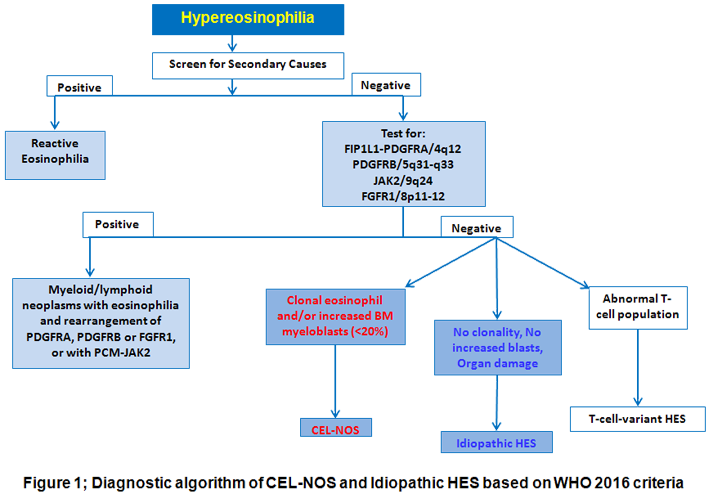
If clonality of eosinophils cannot be proven and there is no increase in myleoblasts, then the diagnosis is idiopathic HES (Bain et al, 2016). Idiopathic HES is a diagnosis of exclusion when secondary and clonal causes of eosinophilia are ruled out (Bain, 2004 A; Bain, 2004B). It is defined as sustained eosinophilia ≥ 1.5X10 9 in peripheral blood for at least 6 months with signs of organ involvement and dysfunction in which the underlying cause remains unknown (Figure 1). There is no increase in blasts and no evidence of eosinophil clonalilty. Yet, the advances in molecular diagnostic technologies have demonstrated that many patients who had previously been considered as having idiopathic HES can now be found to have an eosinophilic leukemia since clonal molecular genetic abnormality can be demonstrated (Gotlib and Cools 2008). Moreover, transformation to acute myeloid leukemia in some patients with idiopathic HES also provides evidence that the disorder was likely from the start to be a clonal CEL (Wang et al, 2016).
Epidemiology
Clinics
Cytology
The bone marrow is usually hypercellular and shows eosinophilic hyperplasia. Eosinophil counts may range from 10% -70% of the bone marrow nucleated cells, with an average of 30%. The maturation of eosinophils and myeloid cells is progressive but often left-shifted with increased blasts (5%-19%). Charcot-Leyden crystals are frequently seen which are colorless crystals formed from the breakdown of eosinophils. Eosinophils may show dysplastic changes such as nuclear hypersegmentation or hyposegmentation, cytoplasmic vacuolization or hypogranularity, and/or abnormal eosinophilic granules. Still, these morphologic changes and Charcot-Leyden crystals are not specific for CEL since may be seen in reactive eosinophilia. Marrow fibrosis is seen in some cases (Bain et al, 2016). Eosinophilic infiltration may also be present in extramedullary tissues, most frequently involving skin, heart, lung, nervous system and gastrointestinal (GI) tract. Organ damage induced by eosinophilic infiltration is due to the release of eosinophil granules which contain toxic cationic proteins, the primary mediators of tissue damage. The site of infiltration usually shows some degree of fibrosis, often with the presence of Charcot-Leyden crystals.
Cytogenetics
Treatment
Prognosis
Note
Genes Involved and Proteins
Article Bibliography
| Pubmed ID | Last Year | Title | Authors |
|---|---|---|---|
| 26497854 | 2015 | Whole-exome sequencing and genome-wide methylation analyses identify novel disease associated mutations and methylation patterns in idiopathic hypereosinophilic syndrome. | Andersen CL et al |
| 15548834 | 2004 | Eosinophilic leukemia and idiopathic hypereosinophilic syndrome are mutually exclusive diagnoses. | Bain BJ et al |
| 20639012 | 2010 | Incidence of myeloproliferative hypereosinophilic syndrome in the United States and an estimate of all hypereosinophilic syndrome incidence. | Crane MM et al |
| 29044676 | 2017 | World Health Organization-defined eosinophilic disorders: 2017 update on diagnosis, risk stratification, and management. | Gotlib J et al |
| 18843283 | 2008 | Five years since the discovery of FIP1L1-PDGFRA: what we have learned about the fusion and other molecularly defined eosinophilias. | Gotlib J et al |
| 22473587 | 2012 | Chronic eosinophilic leukemia-not otherwise specified has a poor prognosis with unresponsiveness to conventional treatment and high risk of acute transformation. | Helbig G et al |
| 19910029 | 2009 | Hypereosinophilic syndrome: a multicenter, retrospective analysis of clinical characteristics and response to therapy. | Ogbogu PU et al |
| 16681635 | 2006 | Eosinophilia: secondary, clonal and idiopathic. | Tefferi A et al |
| 27174585 | 2016 | Targeted next-generation sequencing identifies a subset of idiopathic hypereosinophilic syndrome with features similar to chronic eosinophilic leukemia, not otherwise specified. | Wang SA et al |
Citation
Anwar N. Mohamed
Chronic Eosinophilic Leukemia-Not Otherwise Specified (CEL-NOS)
Idiopathic Hypereosinophilic Syndrome (IHES)
Atlas Genet Cytogenet Oncol Haematol. 2018-06-01
