Gastric Tumors: an overview
2008-11-01 Paul Lochhead , Emad El-Omar Affiliation1.Gastrointestinal Research Group, Division of Applied Medicine, School of Medicine, Dentistry, Aberdeen University, Aberdeen AB25 2ZD, Scotland, UK
Summary
Note
Classification
Classification
- Neoplastic
- Epithelial adenomas
- Fundic gland polyps
- GISTs
- Lipomas
- Leiomyomas
- Neural tumours (e.g. Schwannomas)
- Non-Neoplastic
- Hyperplastic polyps
- Inflammatory fibroid polyps
- Hamartomatous polyps
Malignant Tumours
- Adenocarcinoma
- Primary gastric lymphoma
- GISTs
- Metastatic deposits
- Carcinoids
- Rare tumours
- e.g. Sarcomas, neuroendocrine carcinoma, primary squamous cell carcinoma and adenoacanthomas
Clinics and Pathology
Note
Small hyperplastic and fundic gland polyps are relatively common. They are generally regarded as being of no significance although multiple fundic gland polyps with evidence of dysplasia can occur in familial adenomatous polyposis (FAP). Fundic gland polyps and, to a lesser extent, hyperplastic polyps, occur with increased frequency in patients on long-term proton pump inhibitor therapy.
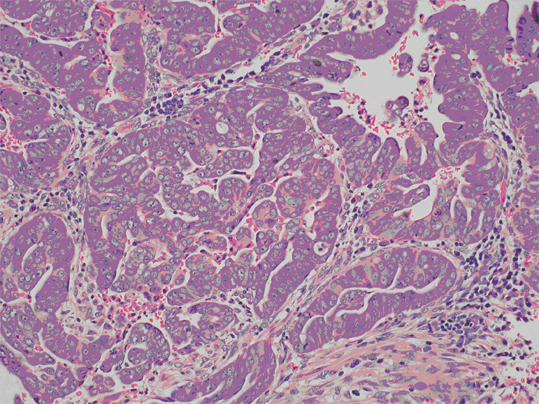
The vast majority of primary lymphomas arising in the stomach are of non-Hodgkins B-cell type. Recent series have demonstrated that low-grade marginal zone lymphomas of mucosa-associated lymphoid tissue (or MALT lymphomas) account for over 50% of cases of primary gastric lymphoma. Historically the predominant histological type was diffuse large B-cell lymphoma (DLBCL).Adenomatous polyps in the stomach usually arise against a background of chronic atrophic gastritis with intestinal metaplasia although they too can occur in FAP. Gastric adenomata are composed of dysplastic epithelium with tubular and/or villous architecture. Polyp size and the grade of dysplasia are felt to be predictors of progression to carcinoma. Because gastric adenomata, like those in the colon, represent a pre-malignant condition, excision (usually possible endoscopically) is the treatment of choice.
Etiology
H. pylori is the single most important etiological agent in the pathogenesis of gastric cancer. Numerous epidemiological studies have demonstrated an association between serological evidence of H. pylori infection and gastric cancer risk. The conclusion of several meta-analyses of these data is that chronic H. pylori infection confers around a two-fold increase in the risk of developing gastric cancer. H. pylori strains expressing the cytotoxin-associated gene A antigen (CagA) are associated with a further two-fold increase in gastric cancer risk. The association with H. pylori appears strongest for non-cardia gastric cancer, but applies to both intestinal and diffuse histological subtypes.
With respect to cancer of the gastric cardia, recent data suggest that there are two distinct etiological subtypes: one arising in the context of severe atrophic gastritis and akin to non-cardia cancer, and a second arising in non-atrophic mucosa, associated with gastro-oesophageal reflux disease and resembling oesophageal adenocarcinoma.
The gastric mucosa is normally devoid of lymphoid tissue. H. pylori is implicated as an etiological agent in over 92% of cases of gastric MALT lymphoma. Chronic H. pylori infection results in a lymphoid follicular gastritis and so to the acquisition of gastric MALT. MALT lymphomagenesis is thought to be dependent on clonal expansion driven by H. pylori antigenic stimulation. The mechanisms involved in the transformation of low-grade gastric MALT lymphoma to high grade DLBCL are not well understood.Individual differences in the inflammatory response to H. pylori infection, as determined by host genetic polymorphisms, may predispose to the development of a gastric cancer phenotype. Pro-inflammatory polymorphisms have been described in the interleukin-1 gene cluster, and tumour necrosis factor-alpha, interleukin-10, interleukin-8, and interferon-gamma genes. Having an increasing number of such pro-inflammatory genetic polymorphisms confers an increased gastric cancer risk for an H. pylori-infected individual.
It has been postulated that diets rich in fruit and vegetables are associated with a reduced risk of gastric cancer. To date, data from large prospective studies do not bear this out. Similarly, there are conflicting data regarding the increased risk associated with dietary salt and nitroso compound intake.
There is a dose-dependent relationship between smoking and gastric cancer. It is estimated that over 17% of gastric cancers in Europe are directly attributable to cigarette smoking.
Epidemiology
Clinics
Pathology
Treatment
Prognosis
Clinics
Pathology
Treatment
Prognosis
Prognosis
Note
Note
Clinics
Pathology
Treatment
Note
Cytogenetics
Cytogenetics morphological
Those chromosomes most commonly involved in simple numerical aberrations include X, Y, 1, 7, 8, 9, 17 and 20. Polysomy for chromosome 17 has been reported to be associated with lymphovascular invasion and nodal metastases.
Conventional cytogenetic analysis of 15 gastric cancers using G-banding revealed structural aberrations most commonly involving chromosomes 1, 11, 14, 7, 17, 6, 8 and 13. The aberration add(11)(p15) was found in five of the cancers analysed.
Multicolour spectral karyotyping has been employed to identify recurrent chromosomal rearrangements in gastric cancer cell lines. Chromosome 8 was most commonly involved in rearrangements. Recurrent translocations, frequently involving known oncogene and tumour-suppressor gene loci, were identified with breakpoints most frequently occurring at bands 8q24 and 11q13.
Cytogenetics molecular
Loss of heterozygosity (LOH) studies in gastric adenocarcinomas have shown high LOH at chromosome arms 1p, 3p, 4p, 5q, 7p, 8p, 9p, 12q, 13q, 17p, 18q and 22q. The intratumoural distribution of LOH between early and advanced gastric cancer has been compared, and suggests that multiple losses occur as an early event in tumorigenesis with a few sporadic losses occurring later in disease progression.
Genetics
Note
Genes Involved and Proteins
Gene name
Location
Protein description
Germinal mutations
Somatic mutations
Gene name
Location
Protein description
Somatic mutations
Gene name
Location
Protein description
Somatic mutations
Gene name
Location
Protein description
Germinal mutations
Somatic mutations
Gene name
Location
Protein description
Germinal mutations
Somatic mutations
Gene name
Location
Protein description
Germinal mutations
Somatic mutations
Gene name
Location
Protein description
Somatic mutations
Gene name
Location
Note
Protein description
Gene name
Location
Protein description
Somatic mutations
Gene name
Location
Protein description
Germinal mutations
Somatic mutations
Gene name
Note
Protein description
Germinal mutations
Somatic mutations
Article Bibliography
| Pubmed ID | Last Year | Title | Authors |
|---|---|---|---|
| 16886612 | 2006 | C-MYC locus amplification as metastasis predictor in intestinal-type gastric adenocarcinomas: CGH study in Brazil. | Burbano RR et al |
| 17036397 | 2006 | Interrelationship between chromosome 8 aneuploidy, C-MYC amplification and increased expression in individuals from northern Brazil with gastric adenocarcinoma. | Calcagno DQ et al |
| 17513507 | 2008 | Molecular pathology of familial gastric cancer, with an emphasis on hereditary diffuse gastric cancer. | Carneiro F et al |
| 11213833 | 2001 | Evidence for two modes of allelic loss: multifocal analysis on both early and advanced gastric carcinomas. | Chung YJ et al |
| 12719469 | 2003 | Helicobacter pylori CagA protein targets the c-Met receptor and enhances the motogenic response. | Churin Y et al |
| 16489633 | 2006 | Epidemiology of gastric cancer. | Crew KD et al |
| 17965056 | 2008 | Combination of gastric atrophy, reflux symptoms and histological subtype indicates two distinct aetiologies of gastric cardia cancer. | Derakhshan MH et al |
| 16997152 | 2006 | Role of host genes in sporadic gastric cancer. | El-Omar EM et al |
| 18274437 | 2008 | Gastric adenocarcinoma arising from fundic gland polyps in a patient with familial adenomatous polyposis syndrome. | Garrean S et al |
| 16380980 | 2006 | Fruit and vegetable intake and the risk of stomach and oesophagus adenocarcinoma in the European Prospective Investigation into Cancer and Nutrition (EPIC-EURGAST). | González CA et al |
| 15996045 | 2005 | Familial gastric cancers with Li-Fraumeni Syndrome: a case repast. | Kim IJ et al |
| 12163385 | 2002 | Inverse relationship between APC gene mutation in gastric adenomas and development of adenocarcinoma. | Lee JH et al |
| 16397024 | 2006 | Somatic mutations of ERBB2 kinase domain in gastric, colorectal, and breast carcinomas. | Lee JW et al |
| 11955451 | 2002 | Causal relationship between the loss of RUNX3 expression and gastric cancer. | Li QL et al |
| 15633233 | 2005 | Loss of heterozygosity on 10q23.3 and mutation of tumor suppressor gene PTEN in gastric cancer and precancerous lesions. | Li YL et al |
| 16610016 | 2006 | Mechanisms inactivating the gene for E-cadherin in sporadic gastric carcinomas. | Liu YC et al |
| 18267927 | 2008 | Gastric cancer. | Lochhead P et al |
| 17090188 | 2006 | Gastrointestinal stromal tumors: review on morphology, molecular pathology, prognosis, and differential diagnosis. | Miettinen M et al |
| 11219776 | 2001 | Germ-line p53 mutations predispose to a wide spectrum of early-onset cancers. | Nichols KE et al |
| 11032936 | 2000 | Prognostic value of numerical aberrations of chromosome 17 in differentiated gastric cancer: evaluation by multivariate regression analysis. | Onchi H et al |
| 15978333 | 2005 | Non-random structural chromosomal changes in primary gastric cancer. | Panani AD et al |
| 18381231 | 2008 | Cytogenetic and molecular aspects of gastric cancer: clinical implications. | Panani AD et al |
| 18384215 | 2008 | Gastric polyps: classification and management. | Park DY et al |
| 15761078 | 2005 | Global cancer statistics, 2002. | Parkin DM et al |
| 18206535 | 2008 | Somatic mutations in mismatch repair genes in sporadic gastric carcinomas are not a cause but a consequence of the mutator phenotype. | Pinto M et al |
| 9164544 | 1997 | Relationship of p53 and c-erbB-2 expression to histopathological features, Helicobacter pylori infection and prognosis in gastric cancer. | Shun CT et al |
| 10204605 | 1999 | Higher frequencies of numerical aberrations of chromosome 17 in primary gastric cancers are associated with lymph node metastasis. | Terada R et al |
| 12353264 | 2002 | Clinical implications of chromosomal abnormalities in gastric adenocarcinomas. | Wu CW et al |
| 18462890 | 2008 | Cyclooxygenase-2 expression and its association with angiogenesis, Helicobacter pylori, and clinicopathologic characteristics of gastric carcinoma. | Yamac D et al |
| 16127741 | 2005 | Recurrent chromosomal rearrangements at bands 8q24 and 11q13 in gastric cancer as detected by multicolor spectral karyotyping. | Yamashita Y et al |
| 1670998 | 1991 | Evaluation of immunoreactivity for erbB-2 protein as a marker of poor short term prognosis in gastric cancer. | Yonemura Y et al |
Citation
Paul Lochhead ; Emad El-Omar
Gastric Tumors: an overview
Atlas Genet Cytogenet Oncol Haematol. 2008-11-01
Online version: http://atlasgeneticsoncology.org/solid-tumor/5410/gastric-tumors-an-overview
