Familial platelet disorder with predisposition to acute myelogenous leukemia
2012-09-01 Paula G Heller , Ana C Glembotsky AffiliationDepartment of Hematology Research, Instituto de Investigaciones Medicas Alfredo Lanari, University of Buenos Aires, CONICET, Combatientes de Malvinas 3150, Buenos Aires 1427, Argentina
Identity
Name
Familial platelet disorder with predisposition to acute myelogenous leukemia
Alias
Familial platelet disorder with predisposition to myeloid malignancy , FPD\/AML
Inheritance
Familial platelet disorder with predisposition to acute myelogenous leukemia (FPD\/AML) is an autosomal dominant disorder caused by germline heterozygous mutations in the hematopoietic transcription factor RUNX1. Thirty-six pedigrees have been reported to date. Although rare, the frequency of this disorder has been probably underestimated and it is now being increasingly recognized due to enhanced awareness. FPD\/AML represents one of the few identified genetic disorders underlying pure familial myelodysplastic syndrome (MDS)\/AML cases and represents a useful model to unravel the role of RUNX1 in leukemogenesis.
Omim
601399
Orphanet
71290 Familial platelet syndrome with predisposition to acute myelogenous leukemia
Umls
-
Clinics
Note
FPD\/AML is characterized by inherited thrombocytopenia, platelet function defect and a lifelong risk of development of hematologic malignancies (Song et al., 1999). Thrombocytopenia is usually mild to moderate and is characterized by normal platelet size. Bleeding tends to be more severe than expected according to the degree of thrombocytopenia due to the presence of associated platelet dysfunction and may result in a significant bleeding diathesis. Platelet aggregation is abnormal in response to several platelet agonists and an aspirin-like defect has been described. Although thrombocytopenia is almost always present, normal or low-normal platelet counts have been reported in some patients. Similarly, although platelet dysfunction represents a very frequent feature of this disorder, at present, it is unknown whether all individuals with germline RUNX1 mutation display this abnormality. Furthermore, as platelet function tests are not always routinely performed, the platelet defect may be overlooked in patients with mild bleeding manifestations, leading to failure to identify affected individuals. Recently, decreased megakaryocyte maturation and polyploidization and impaired proplatelet formation have been found to underlie the defect in platelet production (Bluteau et al., 2012), while platelet dysfunction has been attributed to both platelet storage pool deficiency (Gerard et al., 1991) and impaired αIIbβ3 integrin activation (Sun et al., 2004). Several RUNX1-targets have been proposed to be responsible for the platelet defects, including the Mpl receptor (Heller et al., 2005), myosin 9 and myosin 10 (Bluteau et al., 2012), myosin regulatory light chain 9 (Sun et al., 2007), arachidonate 12-lipoxygenase and PKCθ (Sun et al., 2004), although other genes are probably involved.
Neoplastic risk
Patients with FPD\/AML are predisposed to myeloid malignancies, including AML, MDS and mixed myeloproliferative (MPN)\/MDS syndromes. Several AML FAB subtypes have been reported to occur, including M1, M2, M4 and M5, while refractory anemia with excess blasts, chronic myelomonocytic leukemia and hypoplastic MDS with myelofibrosis have been described among the cases with MDS and MPN\/MDS. Patients may present with full-blown leukemia or develop leukemic transformation preceded by MDS. Although most hematological neoplasms involve the myeloid lineage, development of T-cell acute lymphoblastic leukemia has also been reported in rare cases (Preudhomme et al., 2009; Nishimoto et al., 2011). The rate of myeloid malignancies ranges between 20 to 65%. Median age at leukemia onset is 37 years old, ranging from 6 to 75, indicating a variable latency period. Germline RUNX1 mutations seem to be insufficient by themselves for leukemia development and acquisition of additional cooperating events is required. A second event involving RUNX1 (somatic mutation or trisomy 21) often occurs at leukemia progression (Preudhomme et al., 2009) and several cytogenetic abnormalities have also been identified at this stage, including del(5q), -7\/del(7q), +8, del(11q), 11q23 rearrangements, del (20q).
The mechanisms by which germline RUNX1 mutations predispose to leukemia are beginning to be unraveled. RUNX1 deficiency in adult mice (RUNX1 +\/- and -\/-) leads to an increase in committed myeloid progenitors, which could be explained by alteration in proliferative and\/or self-renewal capacity or block in myeloid differentiation. In human, down-regulation of RUNX1-target NR4A3 has been shown by gene profiling of FPD\/AML patient samples, associated to increased clonogenic potential of immature progenitors (Bluteau et al., 2011). Similarly to mouse models, this would lead to an expanded pool of multipotent and committed progenitors prone to secondary mutations, providing an explanation for leukemia predisposition in this disorder. Besides, there is evidence that RUNX1 functions as a tumor suppressor gene through up-regulation of (Linggi et al., 2002), which enhances p53 activity by binding to its negative regulator Mdm3.
The mechanisms by which germline RUNX1 mutations predispose to leukemia are beginning to be unraveled. RUNX1 deficiency in adult mice (RUNX1 +\/- and -\/-) leads to an increase in committed myeloid progenitors, which could be explained by alteration in proliferative and\/or self-renewal capacity or block in myeloid differentiation. In human, down-regulation of RUNX1-target NR4A3 has been shown by gene profiling of FPD\/AML patient samples, associated to increased clonogenic potential of immature progenitors (Bluteau et al., 2011). Similarly to mouse models, this would lead to an expanded pool of multipotent and committed progenitors prone to secondary mutations, providing an explanation for leukemia predisposition in this disorder. Besides, there is evidence that RUNX1 functions as a tumor suppressor gene through up-regulation of (Linggi et al., 2002), which enhances p53 activity by binding to its negative regulator Mdm3.
Treatment
Guidelines for management of FPD\/AML patients are lacking due to the low frequency of this disorder and need to be assessed individually. Bleeding should be managed as for other platelet function disorders, according to the severity of bleeding manifestations. Patients with FPD\/AML who develop AML or MDS are candidates for hematopoietic stem cell transplantation. As thrombocytopenia in FPD\/AML is frequently mild or moderate and may be overlooked, mutational screening of potential sibling donors is required to avoid transplantation of stem cells harbouring the same RUNX1 mutation.
Prognosis
Prognosis depends on disease transformation to MDS\/AML, the risk of which seems to vary according to the type of RUNX1 mutation and its effect on RUNX1 function. Data on the outcome of FPD\/AML-associated MDS\/AML is limited and may vary according to the type of malignancy. Similarly, outcome of HSC transplantation in FPD\/AML is currently poorly defined, although increased graft failure or delayed engraftment and EBV-associated lymphoproliferative disorder have been described.
Genes involved and Proteins
Description
Exons 3 to 5 of the RUNX1 gene encode the DNA-binding runt homology domain, while the transactivation domain is enclosed in exons 7b and 8. RUNX1 is characterized by several isoforms, which are generated by alternative splicing and different promoter usage (Levanon et al., 2001; Miyoshi et al., 1995). Most abundant species include isoforms RUNX1b and RUNX1c, which encode the full-length protein.
Transcription
Transcription of RUNX1c is initiated at the distal promoter and includes exons 1 and 2, while RUNX1b is regulated by the proximal promoter and starts at exon 3, both including exons 4, 5, 6, 7b and 8, according to nomenclature described by Miyoshi and colleagues. Thus, RUNX1b and c differ at their amino (N)-terminal end, being the former 27 amino acids shorter than the latter, although there appears to be no relevant functional differences between them. In contrast, the shorter RUNX1a isoform is a truncated variant spanning exons 3 to 7a with DNA-binding but no transactivation activity which may potentially interfere with RUNX1b and c function, acting as a negative regulator.
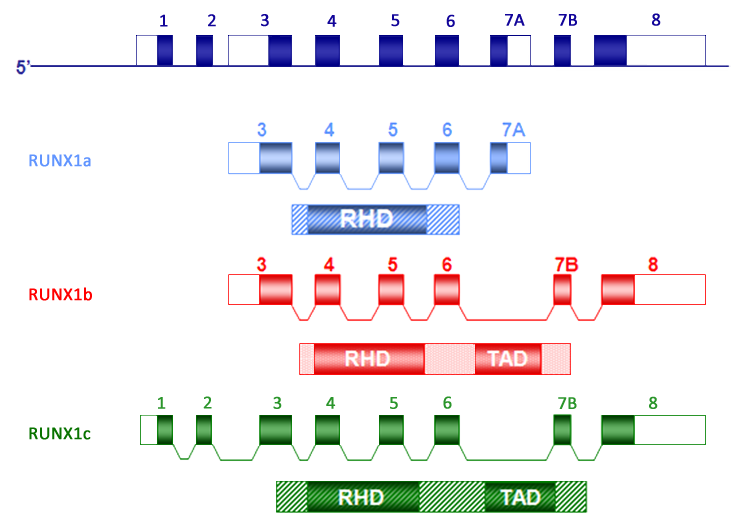
Figure 1. Diagram of the RUNX1 gene and the three major mRNA and protein species, according to the nomenclature described by Miyoshi et al. Exons are represented by boxes, solid boxes indicate coding regions, while open boxes represent untranslated regions. RUNX1a differs from RUNX1b and RUNX1c at the C-terminal half of the protein, while RUNX1c differs at the N-terminal end. The DNA-binding runt homology domain (RHD) and the transactivation domain (TAD) of the protein are depicted.
Description
The RUNX1b protein consists of 453 amino acids with 48 kDa molecular weight, RUNX1c comprises 480 amino acids while RUNX1a is formed by 250 amino acids. RUNX1 belongs to a family of heterodimeric transcription factors which include RUNX2 and RUNX3, all of them forming heterodimers with CBFβ. RUNX factors comprise an N-terminal region named the runt homology domain (RHD), because of its homology to Drosophila Runt protein, which mediates both DNA binding and heterodimerization with CBFβ, and a carboxyl(C)-terminal region responsible for transcriptional regulation (Ito et al., 1999). Heterodimerization with CBFβ enhances its DNA-binding capacity and protects it from proteolytic degradation. RUNX1 binds to the DNA consensus sequence TGTGGT and functions as a transcriptional activator or repressor, depending on promoter structure, the spliced variant expressed and the cellular context. RUNX1 is believed to act as a transcriptional organizer, recruiting other lineage-specific transcription factors to their promoters.
Expression
During embryogenesis, RUNX1 can be detected in hematopoietic stem cells and endothelial cells of the AGM region, while after organogenesis, RUNX1 is predominantly expressed in the hematopoietic system. Highest levels are found in thymus, bone marrow and peripheral blood.
Localisation
Nucleus.
Function
The RUNX1\/CBFβ transcription complex is critical for establishment of definitive hematopoiesis, as revealed in RUNX1-null mice, which die during embryonic development due to extensive bleeding. At this stage, RUNX1 expression at the level of the hemogenic endothelium is critical for endothelial to hematopoietic transition (Link et al., 2010). Despite its role in the establishment of definitive hematopoiesis, RUNX1 seems dispensable for the maintenance of adult hematopoietic stem cells, where it may have only a minor impact in their self-renewal capacity. However, this transcription factor is critical for the development of the megakaryocytic and lymphoid lineages. The role of RUNX1 in megakaryocyte biology has now been unveiled. Previous studies using cell lines suggested that RUNX1 participates in megakaryocyte lineage commitment and divergence from the erythroid pathway (Elagib et al., 2003), while heterozygous or conditional biallelic deletion of RUNX1 in mice leads to increased megakaryocyte growth with a partial arrest in polyploidyzation (Ichikawa et al., 2004). More recent studies performed in FPD\/AML patient samples and RUNX1 knock-down in primary megakaryocytes show that RUNX1 is involved in megakaryocyte differentiation, maturation, polyploidization and proplatelet formation, indicating that this transcription factor regulates platelet production by acting at both early and late stages of this process (Bluteau et al., 2012). Besides, RUNX1 is essential for both T- and B-cell development, as revealed by the presence of several abnormalities in the lymphoid lineage in RUNX1-deficient mouse models, including a reduction in the numbers of CD4- and CD8-positive T cells, reduced CD4\/CD8 ratio and defective T-cell proliferative response to TCR stimulation (Ichikawa et al., 2004; Wong et al., 2011). More recently, RUNX1 was shown to be indispensable for Treg-cell function, implying a role for RUNX1 in autoimmune suppression (Wong et al., 2011). In contrast, although RUNX1 deletion in mouse models leads to increased monocyte versus granulocyte progenitors, RUNX1 has no apparent effects in mature monocyte or granulocyte number or function (Guo et al., 2012). Known targets of RUNX1 in hematopoietic cells include cytokines, cell receptors and differentiation molecules, such as GM-CSF, IL-3, myeloperoxidase, neutrophil elastase, M-CSF and TCR receptors, as well as transcription factors, including CEBPA, PU.1, Gfi1 and Gfi1b.
Homology
Other members of the RUNX family include RUNX2 and RUNX3, which are alternative heterodimeric parterns for CBFβ.
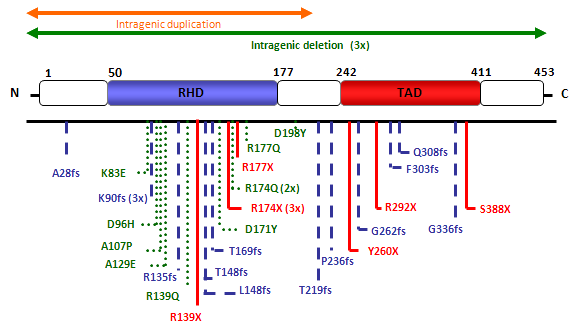
Figure 2. Schematic structure of RUNX1 protein and position of germline mutations identified in thirty-six FPD\/AML pedigrees. Missense mutations are shown in green dotted lines, frameshift mutations are represented by blue dashed lines, while nonsense mutations are shown in red. Intragenic deletion and duplication were identified in three and one pedigree each, respectively. Numbers in parentheses indicate mutations identified in more than one pedigree.
Germinal
Linkage to chromosome 21q22.12 was established in 1996 in a large FPD\/AML pedigree described by Dowton and colleagues (Dowton et al., 1985). Among genes mapping to this region, RUNX1 emerged as an attractive candidate for this disorder and subsequently, RUNX1 mutations were identified in several FPD\/AML patients (Song et al., 1999). Twenty-seven different mutations located in exons 3 to 8 have been detected in thirty-six pedigrees reported so far, including missense, nonsense and frameshift mutations (Liew and Owen, 2011). In addition, whole or partial hemizygous RUNX1 deletion (Song et al., 1999; Beri-Dexheimer et al., 2008; Preudhomme et al., 2009) and intragenic gene duplication (Jongmans et al., 2010) have also been described. These latter defects may be missed by conventional sequencing and further genetic analysis assessing gene copy number, such as SNP genotyping array or array-comparative genomic hybridization (CGH) may be required for diagnosis. Besides, syndromic constitutional microdeletions in 21q22 encompassing the RUNX1 locus have been reported to cause congenital sporadic thrombocytopenia and MDS\/AML predisposition associated to a complex phenotype characterized by mental retardation, developmental delay, dysmorphic features and several birth defects (Shinawi et al., 2008).
Most RUNX1 mutations are clustered within the RHD (exons 3 to 5), although mutations in the C-terminal region have been detected in one fourth of the patients. In vitro functional studies have shown that RHD mutations abrogate the DNA-binding and transactivation capacity while, according to whether they retain or loose their ability to heterodimerize with CBFβ, they interfere with the wild-type protein in a dominant-negative manner or act through haploinsufficiency, respectively. On the other hand, C-terminal mutants have an enhanced capacity to bind DNA, due to lack of a DNA-binding inhibitory domain, and interact strongly with CBFβ and are therefore expected to strongly repress the wild-type allele. It has been suggested that dominant-negative mutations cause higher predisposition to leukemia than those acting via haploinsufficiency, although this observation needs to be confirmed in larger number of patients (Michaud et al., 2002).
Most RUNX1 mutations are clustered within the RHD (exons 3 to 5), although mutations in the C-terminal region have been detected in one fourth of the patients. In vitro functional studies have shown that RHD mutations abrogate the DNA-binding and transactivation capacity while, according to whether they retain or loose their ability to heterodimerize with CBFβ, they interfere with the wild-type protein in a dominant-negative manner or act through haploinsufficiency, respectively. On the other hand, C-terminal mutants have an enhanced capacity to bind DNA, due to lack of a DNA-binding inhibitory domain, and interact strongly with CBFβ and are therefore expected to strongly repress the wild-type allele. It has been suggested that dominant-negative mutations cause higher predisposition to leukemia than those acting via haploinsufficiency, although this observation needs to be confirmed in larger number of patients (Michaud et al., 2002).
Somatic
RUNX1 is one of the genes most frequently dysregulated in leukemia, mostly through chromosomal translocations, mutations and amplifications (Mangan and Speck, 2011). RUNX1 was originally cloned as the target of the t(8;21) chromosomal translocation characteristic of AML FAB subtype M2, which encodes the RUNX1 (AML1)-ETO fusion product, and was subsequently found to be involved in other chromosomal translocations in both myeloid and lymphoblastic neoplasms, such as t(3;21) and t(12;21), which generate RUNX1-MDS1\/EVI1 and TEL-RUNX1 transcripts, respectively. Besides, acquired point mutations in the RUNX1 gene have been reported in 5% sporadic leukemia, predominantly in FAB subtype M0, where they are frequently biallelic. Moreover, mutations have been detected in approximately 8% MDS and chronic myelomonocytic leukemia patients and 28% secondary AML following MDS. While AML mutations occur mainly in the RHD, both N-terminal and C-terminal mutations have been reported in MDS. On the other hand, RUNX1 amplification occurs predominantly in pediatric ALL.
Article Bibliography
| Pubmed ID | Last Year | Title | Authors |
|---|---|---|---|
| 18478040 | 2008 | Clinical phenotype of germline RUNX1 haploinsufficiency: from point mutations to large genomic deletions. | Béri-Dexheimer M et al |
| 22898599 | 2012 | Dysmegakaryopoiesis of FPD/AML pedigrees with constitutional RUNX1 mutations is linked to myosin II deregulated expression. | Bluteau D et al |
| 3855665 | 1985 | Studies of a familial platelet disorder. | Dowton SB et al |
| 12576332 | 2003 | RUNX1 and GATA-1 coexpression and cooperation in megakaryocytic differentiation. | Elagib KE et al |
| 1958483 | 1991 | Inherited platelet-storage pool deficiency associated with a high incidence of acute myeloid leukaemia. | Gerrard JM et al |
| 22451420 | 2012 | Runx1 deletion or dominant inhibition reduces Cebpa transcription via conserved promoter and distal enhancer sites to favor monopoiesis over granulopoiesis. | Guo H et al |
| 15741216 | 2005 | Low Mpl receptor expression in a pedigree with familial platelet disorder with predisposition to acute myelogenous leukemia and a novel AML1 mutation. | Heller PG et al |
| 14966519 | 2004 | AML-1 is required for megakaryocytic maturation and lymphocytic differentiation, but not for maintenance of hematopoietic stem cells in adult hematopoiesis. | Ichikawa M et al |
| 10620014 | 1999 | Molecular basis of tissue-specific gene expression mediated by the runt domain transcription factor PEBP2/CBF. | Ito Y et al |
| 19946261 | 2010 | Novel RUNX1 mutations in familial platelet disorder with enhanced risk for acute myeloid leukemia: clues for improved identification of the FPD/AML syndrome. | Jongmans MC et al |
| 11179664 | 2001 | Architecture and anatomy of the genomic locus encoding the human leukemia-associated transcription factor RUNX1/AML1. | Levanon D et al |
| 21606161 | 2011 | Familial myelodysplastic syndromes: a review of the literature. | Liew E et al |
| 12091906 | 2002 | The t(8;21) fusion protein, AML1 ETO, specifically represses the transcription of the p14(ARF) tumor suppressor in acute myeloid leukemia. | Linggi B et al |
| 19813271 | 2010 | Core binding factor at the crossroads: determining the fate of the HSC. | Link KA et al |
| 22150309 | 2011 | RUNX1 mutations in clonal myeloid disorders: from conventional cytogenetics to next generation sequencing, a story 40 years in the making. | Mangan JK et al |
| 11830488 | 2002 | In vitro analyses of known and novel RUNX1/AML1 mutations in dominant familial platelet disorder with predisposition to acute myelogenous leukemia: implications for mechanisms of pathogenesis. | Michaud J et al |
| 7651838 | 1995 | Alternative splicing and genomic structure of the AML1 gene involved in acute myeloid leukemia. | Miyoshi H et al |
| 20549580 | 2010 | T cell acute lymphoblastic leukemia arising from familial platelet disorder. | Nishimoto N et al |
| 19357396 | 2009 | High frequency of RUNX1 biallelic alteration in acute myeloid leukemia secondary to familial platelet disorder. | Preudhomme C et al |
| 18487507 | 2008 | Syndromic thrombocytopenia and predisposition to acute myelogenous leukemia caused by constitutional microdeletions on chromosome 21q. | Shinawi M et al |
| 10508512 | 1999 | Haploinsufficiency of CBFA2 causes familial thrombocytopenia with propensity to develop acute myelogenous leukaemia. | Song WJ et al |
| 17059412 | 2007 | Decreased platelet expression of myosin regulatory light chain polypeptide (MYL9) and other genes with platelet dysfunction and CBFA2/RUNX1 mutation: insights from platelet expression profiling. | Sun L et al |
| 14525764 | 2004 | Association of CBFA2 mutation with decreased platelet PKC-theta and impaired receptor-mediated activation of GPIIb-IIIa and pleckstrin phosphorylation: proteins regulated by CBFA2 play a role in GPIIb-IIIa activation. | Sun L et al |
| 21091910 | 2011 | Interplay of transcription factors in T-cell differentiation and function: the role of Runx. | Wong WF et al |
External Links
Citation
Paula G Heller ; Ana C Glembotsky
Familial platelet disorder with predisposition to acute myelogenous leukemia
Atlas Genet Cytogenet Oncol Haematol. 2012-09-01
Online version: http://atlasgeneticsoncology.org/cancer-prone-disease/10079/familial-platelet-disorder-with-predisposition-to-acute-myelogenous-leukemia/
Historical Card
2008-07-01 Familial platelet disorder with predisposition to acute myelogenous leukemia by Paula G Heller Affiliation
Department of Hematology Research, Instituto de Investigaciones Medicas Alfredo Lanari, University of Buenos Aires, CONICET, Combatientes de Malvinas 3150, Buenos Aires 1427, Argentina
