DDR1 (discoidin domain receptor tyrosine kinase 1)
2011-05-01 Barbara Roig , Elisabet Vilella AffiliationHospital Psiquiatic Universitari Institut Pere Mata, IISPV, Universitat Rovira i Virgili, C\\\/Sant Llorenc 21, 43201 REUS, Spain
Identity
HGNC
LOCATION
6p21.33
LOCUSID
ALIAS
CAK,CD167,DDR,EDDR1,HGK2,MCK10,NEP,NTRK4,PTK3,PTK3A,RTK6,TRKE
FUSION GENES
DNA/RNA
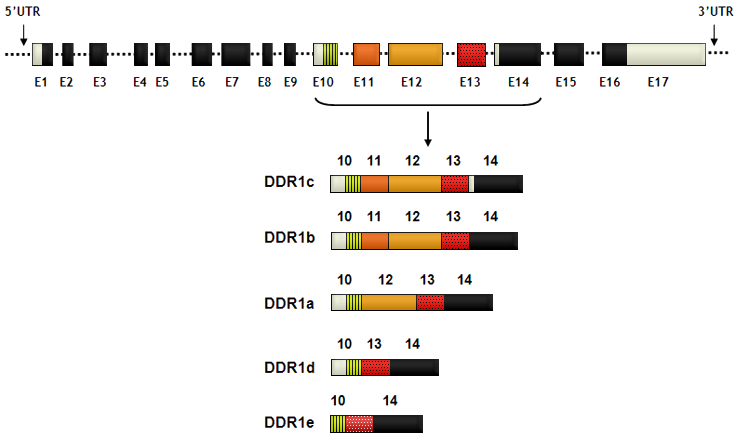
Genomic organisation of the DDR1 gene on chromosome 6. Exons that are implicated in the alternative splicing process of the DDR1 gene are represented by open boxes. The alternative splicing process of exon 10 to exon 14 generates 5 DDR1 isoforms, which are affixed a-e.
Description
The DDR1 gene comprises 17 exons and spans 12 kb of the genomic sequence on chromosome 6 (from position 30851861 bp to 30867933 bp in the positive strand orientation).
Transcription
The 3840-bp mRNA is transcribed in a centromeric to telomeric orientation. Alternative splicing can occur, and 5 named isoforms (DDR1a-e) are recognised.
Pseudogene
No pseudogene has been described.
Proteins

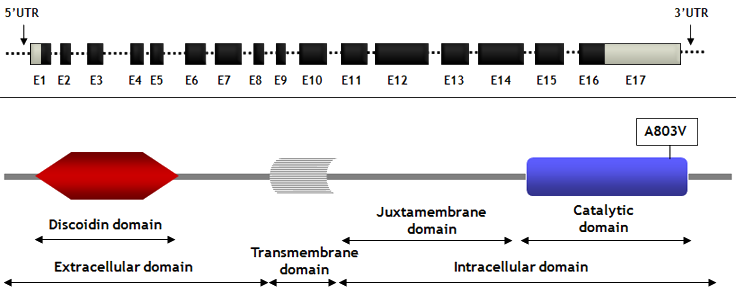
Schematic diagram of the DDR1 protein and localization of the DDR1 Tyrosine phosphorylated sites at intracellular domain.
Description
DDR1 belongs to the DDRs subfamily of tyrosine kinase receptors. This subfamily is composed of only two members, DDR1 and DDR2, and it is distinguished by an extracellular domain that is homologous to the carbohydrate-binding lectin discoidin-I in Dictyostelium discoideum. The Discoidin domain is essential for the ability of DDRs to bind ligands. To-date, collagen is the only unique DDR1 ligand that has been identified. Five isoforms of DDR1 that are generated by alternative splicing have been described. The longest DDR1 transcript codes for the full-length receptor (DDR1c isoform) and is composed of 919 amino acids. DDR1a and DDR1b isoforms lack 37 amino acids in the juxtamembrane domain or 6 amino acids in the kinase domain. DDR1d and DDR1e isoforms are C-terminally truncated receptors. DDR1d lacks exons 11 and 12 causing a frame-shift mutation that generates a stop codon and premature termination of transcription. Finally, DDR1e lacks exons 11 and 12 as well as the first half of exon 10 (Alves et al., 1995).
Expression
DDR1 is ubiquitously expressed in a variety of epithelial tissues (Alves et al., 1995; Curat and Vogel, 2002; Ferri et al., 2004; Hou et al., 2001; Mohan et al., 2001; Sakamoto et al., 2001; Tanaka et al., 1998). DDR1 is also expressed in endothelial blood capillary cells and oligodendrocytes in the human brain (Franco-Pons et al., 2009; Roig et al., 2010). DDR1 is significantly overexpressed in several human cancers (Barker et al., 1995; Colas et al., 2011; Ford et al., 2007; Hajdu et al., 2010; Heinzelmann-Schwarz et al., 2004; Laval et al., 1994; Nemoto et al., 1997; Park et al., 2007; Tun et al., 2011; Weiner et al., 1996; Weiner et al., 2000; Yamanaka et al., 2006; Yoshida et al., 2007) and carcinoma cell lines (Alves et al., 1995; Gu et al., 2011; Park et al., 2007; Sakuma et al., 1996).
Localisation
Transmembrane.
Function
Receptor tyrosine kinases are key components of several signal transduction pathways. These kinases control multiple cellular processes, including motility, proliferation, differentiation, metabolism and survival.
DDR1 is actively involved in tumorigenesis and promotes the proliferation of neoplasic cells. The interaction of DDR1 and Notch1 displays a prosurvival effect (Kim et al., 2011). DDR1 participates in the collective migration of cancer cells by coordinating the cell polarity regulators Par3 and Par6 (Hidalgo-Carcedo et al., 2011).
DDR1 is actively involved in tumorigenesis and promotes the proliferation of neoplasic cells. The interaction of DDR1 and Notch1 displays a prosurvival effect (Kim et al., 2011). DDR1 participates in the collective migration of cancer cells by coordinating the cell polarity regulators Par3 and Par6 (Hidalgo-Carcedo et al., 2011).
Homology
- P. troglodytes, discoidin domain receptor tyrosine kinase 1, DDR1
- C. lupus, discoidin domain receptor tyrosine kinase 1, DDR1
- M. musculus, discoidin domain receptor family member 1, Ddr1
- R. norvegicus, discoidin domain receptor tyrosine kinase 1
- C. lupus, discoidin domain receptor tyrosine kinase 1, DDR1
- M. musculus, discoidin domain receptor family member 1, Ddr1
- R. norvegicus, discoidin domain receptor tyrosine kinase 1
Mutations
Note
Few somatic mutations have been described. Four mutations (G1486T, A496S, CC2469/2470TT, R824W) have been identified in a cohort of 26 primary lung neoplasms (Davies et al., 2005). One somatic mutation (A803V) was found in 4 acute myeloid leukaemia patients (Tomasson et al., 2008).
Implicated in
Entity name
Breast cancer
Note
DDR1 overexpression was observed in human primary breast tumours samples compared to that in normal breast tissues (Barker et al., 1995). In addition, invasive ductal and lobular carcinomas showed differential expression of DDR1. DDR1 was downregulated in lobular carcinomas (Turashvili et al., 2007a; Turashvili et al., 2007b).
Entity name
Note
The DDR1 promoter presents a potential p53 binding-site. A previous study has shown that p53 expression upregulated the mRNA expression levels of DDR1 in human osteosarcoma cells (Sakuma et al., 1996).
Entity name
Oesophageal cancer
Note
The overexpression of DDR1 was reported in 12 carcinomatous oesophageal tissues compared to that in normal tissues. Furthermore, a positive correlation was identified between DDR1 mRNA expression and the proliferative activity of the tumoural cells (Nemoto et al., 1997).
Entity name
Ovarian cancer
Note
DDR1 was highly expressed in 158 histological subtypes of primary epithelial ovarian cancers (EOC) compared to that in normal ovarian surface epithelium samples (Heinzelmann-Schwarz et al., 2004).
Entity name
Endometrial cancer
Note
DDR1 has been implicated as a potential molecular marker of endometrial cancer (Colas et al., 2011; Domenyuk et al., 2007). A gene expression screening of 52 carcinomas samples showed differential expression of several genes, including the DDR1 gene. These data were also demonstrated in 50 tumoural and non-tumoural uterine aspirates (Colas et al., 2011).
Entity name
Brain tumours
Note
DDR1 was originally isolated in malignant childhood brain tumours, which overexpressed DDR1 (Weiner et al., 1996). Replicable findings were found in metastatic brain neoplasms and glioma cells (Yamanaka et al., 2006; Weiner et al., 2000). In glioma cells, DDR1 was involved in cell proliferation and invasion via cell interactions with the extracellular matrix (Ram et al., 2005; Yamanaka et al., 2006). Moreover, a study on DDR1a and DDR1b isoforms overexpression in glioma cells has identified distinct roles for each DDR1 isoforms in the cell attachment process, which is mediated by collagen I (Ram et al., 2005). The analysis of the expression profile in mice that had PDGF-induced glioma showed overexpression of DDR1 (Johansson et al., 2005).
Entity name
Note
A PCNSL pathway analysis revealed upregulation of DDR1 expression in the extracellular matrix and the adhesion-related pathways (Tun et al., 2011).
Entity name
Pituitary adenoma
Note
In different subtypes of pituitary adenoma, DDR1 expression was related to the hormonal background. DDR1 was more highly expressed in macroadenomas, compared to microadenomas, and in PRL- and GH-producing adenomas (Yoshida et al., 2007).
Entity name
Lung cancer
Note
DDR1 was upregulated in tumour lung tissue compared to that in normal tissue and was an independent favourable predictor for prognosis (Ford et al., 2007). Similarly, DDR1 was highly phosphorylated in non-small cell lung cancer (NSCLC) (Rikova et al., 2007).
One study described the presence of DDR1 somatic mutations in lung cancer (Davies et al., 2005). However, no mutations were detected in another lung cancer study (Ford et al., 2007).
One study described the presence of DDR1 somatic mutations in lung cancer (Davies et al., 2005). However, no mutations were detected in another lung cancer study (Ford et al., 2007).
Entity name
Liver cancer
Note
DDR1a and DDR1b isoforms were overexpressed in hepatocellular carcinoma cell lines HLE and Huh-7. DDR1 isoform overexpression enhanced the migration and invasion of the hepatocellular carcinoma cell lines in association with the matrix metalloproteinases MMP2 and MMP9 (Park et al., 2007).
The downregulation of miR-199a-5p, which is a direct target of DDR1, deregulated DDR1 functionality and increased cell invasion in human hepatocellular carcinoma (HCC) (Shen et al., 2010).
Finally, a profiling study on receptor tyrosine kinase phosphorylation in cholangiocarcinoma patients showed high levels of phosphorylation of DDR1 and other tyrosine kinases in tumour tissues in comparison to para-tumour tissues (Gu et al., 2011).
The downregulation of miR-199a-5p, which is a direct target of DDR1, deregulated DDR1 functionality and increased cell invasion in human hepatocellular carcinoma (HCC) (Shen et al., 2010).
Finally, a profiling study on receptor tyrosine kinase phosphorylation in cholangiocarcinoma patients showed high levels of phosphorylation of DDR1 and other tyrosine kinases in tumour tissues in comparison to para-tumour tissues (Gu et al., 2011).
Entity name
Mesenchymal neoplasm
Note
Solitary fibrous tumour (SFT) expression profiling of 23 samples showed an over-expression of several receptor tyrosine kinase genes, including DDR1. However, no mutations were identified using cDNA sequencing (Hajdu et al., 2010).
Article Bibliography
| Pubmed ID | Last Year | Title | Authors |
|---|---|---|---|
| 11344127 | 2001 | Identification of two novel, kinase-deficient variants of discoidin domain receptor 1: differential expression in human colon cancer cell lines. | Alves F et al |
| 7845687 | 1995 | Distinct structural characteristics of discoidin I subfamily receptor tyrosine kinases and complementary expression in human cancer. | Alves F et al |
| 7845682 | 1995 | Expression patterns of the novel receptor-like tyrosine kinase, DDR, in human breast tumours. | Barker KT et al |
| 21207424 | 2011 | Molecular markers of endometrial carcinoma detected in uterine aspirates. | Colas E et al |
| 12397034 | 2002 | Discoidin domain receptor 1 controls growth and adhesion of mesangial cells. | Curat CA et al |
| 16140923 | 2005 | Somatic mutations of the protein kinase gene family in human lung cancer. | Davies H et al |
| 17704737 | 2007 | Identification of new DNA markers of endometrial cancer in patients from the Ukrainian population. | Domenyuk VP et al |
| 15111304 | 2004 | Role of discoidin domain receptors 1 and 2 in human smooth muscle cell-mediated collagen remodeling: potential implications in atherosclerosis and lymphangioleiomyomatosis. | Ferri N et al |
| 17299390 | 2007 | Expression and mutation analysis of the discoidin domain receptors 1 and 2 in non-small cell lung carcinoma. | Ford CE et al |
| 18836851 | 2009 | Discoidin domain receptor 1, a tyrosine kinase receptor, is upregulated in an experimental model of remyelination and during oligodendrocyte differentiation in vitro. | Franco-Pons N et al |
| 21253578 | 2011 | Survey of tyrosine kinase signaling reveals ROS kinase fusions in human cholangiocarcinoma. | Gu TL et al |
| 20527023 | 2010 | IGF2 over-expression in solitary fibrous tumours is independent of anatomical location and is related to loss of imprinting. | Hajdu M et al |
| 15240533 | 2004 | Overexpression of the cell adhesion molecules DDR1, Claudin 3, and Ep-CAM in metaplastic ovarian epithelium and ovarian cancer. | Heinzelmann-Schwarz VA et al |
| 21170030 | 2011 | Collective cell migration requires suppression of actomyosin at cell-cell contacts mediated by DDR1 and the cell polarity regulators Par3 and Par6. | Hidalgo-Carcedo C et al |
| 15750623 | 2005 | Expression analysis of genes involved in brain tumor progression driven by retroviral insertional mutagenesis in mice. | Johansson FK et al |
| 21398698 | 2011 | DDR1 receptor tyrosine kinase promotes prosurvival pathway through Notch1 activation. | Kim HG et al |
| 9396043 | 1997 | Overexpression of protein tyrosine kinases in human esophageal cancer. | Nemoto T et al |
| 17982627 | 2007 | Overexpression of discoidin domain receptor 1 increases the migration and invasion of hepatocellular carcinoma cells in association with matrix metalloproteinase. | Park HS et al |
| 8622863 | 1996 | Identification of two isoforms of the Cak receptor kinase that are coexpressed in breast tumor cell lines. | Perez JL et al |
| 16234985 | 2006 | Discoidin domain receptor-1a (DDR1a) promotes glioma cell invasion and adhesion in association with matrix metalloproteinase-2. | Ram R et al |
| 18083107 | 2007 | Global survey of phosphotyrosine signaling identifies oncogenic kinases in lung cancer. | Rikova K et al |
| 8977099 | 1996 | Receptor protein tyrosine kinase DDR is up-regulated by p53 protein. | Sakuma S et al |
| 20799954 | 2010 | Role of microRNA-199a-5p and discoidin domain receptor 1 in human hepatocellular carcinoma invasion. | Shen Q et al |
| 18270328 | 2008 | Somatic mutations and germline sequence variants in the expressed tyrosine kinase genes of patients with de novo acute myeloid leukemia. | Tomasson MH et al |
| 18184868 | 2008 | Pathway analysis of primary central nervous system lymphoma. | Tun HW et al |
| 17690741 | 2007 | Novel immunohistochemical markers for the differentiation of lobular and ductal invasive breast carcinomas. | Turashvili G et al |
| 11126911 | 2000 | Consistent and selective expression of the discoidin domain receptor-1 tyrosine kinase in human brain tumors. | Weiner HL et al |
| 9075249 | 1996 | Pediatric brain tumors express multiple receptor tyrosine kinases including novel cell adhesion kinases. | Weiner HL et al |
| 16652150 | 2006 | Identification of expressed genes characterizing long-term survival in malignant glioma patients. | Yamanaka R et al |
| 17001518 | 2007 | Enhancement of pituitary adenoma cell invasion and adhesion is mediated by discoidin domain receptor-1. | Yoshida D et al |
Other Information
Locus ID:
NCBI: 780
MIM: 600408
HGNC: 2730
Ensembl: ENSG00000204580
Variants:
dbSNP: 780
ClinVar: 780
TCGA: ENSG00000204580
COSMIC: DDR1
RNA/Proteins
Expression (GTEx)
Pathways
| Pathway | Source | External ID |
|---|---|---|
| Extracellular matrix organization | REACTOME | R-HSA-1474244 |
| Non-integrin membrane-ECM interactions | REACTOME | R-HSA-3000171 |
Protein levels (Protein atlas)
References
| Pubmed ID | Year | Title | Citations |
|---|---|---|---|
| 36809965 | 2024 | DDR1-Induced Paracrine Factors of Hepatocytes Promote HSC Activation and Fibrosis Development. | 0 |
| 38395959 | 2024 | Coexpression network analysis of the adult brain sheds light on the pathogenic mechanism of DDR1 in schizophrenia and bipolar disorder. | 0 |
| 38570692 | 2024 | Inactivation of kindlin-3 increases human melanoma aggressiveness through the collagen-activated tyrosine kinase receptor DDR1. | 0 |
| 36809965 | 2024 | DDR1-Induced Paracrine Factors of Hepatocytes Promote HSC Activation and Fibrosis Development. | 0 |
| 38395959 | 2024 | Coexpression network analysis of the adult brain sheds light on the pathogenic mechanism of DDR1 in schizophrenia and bipolar disorder. | 0 |
| 38570692 | 2024 | Inactivation of kindlin-3 increases human melanoma aggressiveness through the collagen-activated tyrosine kinase receptor DDR1. | 0 |
| 36675255 | 2023 | DDR1 and Its Ligand, Collagen IV, Are Involved in In Vitro Oligodendrocyte Maturation. | 1 |
| 37117273 | 2023 | Collagen I-DDR1 signaling promotes hepatocellular carcinoma cell stemness via Hippo signaling repression. | 2 |
| 37201403 | 2023 | Collagen-induced DDR1 upregulates CXCL5 to promote neutrophil extracellular traps formation and Treg infiltration in breast cancer. | 4 |
| 37768856 | 2023 | Discoidin Domain Receptor Tyrosine Kinase 1 (DDR1) Is a Novel Therapeutic Target in Liposarcoma: A Tissue Microarray Study. | 0 |
| 36675255 | 2023 | DDR1 and Its Ligand, Collagen IV, Are Involved in In Vitro Oligodendrocyte Maturation. | 1 |
| 37117273 | 2023 | Collagen I-DDR1 signaling promotes hepatocellular carcinoma cell stemness via Hippo signaling repression. | 2 |
| 37201403 | 2023 | Collagen-induced DDR1 upregulates CXCL5 to promote neutrophil extracellular traps formation and Treg infiltration in breast cancer. | 4 |
| 37768856 | 2023 | Discoidin Domain Receptor Tyrosine Kinase 1 (DDR1) Is a Novel Therapeutic Target in Liposarcoma: A Tissue Microarray Study. | 0 |
| 35032738 | 2022 | Identification of novel discoidin domain receptor 1 (DDR1) inhibitors using E-pharmacophore modeling, structure-based virtual screening, molecular dynamics simulation and MM-GBSA approaches. | 13 |
Citation
Barbara Roig ; Elisabet Vilella
DDR1 (discoidin domain receptor tyrosine kinase 1)
Atlas Genet Cytogenet Oncol Haematol. 2011-05-01
Online version: http://atlasgeneticsoncology.org/gene/40280/
