LRP1B (low density lipoprotein receptor-related protein 1B)
2013-07-01 Hugo Prazeres , Catarina Salgado , Cecília Duarte , Paula Soares AffiliationInstitute of Molecular Pathology, Immunology of the University of Porto (IPATIMUP), 4200-465 Porto, Portugal
Identity

DNA/RNA
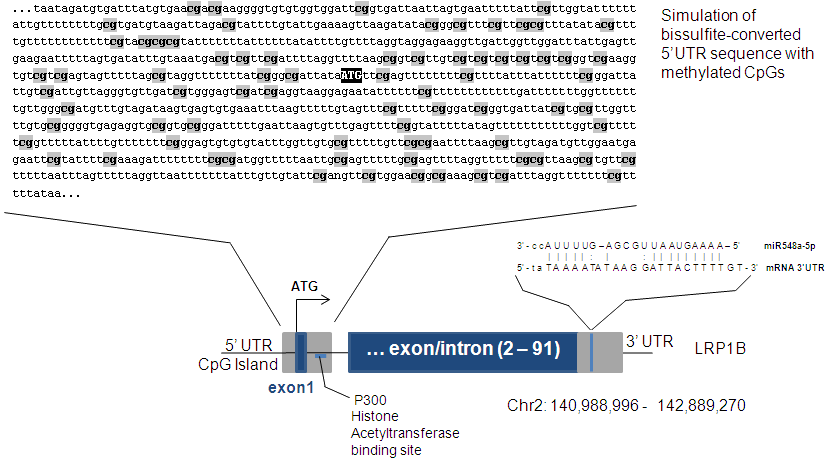
Description
Transcription
Transcripts with alternative C-terminal result from alternative splicing of exon 90, which impact differential binding of partners interacting with the cytoplasmic domain of LRP1B (Shiroshima et al., 2009).
Pseudogene
Proteins
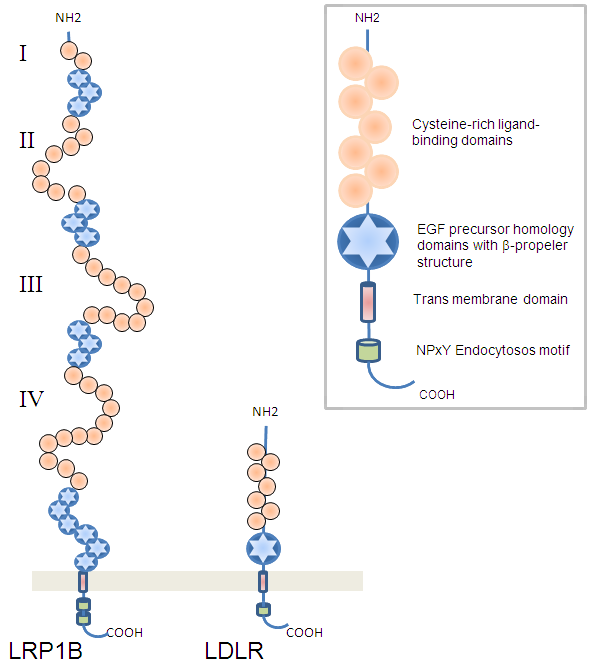
Description
Expression
Localisation
Function
LRP1B functions at the extracellular and cell membrane levels:
In order to characterize LRP1B ligands, immobilized recombinant extracellular sub-domains of LRP1B have been used as decoys to perform affinity chromatography using brain lysates (Liu et al., 2001) or in serum (Haas et al., 2011) as a source of potential physiological ligands. Using this strategy, LRP1B has been previously found to bind lipoproteins and ligands of the uPA system (Liu et al., 2001; Li et al., 2002; Knisely et al., 2007). Also several serum proteins, including fibrinogen and apoE-carrying lipoproteins showed affinity to LRP1B extracellular regions (Haas et al., 2011). It should nevertheless be noted that these approaches inherently under-estimate the full impact of LRP1B activity since, in the former study (Liu et al., 2001), the proteome which has been interrogated was derived from brain-lysate fractions, rather than the extracellular proteome which shares the physiological milieu with LRP1B. In the latter study (Haas et al., 2011), the use of serum restricts candidate ligands to systemic circulating factors and neglects local factors that may play a role in the tissue microenvironment. Evidence that LRP1B activity may, directly or indirectly, modulate the abundance of multiple extracellular factors comes from the analysis of conditioned media from LRP1B overexpressing cells, relative to their parental counterparts. Conditioned media from cells overexpressing LRP1B shows a reduction in the amounts of MMP2 as well as other metalloproteinases, growth factors, cytokines and angiogenic factors, indicating that LRP1B impacts the overall extracellular proteome (Prazeres et al., 2011). It is thus expected that LRP1B, in analogy with other LRs, can displays a myriad of additional extracellular ligands that impact the physiology in the extracellular microenvironment.
LRP1B ligands also include the cellular prion protein (Taylor and Hooper, 2007; Lu et al., 2010).
At the membrane level, LRP1B has been shown to modulate the localization of Urokinase and PDGF receptors (Tanaga et al., 2004) and to retain beta-amyloid precursor protein at the cell surface and reducing amyloid-beta peptide production (Cam et al., 2004).
Intracellular LRP1B partners:
Six interacting partners of the LRP1B cytoplasmic region have been identified by yeast two-hybrid screen and immunoprecipitation. One of the partners, PICK1 recognizes the C-terminus of LRP1B and inhibits phosphorylation of LRP1B by PKC alpha (Shiroshima et al., 2009). The output of these interactions in terms of signaling pathways activated in consequence of LRP1B activity remains unexplored.
Proteolytic release of LRP1B domains:
LRP1B ectodomains resulting from proteolytic shedding of the extracellular region can be found in the soluble form (Dietrich et al., 2010).
LRP1B has also been shown to undergo regulated intra-membrane proteolysis in a gamma-secretase-dependent manner, releasing an intracellular domain (ICD) that then translocates to the nucleus (Liu et al., 2007). The functions of the ICD in the nucleus are unknown.
Functions associated with heterologous ligands:
LRP1B may also act as a receptor for heterologous biomolecules such as the Pseudomonas exotoxin (Pastrana et al., 2005) and, most interestingly, for certain drugs, putting emphasis on the role of endocytosis in cellular drug uptake (Chung and Wasan, 2004). In accordance with this, reduced uptake of liposomes by LRP1B may underlie the mechanism of acquired resistance to liposomal doxorubicin chemotherapy in high-grade serous ovarian cancers that display LRP1B deletion (Cowin et al., 2012).
Homology
Mutations
Germinal
Somatic
Aside from deletions, LRP1B point mutations have been reported in a significant percentages of lung cancer (Ding et al., 2008) as well as in the sequencing of genomes derived from melanoma (Nikolaev et al., 2011) and triple negative breast cancer (Craig et al., 2013).
Implicated in
LRP1B, a member of the low-density lipoprotein (LDL) receptor family, was identified as a putative tumor suppressor. The down-expression of LRP1B was observed in multiple primary cancers.
The role of LRP1B as a tumor suppressor may result from modulation of cell migration and invasive capacity, through regulation of the urokinase plasminogen system (Liu et al., 2001). Cells expressing LRP1B display a substantially slower rate of uPA/PAI-1 complex internalization (Knisely et al., 2007) which impairs the regeneration of unoccupied uPAR on the cell surface and correlates with a diminished rate of cell migration (Li et al., 2002; Tanaga et al., 2004). Aside from members of the plasminogen system, LRP1B expression has been shown to deplete the extracellular medium of MMP2 and other factors (Prazeres et al., 2011). These results support the hypothesis that LRP1B endocytosis may (directly or indirectly) constrain the abundance of critical factors in the tumor microenvironment.
Kohno, Otsuka et al. (2010) have verified homozygous deletions in 176 genes. They consisted of 171 protein-encoding genes and five miRNA genes. These 176 genes were located in 45 regions on 17 chromosomes. They included known tumor suppressor genes, as well as candidate tumor suppressor genes shown to be hemizygously or homozygously deleted in several types of human cancers, such as LRP1B (Sonoda et al., 2004).
These functional specificities in cell spreading, migration and invasion strongly validated that LRP1B may function as a tumor suppressor, and exert opposite effects to LRP1 on cell transformation and malignant progression.
LRP1B has been found frequently mutated in glioblastoma (GBM) (Roversi et al., 2006). A novel internal deletion of LRP1B was discovered in the U118 GBM cell line and four GBM samples. Nucleotide sequencing of the LRP1B gene from U118 cells showed loss of exons 3 to 18 and an early stop codon, suggesting that the protein was no longer functional. This data suggest that LRP1B acts as a tumor suppressor gene in glioma cells and is aberrant in GBM (Yin et al., 2009).
Due to high degree of intratumoral heterogeneity and the large number of chemotherapeutic agents commonly used in the relapse setting in high-grade serous cancer (HGSC) patients, the most common subtype of ovarian cancer, it is likely that there will be multiple mechanisms of acquired resistance. It was described that the deletion or downregulation of the lipid transporter LRP1B emerged as a significant correlate of acquired resistance. Functional studies showed that reducing LRP1B expression was sufficient to reduce the sensitivity of HGSC cell lines to liposomal doxorubicin, but not to doxorubicin, whereas LRP1B overexpression was sufficient to increase sensitivity to liposomal doxorubicin. These data indicates that LRP1B loss contributes to the emergence of resistance to chemotherapy, specifically to liposomal doxorubicin (Cowin et al., 2012).
In conclusion, in high-grade serous ovarian cancers, LRP1B deletion is associated with worse prognosis as a result of acquired chemotherapy resistance to liposomal doxorubicin (Cowin et al., 2012).
In a review, Jaeger and Pietrzik (2008) have highlighted the involvement of different lipoprotein receptors in AD. Their functional implications reach from mediating amyloid precursor protein (APP) internalization, as LRP1B, intracellular trafficking, Aβ clearance out of the brain (LRP1) to an involvement in ApoE/cholesterol metabolism. These findings implicate an important role for lipoprotein receptors in the underlying mechanisms leading to the development of AD. These mechanisms will give way to new therapeutic strategies for the treatment of neurodegenerative diseases via interference with the role of lipoprotein receptors.
Tanaga, Bujo et al. (2004) have described that LRP1B modulates the catabolism of uPAR and PDGFR, affecting the migration of smooth muscle cells (SMCs). This functional characterization of LRP1B opens novel avenues for elucidating the (patho)physiological significance of SMC migration in atheromatous plaques.
Article Bibliography
| Pubmed ID | Last Year | Title | Authors |
|---|---|---|---|
| 12533690 | 2003 | Genome-wide analyses on loss of heterozygosity in head and neck squamous cell carcinomas. | Beder LB et al |
| 20164920 | 2010 | The landscape of somatic copy-number alteration across human cancers. | Beroukhim R et al |
| 15126508 | 2004 | The low density lipoprotein receptor-related protein 1B retains beta-amyloid precursor protein at the cell surface and reduces amyloid-beta peptide production. | Cam JA et al |
| 16857411 | 2007 | Fine deletion mapping of chromosome 2q21-37 shows three preferentially deleted regions in oral cancer. | Cengiz B et al |
| 15109771 | 2004 | Potential role of the low-density lipoprotein receptor family as mediators of cellular drug uptake. | Chung NS et al |
| 22896685 | 2012 | LRP1B deletion in high-grade serous ovarian cancers is associated with acquired chemotherapy resistance to liposomal doxorubicin. | Cowin PA et al |
| 23171949 | 2013 | Genome and transcriptome sequencing in prospective metastatic triple-negative breast cancer uncovers therapeutic vulnerabilities. | Craig DW et al |
| 20383322 | 2010 | Ectodomains of the LDL receptor-related proteins LRP1b and LRP4 have anchorage independent functions in vivo. | Dietrich MF et al |
| 18948947 | 2008 | Somatic mutations affect key pathways in lung adenocarcinoma. | Ding L et al |
| 21420681 | 2011 | LRP1b shows restricted expression in human tissues and binds to several extracellular ligands, including fibrinogen and apoE-carrying lipoproteins. | Haas J et al |
| 1423604 | 1992 | LDL receptor-related protein internalizes and degrades uPA-PAI-1 complexes and is essential for embryo implantation. | Herz J et al |
| 11560943 | 2001 | LRP: a multifunctional scavenger and signaling receptor. | Herz J et al |
| 1301956 | 1992 | Molecular genetics of the LDL receptor gene in familial hypercholesterolemia. | Hobbs HH et al |
| 18288927 | 2008 | Functional role of lipoprotein receptors in Alzheimer's disease. | Jaeger S et al |
| 20169162 | 2010 | Delineating genetic alterations for tumor progression in the MCF10A series of breast cancer cell lines. | Kadota M et al |
| 17658514 | 2007 | Slow endocytosis of the LDL receptor-related protein 1B: implications for a novel cytoplasmic tail conformation. | Knisely JM et al |
| 20073072 | 2010 | A catalog of genes homozygously deleted in human lung cancer and the candidacy of PTPRD as a tumor suppressor gene. | Kohno T et al |
| 11830589 | 2002 | Low-density lipoprotein receptor-related protein mediates the endocytosis of anionic liposomes in neurons. | Lakkaraju A et al |
| 12004004 | 2002 | Alteration of the LRP1B gene region is associated with high grade of urothelial cancer. | Langbein S et al |
| 12194987 | 2002 | Low density lipoprotein (LDL) receptor-related protein 1B impairs urokinase receptor regeneration on the cell surface and inhibits cell migration. | Li Y et al |
| 18626063 | 2008 | LDL receptor-related protein 1: unique tissue-specific functions revealed by selective gene knockout studies. | Lillis AP et al |
| 11384978 | 2001 | The putative tumor suppressor LRP1B, a novel member of the low density lipoprotein (LDL) receptor family, exhibits both overlapping and distinct properties with the LDL receptor-related protein. | Liu CX et al |
| 11031110 | 2000 | Genomic organization of a new candidate tumor suppressor gene, LRP1B. | Liu CX et al |
| 17227771 | 2007 | gamma-Secretase-mediated release of the low density lipoprotein receptor-related protein 1B intracellular domain suppresses anchorage-independent growth of neuroglioma cells. | Liu CX et al |
| 19028452 | 2009 | Proteomic profiling of human plasma exosomes identifies PPARgamma as an exosome-associated protein. | Looze C et al |
| 20095042 | 2010 | Aberrant methylation impairs low density lipoprotein receptor-related protein 1B tumor suppressor function in gastric cancer. | Lu YJ et al |
| 17457719 | 2007 | The LDL receptor-related protein (LRP) family: an old family of proteins with new physiological functions. | May P et al |
| 17674361 | 2007 | Homozygous deletion scanning of the lung cancer genome at a 100-kb resolution. | Nagayama K et al |
| 16918994 | 2006 | Genetic or epigenetic silencing of low density lipoprotein receptor-related protein 1B expression in oral squamous cell carcinoma. | Nakagawa T et al |
| 23521319 | 2013 | Down expression of LRP1B promotes cell migration via RhoA/Cdc42 pathway and actin cytoskeleton remodeling in renal cell cancer. | Ni S et al |
| 22197931 | 2011 | Exome sequencing identifies recurrent somatic MAP2K1 and MAP2K2 mutations in melanoma. | Nikolaev SI et al |
| 1378833 | 1992 | Purified alpha 2-macroglobulin receptor/LDL receptor-related protein binds urokinase.plasminogen activator inhibitor type-1 complex. Evidence that the alpha 2-macroglobulin receptor mediates cellular degradation of urokinase receptor-bound complexes. | Nykjaer A et al |
| 16095885 | 2005 | LRP 1 B functions as a receptor for Pseudomonas exotoxin. | Pastrana DV et al |
| 21057533 | 2011 | Chromosomal, epigenetic and microRNA-mediated inactivation of LRP1B, a modulator of the extracellular environment of thyroid cancer cells. | Prazeres H et al |
| 16900213 | 2006 | Differential DNA methylation patterns of small B-cell lymphoma subclasses with different clinical behavior. | Rahmatpanah FB et al |
| 16247447 | 2006 | Identification of novel genomic markers related to progression to glioblastoma through genomic profiling of 25 primary glioma cell lines. | Roversi G et al |
| 15882972 | 2005 | LRP1B is a negative modulator of increased migration activity of intimal smooth muscle cells from rabbit aortic plaques. | Seki N et al |
| 19071120 | 2009 | Identification of LRP1B-interacting proteins and inhibition of protein kinase Calpha-phosphorylation of LRP1B by association with PICK1. | Shiroshima T et al |
| 16221525 | 2006 | Common fragile sites, extremely large genes, neural development and cancer. | Smith DI et al |
| 15172977 | 2004 | Frequent silencing of low density lipoprotein receptor-related protein 1B (LRP1B) expression by genetic and epigenetic mechanisms in esophageal squamous cell carcinoma. | Sonoda I et al |
| 15166012 | 2004 | LRP1B attenuates the migration of smooth muscle cells by reducing membrane localization of urokinase and PDGF receptors. | Tanaga K et al |
| 17155929 | 2007 | The low-density lipoprotein receptor-related protein 1 (LRP1) mediates the endocytosis of the cellular prion protein. | Taylor DR et al |
| 17875690 | 2007 | Ultradeep bisulfite sequencing analysis of DNA methylation patterns in multiple gene promoters by 454 sequencing. | Taylor KH et al |
| 17363581 | 2007 | Large-scale CpG methylation analysis identifies novel candidate genes and reveals methylation hotspots in acute lymphoblastic leukemia. | Taylor KH et al |
| 21947084 | 2012 | The role of lipoprotein receptors on the physiological function of APP. | Wagner T et al |
| 10559979 | 1999 | Lipoprotein receptors: new roles for ancient proteins. | Willnow TE et al |
| 19435819 | 2009 | High-resolution genomic copy number profiling of glioblastoma multiforme by single nucleotide polymorphism DNA microarray. | Yin D et al |
| 14731325 | 2000 | Fragile histidine triad (FHIT) gene abnormalities in lung cancer. | Zöchbauer-Müller S et al |
Other Information
Locus ID:
NCBI: 53353
MIM: 608766
HGNC: 6693
Ensembl: ENSG00000168702
Variants:
dbSNP: 53353
ClinVar: 53353
TCGA: ENSG00000168702
COSMIC: LRP1B
RNA/Proteins
| Gene ID | Transcript ID | Uniprot |
|---|---|---|
| ENSG00000168702 | ENST00000389484 | Q9NZR2 |
| ENSG00000168702 | ENST00000434794 | E7ERG8 |
| ENSG00000168702 | ENST00000437977 | H0Y7T7 |
| ENSG00000168702 | ENST00000442974 | H7C0A8 |
Expression (GTEx)
Protein levels (Protein atlas)
References
| Pubmed ID | Year | Title | Citations |
|---|---|---|---|
| 38612772 | 2024 | LDL Receptor-Related Protein 1B Polymorphisms Associated with Increased Risk of Lymph Node Metastasis in Oral Cancer Group with Diabetes Mellitus. | 1 |
| 38612772 | 2024 | LDL Receptor-Related Protein 1B Polymorphisms Associated with Increased Risk of Lymph Node Metastasis in Oral Cancer Group with Diabetes Mellitus. | 1 |
| 36348503 | 2023 | Association between the LRP1B and APOE loci and the development of Parkinson's disease dementia. | 15 |
| 36916542 | 2023 | MicroRNA-196a-5p targeting LRP1B modulates phenotype of thyroid carcinoma cells. | 0 |
| 37742945 | 2023 | LRP1B-a prognostic marker in tubo-ovarian high-grade serous carcinoma. | 0 |
| 37778229 | 2023 | Loss of LRP1B expression drives acquired chemo and radio-resistance in HPV-positive head and neck cancer. | 0 |
| 36348503 | 2023 | Association between the LRP1B and APOE loci and the development of Parkinson's disease dementia. | 15 |
| 36916542 | 2023 | MicroRNA-196a-5p targeting LRP1B modulates phenotype of thyroid carcinoma cells. | 0 |
| 37742945 | 2023 | LRP1B-a prognostic marker in tubo-ovarian high-grade serous carcinoma. | 0 |
| 37778229 | 2023 | Loss of LRP1B expression drives acquired chemo and radio-resistance in HPV-positive head and neck cancer. | 0 |
| 34889813 | 2022 | LRP1B Expression Is Correlated With Age and Perineural Invasion in Metastatic Cutaneous Squamous Cell Carcinoma: A Pilot Study. | 1 |
| 35389768 | 2022 | Downregulation of Low-density lipoprotein receptor-related protein 1B (LRP1B) inhibits the progression of hepatocellular carcinoma cells by activating the endoplasmic reticulum stress signaling pathway. | 5 |
| 35777027 | 2022 | LRP1B mutation associates with increased tumor mutation burden and inferior prognosis in liver hepatocellular carcinoma. | 1 |
| 35841413 | 2022 | Analysis of copy number alterations in bladder cancer stem cells revealed a prognostic role of LRP1B. | 5 |
| 36606427 | 2022 | Integrative analysis of the proteome and transcriptome in gastric cancer identified LRP1B as a potential biomarker. | 1 |
Citation
Hugo Prazeres ; Catarina Salgado ; Cecília Duarte ; Paula Soares
LRP1B (low density lipoprotein receptor-related protein 1B)
Atlas Genet Cytogenet Oncol Haematol. 2013-07-01
Online version: http://atlasgeneticsoncology.org/gene/41200/lrp1b-(low-density-lipoprotein-receptor-related-protein-1b)
