SHC1 (SHC (Src homology 2 domain containing) transforming protein 1)
2009-02-01 Lucilla Luzi , Enrica Migliaccio , Pier Giuseppe Pelicci AffiliationIFOM, FIRC Institute for Molecular Oncology Foundation, Via Adamello 16, 20139 Milano, Italy (LL); EIO, European Institute of Oncology, Via Ripamonti 435, 20141 Milano, Italy (EM, PGP)
Identity
HGNC
LOCATION
1q21.3
IMAGE

LEGEND
Mapping of SHC1 gene on genomic context of the human chromosome 1.
LOCUSID
ALIAS
SHC,SHCA
FUSION GENES
DNA/RNA
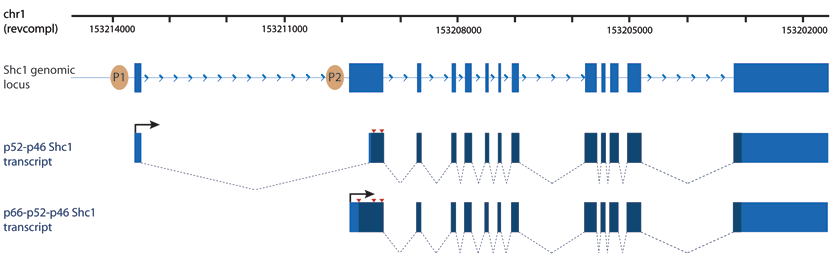
SHC1 locus organization and alternative splicing isoforms. Dark blue boxes correspond to CDS; light blue portions represent 5 and 3 UTR respectively; red triangles point to the first ATG codon of p66, p52 and p46 isoforms in that order.
Description
SHC1 gene covers 12,066 bp of DNA on q21.3 arm of chr1 and counts 13 exons and 13 introns.
Transcription
SHC1 locus produces two distinct transcripts directed from alternative promoters; altogether they encode for three overlapping protein isoforms of 66, 52, and 46 kDa thus called p66Shc, p52Shc and p46Shc. The first transcript (NM_003029) is 3,076 bp long and specifically encodes for the p52 and p46 forms from two different in-frame ATGs and derives from the splicing of the first non-coding exon to an internal site of the second exon; this process produces the skipping of the sequence that encodes for the longest p66Shc isoform. The second transcript (NM_183001 and BX647149) is 3,497bp long, it is transcribed starting from the beginning of the second exon, under the regulation of a different promoter and it encodes for all three p66, p52 and p46Shc isoforms by means of alternative ATGs usage.
Pseudogene
Two possible processed pseudogenes of SHC1 are located on chrX and chr17.
Proteins

Modular domain organization of the three SHC1 protein isoforms.
Description
Regardless of their high structural similarity, a growing bunch of experimental evidences suggests that the p66Shc and p52/p46Shc isoforms are functionally non-redundant. P66, p52 and p46Shc consist of 583, 474 and 428 aa, respectively. All the three SHC1 protein isoforms share the same basic modular organization: they contain two different phosphotyrosine-binding domains, namely a PTB domain in the amino-terminal and a SH2 in the carboxy-terminal, separated by a poorly characterized glycine/proline-rich region rather similar to the collagen protein and therefore called Collagen Homology domain 1, CH1. In vitro experiments suggest that the "proline rich motif" found in the CH1 domain might be responsible for the interaction between p52Shc and the SH3 domain of SRC, LYN, FYN cytoplasmic tyrosine kinases, but the functional role of this interaction is still unclear and there are no genetic or biochemical evidences that these proteins interact in vivo. The longest p66Shc isoform contains a supplementary amino-terminal glycine/proline-rich region, called CH2. The N-term PTB and C-term SH2 modularity is an exclusive feature of the Shc protein family. Both PTB and SH2 domains bind to phosphorylated tyrosines within specific, short peptide sequences: amino-terminal residues immediately adjacent to the pY confer specificity on PTB domain; conversely carboxy-terminal amino acids draw specificity for the SH2. The CH1 region contains three key tyrosines, Y239, Y240 and Y317 that become phosphorylated upon commitment of a number of cell surface ligand-activated receptors. Recently, in murine systems, was demonstrated that SHC1 may signal through the CH1 pYs motif both in a dependent and independent manner supporting different pathways in tissue morphogenesis. The p66Shc specific CH2 region does not become tyrosine phosphorylated, but gets phosphorylation on serine 36 (S36) upon oxidative stress; Tetradecanoylphorbol-13-acetate (TPA) induces phosphorylation both of Ser 36 and Ser 138 of p66Shc. A new functional region, the "redox centre", responsible for cytochrome c binding, has been recently characterized within the p66Shc CH2-PTB domains. It has been mapped within a portion that presents the highest degree of identity in sequence alignments of p66Shc vertebrate orthologous and it is essential for the p66Shc function in ROS regulation. This region (designated CB, for cytochrome c binding) contains three glutamic acid (E125, E132, E133) and two tryptophan (W134 and W148) conserved residues.
Expression
p52/p46Shc are widely expressed in cultured cell and in almost all adult mouse tissues with an invariable relative amount; p66Shc protein instead shows a more peculiar pattern since it is expressed in the most of cells except in the hematopoietic lineage, where it is absent or barely recognizable. During early rat embryonic development SHC1 is most significantly expressed in the endothelium, in mesenchymal cells of the cardiovascular system and in the forebrains area of active proliferation of immature neuroblasts. In postnatal and adult rat brain, SHC1 mRNAs and proteins are not expressed. In the adult olfactory epithelium, in which neuronal cell renewal occurs throughout life, SHC1 remained strongly expressed. In both human and murine adult tissues, p52Shc and p46Shc (mRNA and proteins) are ubiquitously expressed, while p66Shc is expressed at different levels in specific tissues, such as lung, spleen, liver, heart, and kidney and is absent in the hematopoietic lineage.
The level of p66Shc mRNA is highest in human dermal fibroblasts (DFs) from centenarians in respect to DFs from old and young people suggesting that the expression of p66Shc increases with age and associates with human longevity.
The level of p66Shc mRNA is highest in human dermal fibroblasts (DFs) from centenarians in respect to DFs from old and young people suggesting that the expression of p66Shc increases with age and associates with human longevity.
Localisation
P52Shc proteins is localized on endoplasmic reticulum membranes and is redistributed after tyrosine kinase receptor activation; p46Shc localizes to the mitochondrial matrix via a N-terminal mitochondrial targeting signal. The p66Shc isoform localizes in different intracellular compartments including endoplasmic reticulum and mitochondria.
Function
P52/p46Shc and the p66Shc proteins carry out very different cellular roles, therefore p52/p46Shc and p66Shc functions are individually described.
P52/p46Shc
- Ras regulation. Upon growth factor stimulation p56Shc physically associate with the activated receptor tyrosine kinases via the SH2 domain and become rapidly and efficiently tyrosine-phosphorylated in three major tyrosine residues present in the CH1 domain (Y239/240, Y317). Tyrosine phosphorylation mediates interactions with the SH2 domain of the Grb2 adaptor protein that is constitutively complexed with Sos, an ubiquitously expressed Ras guanine nucleotide exchange factor. Recruitment of the Grb2/Sos complex by phosphorylated p52/p46Shc proteins results in the membrane relocalization of Sos, an event considered sufficient to induce Ras activation.
- Growth factors signaling and survival. P52/p46Shc has been shown to function in signaling of many receptors that are themselves tyrosine kinases, such those for epidermal growth factor (EGF), Insulin (I), platelet growth factor (PDGF), nerve growth factor (NGF), hepatocyte growth factor/scatter factor (HGF/SF and ErbB2, but it also signals on receptors associated with cytoplasmic tyrosine kinases such as the antigen T and B cell receptors, and those for the Stem cell factor (SCF) otherwise known as KIT ligand or Steel factor (SLF), granulocyte macrophage colony-stimulating factor (GM-CSF), erythropoietin (EPO) and interleukin IL-2, IL-3, IL-5. In particular, in the interleukin receptors signaling, SHC1, binding to the Grb2-Gab2 complex, also has an essential role in the PI-3K/Akt pathway. It was reported that Shc could regulate c-Myc activation in response to IL-3 stimulation but little is known about mechanism and target genes affected.
- Signaling by cell adhesion molecules. The role of SHC1 in signaling lastly includes the integrin family and G-protein coupled receptors. Indeed, in endothelial cells, beside the roles in mediating Receptor Tyrosine Kinases signaling, Shc was recently demonstrated contributing to sense shear stress, which is the mechanical force generated by the blood fluid moving along the vascular endothelium. SHC1 exerts a role in all mechanisms described to be responsible for the mechano-transduction signaling that are TRK pathways, cell matrix adhesion through integrins binding and cell-cell adhesion by interaction with cadherins in adherent junctions.
- Cytoskeleton Organization. MEFs lacking p52/p46Shc exhibit defective cytoskeletal organization and reduced ERK activation when plated on fibronectin (an extracellular matrix protein), a defect that is rescued reintroducing p52/p46Shc.
- Animal model. SHC1 knock-out is embryonic lethal, infact SHC1 mutants die by E11.5 with evidence of a gross cardiovascular defect.
- Negative regulation of growth factors signaling. In contrast to p52Shc, overexpression of p66Shc is incapable of transforming mouse fibroblasts, does not induce MAPK activation and has a negative effect on the FOS promoter in an a transactivation assay.
- ROS production. P66Shc is involved in the intracellular pathway(s) that regulates reactive oxygen species (ROS) metabolism and apoptosis. For this function, p66Shc uses reducing equivalents of the mitochondrial electron-transfer chain through the direct oxidation of cytochrome c forming hydrogen peroxide that in turn induces mitochondrial permeability pore opening and apoptosis.
- Animal model. P66Shc is a genetic determinant of life span in mammals, as its deletion in mice (p66Shc-/-) results in retarded aging, decreased incidence of aging-associated diseases, such as atherosclerosis, and prolonged life span. p66Shc-generated ROS is implicated in regulation of insulin signaling in the fat tissue, suggesting that intracellular oxidative stress might accelerate aging by favoring fat deposition and increasing the incidence and penetrance of fat-related disorders.
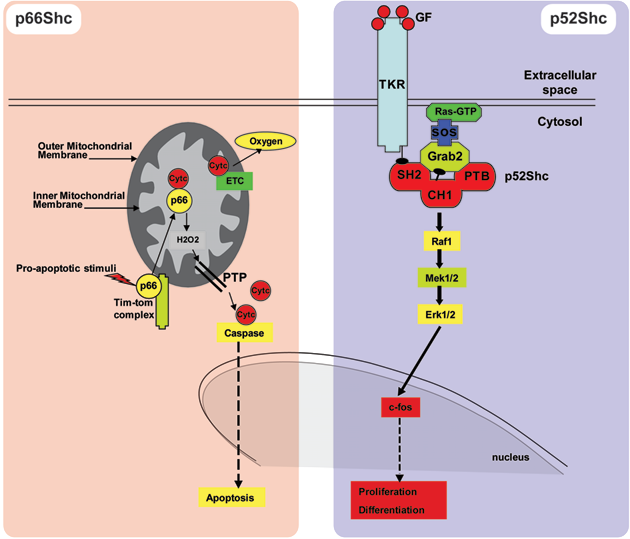
Schematic description of different contribution of SHC1 proteins in survival and apoptosis. Upon growth factor (GF) stimulation p52Shc binds to activated receptor (RTKs) becomes phosphorylated and binds to Grb2-Sos complex. The translocation of Grab2/SOS complex from the cytosol to the cellular membrane induces Ras activation that in turn leads to MAP kinase/Erk pathway triggering that finally regulates cell proliferation and/or differentiation. Pro-apoptotic signals, instead, induce p66Shc release from a putative inhibitory complex (Tim -Tom mitochondrial import complex) on mitochondria. Activated p66Shc then reduces cytochrome c and generates hydrogen peroxide (H2O2) that leads to permeability transition pore (PTP) opening, mitochondrial swelling, cytochrome c release, caspase activation and apoptosis.
Homology
P52Shc protein is highly conserved during evolution accounting homologues already in worms and insects; the longest isoform, p66Shc seems to represent a later specialization of the protein being arisen later in the evolution, infact the first organisms where it can be found are fishes.
Mutations
Note
The SHC1 genes polymorphisms known in the coding region correspond to Met225Val in the p46 isoform, Met300Val in the p52 isoform and to Met410Val in the p66 isoform. This polymorphism has been associated with a significantly decreased risk for breast cancer, strongly in women diagnosed below the age of 50. The same polymorphism in SHC1 was associated with longevity.
Implicated in
Entity name
Cancers (indirect)
Note
P52/p46 proteins are implicated in cell proliferation and carcinogenesis.
The p52Shc and p46Shc isoforms of Shc are overexpressed or hyper-phosphorylated in many tumor types where known Tyrosine kinases Receptors are constitutively activated.
Recently was demonstrated that SHC1 is a crucial determinant of the Neu/ErbB-2 -TGFb cooperation signaling that promotes breast cancer cell motility and invasion.
The involvement of p66Shc in tumorigenesis is still controversial. Altered levels of p66Shc were reported to be found in some tumors but the results seem contradictory. In the breast cancer cells and primary tumors p66Shc was described to be both over-expressed and down-regulated. Indeed the ablation of p66Shc does not increase spontaneous or induced tumor incidence in mice. P66Shc adaptor protein may have a potential implication in the pathophysiology of aging.
The p52Shc and p46Shc isoforms of Shc are overexpressed or hyper-phosphorylated in many tumor types where known Tyrosine kinases Receptors are constitutively activated.
| Constitutively activated p52Shc | Human tumor cell lines | Constitutively activated receptor |
| Vulval carcinoma, Bladder carcinoma, Neuroblastoma Hepatocarcinoma | EGFR | |
| Pancreatic carcinoma | PDGFR | |
| Lung carcinoma | ErbB2 | |
| Chronic myeloid Leukaemia | Bcr-abl | |
| Thyroid carcinoma | Ret |
The involvement of p66Shc in tumorigenesis is still controversial. Altered levels of p66Shc were reported to be found in some tumors but the results seem contradictory. In the breast cancer cells and primary tumors p66Shc was described to be both over-expressed and down-regulated. Indeed the ablation of p66Shc does not increase spontaneous or induced tumor incidence in mice. P66Shc adaptor protein may have a potential implication in the pathophysiology of aging.
Article Bibliography
| Pubmed ID | Last Year | Title | Authors |
|---|---|---|---|
| 18838380 | 2008 | p66Shc-generated oxidative signal promotes fat accumulation. | Berniakovich I et al |
| 8755247 | 1996 | Not all Shc's roads lead to Ras. | Bonfini L et al |
| 10373445 | 1999 | Mechanotransduction in response to shear stress. Roles of receptor tyrosine kinases, integrins, and Shc. | Chen KD et al |
| 11369938 | 2001 | Shc signaling in differentiating neural progenitor cells. | Conti L et al |
| 8479536 | 1993 | Association of Sos Ras exchange protein with Grb2 is implicated in tyrosine kinase signal transduction and transformation. | Egan SE et al |
| 17409413 | 2007 | RaLP, a new member of the Src homology and collagen family, regulates cell migration and tumor growth of metastatic melanomas. | Fagiani E et al |
| 12052829 | 2002 | Serine/threonine phosphorylation of ShcA. Regulation of protein-tyrosine phosphatase-pest binding and involvement in insulin signaling. | Faisal A et al |
| 17626887 | 2007 | Combinatorial ShcA docking interactions support diversity in tissue morphogenesis. | Hardy WR et al |
| 17452444 | 2007 | Analysis of a Shc family adaptor protein, ShcD/Shc4, that associates with muscle-specific kinase. | Jones N et al |
| 10809671 | 2000 | The ShcA phosphotyrosine docking protein sensitizes cardiovascular signaling in the mouse embryo. | Lai KM et al |
| 18606845 | 2008 | Shc coordinates signals from intercellular junctions and integrins to regulate flow-induced inflammation. | Liu Y et al |
| 8628261 | 1996 | Sch proteins are localized on endoplasmic reticulum membranes and are redistributed after tyrosine kinase receptor activation. | Lotti LV et al |
| 11088019 | 2000 | Evolution of Shc functions from nematode to human. | Luzi L et al |
| 7556090 | 1995 | Signal transduction by the alpha 6 beta 4 integrin: distinct beta 4 subunit sites mediate recruitment of Shc/Grb2 and association with the cytoskeleton of hemidesmosomes. | Mainiero F et al |
| 16677103 | 2006 | Apoptosis and aging: role of p66Shc redox protein. | Migliaccio E et al |
| 15036421 | 2004 | Variation in the SHC1 gene and longevity in humans. | Mooijaart SP et al |
| 18332126 | 2008 | Signaling through ShcA is required for transforming growth factor beta- and Neu/ErbB-2-induced breast cancer cell motility and invasion. | Northey JJ et al |
| 9346957 | 1997 | The 66-kDa Shc isoform is a negative regulator of the epidermal growth factor-stimulated mitogen-activated protein kinase pathway. | Okada S et al |
| 15078873 | 2004 | The life span determinant p66Shc localizes to mitochondria where it associates with mitochondrial heat shock protein 70 and regulates trans-membrane potential. | Orsini F et al |
| 17081113 | 2006 | Regulatory effects of the mitochondrial energetic status on mitochondrial p66Shc. | Orsini F et al |
| 8760305 | 1996 | A family of Shc related proteins with conserved PTB, CH1 and SH2 regions. | Pelicci G et al |
| 7675449 | 1995 | Constitutive phosphorylation of Shc proteins in human tumors. | Pelicci G et al |
| 12242309 | 2002 | The neuron-specific Rai (ShcC) adaptor protein inhibits apoptosis by coupling Ret to the phosphatidylinositol 3-kinase/Akt signaling pathway. | Pelicci G et al |
| 8235613 | 1993 | Interaction of Shc with the zeta chain of the T cell receptor upon T cell activation. | Ravichandran KS et al |
| 1465135 | 1992 | Association of the Shc and Grb2/Sem5 SH2-containing proteins is implicated in activation of the Ras pathway by tyrosine kinases. | Rozakis-Adcock M et al |
| 8223433 | 1993 | Signal transduction by the high-affinity GM-CSF receptor: two distinct cytoplasmic regions of the common beta subunit responsible for different signaling. | Sato N et al |
| 8101647 | 1993 | Shc products are substrates of erbB-2 kinase. | Segatto O et al |
| 8316835 | 1993 | The function of GRB2 in linking the insulin receptor to Ras signaling pathways. | Skolnik EY et al |
| 19164921 | 2009 | Spatial signaling networks converge at the adaptor protein Shc. | Sweet DT et al |
| 16829231 | 2006 | Mitochondrial DNA copy number is regulated by cellular proliferation: a role for Ras and p66(Shc). | Trinei M et al |
| 11948181 | 2002 | The p66Shc longevity gene is silenced through epigenetic modifications of an alternative promoter. | Ventura A et al |
| 15308584 | 2004 | The insulin-like growth factor-1 pathway mediator genes: SHC1 Met300Val shows a protective effect in breast cancer. | Wagner K et al |
| 8929541 | 1996 | The adaptor protein Shc couples a class of integrins to the control of cell cycle progression. | Wary KK et al |
| 9741627 | 1998 | A requirement for caveolin-1 and associated kinase Fyn in integrin signaling and anchorage-dependent cell growth. | Wary KK et al |
| 7516469 | 1994 | Identification of Src, Fyn, and Lyn SH3-binding proteins: implications for a function of SH3 domains. | Weng Z et al |
| 15753984 | 2005 | Enhanced expression of p46 Shc in the nucleus and p52 Shc in the cytoplasm of human gastric cancer. | Yukimasa S et al |
| 8524391 | 1995 | Structure and ligand recognition of the phosphotyrosine binding domain of Shc. | Zhou MM et al |
Other Information
Locus ID:
NCBI: 6464
MIM: 600560
HGNC: 10840
Ensembl: ENSG00000160691
Variants:
dbSNP: 6464
ClinVar: 6464
TCGA: ENSG00000160691
COSMIC: SHC1
RNA/Proteins
Expression (GTEx)
Pathways
Protein levels (Protein atlas)
PharmGKB
| Entity ID | Name | Type | Evidence | Association | PK | PD | PMIDs |
|---|---|---|---|---|---|---|---|
| PA30592 | MAP3K1 | Gene | Pathway | associated | |||
| PA34183 | RAF1 | Gene | Pathway | associated | |||
| PA7360 | EGFR | Gene | Pathway | associated |
References
| Pubmed ID | Year | Title | Citations |
|---|---|---|---|
| 38763954 | 2024 | The mitochondria-related gene risk mode revealed p66Shc as a prognostic mitochondria-related gene of glioblastoma. | 0 |
| 38805286 | 2024 | CCDC6-RET fusion protein regulates Ras/MAPK signaling through the fusion- GRB2-SHC1 signal niche. | 0 |
| 38763954 | 2024 | The mitochondria-related gene risk mode revealed p66Shc as a prognostic mitochondria-related gene of glioblastoma. | 0 |
| 38805286 | 2024 | CCDC6-RET fusion protein regulates Ras/MAPK signaling through the fusion- GRB2-SHC1 signal niche. | 0 |
| 35986536 | 2023 | Mitochondrial Translocation of P66Shc Aggravates Cisplatin-induced AKI by Promoting Ferroptosis. | 2 |
| 37371529 | 2023 | YES1 Kinase Mediates the Membrane Removal of Rescued F508del-CFTR in Airway Cells by Promoting MAPK Pathway Activation via SHC1. | 1 |
| 37523129 | 2023 | MicroRNA 452 regulates SHC1 expression in human colorectal cancer and colitis. | 0 |
| 35986536 | 2023 | Mitochondrial Translocation of P66Shc Aggravates Cisplatin-induced AKI by Promoting Ferroptosis. | 2 |
| 37371529 | 2023 | YES1 Kinase Mediates the Membrane Removal of Rescued F508del-CFTR in Airway Cells by Promoting MAPK Pathway Activation via SHC1. | 1 |
| 37523129 | 2023 | MicroRNA 452 regulates SHC1 expression in human colorectal cancer and colitis. | 0 |
| 34719845 | 2022 | Genistein suppresses ox-LDL-elicited oxidative stress and senescence in HUVECs through the SIRT1-p66shc-Foxo3a pathways. | 7 |
| 35042950 | 2022 | The E3 ubiquitin ligase SOCS-7 reverses immunosuppression via Shc1 signaling in hepatocellular carcinoma. | 0 |
| 35612429 | 2022 | The p66Shc Protein Mediates Insulin Resistance and Secretory Dysfunction in Pancreatic β-Cells Under Lipotoxic Conditions. | 6 |
| 36265795 | 2022 | Dynamics of antioxidant heme oxygenase-1 and pro-oxidant p66Shc in promoting advanced prostate cancer progression. | 2 |
| 34719845 | 2022 | Genistein suppresses ox-LDL-elicited oxidative stress and senescence in HUVECs through the SIRT1-p66shc-Foxo3a pathways. | 7 |
Citation
Lucilla Luzi ; Enrica Migliaccio ; Pier Giuseppe Pelicci
SHC1 (SHC (Src homology 2 domain containing) transforming protein 1)
Atlas Genet Cytogenet Oncol Haematol. 2009-02-01
Online version: http://atlasgeneticsoncology.org/gene/42287/shc1
