TACC3 (transforming, acidic coiled-coil containing protein 3)
2009-04-01 Melissa R Eslinger , Brenda Lauffart , Ivan H Still AffiliationIdentity
HGNC
LOCATION
4p16.3
IMAGE

LOCUSID
ALIAS
ERIC-1,ERIC1,Tacc4,maskin
FUSION GENES
DNA/RNA
Description
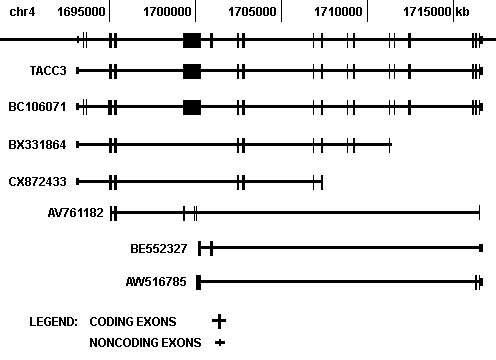
The gene is composed of 16 verified exons spanning 23.6kb.
Transcription
Encodes a single confirmed 2788nt transcript (NM_006342) (Still et al., 1999), although one additional transcript with two additional small 5 coding exons between exon 1 and the first coding exon (exon 2), based on NM_006342, is indicated based on several cDNAs that may however be from suspect cDNA libraries (see UCSC Genome Bioinformatics Site (http://genome.ucsc.edu)). Four additional transcripts variants are suggested based on singleton Expressed sequence tags in tumor cell lines (AW516785, BE552327, BX331864) and/or stem cell progenitors (AV761182, CX872433).
Pseudogene
None.
Proteins
Description
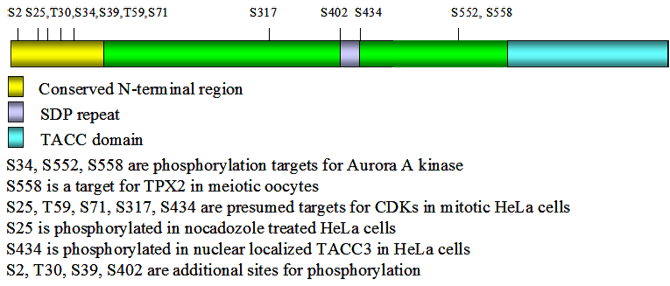
TACC3 encodes a single protein of 838 amino acids with a molecular mass of 90kDa (Still et al., 1999). The protein is heavily phosphorylated based on direct evidence and based on predictions from the Xenopus and mouse orthologs (Beausoleil et al., 2004; Beausoleil et al., 2008; Kinoshita et al., 2005; Yu et al., 2007; Cantin et al., 2008; Dephoure et al., 2008). Thus, human TACC3 migrates at approximately 150kDa in SDS-PAGE. Additional variants are suggested based on singleton cDNAs (see above) but their predicted protein isoforms have not been confirmed.
Expression
High levels during early (mouse) embryogenesis, in particular during early differentiation of specific tissues (Sadek et al., 2003). In adult tissues, expression is relatively limited, with high levels noted in hematological tissues such as the thymus, spleen and leukocytes, and reproductive tissues, especially meiotic cells of the testes and ovary (Still et al., 1999; Sadek et al., 2003). Epithelial layers of the lung, mammary gland and ovary express TACC3 and alterations in expression are noted during tumorigenesis (see below). Expression in human adult tissues is summarized in Lauffart et al. 2006.
Localisation
Human (and mouse) TACC3 is located in the interphase nucleus and/or cytosol, depending on cell type and cancer type (Gergely et al., 2000; Aitola et al., 2003; Lauffart et al., 2005; Jung et al., 2006; Vettaikkorumakankauv et al., 2008). TACC3 does not however contain a classical nuclear localisation signal (Still et al., 1999). TACC3 associates with the centrosome in a cell cycle dependent manner (Gergely et al., 2000). Phosphorylation of TACC3 by Aurora A on key serine residues is required for this interaction (Kinoshita et al., 2005; LeRoy et al., 2007). Overexpression of TACC3 from artificial constructs can result in accumulation in the cytosol of some cells resulting in oligmerisation in punctate structures (Gergely et al., 2000).
Function
Gene knockout and knockdown studies in mouse have indicated that TACC3 is vital for embryonic development. A functionally null TACC3 mutant dies during mid to late gestation due to excessive apoptosis affecting hematopoietic and other organ systems (Piekorz et al., 2002). Hypomorphic alleles result in defects in mitosis affecting mesenchymal sclerotome and therefore the axial skeleton (Yao et al., 2007). These mutational mouse models indicate that TACC3 has a role in chromosomal alignment, separation and cytokinesis and that TACC3 can be associated with p53-mediated apoptosis.
TACC3 has a well characterized function in microtubule dynamics, particularly during mitosis, based on mutational analysis (see above) and physical interactions with Aurora A and Aurora B kinases, CKAP5 (ch-TOG/XMAP215) and AKAP9 via the TACC domain (see Peset and Vernos, 2008 for review). Interaction with CEP120 is important in interkinetic nuclear migration and maintenance of neural progenitor self-renewal during the development of the neocortex (Xie et al., 2007). Phosphorylation of Ser34, Ser552 and Ser558 by Aurora A are required for localization to centrosomes and is necessary for recruitment of CKAP5 and nucleation of microtubules (Kinoshita et al., 2005; LeRoy et al., 2007). Ser25, Thr59, Ser71, Ser317, and Ser 434 are presumed targets for cyclin dependent kinases in mitotic HeLa cells (Yu et al., 2007; Cantin et al., 2008; Dephoure et al., 2008). By homology, Ser558 phosphorylation by TPX2 is required for nucleation of microtubules in meiotic oocytes (Brunet et al., 2008).
TACC3 also has a defined role in interphase cells as a transcriptional cofactor for the aryl-nuclear translocator protein (Sadek, 2000), FOG1 (Garriga-Canut and Orkin, 2004; Simpson et al., 2004) and is a possible indirect activator of CREB via FHL family of coactivator/corepressor proteins (Lauffart et al., 2007b). Roles in transcriptional regulation have also been proposed based on TACC3 binding to GAS41 (YEATS4) via the SDP repeat, histone acetyl transferases hGCN5L2 (KAT2A), pCAF (KAT2B), and retinoid X-receptor beta via the TACC domain (Gangisetty, 2004; Lauffart et al., 2002; Vettaikkorumakankauv et al., 2008). TACC3 functionally interacts with MBD2 bound to methylated promoters, promoting transcription by displacement of HDAC2 and recruitment of KAT2B (Angrisano et al., 2006). Human TACC3 may be involved in transcriptional termination and/or pre-mRNA splicing through TTF2 (Leonard et al., 2003). TACC3 can interact with BARD1, BRCA1 and p53 and has been shown to have some protective affects against adriamycin-mediated DNA damage in ovarian cancer cells (Lauffart et al., 2007a). Phosphorylation of the last amino acid of the SDP repeat, Ser434, is noted in nuclear extracts of HeLa (Beausoleil, 2004; Beausoleil, 2006), although its functional significance is unknown.
TACC3 has a well characterized function in microtubule dynamics, particularly during mitosis, based on mutational analysis (see above) and physical interactions with Aurora A and Aurora B kinases, CKAP5 (ch-TOG/XMAP215) and AKAP9 via the TACC domain (see Peset and Vernos, 2008 for review). Interaction with CEP120 is important in interkinetic nuclear migration and maintenance of neural progenitor self-renewal during the development of the neocortex (Xie et al., 2007). Phosphorylation of Ser34, Ser552 and Ser558 by Aurora A are required for localization to centrosomes and is necessary for recruitment of CKAP5 and nucleation of microtubules (Kinoshita et al., 2005; LeRoy et al., 2007). Ser25, Thr59, Ser71, Ser317, and Ser 434 are presumed targets for cyclin dependent kinases in mitotic HeLa cells (Yu et al., 2007; Cantin et al., 2008; Dephoure et al., 2008). By homology, Ser558 phosphorylation by TPX2 is required for nucleation of microtubules in meiotic oocytes (Brunet et al., 2008).
TACC3 also has a defined role in interphase cells as a transcriptional cofactor for the aryl-nuclear translocator protein (Sadek, 2000), FOG1 (Garriga-Canut and Orkin, 2004; Simpson et al., 2004) and is a possible indirect activator of CREB via FHL family of coactivator/corepressor proteins (Lauffart et al., 2007b). Roles in transcriptional regulation have also been proposed based on TACC3 binding to GAS41 (YEATS4) via the SDP repeat, histone acetyl transferases hGCN5L2 (KAT2A), pCAF (KAT2B), and retinoid X-receptor beta via the TACC domain (Gangisetty, 2004; Lauffart et al., 2002; Vettaikkorumakankauv et al., 2008). TACC3 functionally interacts with MBD2 bound to methylated promoters, promoting transcription by displacement of HDAC2 and recruitment of KAT2B (Angrisano et al., 2006). Human TACC3 may be involved in transcriptional termination and/or pre-mRNA splicing through TTF2 (Leonard et al., 2003). TACC3 can interact with BARD1, BRCA1 and p53 and has been shown to have some protective affects against adriamycin-mediated DNA damage in ovarian cancer cells (Lauffart et al., 2007a). Phosphorylation of the last amino acid of the SDP repeat, Ser434, is noted in nuclear extracts of HeLa (Beausoleil, 2004; Beausoleil, 2006), although its functional significance is unknown.
Homology
Member of the TACC family, based on the presence of the evolutionarily conserved approximately 200 amino acid carboxy terminal coiled coil domain (TACC domain) (Still et al., 1999; Still et al., 2004). TACC3 orthologues are noted in all vertebrates sequenced to date (Still et al., 2004 and Still unpublished). However, the central region between the conserved N-terminal region and the TACC domain is highly variable in size and sequence. The SDP repeats are noted within the central region in most vertebrates except mouse and rat (Still et al., 2004).
Mutations
Note
Somatic mutations noted in ovarian cancer samples (Lauffart et al., 2005; Eslinger, 2006).
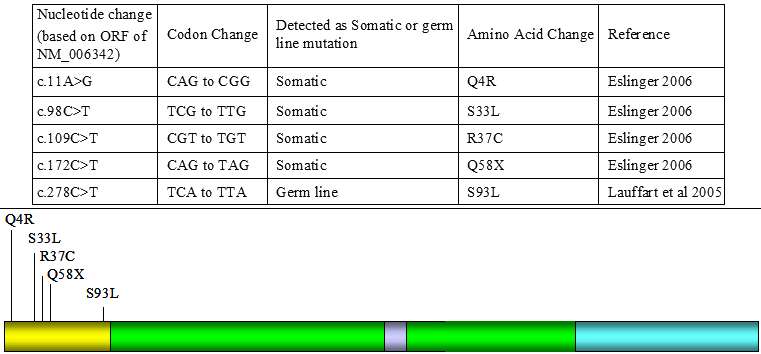
See legend for normal protein.
Implicated in
Entity name
Ovarian cancer
Prognosis
Overexpression of TACC3 is associated with chemoresistance in ovarian tumors (LEsperance et al., 2006).
Oncogenesis
Total cellular expression or nuclear localization lost in ovarian cancer (Lauffart et al., 2005).
Entity name
Non-small cell lung cancer
Prognosis
High TACC3 expression is an independent prognostic indicator associated with significantly shorter median survival time. TACC3 expression was correlated with p53 expression and poor prognosis (Jung et al., 2006).
Oncogenesis
A high level of TACC3 expression was observed in 14.8% of cases of non small cell lung cancer, predominantly of the squamous cell carcinoma type (Jung et al., 2006).
Entity name
Breast cancer
Prognosis
Loss of TACC3 is observed as a predictor of poor prognosis in breast cancer (Conte et al., 2002).
Oncogenesis
TACC3 protein downregulated in breast cancer (Conte et al., 2002).
Entity name
Prognosis
TACC3 overexpression correlates with the t(4;14) translocation that is associated with poor prognosis (Stewart et al., 2004).
Oncogenesis
TACC3 is located close to the MMSET gene that is rearranged in t(4;14) translocation (Still et al., 1999). This rearrangement upregulates the TACC3 gene (Stewart et al., 2004).
Entity name
Thyroid cancer
Prognosis
Reduction of expression associated with increased malignancy in cell line models (Ulisse et al., 2007).
Oncogenesis
Analysis of differentiated thyroid cancers indicates that TACC3 mRNA levels were either upregulated (44%) or downregulated (56%) in tumors, in some cases correlation was observed between TACC3 and Aurora-A kinase (Ulisse et al., 2007). However protein analysis was not reported.
Breakpoints
Note
Rearrangements of the human TACC3 gene have not been described. However, translocation breakpoints in the WHSC1 gene, associated with multiple myeloma upregulate the intact TACC3 promoter (Stewart et al., 2004). Tacc3 in the mouse genome is a site of proviral integration of MoMuLV transmitted via milk from infected mothers. This leads to upregulation of the gene and leads to the development of lymphomas (Chakraborty et al., 2008).
Article Bibliography
| Pubmed ID | Last Year | Title | Authors |
|---|---|---|---|
| 12642624 | 2003 | Aint/Tacc3 is highly expressed in proliferating mouse tissues during development, spermatogenesis, and oogenesis. | Aitola M et al |
| 16410616 | 2006 | TACC3 mediates the association of MBD2 with histone acetyltransferases and relieves transcriptional repression of methylated promoters. | Angrisano T et al |
| 16964243 | 2006 | A probability-based approach for high-throughput protein phosphorylation analysis and site localization. | Beausoleil SA et al |
| 18833336 | 2008 | Meiotic regulation of TPX2 protein levels governs cell cycle progression in mouse oocytes. | Brunet S et al |
| 18220336 | 2008 | Combining protein-based IMAC, peptide-based IMAC, and MudPIT for efficient phosphoproteomic analysis. | Cantin GT et al |
| 18501945 | 2008 | Retroviral gene insertion in breast milk mediated lymphomagenesis. | Chakraborty J et al |
| 18669648 | 2008 | A quantitative atlas of mitotic phosphorylation. | Dephoure N et al |
| 14767476 | 2004 | The transforming acidic coiled coil proteins interact with nuclear histone acetyltransferases. | Gangisetty O et al |
| 15037632 | 2004 | Transforming acidic coiled-coil protein 3 (TACC3) controls friend of GATA-1 (FOG-1) subcellular localization and regulates the association between GATA-1 and FOG-1 during hematopoiesis. | Garriga-Canut M et al |
| 11121038 | 2000 | The TACC domain identifies a family of centrosomal proteins that can interact with microtubules. | Gergely F et al |
| 15705873 | 2005 | Protein expression profiling identifies subclasses of breast cancer and predicts prognosis. | Jacquemier J et al |
| 16930330 | 2006 | Expression of transforming acidic coiled-coil containing protein 3 is a novel independent prognostic marker in non-small cell lung cancer. | Jung CK et al |
| 16172205 | 2005 | Aurora A phosphorylation of TACC3/maskin is required for centrosome-dependent microtubule assembly in mitosis. | Kinoshita K et al |
| 16773180 | 2006 | Gene expression profiling of paired ovarian tumors obtained prior to and following adjuvant chemotherapy: molecular signatures of chemoresistant tumors. | L'Espérance S et al |
| 18481206 | 2007 | Interaction of TACC proteins with the FHL family: implications for ERK signaling. | Lauffart B et al |
| 17545617 | 2007 | Localization of human TACC3 to mitotic spindles is mediated by phosphorylation on Ser558 by Aurora A: a novel pharmacodynamic method for measuring Aurora A activity. | LeRoy PJ et al |
| 12927788 | 2003 | hLodestar/HuF2 interacts with CDC5L and is involved in pre-mRNA splicing. | Leonard D et al |
| 18656360 | 2008 | The TACC proteins: TACC-ling microtubule dynamics and centrosome function. | Peset I et al |
| 11847113 | 2002 | The centrosomal protein TACC3 is essential for hematopoietic stem cell function and genetically interfaces with p53-regulated apoptosis. | Piekorz RP et al |
| 11025203 | 2000 | Isolation and characterization of AINT: a novel ARNT interacting protein expressed during murine embryonic development. | Sadek CM et al |
| 12711550 | 2003 | TACC3 expression is tightly regulated during early differentiation. | Sadek CM et al |
| 15234987 | 2004 | A classic zinc finger from friend of GATA mediates an interaction with the coiled-coil of transforming acidic coiled-coil 3. | Simpson RJ et al |
| 15198734 | 2004 | Correlation of TACC3, FGFR3, MMSET and p21 expression with the t(4;14)(p16.3;q32) in multiple myeloma. | Stewart JP et al |
| 15207008 | 2004 | Structure-function evolution of the transforming acidic coiled coil genes revealed by analysis of phylogenetically diverse organisms. | Still IH et al |
| 10366448 | 1999 | The third member of the transforming acidic coiled coil-containing gene family, TACC3, maps in 4p16, close to translocation breakpoints in multiple myeloma, and is upregulated in various cancer cell lines. | Still IH et al |
| 17914111 | 2007 | Transforming acidic coiled-coil 3 and Aurora-A interact in human thyrocytes and their expression is deregulated in thyroid cancer tissues. | Ulisse S et al |
| 17920017 | 2007 | Cep120 and TACCs control interkinetic nuclear migration and the neural progenitor pool. | Xie Z et al |
| 17359303 | 2007 | TACC3 is required for the proper mitosis of sclerotome mesenchymal cells during formation of the axial skeleton. | Yao R et al |
| 17924679 | 2007 | Improved titanium dioxide enrichment of phosphopeptides from HeLa cells and high confident phosphopeptide identification by cross-validation of MS/MS and MS/MS/MS spectra. | Yu LR et al |
Other Information
Locus ID:
NCBI: 10460
MIM: 605303
HGNC: 11524
Ensembl: ENSG00000013810
Variants:
dbSNP: 10460
ClinVar: 10460
TCGA: ENSG00000013810
COSMIC: TACC3
RNA/Proteins
Expression (GTEx)
Pathways
| Pathway | Source | External ID |
|---|---|---|
| RNA transport | KEGG | ko03013 |
| RNA transport | KEGG | hsa03013 |
Protein levels (Protein atlas)
References
| Pubmed ID | Year | Title | Citations |
|---|---|---|---|
| 38084010 | 2024 | Non-Small Cell Lung Carcinoma With Clear Cell Features and FGFR3::TACC3 Gene Rearrangement : Clinicopathologic and Next Generation Sequencing Study of 7 Cases. | 1 |
| 38480537 | 2024 | Cellular senescence gene TACC3 associated with colorectal cancer risk via genetic and DNA methylated alteration. | 0 |
| 38084010 | 2024 | Non-Small Cell Lung Carcinoma With Clear Cell Features and FGFR3::TACC3 Gene Rearrangement : Clinicopathologic and Next Generation Sequencing Study of 7 Cases. | 1 |
| 38480537 | 2024 | Cellular senescence gene TACC3 associated with colorectal cancer risk via genetic and DNA methylated alteration. | 0 |
| 36780330 | 2023 | Oncogenic driver FGFR3-TACC3 requires five coiled-coil heptads for activation and disulfide bond formation for stability. | 1 |
| 36790370 | 2023 | TACC3-ch-TOG interaction regulates spindle microtubule assembly by controlling centrosomal recruitment of γ-TuRC. | 3 |
| 36864125 | 2023 | Targeting TACC3 represents a novel vulnerability in highly aggressive breast cancers with centrosome amplification. | 6 |
| 37341435 | 2023 | TACC3 is an independent prognostic marker, and knockdown of TACC3 enhances the efficacy of CDK1 inhibitor RO3306 in liver cancer cells. | 0 |
| 36780330 | 2023 | Oncogenic driver FGFR3-TACC3 requires five coiled-coil heptads for activation and disulfide bond formation for stability. | 1 |
| 36790370 | 2023 | TACC3-ch-TOG interaction regulates spindle microtubule assembly by controlling centrosomal recruitment of γ-TuRC. | 3 |
| 36864125 | 2023 | Targeting TACC3 represents a novel vulnerability in highly aggressive breast cancers with centrosome amplification. | 6 |
| 37341435 | 2023 | TACC3 is an independent prognostic marker, and knockdown of TACC3 enhances the efficacy of CDK1 inhibitor RO3306 in liver cancer cells. | 0 |
| 35855850 | 2022 | High Expression of TACC3 Is Associated with the Poor Prognosis and Immune Infiltration in Lung Adenocarcinoma Patients. | 0 |
| 35959857 | 2022 | Elevated expression of transforming acidic coiled-coil-containing protein 3 (TACC3) reflects aggressiveness of primary central nervous system lymphomas. | 0 |
| 35855850 | 2022 | High Expression of TACC3 Is Associated with the Poor Prognosis and Immune Infiltration in Lung Adenocarcinoma Patients. | 0 |
Citation
Melissa R Eslinger ; Brenda Lauffart ; Ivan H Still
TACC3 (transforming, acidic coiled-coil containing protein 3)
Atlas Genet Cytogenet Oncol Haematol. 2009-04-01
Online version: http://atlasgeneticsoncology.org/gene/42458
